
How is input VAT invoice automatic collection software implemented? From authorized aggregation to archiving with audit trails

How is input VAT invoice automatic collection software implemented? From authorized aggregation to archiving with audit trails
Input VAT invoices are scattered across tax digital accounts, employees, email, and business systems, and relying on finance to download, enter, and check them one by one easily creates congestion at month-end. The value of automatic collection is not just "downloading invoices back," but letting each invoice, starting from authorized access, go through query and aggregation, verification and duplicate checking, purpose confirmation, and archiving with audit trails in sequence. Each step has different responsibilities, and a slogan of "fully automatic" cannot replace necessary authorization and review.
Compliant input VAT invoice automatic collection is a combination of "official account capabilities + enterprise authorization + internal processes," not scraping data by bypassing the tax platform. |
▍1. What official capabilities can the tax digital account provide?
Public reply from the tax authorityIntroduction: the Tax Digital Account of the Electronic Invoice Service Platform aggregates full invoice data and provides taxpayers with functions such as invoice query and statistics, purpose selection and confirmation, information download, verification, and entry marking. As the invoice recipient, an enterprise can query obtained fully digitalized e-invoices through the Electronic Tax Bureau's "Invoice Query Statistics - Full Invoice Query." Here, "full" refers to the official data scope of the Tax Digital Account; third-party software access and synchronization must still meet identity authentication, enterprise authorization, interface, and implementation conditions.
▍2. The five-step process of input VAT invoice automatic collection
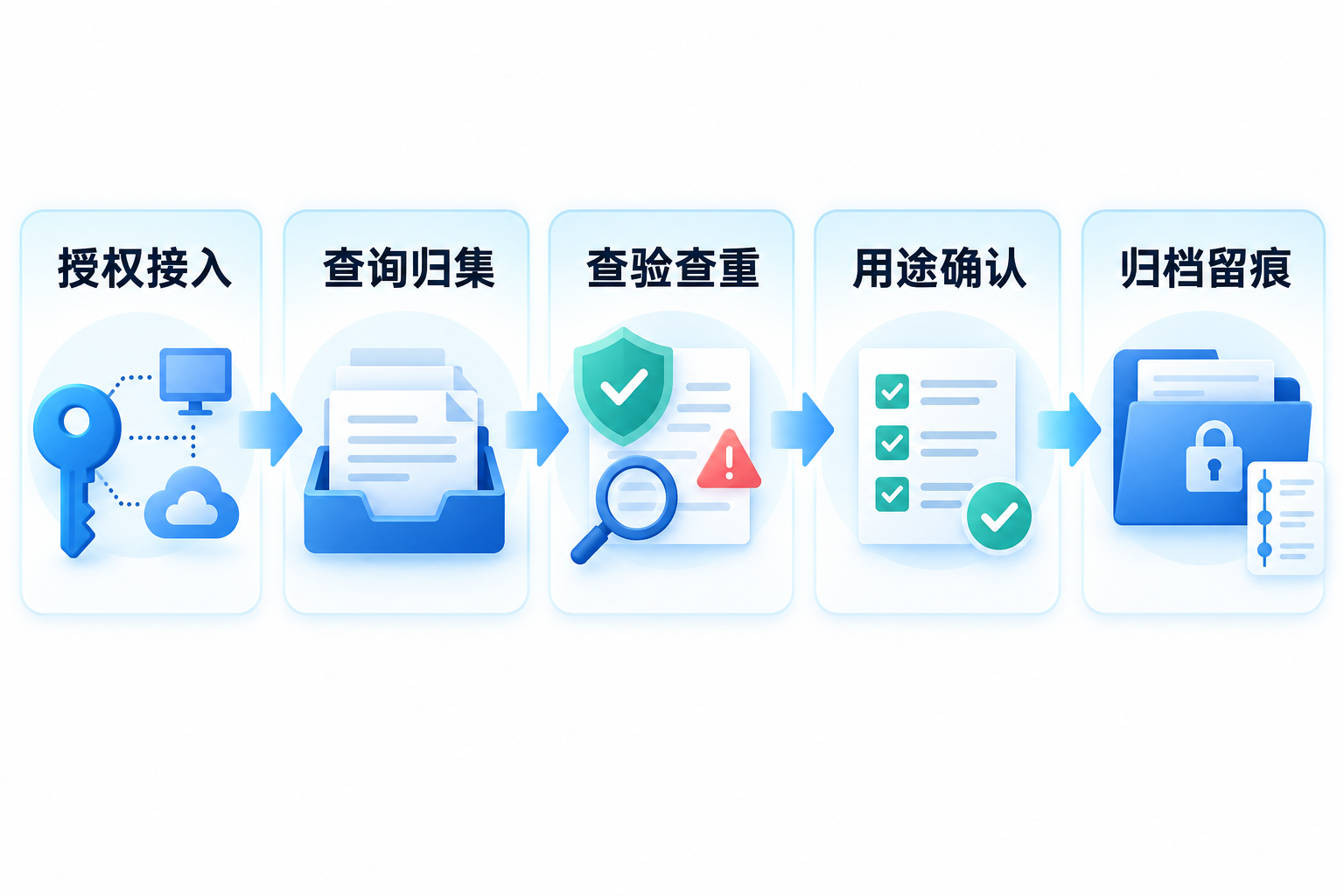
The first step is authorized access: clarify the enterprise entity, operators, data scope, and validity period. The second step is query and aggregation: gather receipts from tax digital accounts, employee uploads, email, scanned copies, and business systems according to unified rules. The third step is verification and duplicate checking: check invoice face information and status, and compare with the enterprise's internal reimbursement and entry records. The fourth step is purpose confirmation: where VAT deduction vouchers that meet regulations need to be declared for deduction or tax refund handling, the purpose should be confirmed through the Tax Digital Account or the VAT Invoice Comprehensive Service Platform. The fifth step is archiving with audit trails: retain original electronic files, structured data, approval processes, and related vouchers to form a searchable evidence chain.
▍3. Passing verification does not mean the business is already compliant
The National VAT Invoice Verification Platform is used to check invoice face information and cannot replace an enterprise's judgment on whether a transaction is real, whether expenses are reasonable, or whether all tax deduction conditions are met. Automatic duplicate checking mainly solves internal duplicate submission, duplicate reimbursement, or duplicate entry issues and cannot replace contracts, orders, acceptance, payment, and approval materials. A sound system should record "verification results," "internal rules," "business evidence," and "manual conclusions" separately, rather than treating a green check mark as the final compliance conclusion.
▍4. Why should purpose confirmation be managed separately?
State Taxation Administration Q&AIt is clarified that where taxpayers obtain VAT deduction vouchers that meet regulations and need to use them to declare and deduct input VAT or apply for export tax refunds or tax refunds on behalf of others, they should confirm the purpose through the Tax Digital Account or the VAT Invoice Comprehensive Service Platform. Therefore, collection, verification, entry, and deduction are not the same action. Enterprise software can assist in establishing pending confirmation lists, status synchronization, and exception reminders, but the final result should be subject to the official platform and the requirements of the competent tax authority.
▍5. How does the Kailing input invoice collection solution participate in this chain?
Kailing TechnologyInput invoice collection management platformSupports multi-channel aggregation via QR code scanning, email, OCR, card wallet, and tax invoice pool, and provides verification, duplicate checking, purpose management, and status monitoring capabilities;AI OCR Visual Capability PlatformCan extract paper or image receipts into structured fields;Electronic Accounting Archive Management SystemUsed to aggregate original files, vouchers, and related materials. The specific available channels, automation scope, and integration methods with existing ERP and expense control systems should be confirmed according to the enterprise environment before implementation.
▍6. What exception branches should be set up before go-live?
At minimum, it should cover duplicate invoices, red-letter or voided status, inconsistent entities, abnormal amount or tax amount cross-checks, cross-period invoices, purpose status conflicts, interface interruptions, and low-confidence recognition. Exceptions should pause automatic flow, be transferred to authorized personnel for review, and retain handling reasons and operation logs. Only by designing normal paths and exception paths together can automatic collection save labor without weakening internal controls.
Keywords: Input VAT invoice automatic collection software, input VAT invoice management, tax digital account, full-volume invoice query, invoice verification and duplicate checking, purpose confirmation, electronic accounting archives, Kailing Technology
As a comprehensive business-finance-tax digitalization solution service provider, Kailing Technology provides business-finance-tax management digital transformation products and operational services for various government agencies, institutions, and large, medium, and small enterprises. The product line includes: solutions for sales contract management system, procurement contract management system, fully digitalized Leqi interface project, automatic output invoicing system, reverse invoicing system, invoice issuance for individuals system, employee expense control and reimbursement system, input VAT invoice management system, supply chain collaborative reconciliation system, image AI OCR recognition system, automatic financial bookkeeping system, electronic accounting archives system, etc., comprehensively driving the digitalization process across various fields.
Consultation Hotline: 18513895936 / 010-60974119 Location: Beijing