
How does the charging pile and charging station industry issue invoices? Kailing Technology's pay-as-you-charge invoicing compliance solution for charging piles connects orders, payments, and invoices

How does the charging pile and charging station industry issue invoices? Kailing Technology's pay-as-you-charge invoicing compliance solution for charging piles connects orders, payments, and invoices

For charging station invoicing, the true sales entity and the nature of the transaction should first be clearly identified, and then the charging order, metering data, payment, and invoice should be connected. Kailing Technology's pay-as-you-charge invoicing compliance solution for charging piles helps operators organize this information around a real charging transaction. The tax rate cannot be simply understood as 13% for all revenue across the entire industry, nor should the platform be assumed by default to issue invoices as the seller merely because it collects payment on behalf of others.
▍A single charging order may involve more than one company
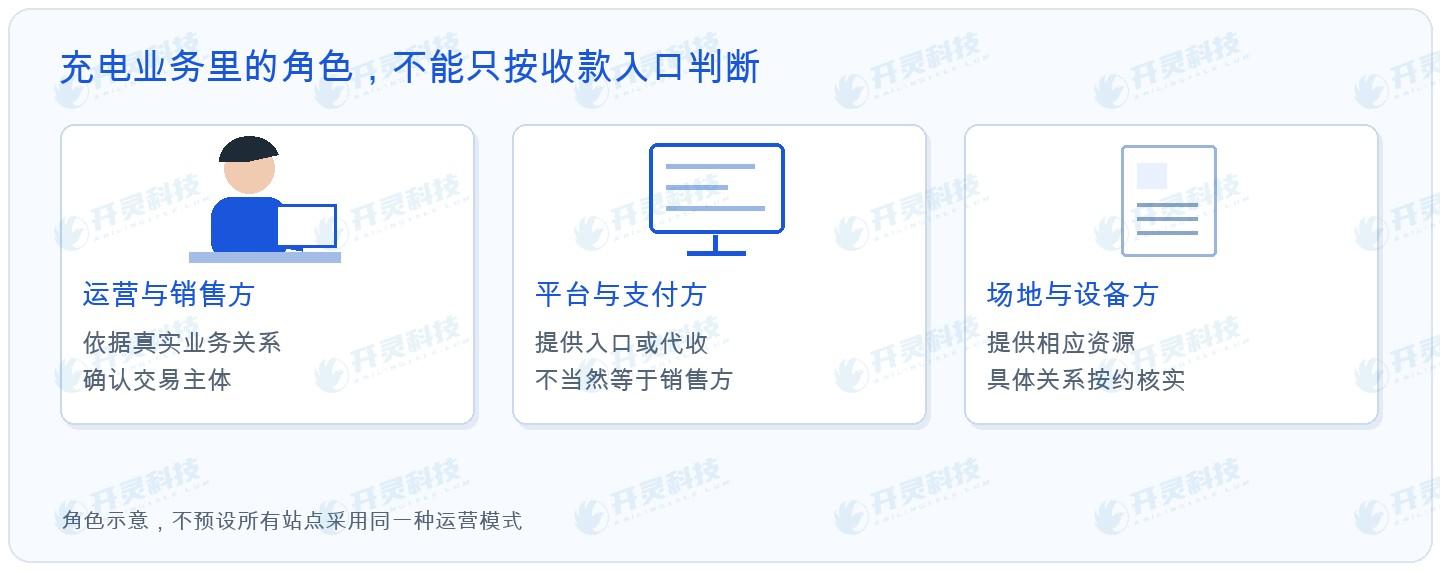
The vehicle owner finds a site in the app, uses on-site equipment to charge, and then pays through the platform. For the consumer, this is one continuous operation; for the back office, the equipment owner, actual operator, platform, and site provider may not be the same. Who owns the charging pile and who provides the transaction entry point cannot alone determine the sales entity on the invoice.
The judgment should return to the contractual relationship and actual business. Whoever sells the corresponding goods or services to the buyer bears the corresponding transaction responsibility, and how funds are settled and the roles of all parties need to be clear. Models such as self-operation, entrusted operation, and aggregation platforms may form different arrangements; the system should be configured according to verified relationships, and a single collection account cannot replace all judgment.
Clearly identifying the entity also helps customer service. When a vehicle owner asks about an invoice, staff can explain which company issued it and where to check it; when the operator reconciles settlement, it can also see the link between platform collection on behalf of others and its own sales, rather than repeatedly searching for the same record across several back offices.
▍The 13% in Announcement No. 13 of 2026 must be read together with its applicable conditions
Announcement No. 13 of 2026 of the Ministry of Finance and the State Taxation Administration clarifies that for general taxpayers selling electricity while also charging fees for battery replacement, site parking, equipment maintenance, and similar items, the 13% tax rate applicable to the main business applies. Here there are conditions such as taxpayer status, sale of electricity, and simultaneous collection of fees; it does not put the same tax rate label on all revenue in the charging industry.
Businesses such as independent leasing, separate installation, or platform services still need to be judged according to their own transaction nature; the treatment of small-scale taxpayers also cannot directly apply the 13% treatment of general taxpayers. Fee names and actual content need to be checked, and tax results cannot be determined by arbitrarily changing names.
▍Kailing Technology's pay-as-you-charge invoicing solution for charging piles organizes information around confirmed orders
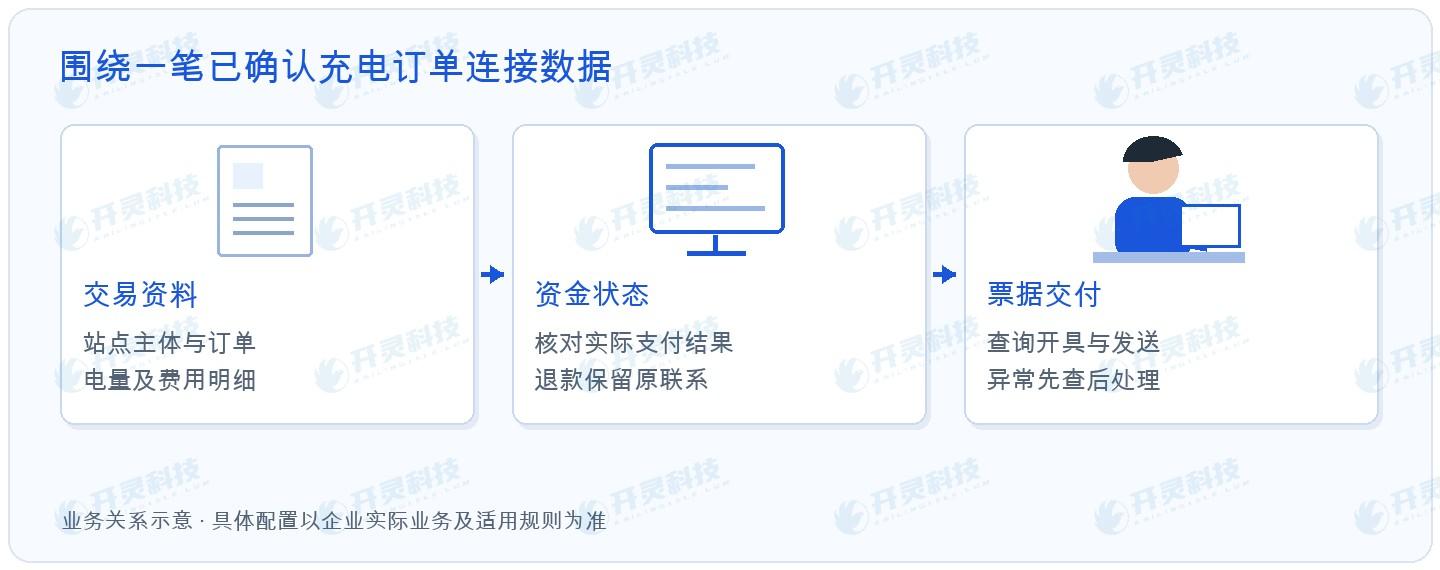
When charging begins, the final electricity quantity and fee are usually not yet determined; only after settlement is completed does the order have the corresponding metering and billing results. The system should trigger invoicing based on the true order status, rather than treating an unfinished transaction as a final sale just because the vehicle owner started the device or prepaid funds.
Information that can be used for linkage includes site and transaction entity, order identifier, metered electricity, fee details, payment result, and invoice status. Enterprises should clarify whether these data come from the operations system, billing service, or payment channel, and organize them together with stable associations. When finance reviews an invoice, it can trace back to the corresponding charging fact rather than only seeing a settlement total.
Kailing Technology provides business, finance-tax, and system connection solutions. When access methods such as Leqi are involved, the actual direct connection and user entity, authorization relationships, and available interfaces should be verified, and the specific construction scope should be determined according to project conditions. An existing operations platform can continue to handle orders and billing, while the invoicing step is coordinated through confirmed data.
▍Order completion, funds arrival, and invoice delivery do not have to be squeezed into one status
The operations back office showing that charging has ended does not automatically mean that payment and invoicing are both complete. A payment may still be under confirmation, and an invoice may already have been issued but not yet downloaded by the vehicle owner. Only by distinguishing these statuses can customer service know whether the next action is to check payment, process invoicing, or resend an existing invoice.
Especially for interface timeouts, the result of the original request should be checked first before deciding whether to retry. Otherwise, if the original invoice has already been generated and the new request is treated as new business, the risk of duplicate issuance may increase. Stable order association and request deduplication are indispensable collaboration foundations behind a convenient experience.
For vehicle owners, the interface does not need to show all technical details, but it should provide understandable information. Which result is being confirmed, where an existing invoice can be obtained, and what header information needs to be supplemented can all be clearly explained. This reduces repeated user applications and also reduces avoidable customer service inquiries for the site.
▍After a refund occurs, retain the original business trail
For charging exceptions, fee adjustments, or other refund situations, the original order and the actual refund scope must first be identified. Fund refunds and invoice corrections are related but different processes; it should not be assumed that after the payment channel refunds money, the invoice automatically completes all adjustments.
The corresponding invoice handling should be carried out according to the original invoice status and applicable rules, and the link to the original transaction should be preserved. Partial refunds especially need to explain which fee or which part of the business was adjusted; the entire order cannot simply be deleted and re-entered with one amount, leaving operations, finance, and customer service each holding different versions.
Enterprises can also use an exception list to observe which problems recur. If the main issue is slow return of payment results, the relevant connection should be handled; if entity errors occur frequently, site configuration and operating relationships should be checked; if invoices have been issued but users cannot find them, the delivery entry point should be optimized. Different causes correspond to different improvement directions, and not all complaints should be attributed to invoicing speed.
▍When compliance is expressed clearly, the service is also easier to understand
For charging operation enterprises, digital invoicing is not just about sending invoices to vehicle owners faster; it also gives site transactions a clear record in the back office. When the entity and tax treatment are clear and orders and funds can be reconciled, customer service and finance can collaborate around the same business.
When preparing for construction, you can first sort out the operating relationships between self-operated and partner sites, confirm common order statuses, billing items, and payment channels, and then discuss specific connections. This kind of review does not need to wait until the system goes live, nor should a generic industry diagram directly replace each enterprise's actual business.
For enterprises continuously adding sites, the entity and billing rules also need an assigned owner. Confirming the operating relationship when a new site is connected and checking related configurations after cooperation methods change can prevent historical settings from being copied indiscriminately into new business. The convenience of a shared system should be based on correctly expressing the real differences among sites.
▍FAQ: Hot questions about invoicing at charging stations
Q: Are all charging station fees subject to 13%?
A: It cannot be generalized. The taxpayer type and the substance of the business must be checked and judged according to applicable provisions such as Announcement No. 13 of 2026; an independent business should not simply copy a tax rate just because it takes place at a charging station.
Q: If the platform collects payment, does the platform issue the invoice as the seller?
A: Not necessarily. Collecting payment on behalf of another and actual sales are different relationships; the invoicing entity should be determined based on the real operations and transaction arrangements, not merely on the payment entry point.
Q: If the vehicle owner did not receive the invoice, can they resubmit an invoicing request?
A: First check the invoice status corresponding to the original order. If it has already been issued, handle the query or delivery; if the result is unclear, verify first to avoid treating network waiting as a basis for issuing again.
Connect charging orders, transaction entities, and invoice results, and discuss Kailing Technology's charging pile invoicing solution:www.kailingteck.com 。
As a national high-tech enterprise, Kailing Technology focuses on the digital and intelligent transformation of enterprise business-finance-tax and operations management, providing software products, system integration, implementation and delivery, and operational services for various government agencies, institutions, group enterprises, and SMEs.
The company has now formed ten core product lines, including: AI digital employee system, enterprise expense control management system, customer relationship management system, reverse invoicing management system, invoice issuance for individuals management system, electronic archives management system, tax fully digitalized e-invoice Leqi system, tax invoice management system, group tax filing system, and AI OCR recognition system. It is committed to connecting enterprise business, finance, tax, funds, and archive data to help customers improve operational efficiency, business-finance-tax compliance capabilities, and digital management levels.
If you have any business-finance-tax digital transformation needs, welcome to contact us. Beijing Kailing Technology will serve you wholeheartedly.
 Keywords: Pay-as-you-charge invoicing for charging pile transactions, charging station invoicing, 13% charging service fee, Announcement No. 13 of 2026, integrated order-payment-invoice
As a comprehensive business-finance-tax digitalization solution service provider, Kailing Technology provides business-finance-tax management digital transformation products and operational services for various government agencies, institutions, and large, medium, and small enterprises. The product line includes: solutions for sales contract management system, procurement contract management system, fully digitalized Leqi interface project, automatic output invoicing system, reverse invoicing system, invoice issuance for individuals system, employee expense control and reimbursement system, input VAT invoice management system, supply chain collaborative reconciliation system, image AI OCR recognition system, automatic financial bookkeeping system, electronic accounting archives system, etc., comprehensively driving the digitalization process across various fields.
Consultation Hotline: 18513895936 / 010-60974119 Location: Beijing