
How to spot-check the recognition results of the same batch of overseas invoices? Kailing Technology overseas invoice AI OCR routes low-confidence fields into manual review

Review of the same batch of overseas invoices should not be limited to randomly drawing a few, nor should it only look at low-confidence results prompted by the system. When Kailing Technology overseas invoice AI OCR is used for invoice recognition and structured processing, low-confidence field review can be designed based on output capabilities while also covering high-confidence samples, amount logic, and rare layouts. The goal is to place limited human attention where it may truly affect the business, rather than making reviewers copy the entire batch of invoices again.
▍What reviewers need most is to know where to look first
Faced with a batch of invoices in different languages and layouts, if finance reads each one from beginning to end, the convenience brought by the recognition tool will be offset by the second check. But if they do not look at all and import into the business system just because the table is neat, a small number of key errors may be brought in as well.
Different fields do not have the same impact. An abbreviation in a merchant address may only affect search experience; the decimal position of an amount, the month-day order of a date, or the judgment of currency may change the expense result. Review should allocate effort around business risk, not just count "how many were looked at."
This also shows that invoice quantity is not the only measure for spot-check design. For the same batch of materials, if all are familiar invoice types, one coverage method can be used; if new languages, low-quality photos, and new expense types are mixed in, the relevant checks need to be expanded. The more complex the sources, the less a fixed ratio can replace judgment.
▍A low-confidence prompt is a clue, not a verdict of error
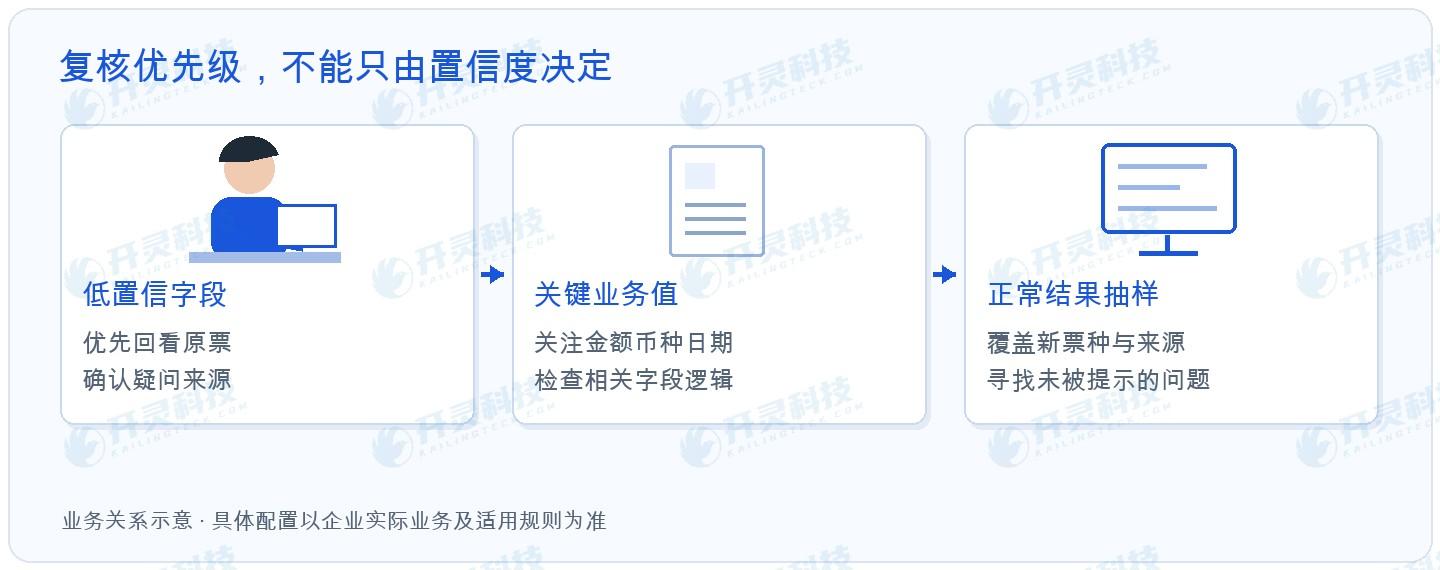
Recognition confidence reflects the model's or recognition process's judgment of the result and is not naturally equivalent to business accuracy. Different systems, fields, and models may have different output scopes. Before project implementation, it should be confirmed whether field-level confidence information is provided, what it means, and how it is presented to reviewers.
Fields with prompts are worth checking first, but they may simply use an uncommon font and the original value may actually be fine; fields without prompts may also have stable misreadings. For example, a certain date format is consistently interpreted as another order, and the model is very "certain," yet the financial semantics are incorrect. Therefore, the low-confidence queue cannot be the only scope of checking.
For important fields such as amount, currency, date, and expense nature, business rules can also be combined to check their relationships. Whether there are unexplained differences between the total and details, whether the currency in the same document is consistent, and whether the date needs further confirmation; these checks supplement what recognition confidence alone cannot cover.
▍Kailing Technology overseas invoice AI OCR keeps review comments on specific fields
Kailing Technology AI OCR performs recognition, translation, and structured organization for multilingual invoices. When used for batch processing, enterprises can agree on the review checklist fields, source associations, confirmation status, and return method, so reviewers can find the original invoice from the value to be confirmed, rather than only receiving a vague notice that "this batch has anomalies."
A useful review item should explain the current value, the reason for doubt, and who needs to confirm it. If the amount is unclear, the submitter can be asked to provide a clearer file; if the meaning of a foreign language is uncertain, someone familiar with the language or business can assist; if the expense category relates to internal policy, it is left to the corresponding finance role to decide. Recognition issues do not all have to be covered by the same person.
Enterprises should also distinguish machine re-recognition from final manual confirmation. Getting another result after rerunning does not mean the new value is necessarily correct; manual confirmation should also retain its basis, rather than overwriting the original value and leaving only the final table. When similar invoices are encountered later, these records can help the team understand where the error came from.
▍Sampling must cover the side that "looks normal"
If manual work only handles alert records, the enterprise cannot know whether the parts without alerts are reliable. More meaningful sampling covers different countries or languages, invoice types, source channels, and image quality from normal results, with particular attention to newly added material types. The sampling scope is determined by business risk and batch changes, and a universal ratio should not be announced without a basis.
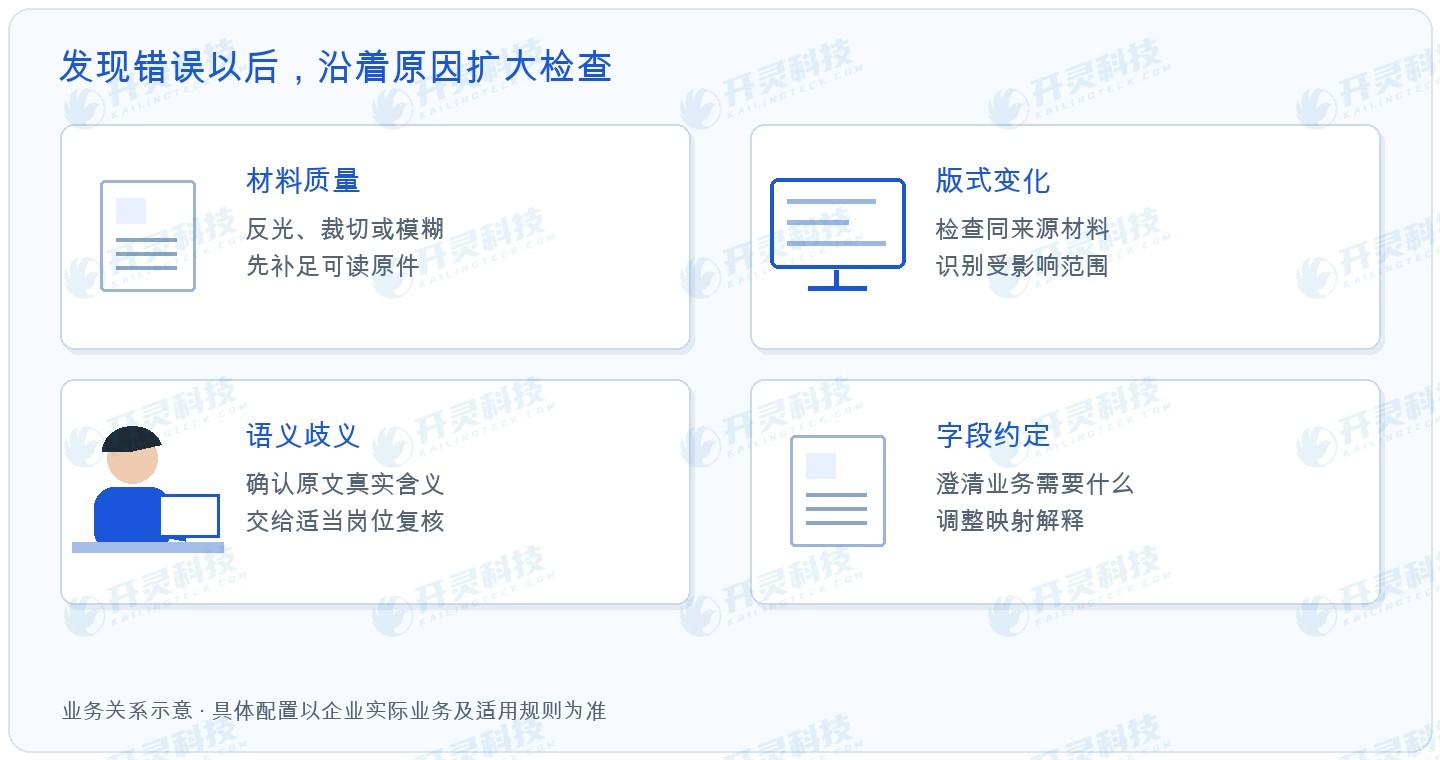
After discovering a certain type of error, the scope of impact should be checked rather than only fixing the current one. A layout change for a merchant, misreading of a specific currency symbol, or cropping caused by a scanning device may all affect multiple documents from the same source. Review conclusions should be able to return to the corresponding group to help decide whether to expand checks or reprocess the relevant parts.
At the same time, results from different batches should remain comparable in scope. If a particular check deliberately selects difficult invoices and finds more problems, that does not directly mean overall performance has worsened; if another batch mostly comes from familiar templates and runs smoothly, that also cannot be extrapolated to all overseas invoices. Recording the sample scope is what gives improvement discussions a basis.
▍Turn one correction into material that helps the next batch take fewer detours
Some problems come from shooting habits, such as invoice edges being cropped, reflections covering the total, or multiple invoices overlapping. Feeding typical causes back to the material submitter is often more effective than repeatedly recognizing in the backend. Explaining what original quality is needed is easier to get cooperation for than simply asking to "re-upload."
Other problems come from unclear field conventions. Business staff say they want the "tax amount," but invoices from different countries may have fees of different natures; finance needs a specific field, yet the recognition side does not have a sufficiently clear definition. Review comments can prompt both sides to supplement field explanations and mapping conditions, rather than attributing all deviations to the model.
When an enterprise continuously accumulates confirmed samples and revision reasons, spot-checking is no longer just the final gate but also a feedback source for optimizing collection, recognition, and business acceptance. Only in this way of use can Kailing Technology overseas invoice AI OCR better help finance shift from tedious entry to key judgment.
There is still a clear boundary of responsibility here: confirmation of a recognition result does not mean the expense has been approved for reimbursement, nor does it mean its tax treatment is automatically established. Field accuracy and business compliance require their own appropriate reviews; the two can connect, but should not be merged into one confirmation.
In daily arrangements, clear follow-up responsibility can also be set for materials awaiting supplementation, avoiding a low-confidence prompt lingering for a long time with no one handling it. The review queue needs a basis for entering and leaving: after the original is supplemented, the explanation is confirmed, or the correction is completed, the relevant personnel know how the doubt has been resolved.
▍FAQ on spot-checking of batch invoices
Q: If confidence is very high, is spot-checking still needed?
A: It is necessary to retain checks on normal results, especially for new invoice types and important fields. High confidence does not rule out semantic misjudgment or stability errors in the same layout.
Q: If one error appears, does the entire batch need to be redone?
A: First analyze the source and scope of impact. If the problem is concentrated in the same format or collection channel, priority can be given to expanding checks on that group; whether to process the entire batch should have a specific basis.
Q: After manual correction, will it automatically learn all similar invoices?
A: We cannot promise that. Revised samples can be used for subsequent optimization, but whether they enter rule or model improvements and which scenarios they cover requires a clear product mechanism and implementation arrangement.
Reserve finance's attention for key doubts and work with Kailing Technology to design a recognition and review solution suited to actual document types: https://www.kailingteck.com/ai-ocr/ .
As a national high-tech enterprise, Kailing Technology focuses on the digital and intelligent transformation of enterprise business-finance-tax and operations management, providing software products, system integration, implementation and delivery, and operational services for various government agencies, institutions, group enterprises, and SMEs.
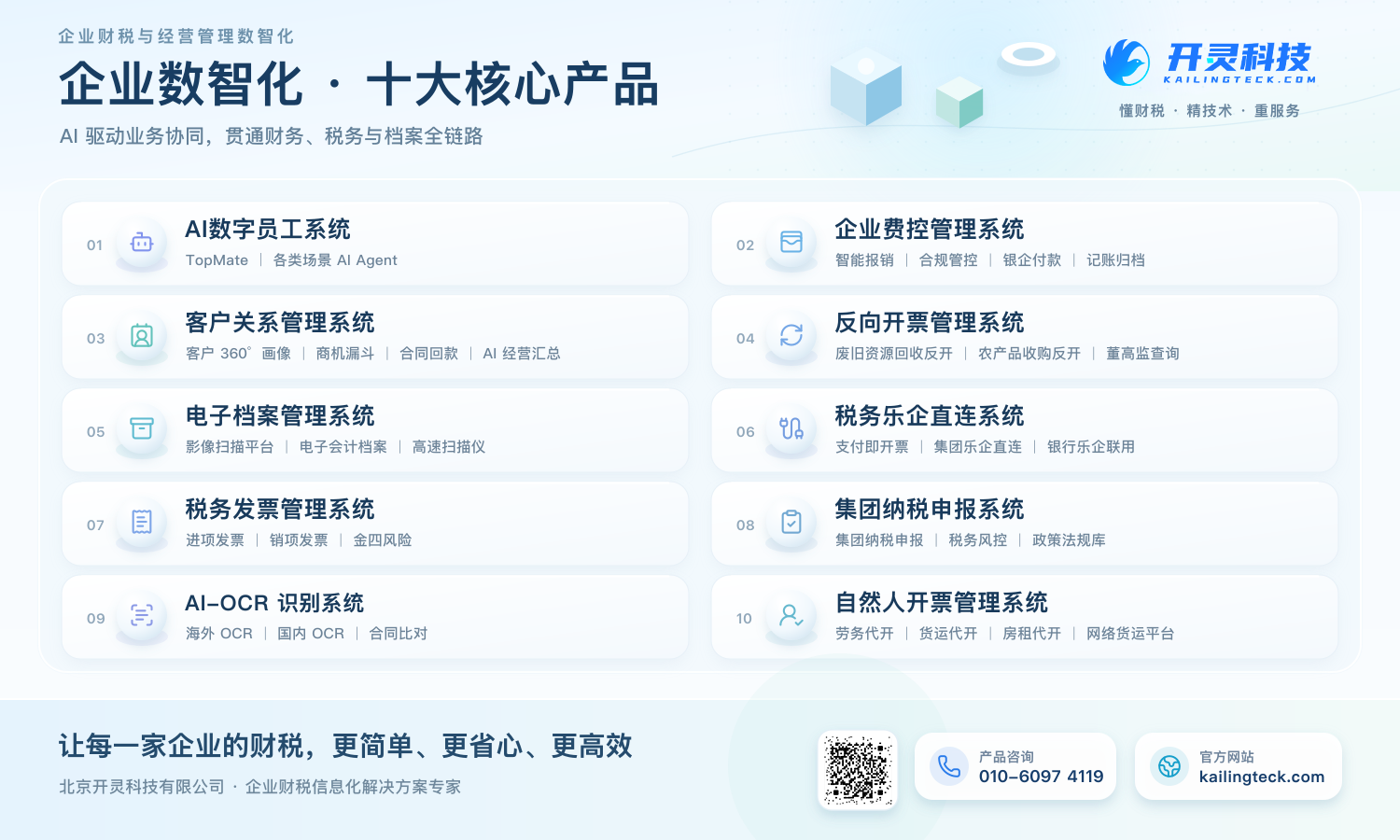
The company has now formed ten core product lines, including: AI digital employee system, enterprise expense control management system, customer relationship management system, reverse invoicing management system, invoice issuance for individuals management system, electronic archives management system, tax fully digitalized e-invoice Leqi system, tax invoice management system, group tax filing system, and AI OCR recognition system. It is committed to connecting enterprise business, finance, tax, funds, and archive data to help customers improve operational efficiency, business-finance-tax compliance capabilities, and digital management levels.
If you have any business-finance-tax digital transformation needs, welcome to contact us. Beijing Kailing Technology will serve you wholeheartedly.
Keywords: overseas invoice AI OCR, low-confidence fields, invoice spot-checking, manual review, multilingual invoice recognition
As a comprehensive business-finance-tax digitalization solution service provider, Kailing Technology provides business-finance-tax management digital transformation products and operational services for various government agencies, institutions, and large, medium, and small enterprises. The product line includes: solutions for sales contract management system, procurement contract management system, fully digitalized Leqi interface project, automatic output invoicing system, reverse invoicing system, invoice issuance for individuals system, employee expense control and reimbursement system, input VAT invoice management system, supply chain collaborative reconciliation system, image AI OCR recognition system, automatic financial bookkeeping system, electronic accounting archives system, etc., comprehensively driving the digitalization process across various fields.
Consultation Hotline: 18513895936 / 010-60974119 Location: Beijing