
Scheduled daily, event-triggered, or manually initiated? Kailing Technology enterprise AI digital employee teaches you how to configure the task run cycle

Scheduled, event-triggered, and manual initiation: none is suitable for all digital employee tasks. Kailing Technology AI digital employee can start work according to time schedules, business events, or personnel instructions, and enterprises should choose the method based on when data is ready, when results are used, and whether a person needs to confirm. Running frequently does not mean the business is keeping up; letting tasks appear at the right time is closer to a truly useful assistant.
▍Tasks are not better the more frequently they run; first look at when the business needs them
A business briefing that must be read every morning is suitable for preparation around a fixed reading time. Information organization that needs to start as soon as a customer submits new materials is suitable for following business changes. Temporarily wanting to check a certain project is more like work initiated by a person. All of them can be assisted by digital employees, but 'when to start' should not be decided by the same schedule.
Choosing the wrong startup method often produces two experiences. Tasks that should respond promptly are still waiting for the next planned round; tasks that do not need to run frequently keep repeatedly reading unchanged data. The former makes the business feel slow, while the latter increases invalid calls and inspection burden, and managers may also be misled by a string of success logs into thinking that the more runs there are, the greater the value.
You can first ask a question close to the user: if this result arrived a little later, what decision would it affect? If it affects a fixed daily meeting, arrange it around the meeting; if it affects order processing, focus on order events; if the business responsible person must judge the processing scope, retain a manual entry point. Clarifying the work value first and then setting the system clock will be more reasonable than directly choosing 'once every hour.'
▍The three startup methods of Kailing Technology AI digital employee each suit different positions
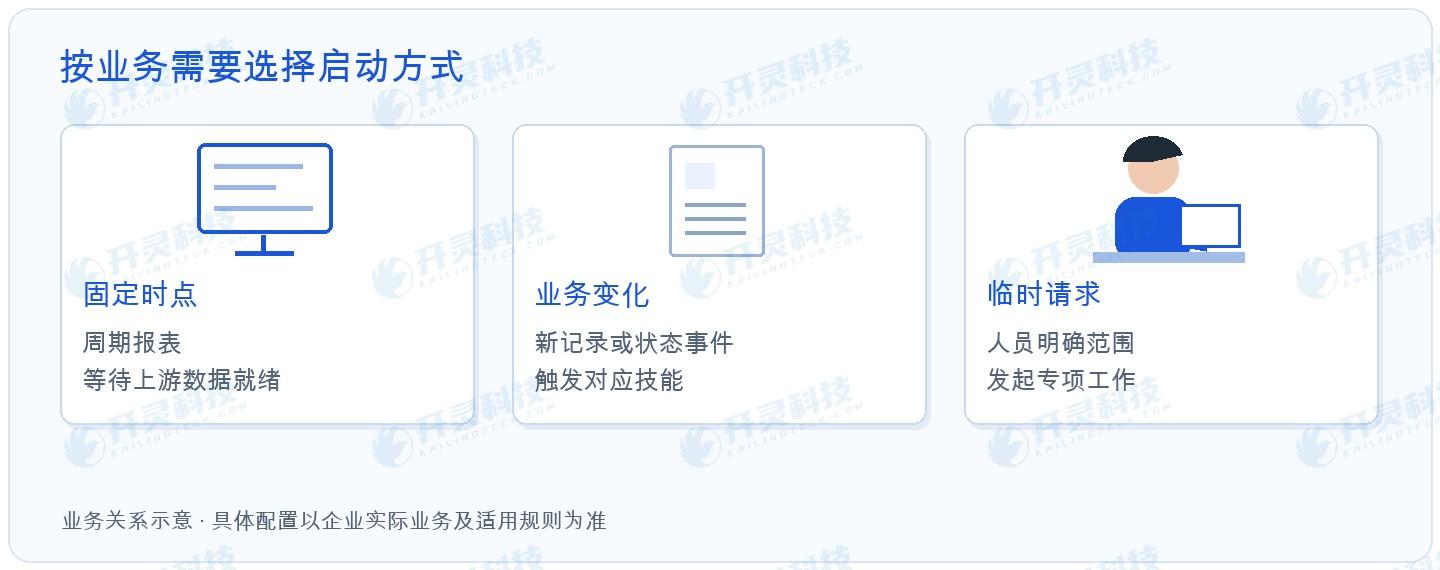
Scheduled tasks are suitable for work with a stable rhythm, such as periodic summaries, daily checks, and preparation of fixed reports. The key is not only to set an execution time, but also to know when upstream data is complete. If a report runs before data synchronization, even if it shows completion every time, it may only be delivering an incomplete result on time.
Event triggers are better suited to work that follows status changes. When the system receives a new business record or a certain step is completed, it then starts the relevant skills, which can reduce empty runs. Its premise is that the event source is reliable and the necessary information can be passed; if the existing system cannot provide the corresponding signal, it is necessary to evaluate interfaces or other connection methods, and you cannot just draw an arrow on the solution diagram.
Manual initiation is suitable for temporary queries, special organization, and tasks where a person needs to confirm the scope. The user explains the object and purpose, and the digital employee executes existing skills accordingly. This arrangement is not insufficient automation, but rather keeping business judgment in the appropriate place. A one-time temporary analysis does not need to permanently become a backend scheduled task, and it should even less run repeatedly without the user's knowledge.
The three methods can also be combined. For example, prepare a regular summary every day, add reminders when important changes occur, and call queries when the responsible person temporarily needs them. The key to combination is to avoid the same work being started repeatedly through different entry points, which requires a unified task object, request identifier, and execution status. The more flexible the entry points, the more the backend needs to clearly distinguish new work from existing work.
▍Write waiting, catch-up runs, and pauses into the task schedule
A task starting smoothly does not mean its upstream and downstream will always be on time. Late data, system maintenance, and temporarily unavailable interfaces can all make the original plan fall through. Enterprises need to decide: wait for the data to be complete before running, first form partial results and explain the scope, or pause and hand it to the responsible person. These choices should serve the business purpose, rather than letting the system fill in unknown information on its own just to show success.
After a missed run, not all tasks should be caught up from the historical date all the way to today. A daily report may need to fill in the missing period, but reminder-type messages may already have lost timeliness; actions involving external status such as payments and invoicing should even less be directly repeated according to the same logic. You should first verify the actual business results, then decide subsequent handling.
When tasks depend on each other, it is best to let the schedule clearly express 'after what is completed, who can continue.' For example, if data organization has not yet finished, it is not appropriate to push the final analysis to the responsible person. Existing enterprise workflows can continue to handle sequence coordination, while Kailing Technology AI digital employee handles the assigned position skills. The two cooperate through established interfaces, and there is no need to overturn the original system just to introduce AI.
For operations personnel, the right to pause is equally important. Reports no longer used during holidays, reminders after a phased project ends, and data sources that have become invalid should all be stopped in time. Maintaining the task list means maintaining the work the enterprise truly needs at present, avoiding digital employees being busy for a long time on business that has already ended.
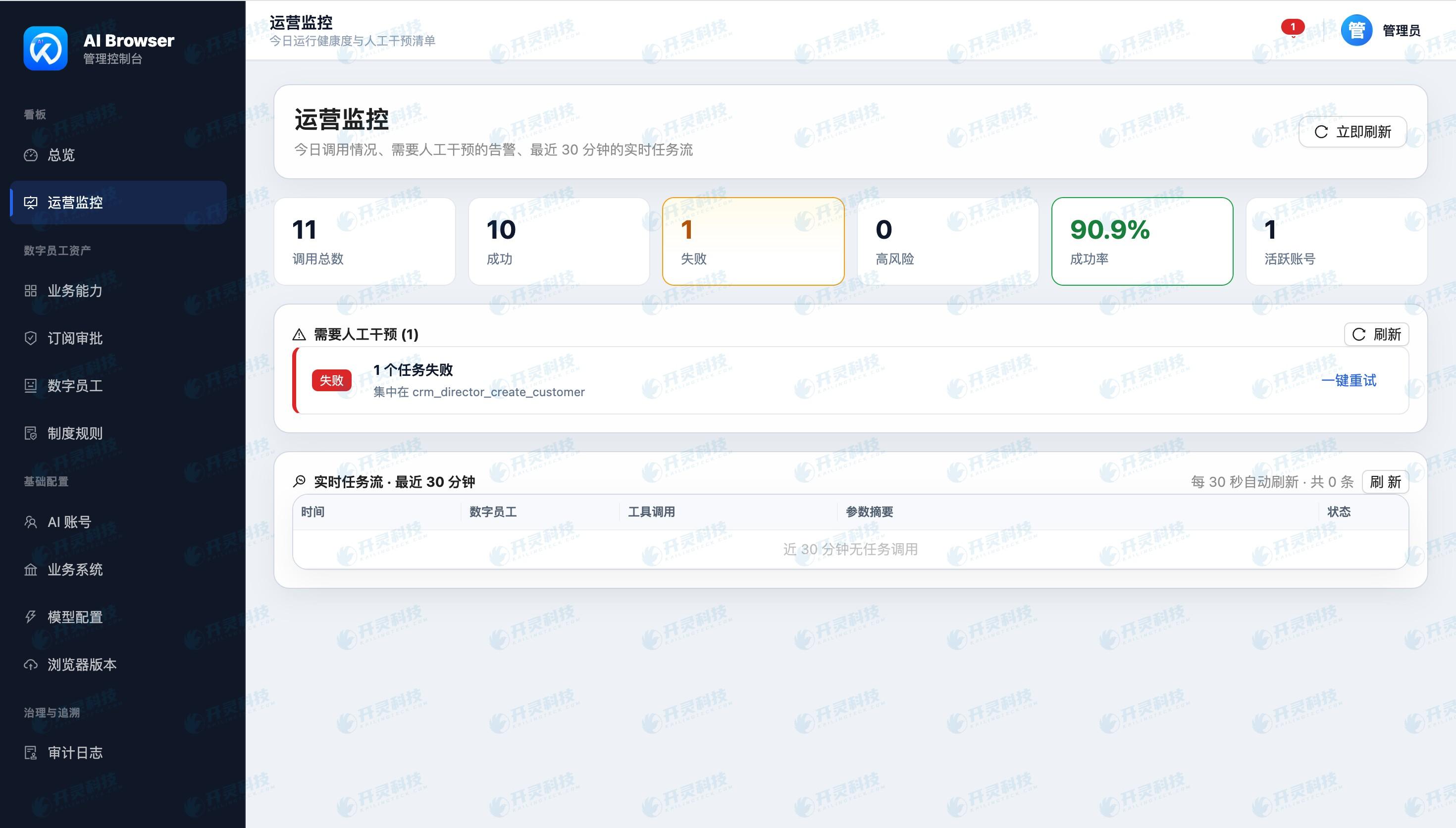
▍One task card lets business and technology discuss the same thing
When arranging a new task, you can use a concise task card to record the service recipient, required inputs, startup conditions, expected output, and exception contact. Business personnel do not need to learn scheduling terminology first to judge whether the arrangement fits work habits; technical personnel can use it to confirm data connections, account permissions, and operating conditions.
Kailing Technology AI digital employee organizes tasks, skills, and account permissions, and supports enterprises in continuously adjusting around actual positions. What is worth noting here is not whether a one-time setting can remain unchanged forever, but whether the corresponding task can be found after the business changes, whether the impact on which work is known after modification, and whether exceptions can be handed to a clear person for handling.
Task run records should also serve to improve the schedule. If a certain result always arrives after the responsible person's meeting, check the upstream waiting and execution time; if a large number of runs bring no new information, you can lower the frequency or switch to event triggers; if temporary needs appear repeatedly, then consider consolidating them into a periodic task. The rhythm is not decided once and for all, but gradually fits the team through actual use.
From a management perspective, an appropriate task cycle can also help control costs. Enterprises do not need to simply pursue denser model calls, and can leave resources for work that truly affects the business. Those reduced invalid runs, together with those useful results that arrive more promptly, are both part of the operational quality of digital employees.
▍FAQ: Common problems when configuring the run cycle
Q: Can a daily scheduled task be executed once more temporarily?
A: A manual entry point can be retained in combination with product configuration, but it is necessary to identify whether it conflicts with a running task and to check whether this output will overwrite, duplicate, or affect existing results.
Q: What if the existing business system has no event interface?
A: You can first use appropriate scheduled checks or manual triggers, then evaluate interface modifications. The choice should be based on data acquisition conditions and business timeliness, and you should not promise that any system can be directly linked in real time.
Q: After one failure, can it automatically retry indefinitely?
A: Not suitable. It is necessary to distinguish temporary technical anomalies from business data issues, limit the retryable scope, and set up notifications and manual takeover for situations that cannot recover on their own.
Q: How do you judge whether a task cycle is set well?
A: Look at whether results are available when needed, whether there are too many invalid runs, and whether exceptions can be handled in time. The count is only a run record and should not replace judgment of business effectiveness.
Find the right startup time for each piece of work and let Kailing Technology AI digital employee integrate into the team's daily routine: https://www.kailingteck.com/de/ .
As a national high-tech enterprise, Kailing Technology focuses on the digital and intelligent transformation of enterprise business-finance-tax and operations management, providing software products, system integration, implementation and delivery, and operational services for various government agencies, institutions, group enterprises, and SMEs.
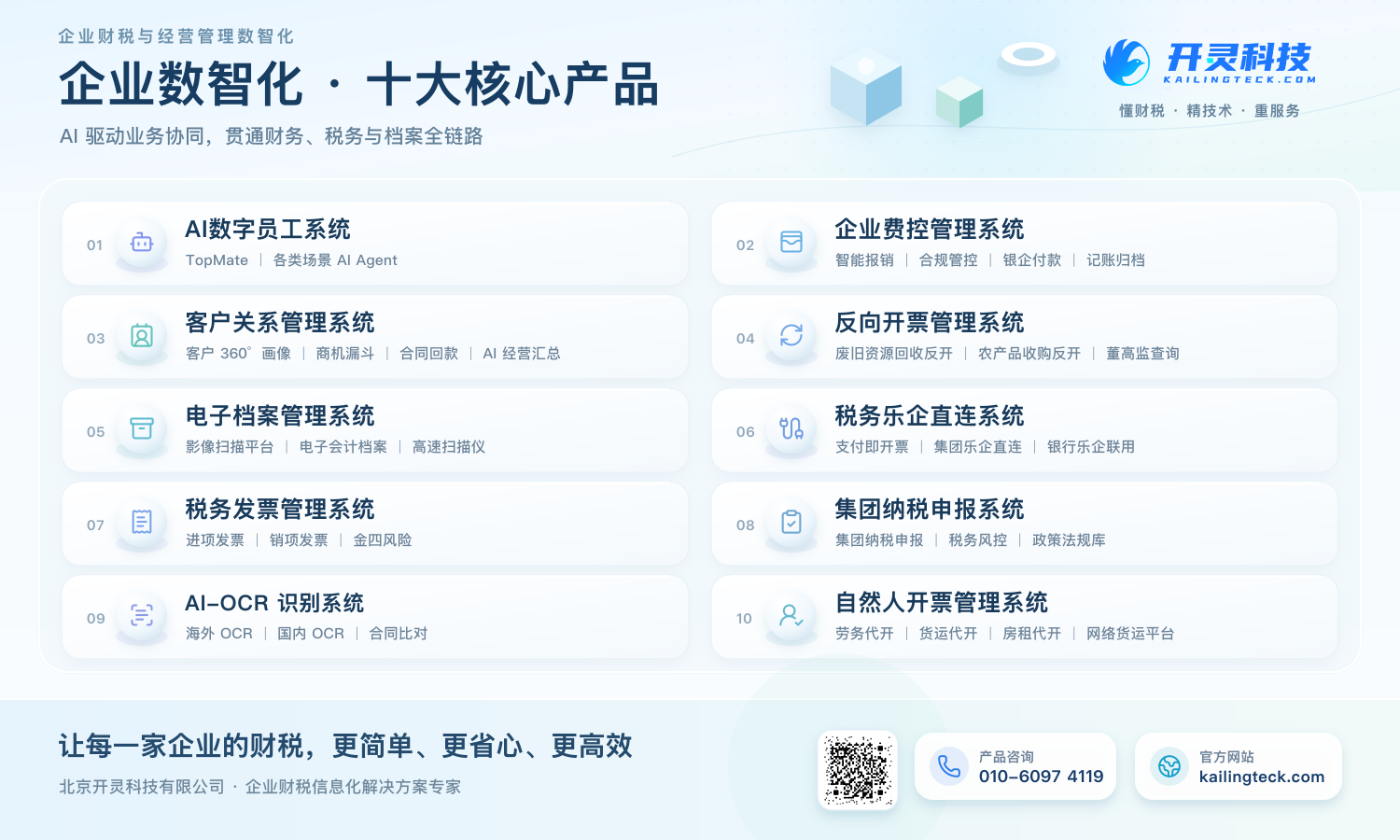
The company has now formed ten core product lines, including: AI digital employee system, enterprise expense control management system, customer relationship management system, reverse invoicing management system, invoice issuance for individuals management system, electronic archives management system, tax fully digitalized e-invoice Leqi system, tax invoice management system, group tax filing system, and AI OCR recognition system. It is committed to connecting enterprise business, finance, tax, funds, and archive data to help customers improve operational efficiency, business-finance-tax compliance capabilities, and digital management levels.
If you have any business-finance-tax digital transformation needs, welcome to contact us. Beijing Kailing Technology will serve you wholeheartedly.
Keywords: AI digital employee, task run cycle, scheduled tasks, event triggers, manual initiation
As a comprehensive business-finance-tax digitalization solution service provider, Kailing Technology provides business-finance-tax management digital transformation products and operational services for various government agencies, institutions, and large, medium, and small enterprises. The product line includes: solutions for sales contract management system, procurement contract management system, fully digitalized Leqi interface project, automatic output invoicing system, reverse invoicing system, invoice issuance for individuals system, employee expense control and reimbursement system, input VAT invoice management system, supply chain collaborative reconciliation system, image AI OCR recognition system, automatic financial bookkeeping system, electronic accounting archives system, etc., comprehensively driving the digitalization process across various fields.
Consultation Hotline: 18513895936 / 010-60974119 Location: Beijing