
Kailing Technology resource recycling reverse invoicing system: For individual sellers with a single truck mixed with scrap copper, scrap aluminum, and scrap iron, how do you issue invoices after sorting and grading?
Mixed scrap copper, scrap aluminum, and scrap iron cannot be invoiced vaguely based only on the total vehicle weight. Resource recycling businesses eligible for reverse invoicing should, based on the real seller and the actual purchased goods, match the sorted categories, grades, and weights with the settlement details. The Kailing Technology resource recycling reverse invoicing system organizes business records around receiving, settlement, and invoicing, so that goods that can be clearly sorted on site can also be clearly explained on the finance side.
▍Why can one truckload of goods produce two different statements at settlement?
The busyness of a recycling yard often begins when vehicles enter. The seller says this truckload of metal is mainly copper, while receiving staff find aluminum, iron pieces, and inclusions inside; weighing gives the net weight of the whole vehicle, but value judgments for different materials only hold after sorting. If settlement is first based on one general product name and the category proportions are found to be wrong later, rework in payment and invoicing becomes likely.
This is not about adding a complex set of paperwork to the site, but about acknowledging that "vehicle entry" and "cargo detail confirmation" solve different problems. The former indicates how much goods were delivered on a given trip, while the latter explains what the enterprise actually purchased. A single batch can contain multiple items of goods, and one should not assume that because there is only one vehicle, the invoice should also have only one line.
Sorting staff, settlement staff, and the seller need to use the same confirmation result together. If how impurities are deducted, how categories are assigned, and how grades are determined by agreement are only discussed verbally, finance will find it hard to reconstruct the basis days later. Leave key conclusions in the receiving record so later roles do not have to ask the site again.
▍Retaining "one truck, multiple categories" in the Kailing Technology resource recycling reverse invoicing system
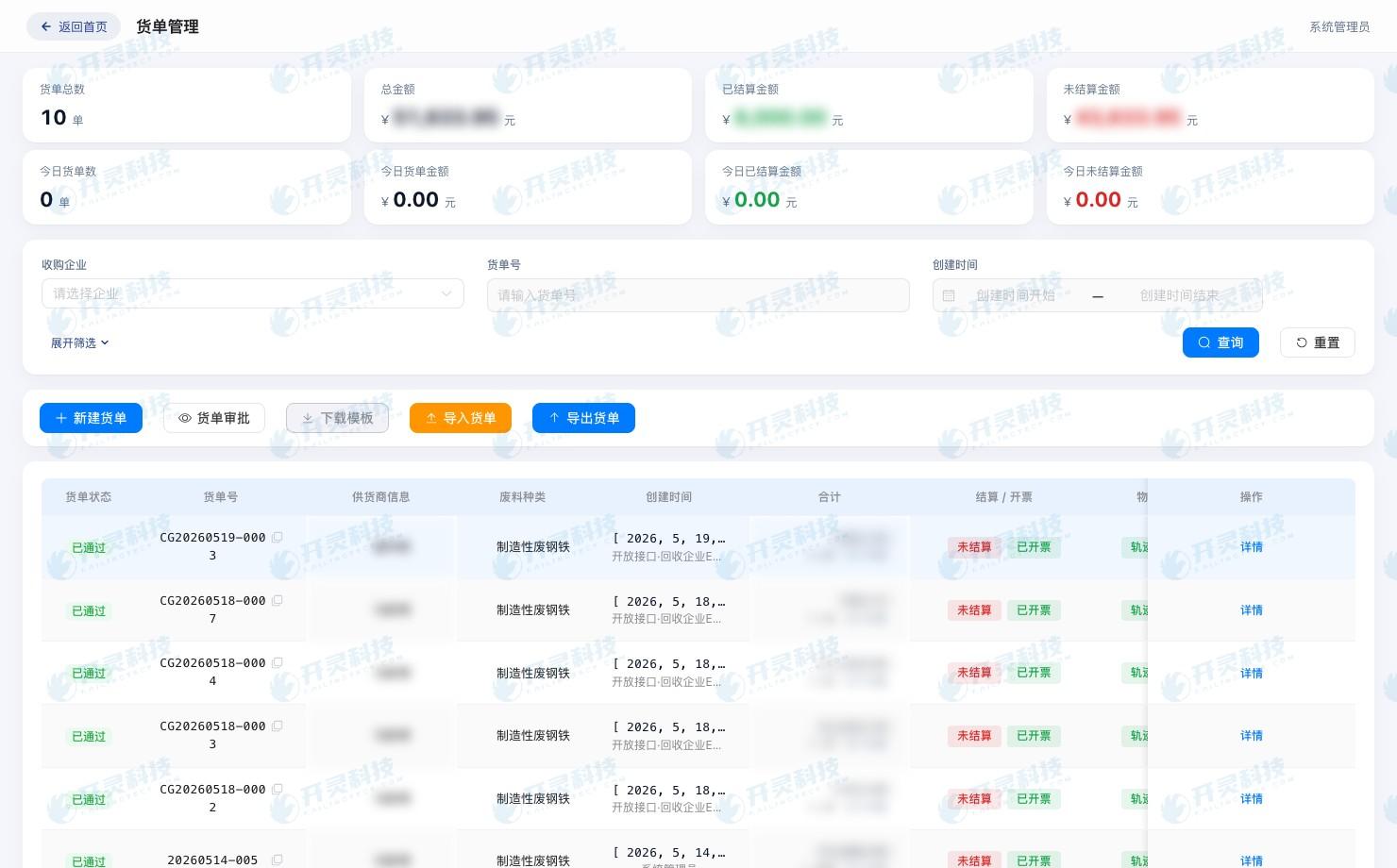
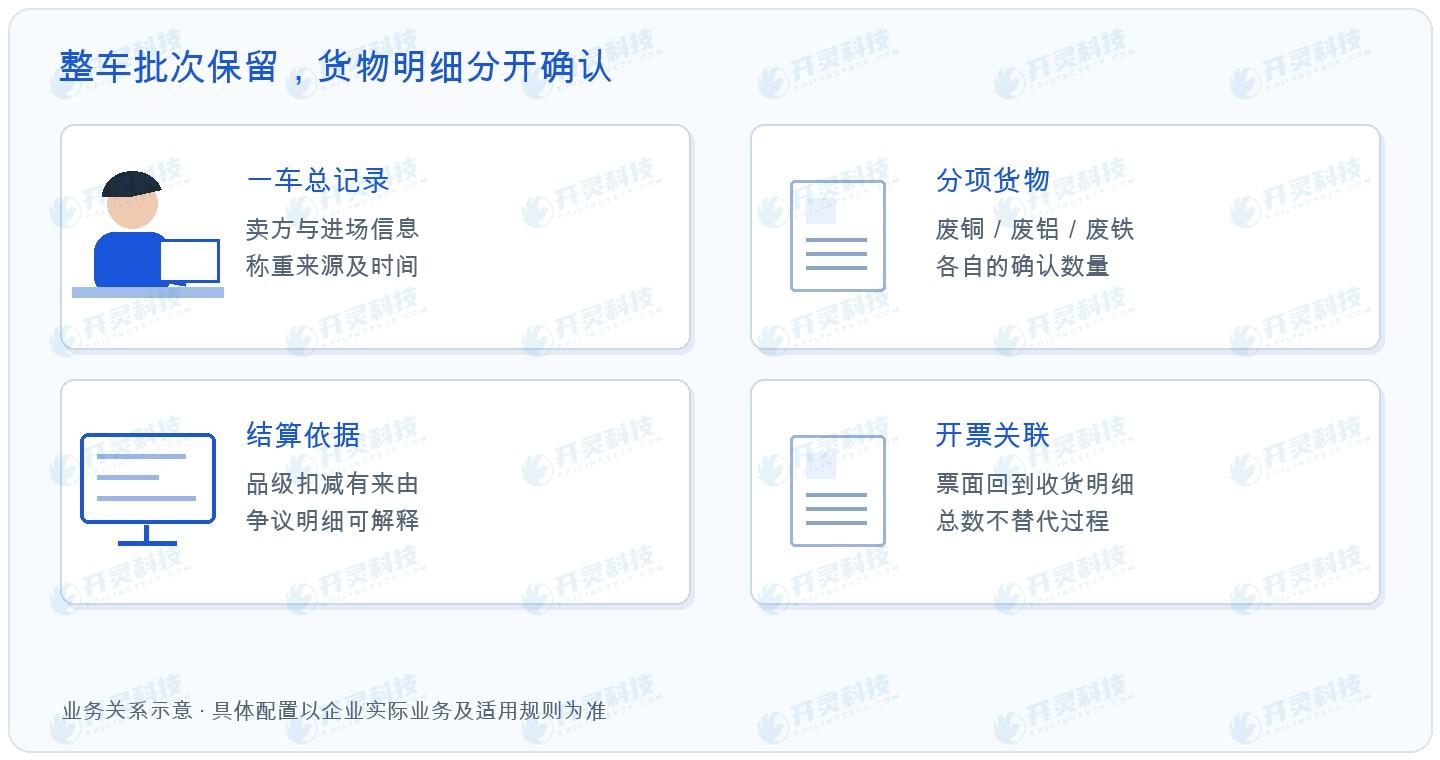
The entry batch can be viewed as one master folder, containing separate line records for scrap copper, scrap aluminum, and scrap iron. The master record preserves the seller, vehicle or entry information, weighing basis, and receiving time; the line records carry the item name, unit of measure, confirmed quantity, and settlement basis. Each item can be explained separately while also tracing back to the same receiving event.
The existing receiving and invoicing ledgers in the system can support this type of business organization. For enterprise-specific management requirements such as grade fields, impurity deductions, and reweighing differences, specific fields and rules need to be agreed during implementation. All on-site judgments cannot be compressed into a single final amount, nor can cargo grades be determined by algorithms without confirmation.
Product name expression is also worth unifying in advance. Procurement habits use abbreviations, the warehouse uses specification-based names, and finance enters them under another dictionary, so the same material may become three names across different documents. Enterprises can maintain the correspondence between daily business names and invoicing product information, but the mapping should respect the actual goods and not force different materials into one category.
▍What the seller confirms is not just the final total
Settlement information that is easy to verify should let the seller clearly see the confirmed quantity of each material category, the agreed pricing method, and the reason for deductions. Giving only a total price may seem to save one explanation, but it may leave disputes until after payment. Especially when sorting and delivery are not completed at the same time, confirmation records can reduce disputes caused by inconsistent memories between both parties.
When a dispute arises, the entire vehicle's data does not have to lose order along with it. The enterprise can distinguish details that have been agreed upon from details still requiring review, handle the settleable portion according to contract, and supplement confirmation after the dispute is resolved. Whether to allow installment settlement and how to form corresponding invoices should be set according to actual business and tax requirements; it is not advisable to treat unconfirmed data as fact just to move faster.
On-site modifications should also indicate their source. If a reweighing result replaces the original weight, or if materials are reclassified, the link between before and after adjustment should be retained. Subsequent invoicing should use the confirmed purchase information, rather than selecting what looks like the latest copy from multiple spreadsheets.
▍Make goods receipt details the explanatory entry point for invoices
Kailing Technology resource recycling reverse invoicing system can include receiving materials, invoicing results, payment records, and related vouchers in the business ledger. When viewing a certain invoice, you can not only see the invoice content, but also follow the associations to find the goods, seller, and settlement basis at that time. For finance, this is more useful than collecting scattered photos from stations again at month-end.
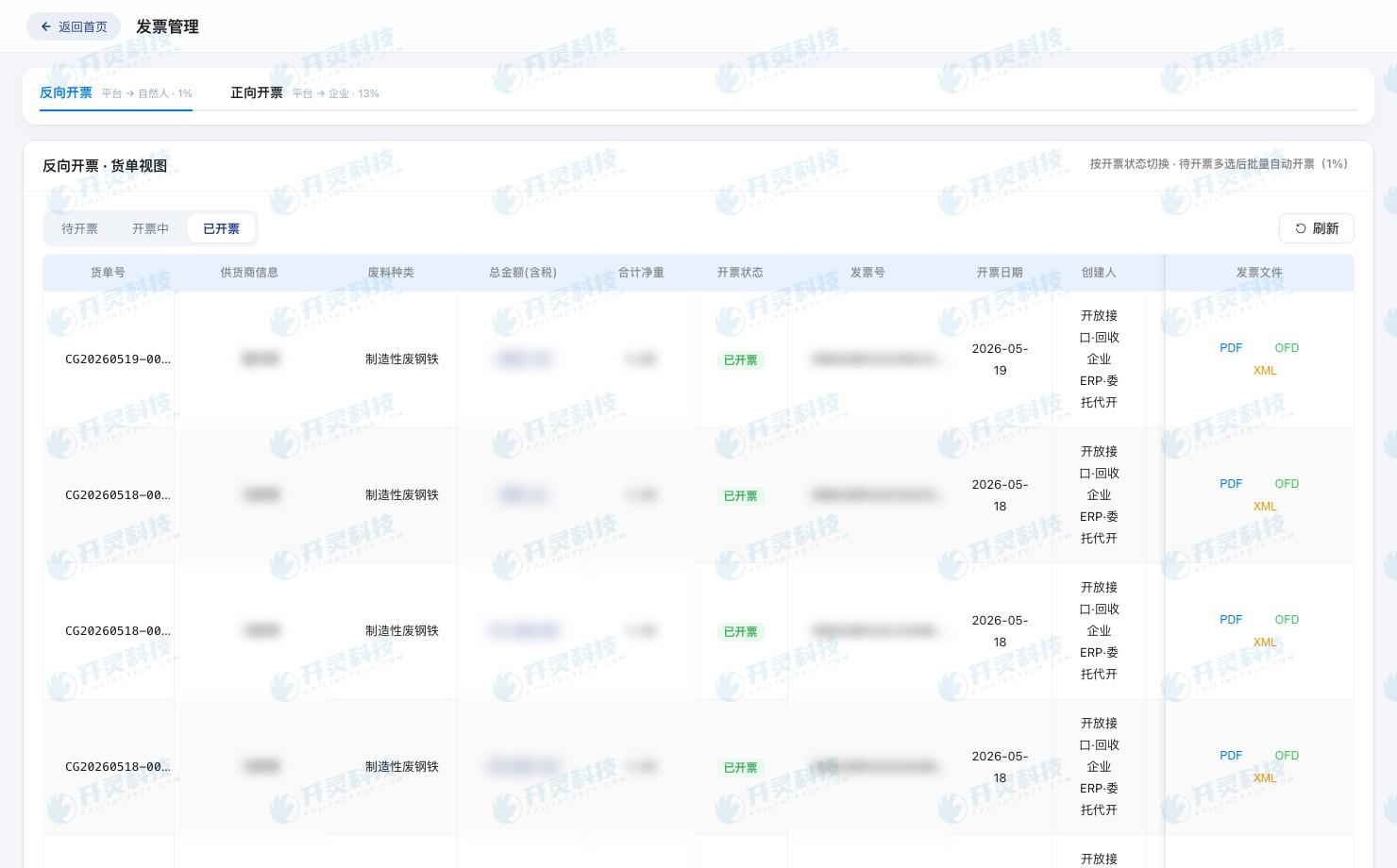
If a return or settlement adjustment occurs after invoice generation, the original record also cannot be quietly overwritten. First distinguish which goods the business change involves and which invoice it corresponds to, then handle invoice corrections and fund adjustments according to the actual status. The recycling system is responsible for organizing relationships and retaining traces, while specific tax handling still needs to comply with the invoicing platform and applicable rules.
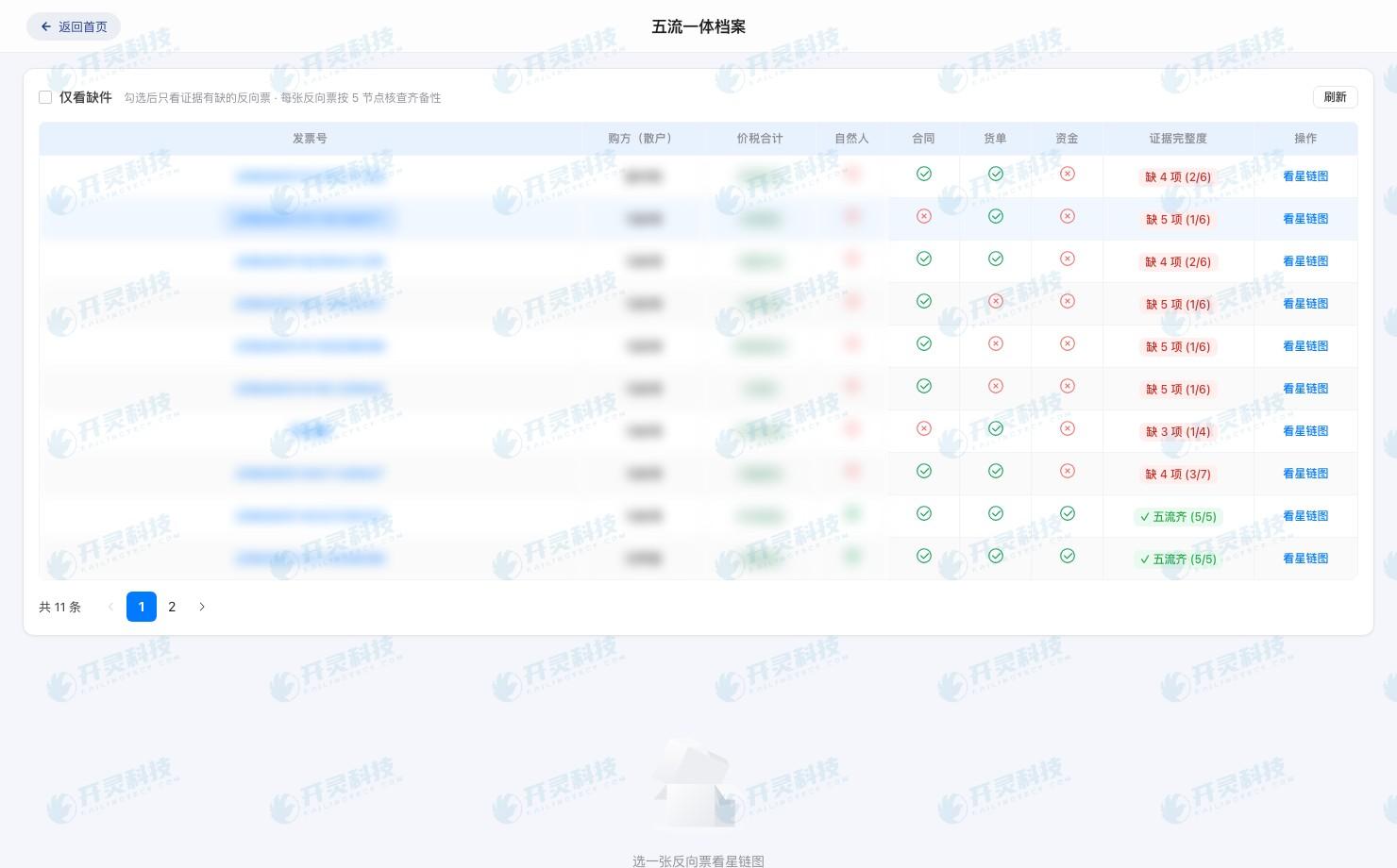
The "five flows" management here is a way of organizing evidence: connecting the identity materials, contractual agreements, receipt facts, invoices, and funds involved in a real transaction. Complete materials help explain the business, but they cannot turn a false acquisition into a compliant transaction, nor can a system ledger replace verification of the real seller.
▍First determine whether reverse invoicing is possible, then discuss how to split the details
Resource recycling reverse invoicing has a clear scope of application; it cannot be used whenever invoices are missing in the procurement process. Enterprises need to verify their own qualifications, seller conditions, and cargo scope. Large receiving volumes and frequent sellers also cannot omit verification of identity and transaction authenticity, and transactions should not be split to evade policy requirements.
Regarding applicable entities and retained materials, refer to official materials such as the "Q&A on 'Reverse Invoicing' by Resource Recycling Enterprises" issued by the State Taxation Administration. An enterprise's category dictionary and business ledger should be configured within the boundaries permitted by policy.
For stations with more mixed-load purchases, the value of digitalization is not moving the invoicing button next to the weighbridge, but enabling entry, sorting, confirmation, and settlement to share traceable data. One less vague pass on site means one less need to find someone to explain again on the back end.
Station managers can also use these records to review where disputes are concentrated. If a certain type of material always needs to be reclassified, the on-site classification criteria should be checked; if category confirmation is fine but payment discrepancies repeatedly occur, the settlement version and payment basis should be investigated. Using the ledger this way goes beyond "gathering materials for an invoice" and can in turn help on-site collaboration.
During promotion, the operating habits familiar to receiving personnel can also be retained. The on-site staff are responsible for recording real observations and confirmation conclusions, and the back office is responsible for converting business language into standardized settlement and invoice fields. Each role does a little less repetitive organizing, rather than requiring everyone to first become an invoicing expert. Only with a clear division of labor can digital tools truly be used continuously during the busy receiving season.
▍FAQ common questions about purchasing mixed scrap metal
Q: Can copper, aluminum, and iron be uniformly written as "scrap materials"?
A: The goods information should be truthfully reflected according to the actual purchased goods. Internal use of a general abbreviation does not mean the invoice can omit necessary details; the actual category and invoicing requirements need to be verified.
Q: What should be done if the sorted weight differs from the first weighing weight?
A: Check whether there are differences in packaging, impurities, reweighing, or measurement standards. After leaving a difference explanation and confirmation record, a value usable for settlement can then be formed; weights should not be arbitrarily adjusted to match the total.
Q: If one grade is found to be wrong after invoicing, can the goods receipt line be changed directly?
A: It is not advisable to change only the source document without handling downstream effects. The related settlements and invoices should be located, corrections should be carried out according to actual progress, and original records and modification basis should be retained to ensure consistent explanations across all ends.
Mixed purchases do not have to rely on finance piecing together the story afterward. Connect sorting results to settlement and invoicing. Welcome to learn about Kailing Technology: https://www.kailingteck.com/fxzy/ .
As a national high-tech enterprise, Kailing Technology focuses on the digital and intelligent transformation of enterprise business-finance-tax and operations management, providing software products, system integration, implementation and delivery, and operational services for various government agencies, institutions, group enterprises, and SMEs.
The company has now formed ten core product lines, including: AI digital employee system, enterprise expense control management system, customer relationship management system, reverse invoicing management system, invoice issuance for individuals management system, electronic archives management system, tax fully digitalized e-invoice Leqi system, tax invoice management system, group tax filing system, and AI OCR recognition system. It is committed to connecting enterprise business, finance, tax, funds, and archive data to help customers improve operational efficiency, business-finance-tax compliance capabilities, and digital management levels.
If you have any business-finance-tax digital transformation needs, welcome to contact us. Beijing Kailing Technology will serve you wholeheartedly.
Keywords: Resource recycling reverse invoicing system, mixed scrap metal, sorting and grading, scrap copper scrap aluminum scrap iron, five-flow integration
As a comprehensive business-finance-tax digitalization solution service provider, Kailing Technology provides business-finance-tax management digital transformation products and operational services for various government agencies, institutions, and large, medium, and small enterprises. The product line includes: solutions for sales contract management system, procurement contract management system, fully digitalized Leqi interface project, automatic output invoicing system, reverse invoicing system, invoice issuance for individuals system, employee expense control and reimbursement system, input VAT invoice management system, supply chain collaborative reconciliation system, image AI OCR recognition system, automatic financial bookkeeping system, electronic accounting archives system, etc., comprehensively driving the digitalization process across various fields.
Consultation Hotline: 18513895936 / 010-60974119 Location: Beijing