
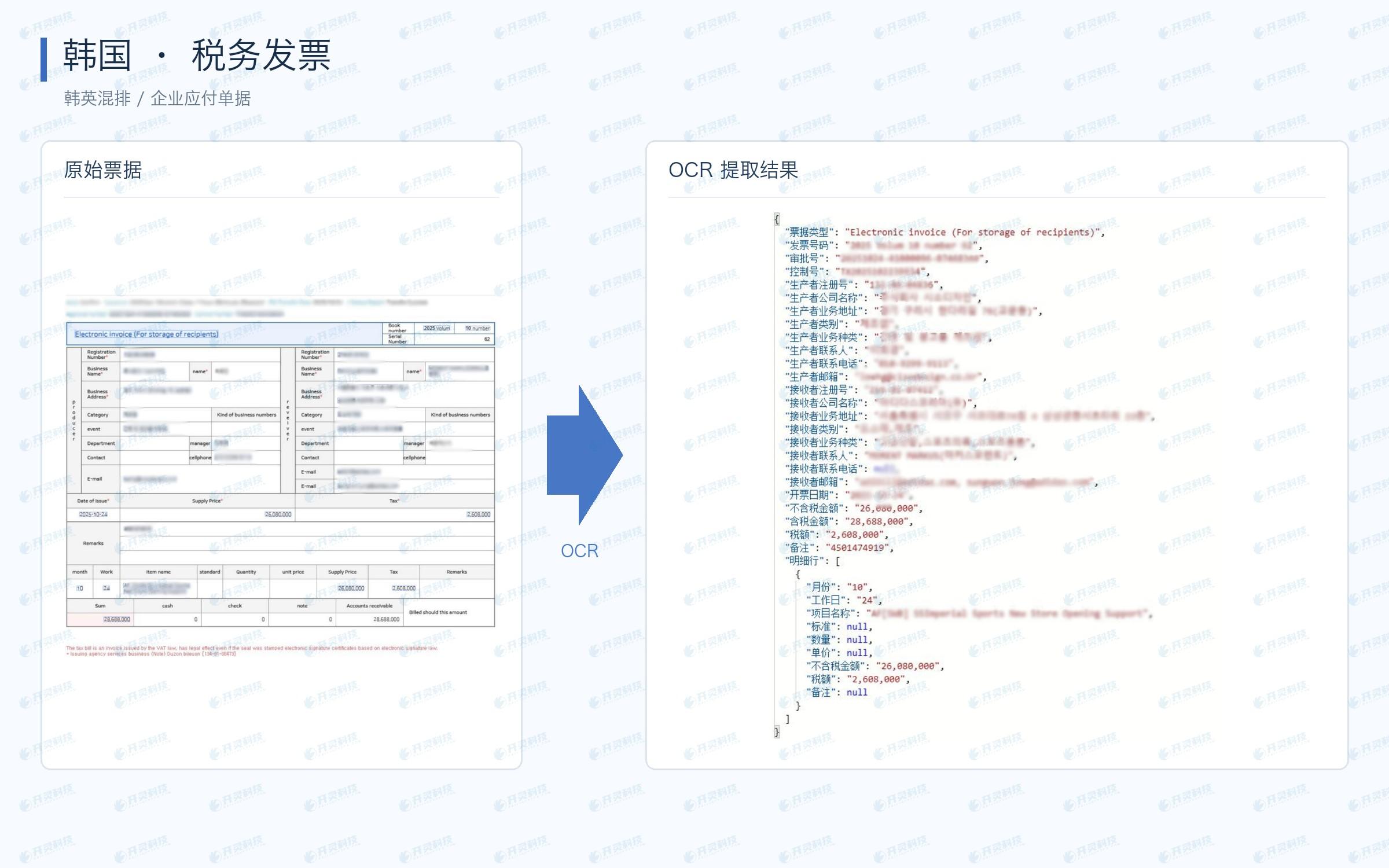
How are the original text and Chinese fields of overseas invoices retained at the same time? Kailing Technology overseas invoice AI OCR outputs original fields and standard fields
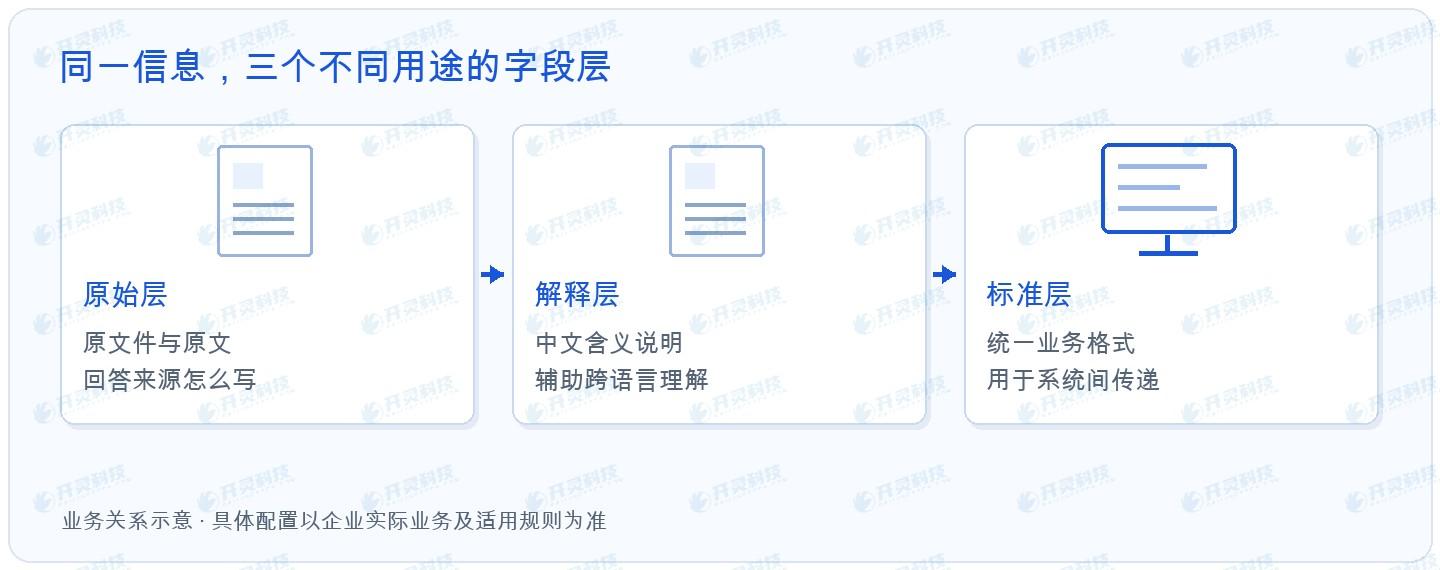
The original text and Chinese fields of overseas invoices should be retained in parallel, rather than overwriting the original content after translation. Kailing Technology overseas invoice AI OCR can handle multilingual recognition, translation, and structured organization; in the output solution, distinguishing original fields, Chinese explanations, and business standard values allows finance to both understand and trace back. Chinese provides an entry point for understanding, while the original invoice and original information retain the basis for verification. Each has its own role.
▍A fluent Chinese sentence may hide the information finance most wants to verify
The merchant name, expense item, and tax fee description on an invoice are often easier to read after translation. But no matter how fluent the translation is, it cannot automatically answer "is this the field on the invoice." For example, a local invoice says service charge, but Chinese processing vaguely classifies it as tax fee, and subsequent accounting may continue classifying along the wrong meaning.
Some differences are not translation quality issues. The original invoice follows local date conventions, while the standard system requires a unified year-month-day format; commas and decimal points in amounts are used differently; merchant names may contain abbreviations. Finance needs to know simultaneously how the original document was written, how the system interprets it, and what value was ultimately submitted to the reimbursement or accounting system.
Saving only the Chinese result is equivalent to keeping the conclusion while taking away the source. When a dispute arises, the reviewer must find the original image again, relocate the text, and then judge whether it is a recognition error, translation deviation, or inappropriate business mapping. Only by separating information layers from the start is there a path back from conclusion to basis later.
▍The three-layer field organization approach of Kailing Technology overseas invoice AI OCR
The original layer preserves traceable invoice files and recognized content, and does not rewrite supplier names, delete currencies, or omit original remarks just to look neat. It answers "what did the source say." For text obtained through the recognition process, it should also not be treated as a substitute for the original that has been proven correct; the ability to view the original invoice must still be retained.
The explanation layer uses Chinese to explain the meaning of the original fields, helping finance staff unfamiliar with the local language understand the materials. It can explain tax fee names, item meanings, and date formats, but when encountering content with unclear semantics, it should retain doubts or refer it for review, rather than packaging uncertain interpretations as certain facts.
The standard layer is oriented toward business systems. For example, unified date formats, currency codes, and enterprise expense categories. It solves the problem of how data is transmitted between systems and cannot be mixed with original fields into one value. The specific bilingual output fields, location information, and interface format need to be agreed during project implementation, rather than assuming that any invoice can be directly applied to the same template.
▍Looking back along one field is easier than repeatedly flipping through the entire invoice
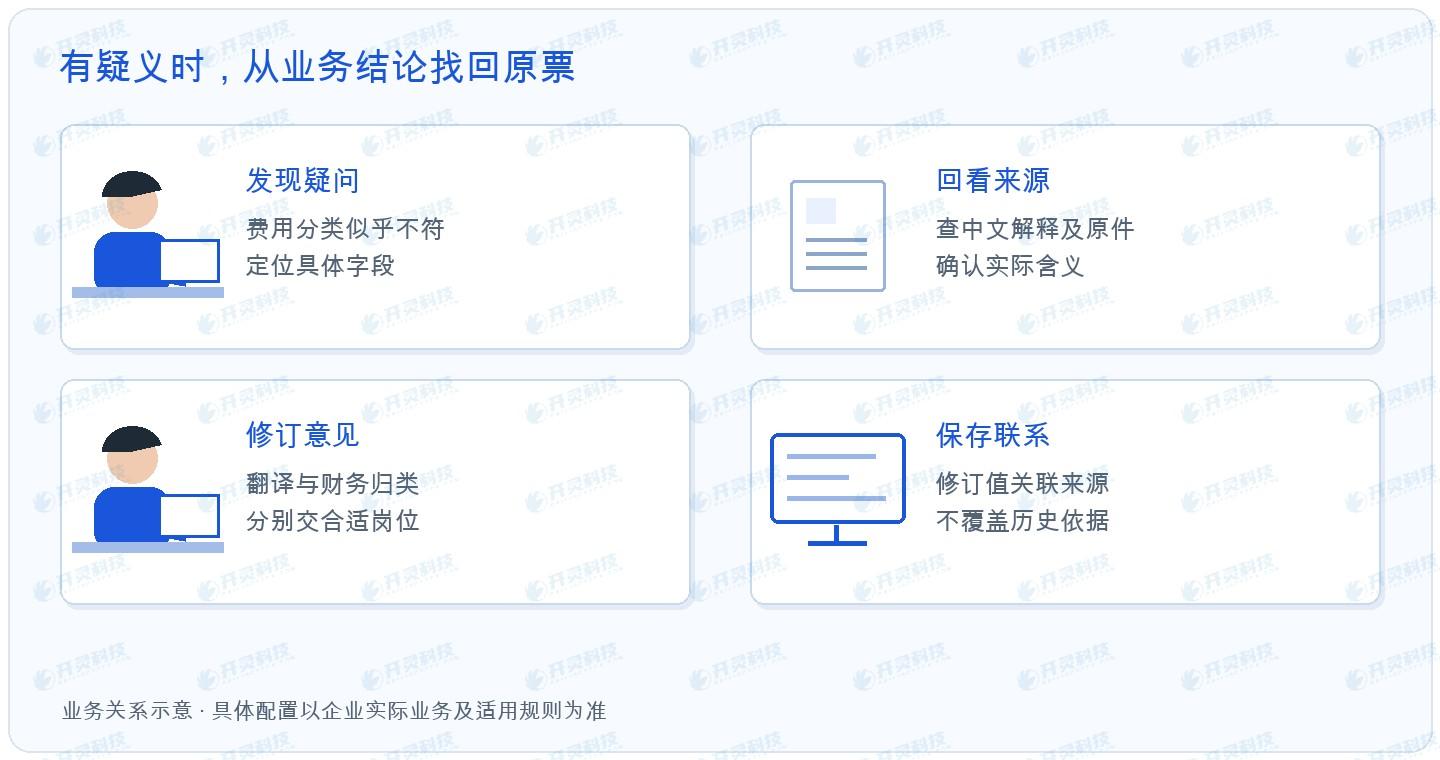
Suppose a reviewer has doubts about the Chinese categorization of an expense. The ideal verification path is to find the corresponding Chinese explanation from the standard expense category, then open the original invoice to confirm the relevant text. This is an illustrative usage scenario and does not involve real customer data. Once the path is clear, review discussions can focus on specific fields rather than vaguely saying "this invoice was recognized incorrectly."
During system integration, source identifiers and processing status can be retained for the same field. Which file it was extracted from, whether it was manually corrected, and which confirmation result was used - this information determines how finance subsequently trusts and reuses the data. The level of source association can be jointly determined based on output capabilities and financial needs, making daily viewing both convenient and sufficiently supported.
Another easily overlooked object is currency. The overseas invoice amount and the amount converted into the local currency should be expressed separately; the exchange rate date, source, and rounding method are determined by enterprise rules. Writing the conversion result back into the original currency amount column would deprive finance of the basis for explaining differences; even if the final total happens to match, it is not worth handling this way.
▍Who can modify translations, and who confirms financial categorization?
Colleagues familiar with foreign languages are suitable for helping clarify the meaning on the invoice, but they may not have the authority to decide accounting accounts; expense reviewers can judge business purpose, but they may not be able to verify all language details. Separating translation revision from financial confirmation can prevent one position's judgment from being unintentionally expanded into approval for all steps.
Kailing Technology overseas invoice AI OCR is used to reduce manual transcription and multilingual reading burden, but ultimately it still needs to connect with the enterprise's review responsibility. For expense natures in doubt, amounts that cannot be clearly read, or materials missing necessary information, the reviewer should be shown the items pending confirmation, rather than only outputting a Chinese table that looks complete.
After a revision, it should also be possible to explain why it was changed. Keeping the link between the original recognized value, the revised content, and the confirmation opinion means the next person handling it does not have to ask again. If rules change, the enterprise also needs to clarify the basis on which historical documents are handled and when new documents switch over; later mappings must not silently change earlier records.
▍Overseas invoice handover can involve less "please take another look for me"
Traveling employees want to submit all materials as soon as possible, finance wants usable data, and business leaders care whether expenses correspond to real activities. The point of parallel three-layer fields is to provide a common working document for these several reading needs. Employees do not have to manually recreate a Chinese invoice for finance's convenience, and finance does not have to rely entirely on employees' interpretation of every foreign-language word.
It is worth noting that convenience in recognition, translation, and archiving does not mean the invoice necessarily meets all local or domestic business-finance-tax requirements. Whether materials can be reimbursed, how they are recorded, and whether they are deductible must be judged in light of business authenticity and applicable regulations. Keeping the original text is precisely what preserves room for these subsequent judgments.
When preparing for integration, business staff can compile a list of fields that will actually be used: which must be sent to the reimbursement system, which are only for review reading, and which need to be archived. It is not that stuffing all the text on an invoice into the same table improves the user experience. Preserving source completeness and controlling the complexity of daily display are not contradictory; the key is to let different reading levels find each other.
For recurring merchants or expense items, confirmed explanation habits can be accumulated, but context still needs attention. Familiar names may also appear in documents of different natures, and historical handling experience should serve as an auxiliary hint, not a new reason to stop verifying.
▍FAQ Q&A on retaining bilingual fields
Q: If a Chinese translation already exists, is it still necessary to retain the original file?
A: A traceable source needs to be retained. Translations are for assisting reading and cannot fully replace the layout, context, and other related information in the original invoice; when questions arise, the original materials should still be viewable.
Q: Should merchant names all be changed to Chinese?
A: It is not advisable to overwrite the original name. A Chinese description or internal enterprise alias that is easy to search can be added while retaining the original text, avoiding the impact of identical names, abbreviations, or translation differences on counterparty verification.
Q: If standard fields are inconsistent with the original text, does that mean recognition was wrong?
A: Not necessarily. Unified date formats and expense category mapping may change the display method. The transformation rules should first be checked; if the semantics or amounts have been changed, then the recognition and manual processing steps should be investigated.
Make overseas invoices readable, traceable, and connectable to business systems. View the Kailing Technology AI OCR solution: https://www.kailingteck.com/ai-ocr/ .
As a national high-tech enterprise, Kailing Technology focuses on the digital and intelligent transformation of enterprise business-finance-tax and operations management, providing software products, system integration, implementation and delivery, and operational services for various government agencies, institutions, group enterprises, and SMEs.
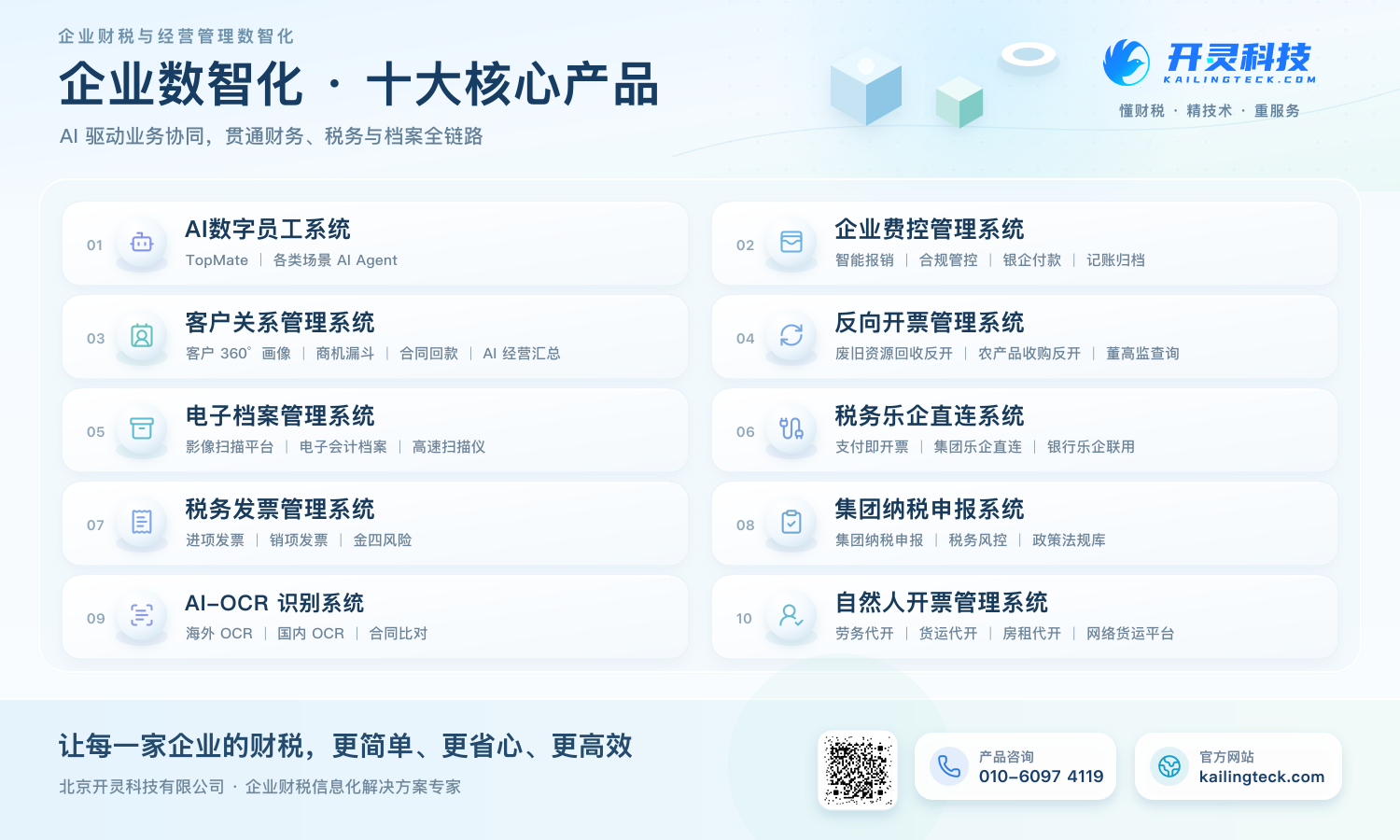
The company has now formed ten core product lines, including: AI digital employee system, enterprise expense control management system, customer relationship management system, reverse invoicing management system, invoice issuance for individuals management system, electronic archives management system, tax fully digitalized e-invoice Leqi system, tax invoice management system, group tax filing system, and AI OCR recognition system. It is committed to connecting enterprise business, finance, tax, funds, and archive data to help customers improve operational efficiency, business-finance-tax compliance capabilities, and digital management levels.
If you have any business-finance-tax digital transformation needs, welcome to contact us. Beijing Kailing Technology will serve you wholeheartedly.
Keywords: overseas invoice AI OCR, original fields, standard fields, multilingual invoice recognition, cross-border finance
As a comprehensive business-finance-tax digitalization solution service provider, Kailing Technology provides business-finance-tax management digital transformation products and operational services for various government agencies, institutions, and large, medium, and small enterprises. The product line includes: solutions for sales contract management system, procurement contract management system, fully digitalized Leqi interface project, automatic output invoicing system, reverse invoicing system, invoice issuance for individuals system, employee expense control and reimbursement system, input VAT invoice management system, supply chain collaborative reconciliation system, image AI OCR recognition system, automatic financial bookkeeping system, electronic accounting archives system, etc., comprehensively driving the digitalization process across various fields.
Consultation Hotline: 18513895936 / 010-60974119 Location: Beijing