
Is keeping only printed copies of fully digitalized e-invoices enough? How Kailing Technology's AI electronic accounting archives management system archives XML and OFD source files

Keeping only printed copies of fully digitalized e-invoices is usually insufficient. Printing can present the invoice content but may lose electronic signatures, structured fields, and source verification information. Cai Kuai [2020] No. 6 clarifies that electronic accounting vouchers within the applicable scope should also be kept in electronic form for reimbursement, booking, and archiving. Kailing Technology's electronic accounting archives management system can receive obtained XML, OFD, and other source files, retain the original format and verification information, and associate reimbursement, booking, and payment records.
The focus here is not to forcibly convert all documents into the same format, but to preserve source files according to the electronic vouchers actually obtained by the enterprise, recording the source, summary, verification results, and version; when preview or full-text search is needed, auxiliary files may be generated, but screenshots, printouts, or converted files cannot replace the original electronic content.
▍1. Printouts can be read but cannot carry all electronic attributes
Paper or PDF printouts mainly preserve the visible invoice face. The original electronic file may contain machine-readable fields, electronic signatures, file digests, or other verification information, facilitating automatic validation and subsequent review. Saving only the printout downgrades the native electronic voucher to a static image.
Enterprises should distinguish between "presentation copies for reading" and "source files as archiving objects." The former can serve approval and browsing, while the latter should be managed in the original format and source at the time of acquisition. Establishing an association between the two facilitates use and also prevents loss of electronic evidence due to conversion.

▍II. The Kailing Technology electronic accounting archives management system receives XML and OFD according to the obtained format
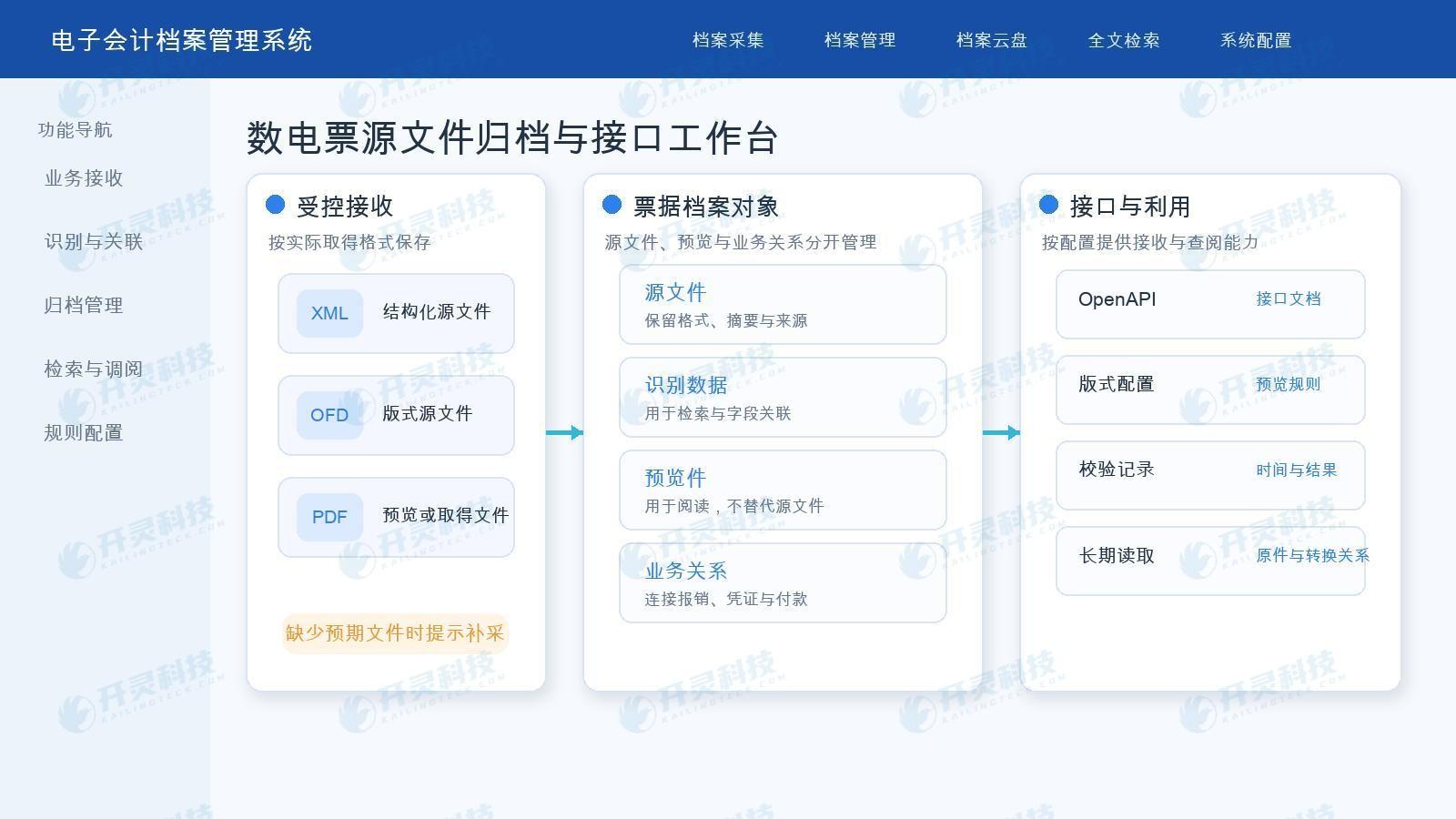
The system can receive electronic files from bill platforms, expense control, input management, or other approved sources, recording file name, format, size, summary, acquisition time, and source system. Structured content is used to extract metadata such as invoice number, amount, and entity, while layout files such as OFD are used to maintain standardized presentation.
The combination of files obtainable may differ by invoice type and source. A list of invoice types and rules for required documents should be established; it cannot be broadly claimed that every invoice has the same set of XML and OFD. When expected source files are missing, the system should prompt for re-acquisition rather than automatically generating a same-named substitute.
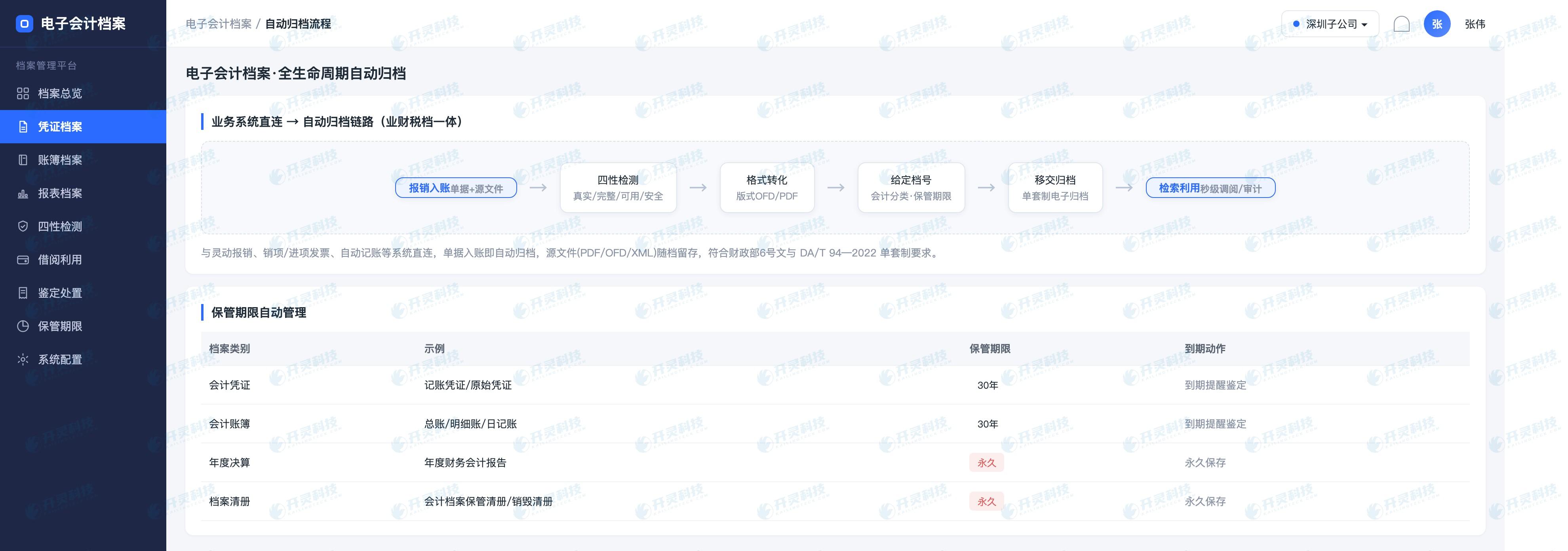
Electronic bill source file receiving and archiving process (information desensitized)
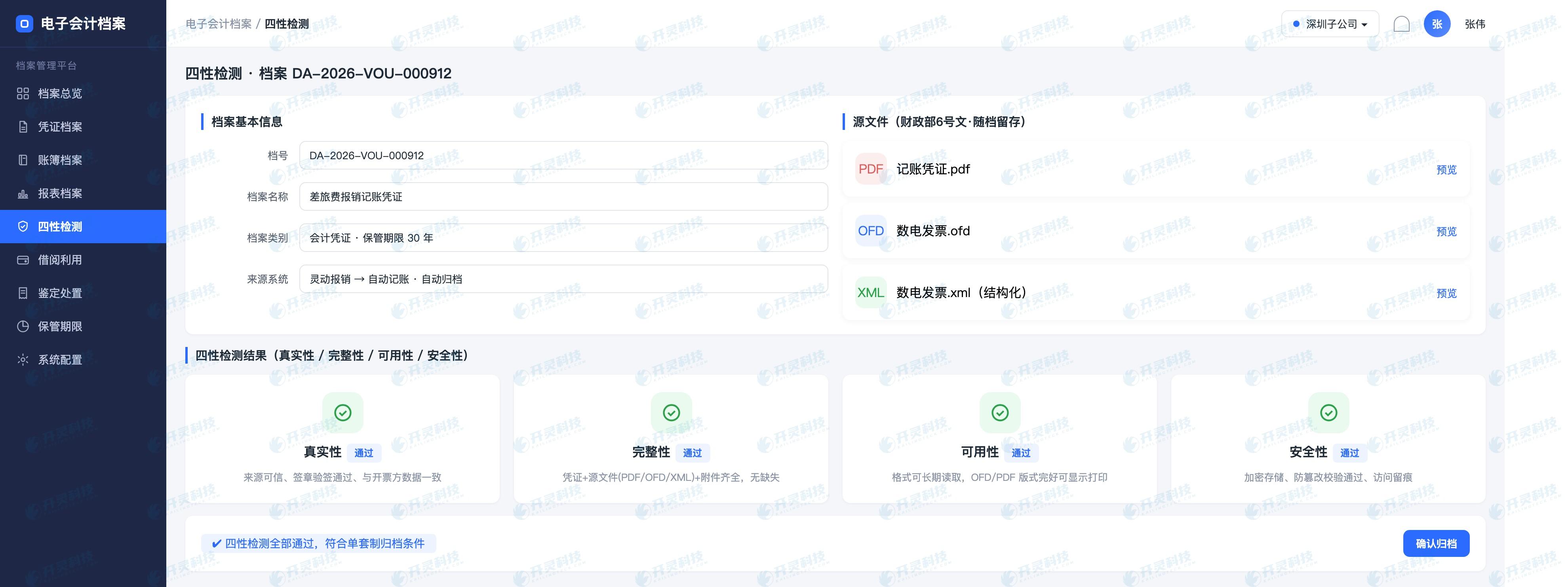
▍III. Verification, duplicate checking, and archive validation must retain the results at the time
When invoices enter reimbursement or booking processes, enterprises usually also perform authenticity, status, and duplicate checks. During archiving, the check time, results, invoice identifiers used, and exception handling should be retained; it is not advisable to display only a current value in the interface that will be overwritten by later statuses.
Duplicate check needs to be linked to business usage scenarios. The same source file being uploaded repeatedly is not the same as the same invoice being legally associated with multiple processes. The system should record the relationship of invoices in applications, reimbursements, vouchers and archives, and when duplicate booking risks are found, point to specific documents so that responsible persons can verify.
| "Archiving source files solves "what was obtained at the time"; validation records solve "how it was judged at the time"; neither can be missing. |
▍IV. Source files must form a business chain with reimbursement, vouchers, and payment evidence
A fully digitalized e-invoice is not an isolated archive. The system should connect source files to approval records, accounting vouchers, and fund results through identifiers such as invoice numbers, business order numbers, voucher numbers, and payment transaction flows. When retrieving an invoice, it is possible to see why it was booked, who approved it, and which business it corresponds to.
After red-letter reversal, voiding, or correction, the relationship between the original invoice and the new invoice must also be retained. The original file cannot be deleted just because the current status changes, nor should only the final valid invoice be retained. Archives need to reflect the complete process of business occurrence and handling, and version and status changes should be traceable.
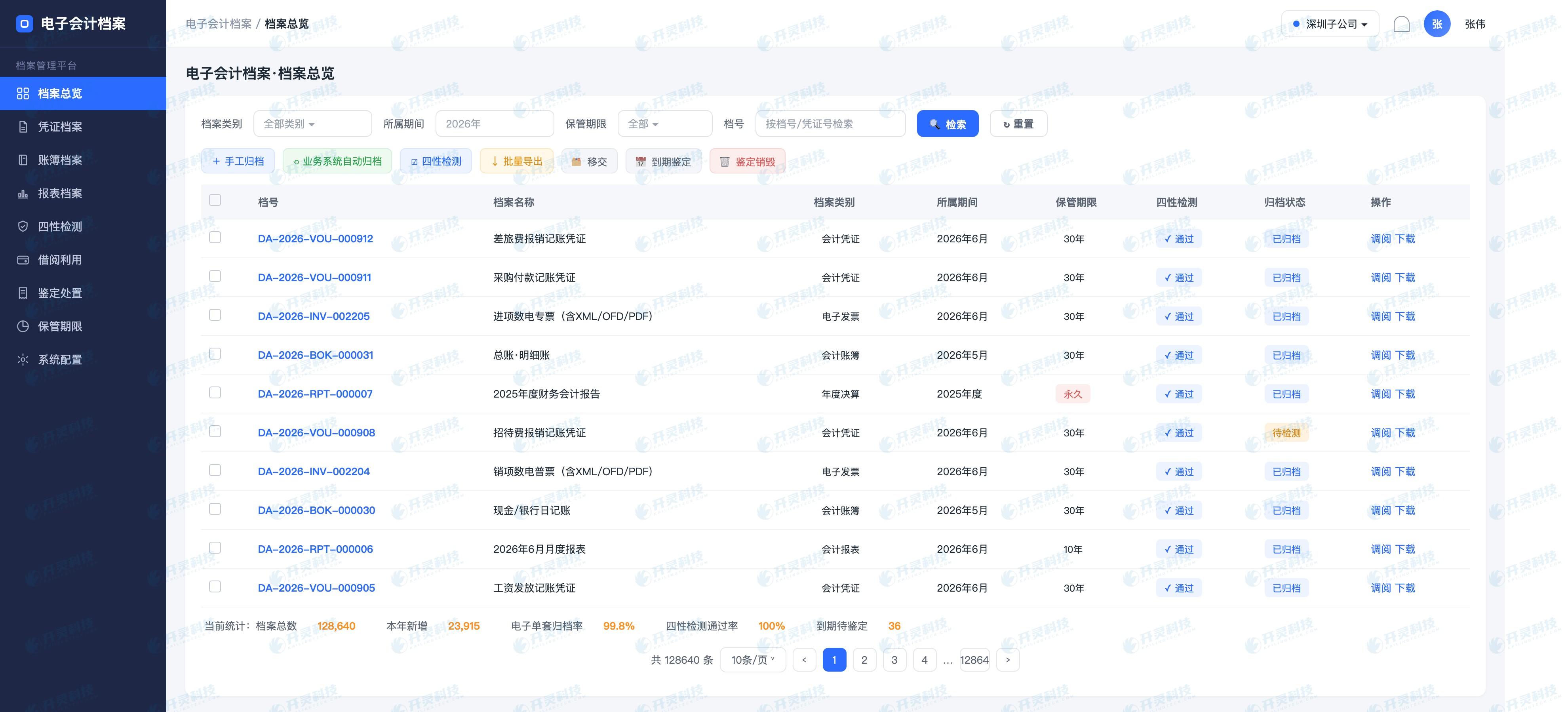
▍V. Long-term preservation requires validating files, reading environment, and migration results
Source file retention may span multiple system versions. Enterprises should regularly check whether files exist, whether summaries are consistent, whether formats can be read, and whether necessary verification information is available, while maintaining reading tools or controlled conversion solutions. Being able to save does not mean it can still be opened correctly years later.
When format migration is truly necessary, retain the migration batch, tools, and the relationship between original and target files, and verify quantity, content, and key metadata. Whether originals continue to be retained and how converted files are identified should follow institutional rules; a single batch conversion must not silently overwrite all source files.
▍VI. Understand electronic evidence in reverse from one printout
Starting from the printed or previewed copy on the reimbursement form, you can trace back to the corresponding source file, acquisition channel, verification record, accounting voucher, and payment evidence; duplicate uploads, red-letter reversals, corrections, source file corruption, and changes in reading tools all affect this evidential relationship.
The key to checking is not whether there is XML or OFD in the folder, but whether the file corresponds to the correct document, whether the original summary is preserved, whether it can be read with authorization, and whether exceptions have handling records. If a preview file is lost, it can still be regenerated from the source file; if the source file is damaged, it can be reliably restored from backup. Only then does the archiving chain truly hold.
- Clarify the source files receivable by invoice type and acquisition channel.
- Source files, preview files, and recognition data remain associated.
- Red-letter reversal, correction, and reuse all have status chains.
- Periodically perform readability checks and recovery drills.
▍VI. Source files and preview files serve different purposes
When archiving fully digitalized e-invoices, the actually obtained XML, OFD, or other source files should be findable from reimbursement or booking records, along with the source, acquisition time, summary, verification results, and preview file associations. Being able to open a PDF screenshot only shows that the invoice face is readable; it does not mean the electronic source file has been completely preserved.
Red-letter reversal, correction, re-upload, and format migration all change the usage status, but the original should not be silently overwritten. The original file, converted file, related business, and processing records are retained together, so that subsequent users can distinguish the content obtained at the time, the currently viewable version, and the business changes that occurred later.
- Configure receivable files by invoice type and source.
- Source file summaries and invoice identifiers can be verified.
- Red-letter reversal, correction, and migration retain historical relationships.
- Backup recovery and readability checks are performed regularly.
▍7. Retaining source files also means retaining verification and usage relationships
XML, OFD, or other actually obtained electronic files serve to preserve electronic attributes; preview copies, recognized text, and printouts serve for reading or retrieval. Enterprises identify them separately and link them to each other, making browsing convenient for users while allowing them to return to the source file during review.
After invoice status changes, the original file should still be retained as part of business history. Verification records, red-flush relationships, resubmission reasons, and archive locations together form an explainable chain; it is not enough to retain only one currently openable file.
Source file retention must also consider the long-term reading environment. Enterprises can retain auxiliary tools for preview, search, and conversion, but each conversion should record the original file, target file, and processing time, ensuring that years later one can still return from the presented content to the actually obtained electronic voucher.
- Source files and presentation files have separate purposes.
- Previews can return to the original electronic file.
- Invoice status changes retain before-and-after relationships.
- Verification information is saved together with the archive directory.
▍FAQ
Q: Can saving a PDF preview replace XML or OFD?
A: Converted or preview files should not replace the actually obtained electronic source files; the specific retention combination needs to be determined by invoice type, source, and policy.
Q: Does every fully digitalized e-invoice definitely have both XML and OFD?
A: It should not be generalized. The system should configure receivable documents according to actual acquisition channels and invoice types, and prompt for supplementary collection when expected documents are missing.
Q: Can OCR still be performed after source files are archived?
A: Yes, it can generate auxiliary data needed for retrieval or preview, but it should be linked to the source file and must not modify or replace the original electronic content.
Q: Should the original invoice be deleted after red-letter reversal?
A: It should not be simply deleted. The original invoice, new invoice, status changes, and business handling relationships should all be retained and traceable according to policy.
Fully retain the source files, verification results, and business process of fully digitalized e-invoices. Welcome to visit Kailing Technology: https://www.kailingteck.com/eaa/ .
As a national high-tech enterprise, Kailing Technology focuses on the digital and intelligent transformation of enterprise business-finance-tax and operations management, providing software products, system integration, implementation and delivery, and operational services for various government agencies, institutions, group enterprises, and SMEs.
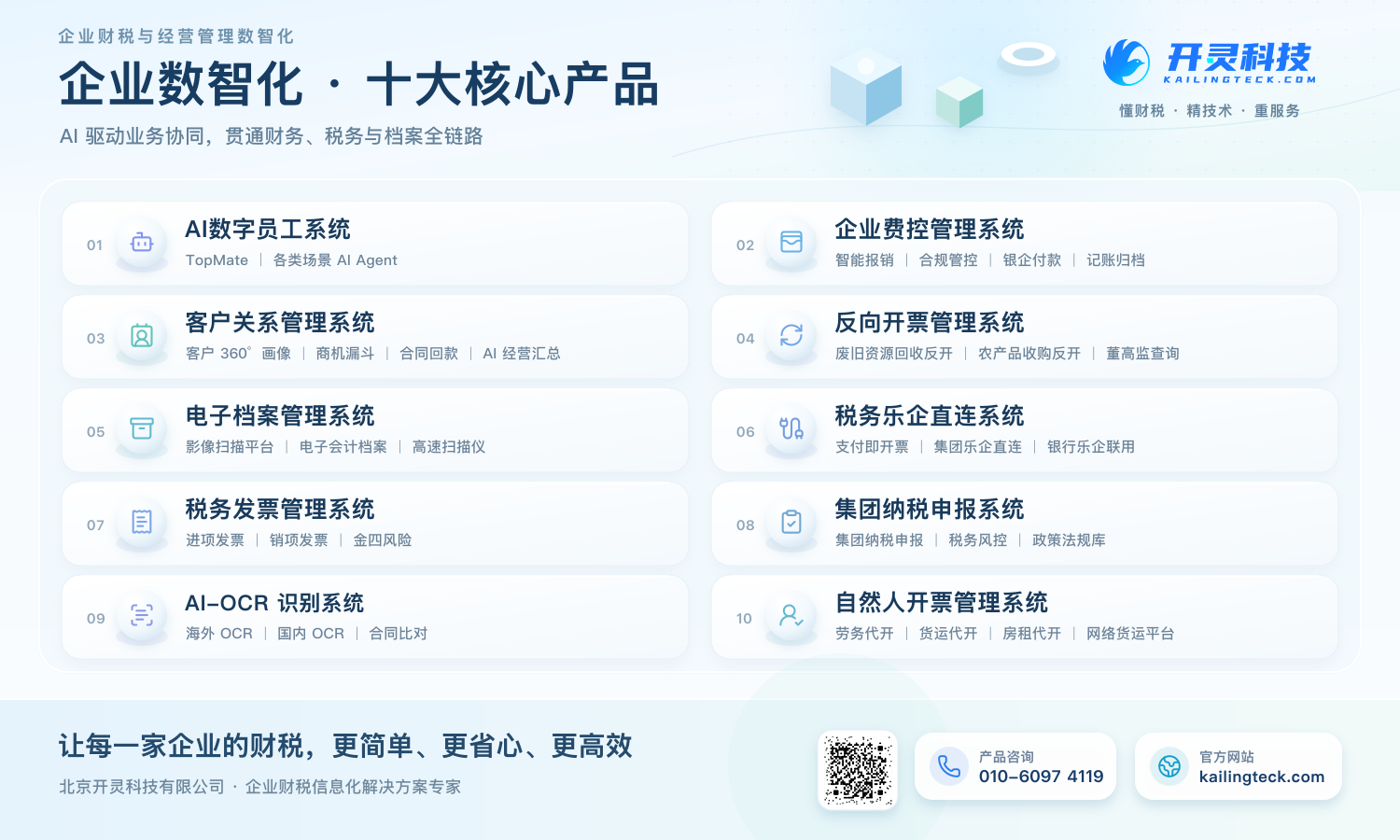
The company has now formed ten core product lines, including: AI digital employee system, enterprise expense control management system, customer relationship management system, reverse invoicing management system, invoice issuance for individuals management system, electronic archives management system, tax fully digitalized e-invoice Leqi system, tax invoice management system, group tax filing system, and AI OCR recognition system. It is committed to connecting enterprise business, finance, tax, funds, and archive data to help customers improve operational efficiency, business-finance-tax compliance capabilities, and digital management levels.
If you have any business-finance-tax digital transformation needs, welcome to contact us. Beijing Kailing Technology will serve you wholeheartedly.
Keywords: Fully digitalized e-invoice archiving, XML source files, OFD electronic invoices, Kailing Technology electronic accounting archives management system
As a comprehensive business-finance-tax digitalization solution service provider, Kailing Technology provides business-finance-tax management digital transformation products and operational services for various government agencies, institutions, and large, medium, and small enterprises. The product line includes: solutions for sales contract management system, procurement contract management system, fully digitalized Leqi interface project, automatic output invoicing system, reverse invoicing system, invoice issuance for individuals system, employee expense control and reimbursement system, input VAT invoice management system, supply chain collaborative reconciliation system, image AI OCR recognition system, automatic financial bookkeeping system, electronic accounting archives system, etc., comprehensively driving the digitalization process across various fields.
Consultation Hotline: 18513895936 / 010-60974119 Location: Beijing