
Implementation plan for payment and invoicing of agricultural product purchase invoices: how to implement five-flow integration
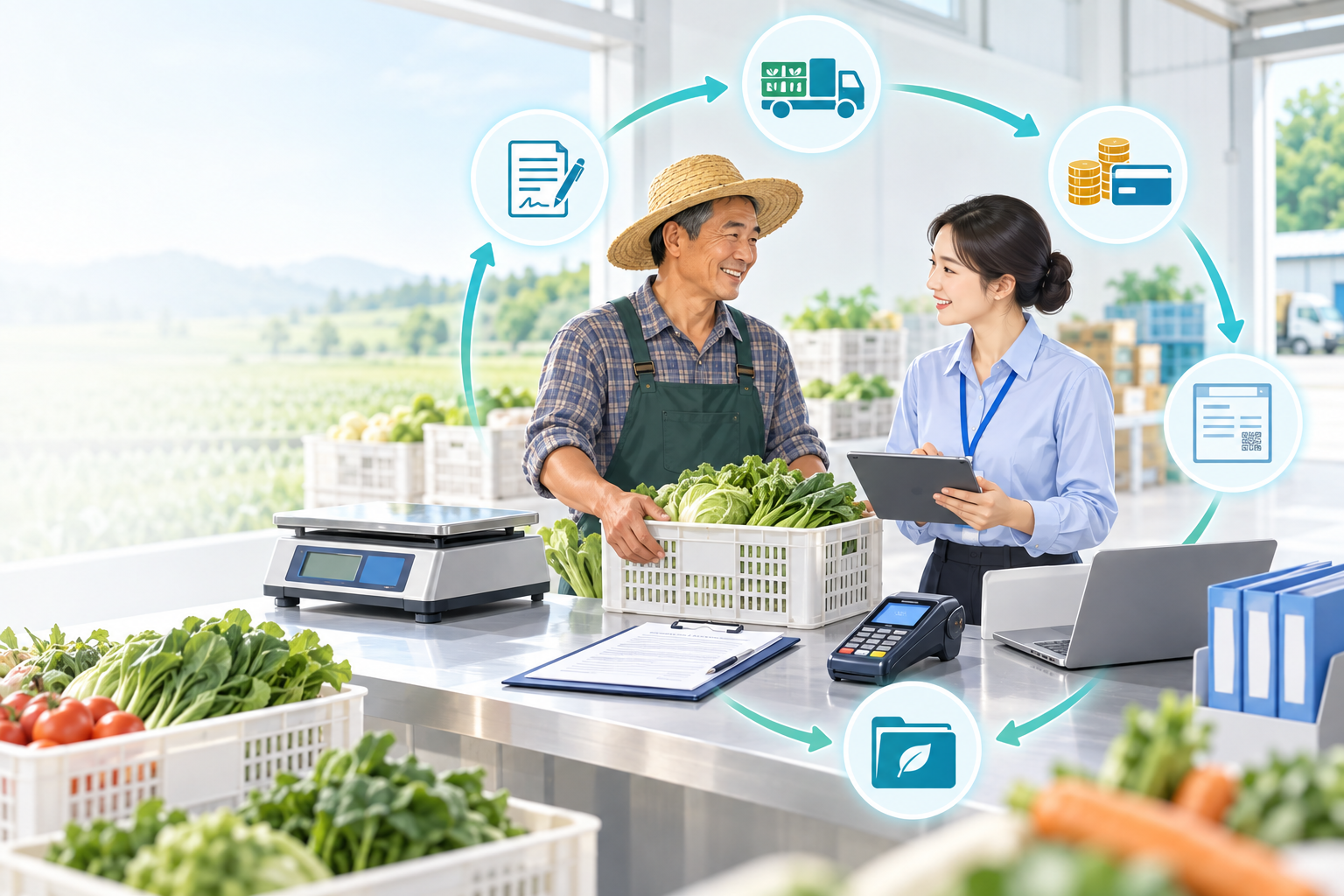
Implementation plan for payment and invoicing of agricultural product purchase invoices: from weighing to archiving, how to connect the whole chain?
When purchasing season arrives, finance fears three things most: money paid but no invoice issued, invoice issued but vouchers do not match, and being unable to answer anything when the tax bureau asks. The particularity of agricultural product purchasing lies in this—the sellers are scattered farmers with no output VAT invoice to deduct, so enterprises must issue purchase invoices in reverse themselves, and must also prove that this purchase is real and this payment corresponds to this batch of goods. The solution is not to add people and forms, but to put payment, invoicing, and archiving into the same chain: Kailing Technology's reverse invoicing solution centers on "invoicing upon purchase, five-flow integration ledger," and with AI OCR and electronic accounting archives, makes every purchase traceable from the moment of weighing.
"The compliance difficulty in agricultural product procurement lies not in the invoicing action, but in whether payment and invoicing can correspond one-to-one and be traceable." |
▍I. Why must agricultural product procurement use reverse invoicing?
Self-produced and self-sold agricultural products by farmers usually cannot be invoiced by the farmers themselves. If enterprises cannot obtain compliant tax deduction vouchers, input VAT cannot be deducted, and costs rise directly. According to current policy, procurement enterprises may issue agricultural product procurement invoices in reverse to individual agricultural producers, as vouchers for input VAT deduction and pre-tax income tax deduction. But reverse invoicing is not as simple as "writing an invoice yourself": the seller's identity must be genuine, the procurement business must be genuine, and the payment must be genuine — none of the three can be missing. State Taxation Administration Announcement No. 5 of 2024 clarified the scope of sellers for cumulative reverse invoicing sales of 5 million yuan over no more than 12 consecutive months, and No. 12 of 2026 set corresponding arrangements for prepayment of individual income tax on business income for the portion of annual sales within 600,000 yuan under three-flows-in-one reverse invoicing. The two figures serve different purposes — one is the seller qualification boundary, the other is the applicable prepayment tax rate — and conflating them will plant hidden risks.
▍II. How can payment and invoicing achieve the "five-flow integration"?
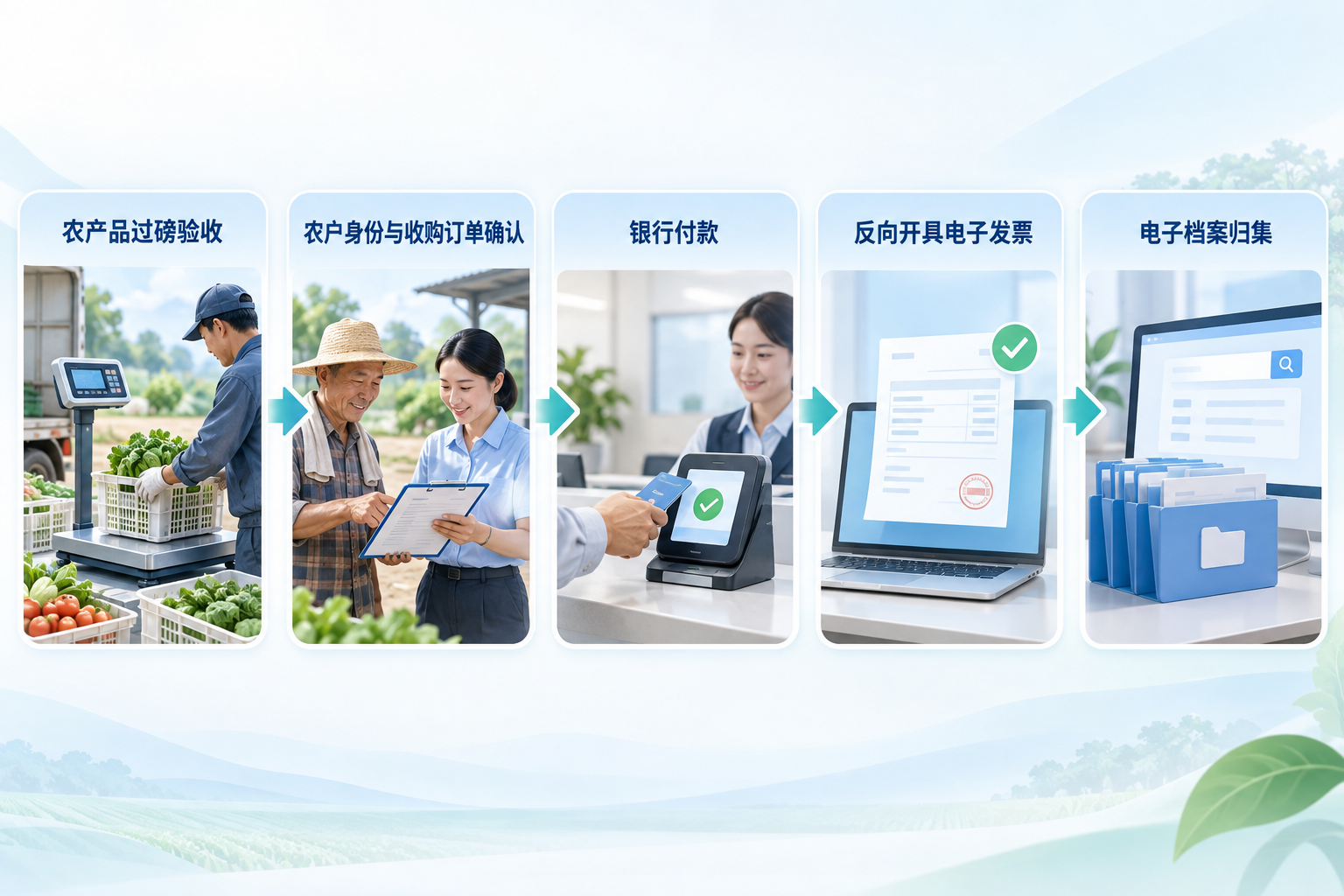
The so-called five-flow integration refers to the mutual verification of contract flow, goods flow, capital flow, invoice flow, and information flow. The practical sequence for agricultural product procurement should be: first, weighing and acceptance records form the goods flow; then, procurement orders and farmer archives form the contract flow; payment through bank-enterprise direct connection or cooperative payment platforms forms the capital flow; after payment is completed, reverse invoicing is automatically triggered to form the invoice flow; all data is deposited as information flow. Kailing Technology's reverse invoicing solution supports invoicing upon procurement: enterprises initiate payment based on real procurement orders, and after payment is completed, agricultural product procurement invoices are automatically issued, with ledgers aggregated by farmer and batch. In this way, invoices are not supplemented after the fact, but grow together with money and goods, and any transaction can be traced back to the weighing slip and payment records.
▍3. What to do when farmer information is scattered and self-production certificates are hard to retain?
This is the most troublesome part for agricultural product acquisition companies: farmers' ID card copies are scattered at various acquisition points, self-production and self-sales declarations are signed but not archived, and at year-end verification everything is turned upside down. The solution is to establish "one household, one file." Kailing Technology's reverse invoicing solution connects the company's farmer files, weighing and acceptance, acquisition orders, and cooperative platforms. Farmers complete real-name and self-production and self-sales information confirmation on the platform or supporting entry point, and the verified business data is sent to the platform and receives invoice and payment results, then is archived by farmer and batch. One household, one file is no longer a temporary folder organized before invoicing, but an archive that grows in real time with the business. With Kailing Technology AI OCR, paper weighing slips, ID cards, and self-production certificates are recognized upon scanning and recorded upon recognition, reducing manual entry errors.
▍IV. After invoicing, how are vouchers and ledgers managed?
Issuing the purchase invoice is only the beginning; afterward, there are still deductions, filing, and inspection preparation to face. It is recommended to uniformly include purchase invoices, payment vouchers, weighbridge tickets, and farmer files in electronic accounting archives: Kailing's electronic accounting archives management system supports scanning vouchers for immediate storage, recognition for immediate archiving, and association for immediate binding into volumes, automatically binding by farmer, batch, and month, and allowing retrieval on demand during tax bureau inspections. At the same time, input VAT invoice management can directly connect to the tax bureau to automatically obtain all invoice sources, verify and check for duplicates, and prevent duplicate or missed filings; at the filing stage, group tax filing supports automatic data retrieval and tax calculation for multiple organizations, and direct connection to the tax bureau for login-free filing, smoothly bringing input data from purchase invoices into the filing forms. Once the entire chain is connected, finance changes from "chasing purchase points for documents" to "opening the system and having them there."
Keywords: agricultural product procurement invoice, reverse invoicing, five-flow integration ledger, invoicing upon procurement, input VAT deduction, AI OCR, electronic accounting archives, one household one archive
As a comprehensive business-finance-tax digitalization solution service provider, Kailing Technology provides business-finance-tax management digital transformation products and operational services for various government agencies, institutions, and large, medium, and small enterprises. The product line includes: solutions for sales contract management system, procurement contract management system, fully digitalized Leqi interface project, automatic output invoicing system, reverse invoicing system, invoice issuance for individuals system, employee expense control and reimbursement system, input VAT invoice management system, supply chain collaborative reconciliation system, image AI OCR recognition system, automatic financial bookkeeping system, electronic accounting archives system, etc., comprehensively driving the digitalization process across various fields.
Consultation Hotline: 18513895936 / 010-60974119 Location: Beijing