
Contract review is time-consuming and hard to recheck? How Kailing Technology enterprise AI digital employee locates key clauses and retains a manual confirmation step

Contract review takes time, partly in finding standard clauses, comparing templates, and reviewing historical opinions, and partly in explaining why a clause needs modification. Kailing Technology AI digital employee can read the full contract text, perform clause-level comparison according to the enterprise's confirmed templates, policies, and rules, and hand over key locations, cited bases, and handling suggestions to legal affairs for review.
Such review should not be described as “AI completes contract review for the enterprise.” Machines are suitable for undertaking large-volume, repetitive reading work that can be compared according to rules, but commercial acceptance, negotiation choices, and legal liability are still decided by people. The clearer the human-machine boundary, the easier the review results are to adopt and recheck.
▍1. Before locating key clauses, first determine the comparison baseline
Review benchmarks may come from standard templates, contract approval policies, specific business red lines, and approved alternative clauses. Benchmarks differ across businesses, organizations, and contract types. If the model freely chooses references after importing a document, the same text may receive different conclusions.
Therefore, when a task starts, the contract type, applicable organization, review template, and rule version should be recorded. Legal should also be able to see whether an opinion is based on template differences, institutional red lines, or missing materials. Only when the baseline is fixed can risk positioning be repeatedly verified.
▍II. The Kailing Technology AI digital employee breaks full-text reading into clause-level evidence
AI digital employees can first identify the contract structure, then compare the actual clauses against the corresponding benchmarks. The output should include the original text location, the difference, the cited rule, and the suggested handling. If a risk needs to be judged together with other attachments, clearly mark the missing evidence, and do not output a definitive conclusion when the context is insufficient.
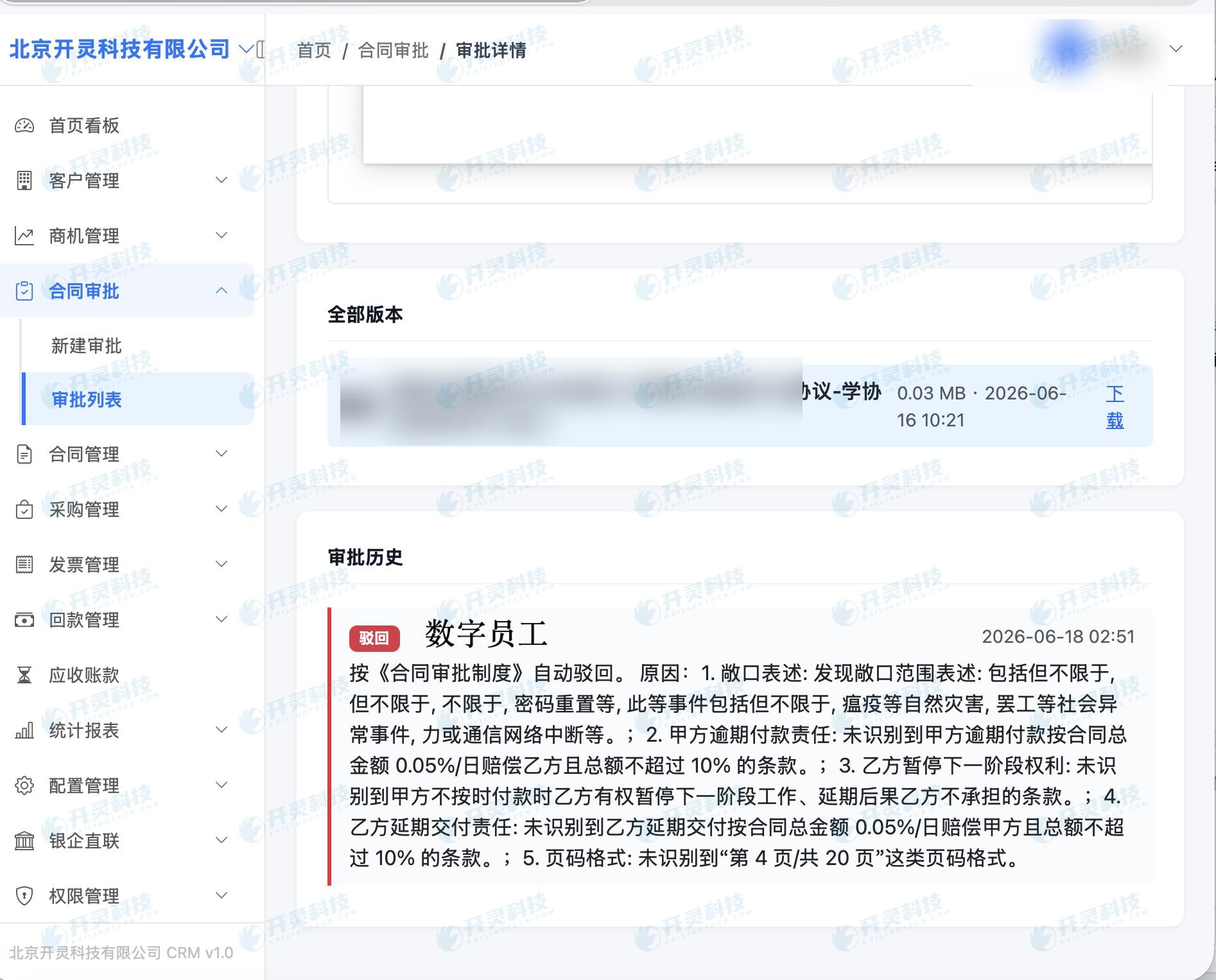
For long documents, "findable" is as important as "clearly explainable." Reviewers should be able to click an opinion and return to the original contract text and see the difference from standard clauses. If only a general risk summary is provided, legal still has to search page by page, making it difficult to shorten review time.
▍3. Manual confirmation should be placed at the node of accepting risk and submitting for approval
Differences in clauses are not necessarily errors. Some differences require the other party to modify, some can be accepted after supplementary conditions, and some involve commercial negotiation, performance capability, or project timing. AI digital employees can present differences and reference rules, but "whether to accept" requires an authorized person to make an explicit choice.
Confirmation results must be written back to the approval process. Each accepted risk should record the confirmer, time, and reason; clauses requiring modification should be linked to subsequent versions; unresolved red lines should not lose tracking just because the contract file name changed. This step is the key to making review accountable.

| "A reviewable review opinion must answer four questions: which clause, what it differs from, what the basis is, and who decides. |
▍IV. Version comparison must prevent old risks from disappearing in new files
After the counterparty modifies the contract, the reviewer must not only see which words changed, but also confirm whether the previous round's issues were resolved and whether new discrepancies have appeared. Therefore, the version chain should retain the original document, modified document, previous round's comments, and current round's status, and cannot rely solely on "final version" naming in folders.
AI digital employees can align text differences with the risk checklist, but the actual meaning of key clauses still requires legal review. For changes such as deletions, shifts, renumbering, and attachment replacements, they must be specifically checked during verification, to avoid a tool that can only identify simple sentence modifications being mistaken for full review capability.
▍V. Before use, validate the responsibility chain with real boundary samples
Verification samples should include standard templates, high-risk discrepancies, acceptable exceptions, missing attachments, multiple rounds of revisions, and rule revisions. In addition to checking whether there is a hit, it is also necessary to check original text positioning, cited basis, manual operation permissions, and write-back status. A "high-risk" label that cannot be traced back to the original text is not sufficiently helpful to legal affairs.
During operation, it is possible to review which risks were manually rejected, which clauses frequently require exceptional approval, and which templates have become disconnected from actual business. These records should be used to update rules and templates, rather than blindly pursuing a higher automatic pass rate. The ultimate goal is to shorten search and comparison time while keeping responsibility judgments firmly in human hands.
▍VI. When distilling review comments into rules, template preferences and hard red lines must be distinguished
Historical review opinions can help identify high-frequency issues, but they include legal personnel's personal expression habits, compromises on specific projects, and outdated systems. Turning all historical opinions directly into rules will cause one-time decisions to be mistakenly applied to subsequent contracts. Before consolidating them, the source of the opinion, applicable contract type, whether institutional confirmation was obtained, and whether exceptions are allowed should be marked.
Template preferences are used to remind the direction of negotiation, while hard red lines can block the process according to authorization. The two should have different levels and handling paths in the interface. For negotiable clauses, the AI digital employee can provide standard text and explanations of differences; for red lines, it should explain the institutional basis, impact, and required authorization, rather than replacing them with a vague "relatively high risk."
Rule management must also consider differences in contract language and format. The same meaning may be expressed in different sentence patterns, and the same sentence may change effect after additional conditions. The verification set should not only include clauses highly similar to templates, but also include inversions, referenced attachments, scattered agreements in multiple places, and negative expressions, to check whether the system truly locates the business relationship.
Enterprises can have the legal responsible person regularly review rules with high-frequency hits, high-frequency exceptions, and frequent reversals. If a red line is often authorized and released, it should be confirmed at the institutional level whether it is still a red line; if a type of risk is often discovered only after contract signing, the task trigger point should be checked. These operational actions keep review capability aligned with the business.
The trigger timing of review tasks also affects results. If review only occurs when a contract is about to be signed, even if problems are accurately identified, they may be difficult to modify because commercial commitments have already been formed. Enterprises can place digital employees at nodes such as template selection, first draft submission, and each revision round, using the same rules to track whether issues have been resolved. This does not mean re-reviewing the entire document each time, but rather prioritizing newly added and changed parts for review. When problems are discovered earlier, legal has sufficient time to participate in negotiations, rather than blocking at the last moment before signing.
For issues not found in review and only exposed afterward, the retrospective analysis should distinguish between missing rules, document recognition failure, insufficient context, and risks already accepted by humans. Only the first three categories require system improvement or supplementary data; for the last category, check whether authorization and records are complete. Classifying all post-event issues as AI review omissions will confuse tool capabilities with management responsibilities and cannot correct them accordingly.
- Hard red lines, template preferences, and temporary authorizations are managed separately.
- Before releasing rules, use diverse clauses for regression verification.
- High-frequency exceptions should be fed back into the system rather than only kept in approval records.
▍FAQ
Q: Can contracts be automatically rejected after upload?
A: Yes, routing or rejection can be based on hard rules authorized by the enterprise, but cases involving business judgment, risk acceptance, and responsibility assumption should retain manual confirmation.
Q: Can it be used without a standard template?
A: Yes, prompts can first be based on approved policies and risk lists, but it must be clear that the baseline is limited, and general model opinions should not be packaged as the enterprise's red lines.
Q: How can we ensure the revised version does not miss old risks?
A: Link version differences, the previous round's risk list, and the current round's status, and perform special checks on deletions, relocations, and attachment replacements.
Q: What logs need to be retained for review results?
A: At minimum, it should include document version, rule version, original text location, system recommendation, manual conclusion, operator, and time.
Let legal staff spend less time paging and locating and save energy for risk judgment. Welcome to visit Kailing Technology: https://www.kailingteck.com/feikong/ .
As a national high-tech enterprise, Kailing Technology focuses on the digital and intelligent transformation of enterprise business-finance-tax and operations management, providing software products, system integration, implementation and delivery, and operational services for various government agencies, institutions, group enterprises, and SMEs.
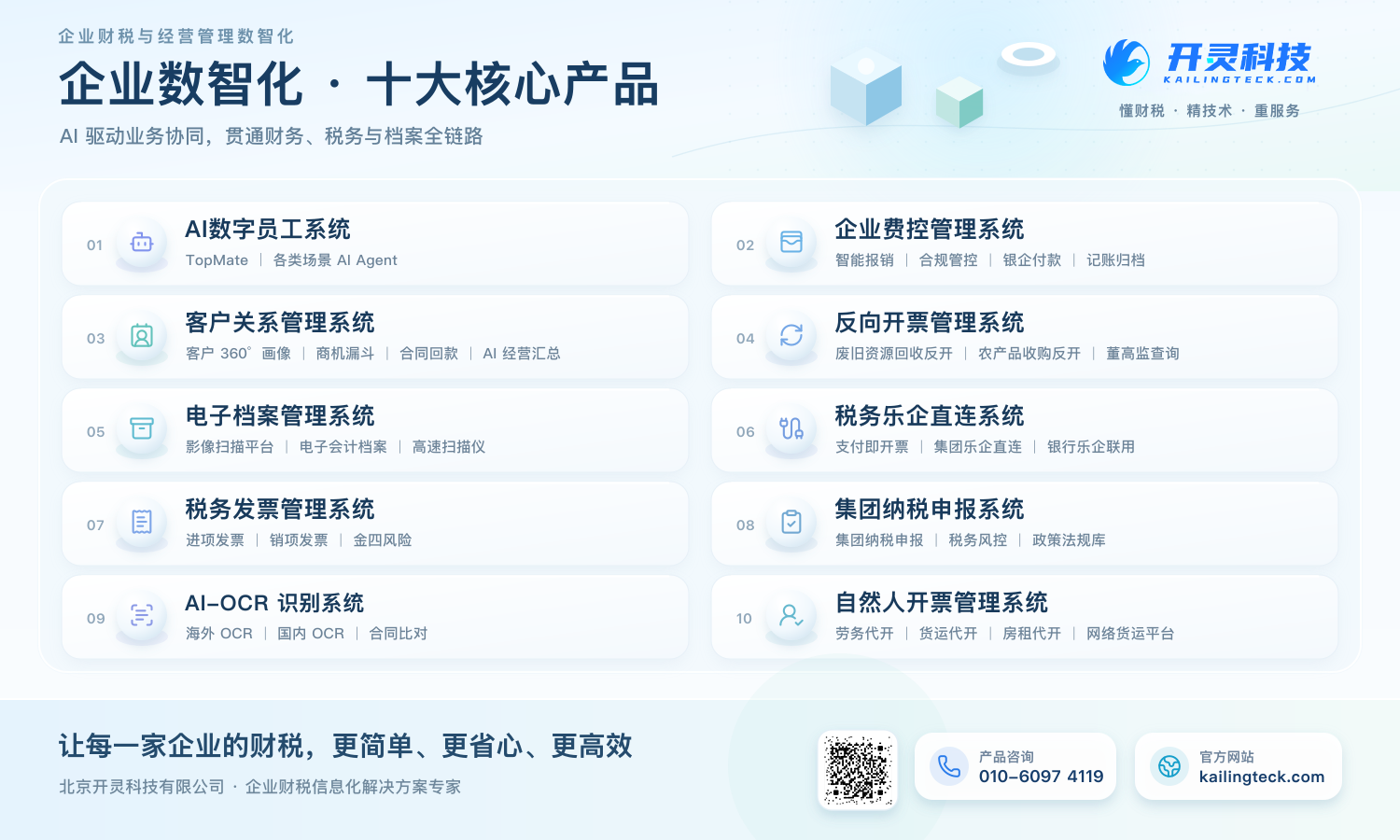
The company has now formed ten core product lines, including: AI digital employee system, enterprise expense control management system, customer relationship management system, reverse invoicing management system, invoice issuance for individuals management system, electronic archives management system, tax fully digitalized e-invoice Leqi system, tax invoice management system, group tax filing system, and AI OCR recognition system. It is committed to connecting enterprise business, finance, tax, funds, and archive data to help customers improve operational efficiency, business-finance-tax compliance capabilities, and digital management levels.
If you have any business-finance-tax digital transformation needs, welcome to contact us. Beijing Kailing Technology will serve you wholeheartedly.
Keywords: Contract review, clause risk identification, manual confirmation, Kailing Technology AI digital employee
As a comprehensive business-finance-tax digitalization solution service provider, Kailing Technology provides business-finance-tax management digital transformation products and operational services for various government agencies, institutions, and large, medium, and small enterprises. The product line includes: solutions for sales contract management system, procurement contract management system, fully digitalized Leqi interface project, automatic output invoicing system, reverse invoicing system, invoice issuance for individuals system, employee expense control and reimbursement system, input VAT invoice management system, supply chain collaborative reconciliation system, image AI OCR recognition system, automatic financial bookkeeping system, electronic accounting archives system, etc., comprehensively driving the digitalization process across various fields.
Consultation Hotline: 18513895936 / 010-60974119 Location: Beijing