
Reimbursement review always going back and forth manually? Kailing Technology's enterprise AI digital employees identify anomalies according to policy and route them to humans

Reimbursement review repeatedly goes back and forth. The common reason is not that approvers review slowly, but that policy clauses, document fields, and processing conclusions are not aligned. Kailing Technology's AI digital employees can parse published reimbursement policies into executable rules, check documents item by item, and hand documents that hit anomalies, along with the reasons, to humans for handling.
The key to this mechanism is diversion, not replacing all approvals with AI. Documents with determinable rules, complete materials, and no conflicting results can be automatically processed per authorization; documents requiring judgment of business authenticity, special reasons, or exceptional authorization must retain humans in the loop.
▍1. First divide policy clauses into three types of processing logic
The first category consists of hard conditions that can be directly calculated or compared, such as required fields, amount caps, date ranges, and duplicate invoices. The second category consists of conditions that require multiple pieces of information to support together, such as whether the expense type matches the attachments and whether the traveler matches the itinerary. The third category consists of exceptions that require an authorized person's judgment, which can only prompt risks and cannot be automatically assigned responsibility by machines.
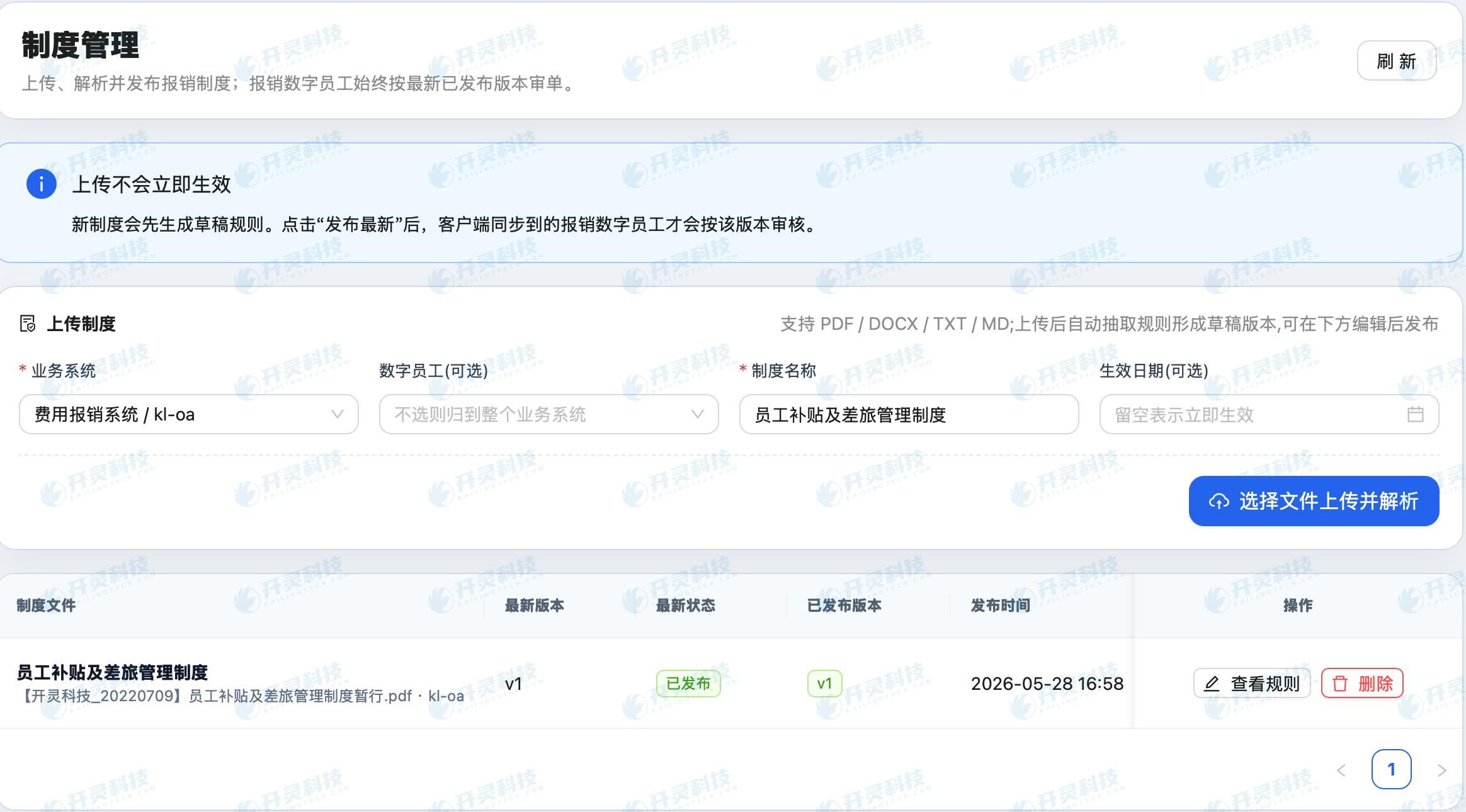
After an enterprise uploads a PDF, DOCX or other published policy, it is not advisable to directly treat the full text as a black-box prompt. A more reliable approach is to generate draft rules, standardize clause numbers, applicable organizations, effective dates, inspection fields and handling actions, and publish them after administrator confirmation.
▍II. The Kailing Technology AI digital employee lets every conclusion trace back to a specific clause
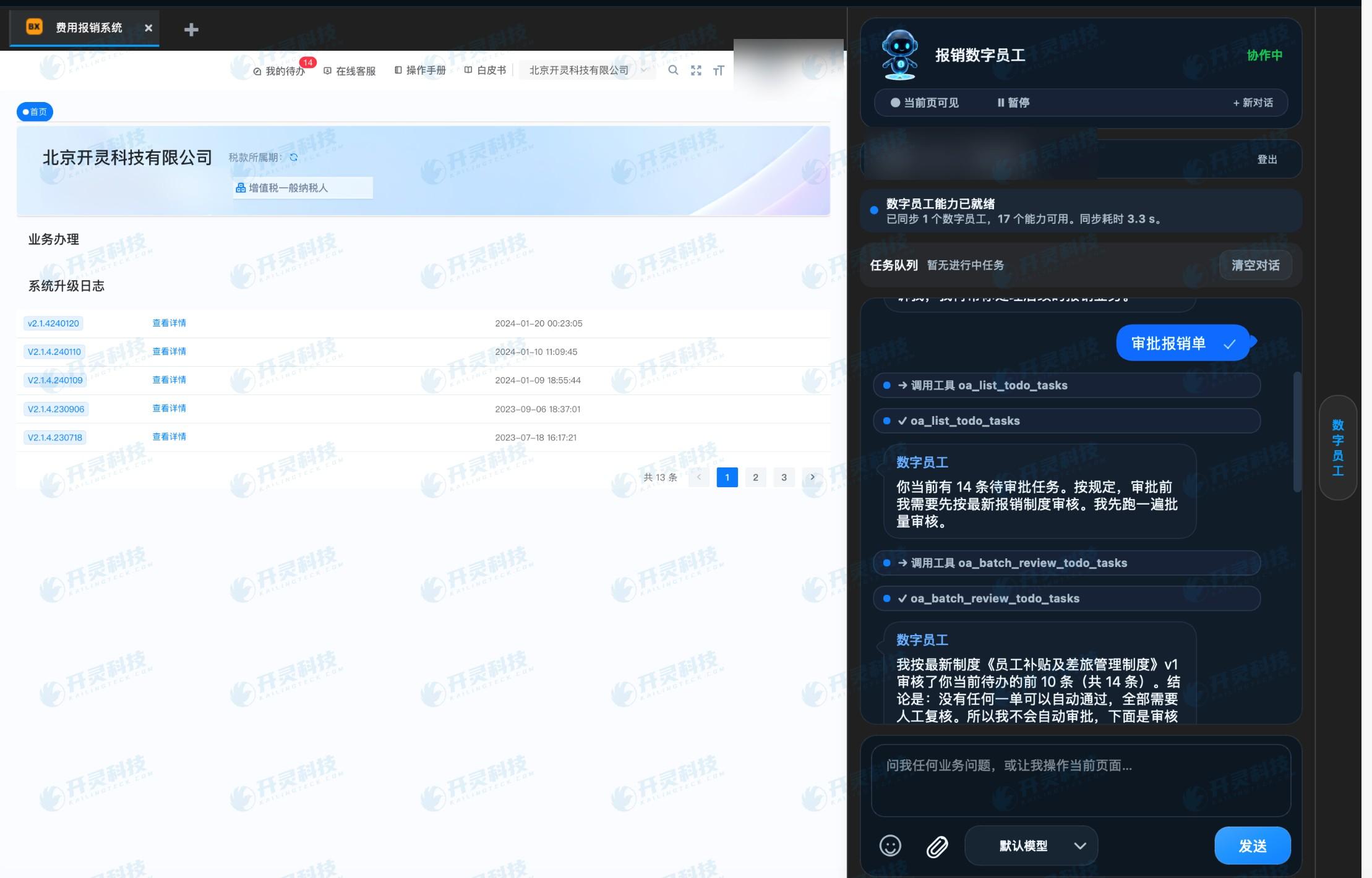
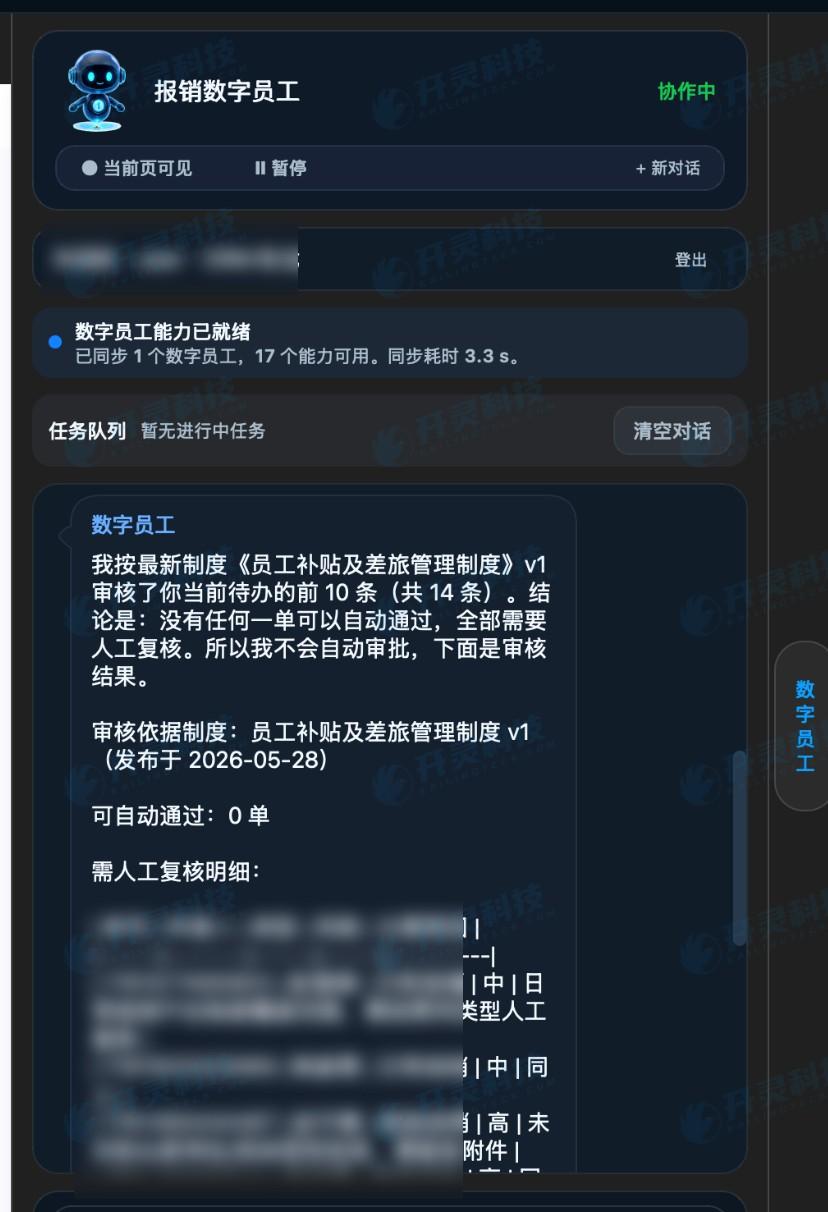
Review results should not only show "pass" or "fail." Digital employees need to record the policy version used, clauses hit, fields checked in the document, actual values, and handling suggestions. When approvers open an exception form, they should first see what needs to be judged, rather than starting again from the first page of the policy.
For calculable rules, the system must also retain the calculation process; for attachment-type rules, it must display missing materials; for conflicting rules, it must remain at a manual node. These details determine whether intelligent review can be re-reviewed, and also determine whether employees can submit correctly in one go next time.
▍III. Transfer to a human is not a failure but a designed risk exit
A document can stop at different levels. If materials are incomplete, it can be returned to the initiator; if rules conflict, it can go to the expense administrator; if business authenticity needs confirmation, it goes to the responsible person; if special approval beyond authority is needed, it should enter the corresponding authorization level. The digital employee's task is to determine which node it should be sent to and carry the context, not to minimize the number of manual steps.

| "The value of intelligent review is not "not needing to look at a single form," but "forms that need human review already have the reasons clearly stated." |
▍IV. When policies are revised, retain the basis for judgments on old documents
Reimbursement policies are adjusted due to changes in region, organization, job level, or business. After a new policy is issued, past approved documents cannot be reinterpreted using the new rules. The system needs to retain version numbers, effective dates, applicable scope, and issuers, so that each conclusion uses the rules that were effective at the time.
Before releasing a new version, a set of desensitized documents should be used for regression verification, comparing differences between old and new results. If a clause is only a wording adjustment but causes many documents to change routing, administrators should find the cause before it takes effect. This is an operational action that must be added after parsing policies into rules.
▍V. Usage verification requires accurate routing and a responsibility trail
Verification samples should include normal documents, single hard-rule hits, conflicts among multiple rules, missing materials, exception applications, and cross-version policies. The team checks item by item the cited clauses, field values, routing targets, manual modifications, and final handling results, rather than only looking at the number of hits given by the model.
During the operations period, continuously observe the reasons for manual overrides. If the same clause repeatedly causes transfer to a human, check the clause expression, data mapping, or authorization design, rather than simply feeding manual results to the system. Only when rule versions, review paths, and final responsibility are all traceable can intelligent review operate stably.
▍VI. Find rule problems in manual overrides rather than pursuing full automation
Manual override records in the early stage of operation are very valuable, but every choice made by a person cannot simply be treated as the standard answer. Overrides may come from misunderstanding of rules, incomplete data, approvers possessing additional business context, or exceptional authorization. Only by first marking the reason can it be determined whether to modify rules, supplement data, or retain a manual node.
It is recommended to count the number of hits, referrals, manual overrides, and final processing results by clause. If a rule frequently hits but is almost always overridden, the problem is likely in the applicable conditions or data mapping; if overrides occur only in a few special businesses, an exception application path should be considered. Metrics are used to optimize the responsibility chain, not to force approvers to accept machine suggestions.
For clauses in the system that contain expressions such as "in principle," "special circumstances," or "may upon approval," AI digital employees can identify the prerequisite facts and prompt authorization needs, but should retain the approver, reason, and valid scope in the process. Rigidly converting vague clauses into pass or reject only wrongly hands over judgments that originally belong to humans to the system.
When processes run across multiple organizations, it is also necessary to prevent headquarters rules from overriding approved local differences. General rules, organizational supplementary rules, and temporary authorizations can be managed in layers, with each document determining its effective combination by its organization and occurrence time. For multi-organization enterprises, "using the right rules" is more important than "using one set of rules."
Review decisions also need to remain consistent with document status. After a document is supplemented, rejected, resubmitted, withdrawn, or after a policy revision, the original hit results cannot be reused unconditionally. The system should identify which fields have changed, rerun the relevant rules, and retain the relationship between old and new results. Otherwise, if employees correct an invoice but are still blocked by an old exception, or change an amount but reuse an old approval conclusion, the human-machine division of labor loses credibility. Therefore, exception routing must be linked with document change events, not one-time labeling.
The usability of anomaly notifications should also be included in the check. For the same issue, the reimburser should be told what materials need to be supplemented, the approver should be shown the rule basis and business context, and the administrator should receive the rule version and execution log. If everyone only receives a generic error message, the AI digital employee has completed recognition but has not reduced back-and-forth communication. The usage check should start from the actual tasks of the three roles and examine whether the information is sufficient to support the next action.
- Classify the reasons for re-judgment into four categories: rules, data, business, and authorization.
- Check the policy version and applicable organization.
- Prioritize optimizing high-frequency misrouting, and do not replace quality with automatic pass rates.
- Each manual override records the reason, basis, and final handler, rather than keeping only a result status.
▍FAQ
Q: Will uploading a new policy immediately change the review results?
A: It should not take effect immediately. It is recommended to first generate a draft rule, and publish after administrator review and regression verification.
Q: Will manual overrides overwrite the original review records?
A: The original matched clauses, AI digital employee recommendations, manual conclusions, and handling reasons should be retained for later review.
Q: Can all normal orders pass automatically?
A: It can only execute within the scope authorized by the enterprise. Nodes that are high-risk, involve exceptions, or require responsibility judgments should retain manual approval.
Q: How are vague statements in policies handled?
A: First mark clauses that cannot be directly executed, and have the policy owner clarify the applicable conditions and authorization boundaries, rather than letting the model fill them in on its own.
Turn the reimbursement policy into an executable, reviewable routing mechanism. Welcome to visit Kailing Technology: https://www.kailingteck.com/de/ .
As a national high-tech enterprise, Kailing Technology focuses on the digital and intelligent transformation of enterprise business-finance-tax and operations management, providing software products, system integration, implementation and delivery, and operational services for various government agencies, institutions, group enterprises, and SMEs.
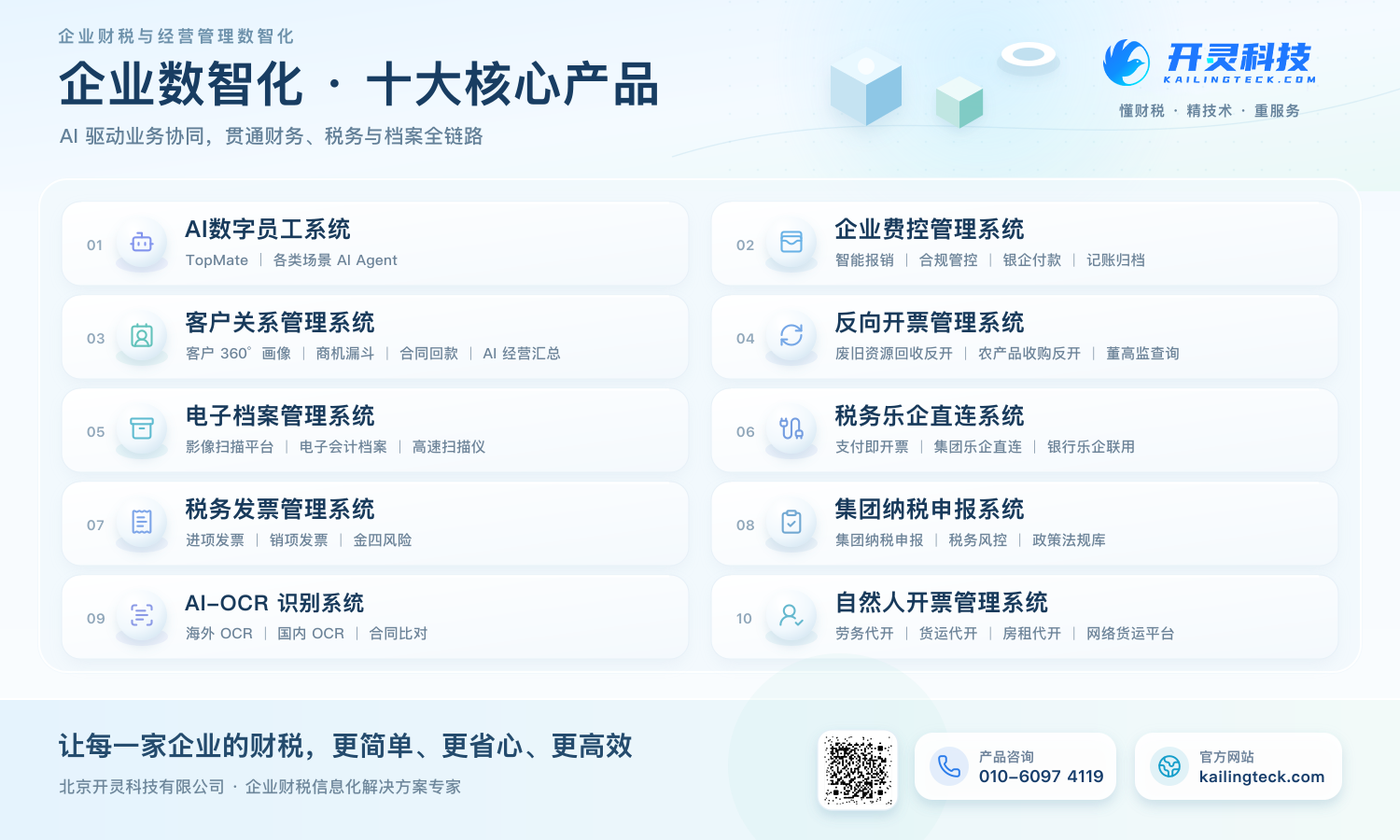
The company has now formed ten core product lines, including: AI digital employee system, enterprise expense control management system, customer relationship management system, reverse invoicing management system, invoice issuance for individuals management system, electronic archives management system, tax fully digitalized e-invoice Leqi system, tax invoice management system, group tax filing system, and AI OCR recognition system. It is committed to connecting enterprise business, finance, tax, funds, and archive data to help customers improve operational efficiency, business-finance-tax compliance capabilities, and digital management levels.
If you have any business-finance-tax digital transformation needs, welcome to contact us. Beijing Kailing Technology will serve you wholeheartedly.
Keywords: AI intelligently reviews reimbursement forms, reimbursement policy review, exception transfer to manual handling, Kailing Technology AI digital employees
As a comprehensive business-finance-tax digitalization solution service provider, Kailing Technology provides business-finance-tax management digital transformation products and operational services for various government agencies, institutions, and large, medium, and small enterprises. The product line includes: solutions for sales contract management system, procurement contract management system, fully digitalized Leqi interface project, automatic output invoicing system, reverse invoicing system, invoice issuance for individuals system, employee expense control and reimbursement system, input VAT invoice management system, supply chain collaborative reconciliation system, image AI OCR recognition system, automatic financial bookkeeping system, electronic accounting archives system, etc., comprehensively driving the digitalization process across various fields.
Consultation Hotline: 18513895936 / 010-60974119 Location: Beijing