
Kailing Technology assists multiple hospitals in launching HIS-integrated invoicing and Leqi Direct Connection, with dual modes connecting the full chain of charging, invoicing, and write-back
Recently, Kailing Technology's HIS automatic invoicing project for the hospital industry has made new progress, having helped multiple hospitals complete the construction and launch of invoicing systems. Based on different hospitals' informatization foundations, business scales, and tax access conditions, the project adopted two invoicing methods—ordinary fully digitalized e-invoice interface connection and Leqi Direct Connection—embedding fully digitalized e-invoice capabilities into charging scenarios such as outpatient and inpatient services, realizing automatic flow of charging data, automatic invoice issuance, automatic write-back of results, and convenient invoice delivery.
This launch is not simply adding an invoicing tool, but re-organizing the data links among HIS, the invoicing platform, and the fully digitalized e-invoice channel around hospital charging business. On the basis of clarifying the applicable boundaries between electronic medical charging bills and fully digitalized e-invoices, the system focuses on covering hospital charging businesses to which fully digitalized e-invoices apply, and selects corresponding invoicing methods according to the actual conditions of different hospitals.
I. Hospital invoicing accelerates into the system collaboration stage
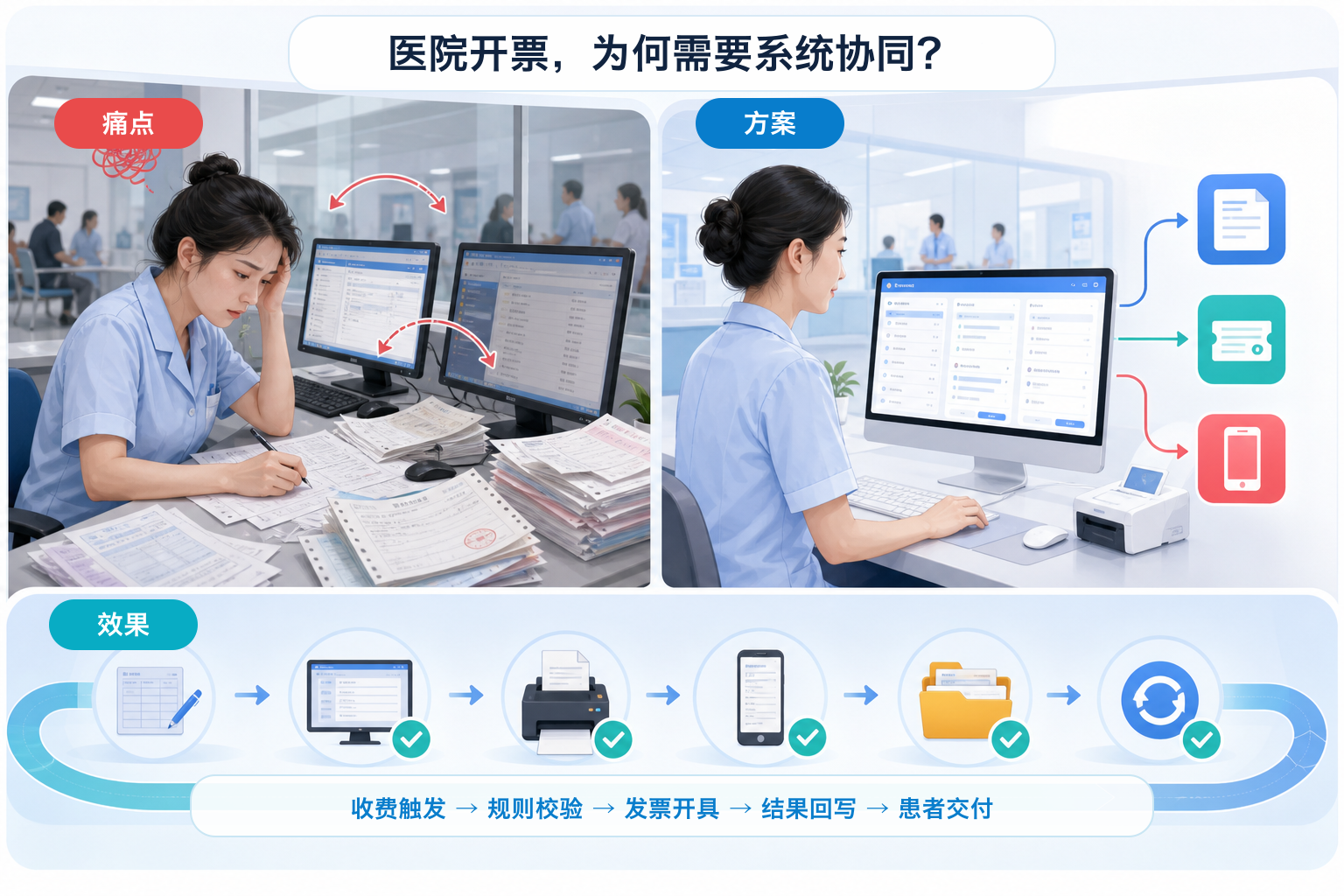
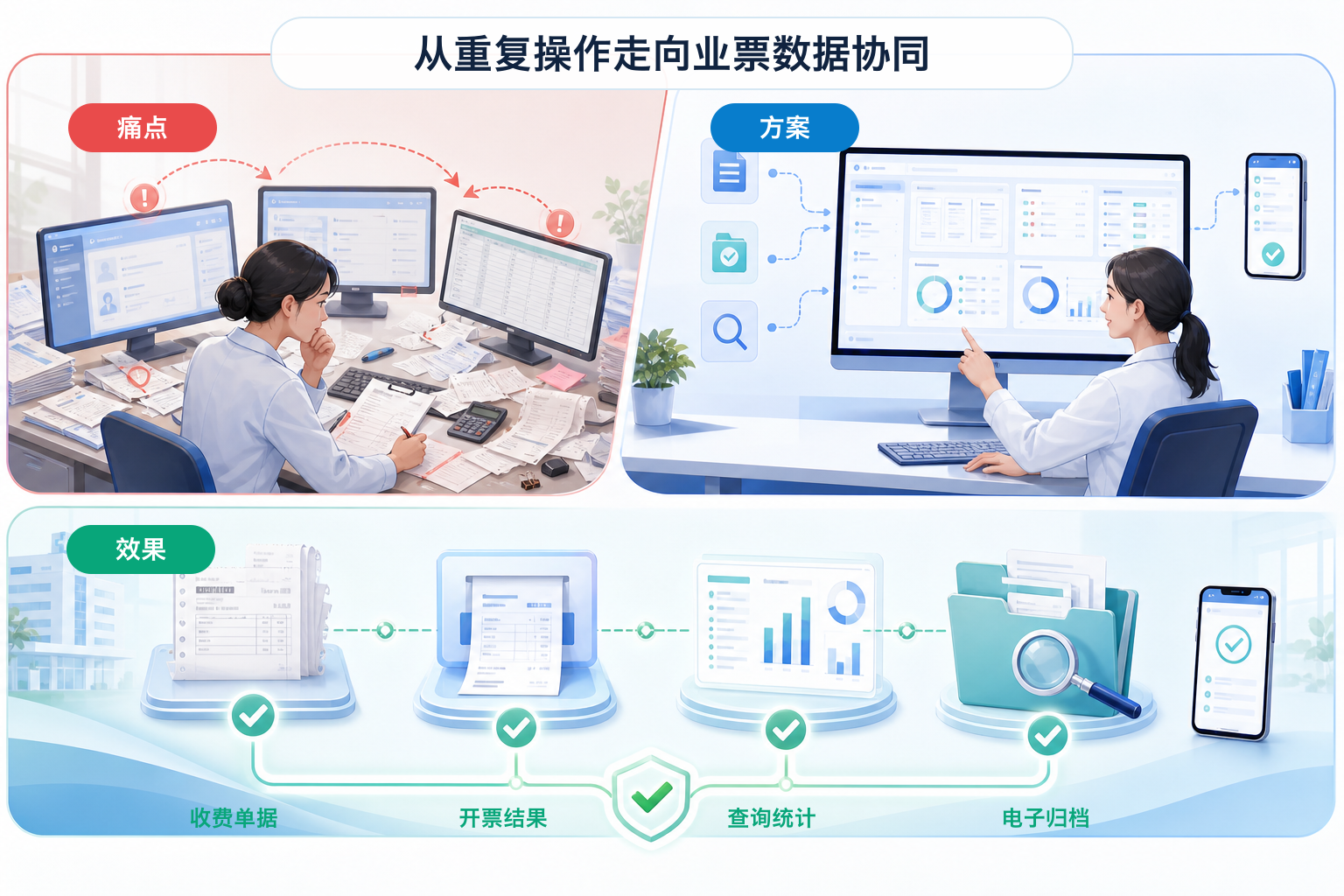
Hospital charging is characterized by many counters, high frequency, a large number of patients, and obvious differences between outpatient and inpatient businesses. Under the traditional model, after patients complete payment or discharge settlement, cashiers often still need to log in to the invoicing system and re-enter patient information, charging items, and amounts; after the invoice is issued, they also need to download the file, fill in the invoice number, and deliver it to the patient.
Such handling methods not only increase the workload of counters and finance staff, but also easily lead to problems such as entry errors, duplicate invoicing, and untimely status feedback. When encountering refunds, red-letter reversals, reissuance, and other business, repeated verification is also required between the HIS and the invoicing system.
Based on hospital HIS charging data, Kailing Technology builds a unified output invoicing platform, incorporating charging, invoicing, write-back, delivery, and query into one business chain. Businesses that meet the rules are automatically processed by the system, while abnormal data enters manual review, shifting hospital staff from entry item by item to handling a small number of special businesses.
II. Method 1: HIS connects to the fully digitalized e-invoice interface to achieve automatic general invoicing
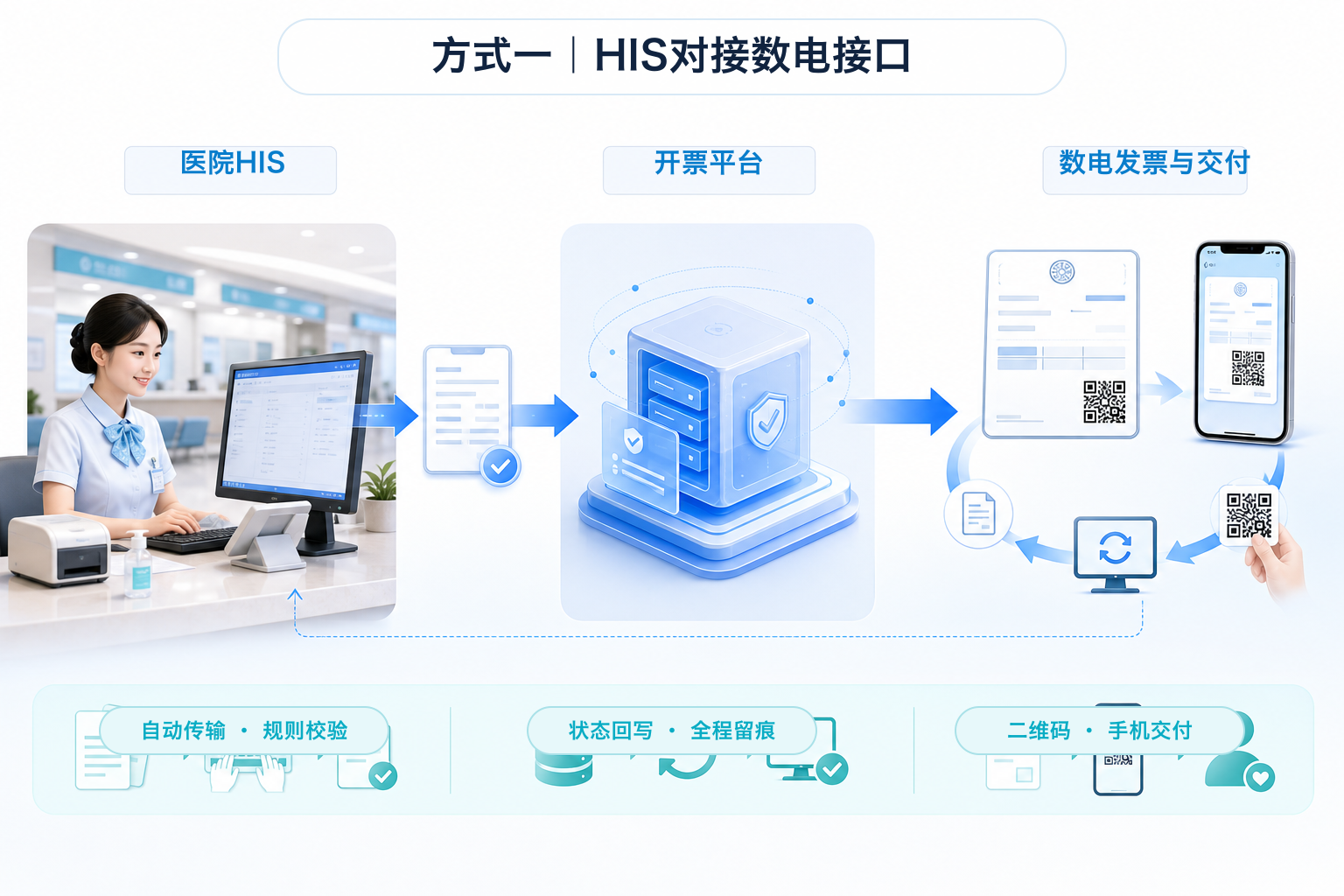
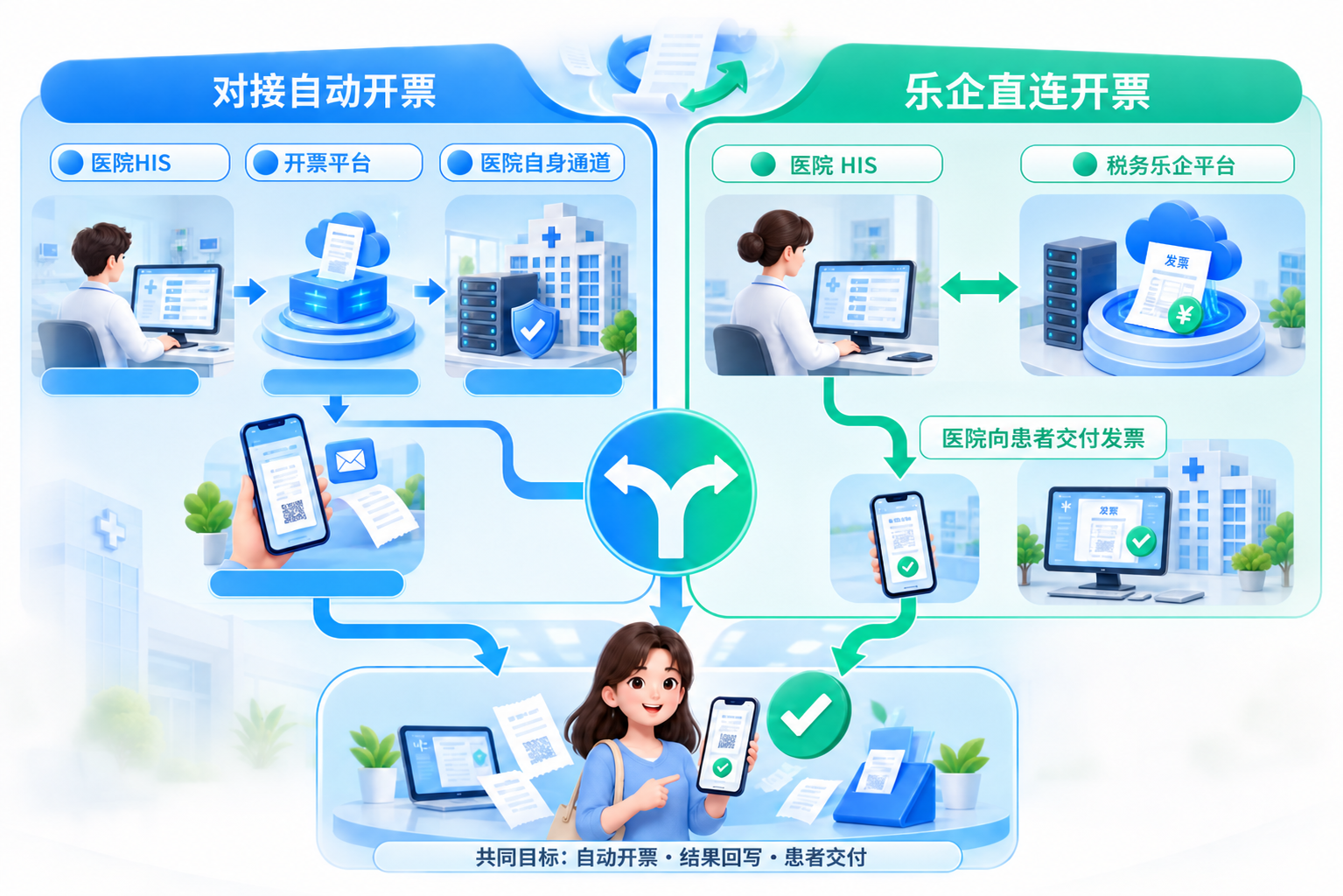
For hospitals that wish to quickly complete HIS invoicing transformation and have not yet built a Leqi Direct Connection channel, the project adopts a general fully digitalized e-invoice interface connection method. In this mode, the hospital is the invoicing entity, the original charging data comes directly from the hospital HIS, and issuance is completed through the hospital's existing fully digitalized e-invoice channel.
After patients complete outpatient payment, medication settlement, or inpatient settlement, the HIS transmits eligible business data to the Kailing Technology output VAT invoicing platform. The platform automatically completes patient information verification, charge item conversion, tax classification code matching, amount verification, and invoice splitting and merging.
After successful invoice issuance, the invoice number, invoicing status, and file information such as PDF, OFD, and XML are automatically written back to the HIS. Patients can obtain invoices through QR codes, SMS, email, download, or free printing. This method does not require the hospital to connect to the Leqi platform as a prerequisite, and can quickly complete invoicing transformation while retaining the original HIS charging process.
III. Method Two: Connect to the Leqi Platform to Achieve Direct Connection with the Hospital's Own System
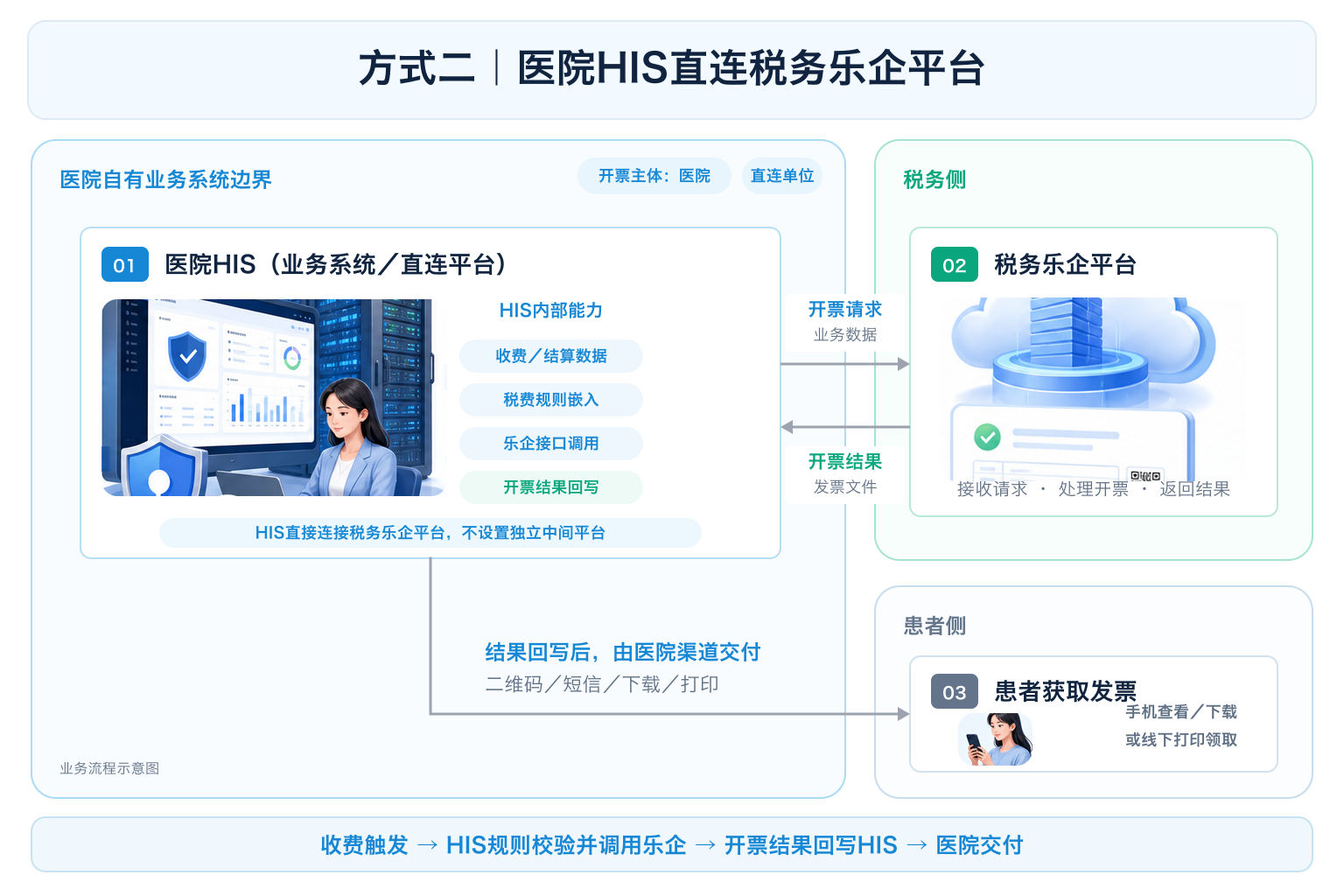
For hospitals that meet Leqi access conditions and wish to embed invoicing rules into their own systems and improve business-finance-tax collaboration capabilities, the project can adopt the Leqi Direct Connection method. According to public specifications of tax authorities, Leqi provides tax-related services with embedded rules, unified standards, and data interoperability through direct connection between tax information systems and the unit's own information system; the hospital's own information system that completes transformation and directly connects to the Leqi platform constitutes a direct connection platform.
Hospitals, as applicant units and direct connection units, initiate the access application under the guidance of the competent tax authority, completing material review, network security access, capability subscription, system modification, rule embedding, and joint debugging testing. Kailing Technology, focusing on hospital scenarios, assists in completing interface adaptation and business modification between HIS, the charging and settlement system, and the Leqi platform.
Unlike ordinary integrated invoicing, Leqi Direct Connection not only transmits invoicing requests but also embeds fully digitalized e-invoice related rules into the hospital's own information system, enabling transaction, settlement, and invoicing data to connect according to unified standards, and completing capability invocation and result interaction through the Leqi platform. The sources of relevant business data are traceable, and the invoicing process and processing status are verifiable.
After the direct connection goes live, the hospital's own direct connection platform issues fully digitalized e-invoices through the Leqi Platform and writes back invoice numbers, invoicing status, and file information to the HIS. The hospital remains the invoicing entity and bears responsibility for the authenticity of charging business, data security, platform operation, and risk prevention and control; Kailing Technology provides system transformation, integration implementation, and operation and maintenance support, without changing the hospital's identity as the responsible entity for tax-related matters.
IV. The two methods run in parallel, adapting to different hospital construction conditions
Ordinary integration automatic invoicing and Leqi Direct Connection invoicing are two independent tax access methods, but the ultimate goal is the same: embed invoicing capabilities into the hospital's existing charging process. Ordinary integration focuses on quickly connecting HIS with existing fully digitalized e-invoice channels; Leqi Direct Connection focuses on directly connecting the hospital's own information system with the Leqi platform, embedding tax business rules into the business system, and strengthening collaborative and traceable management of transaction, settlement, and invoicing data.
Kailing Technology formulates different solutions based on hospital business scale, invoicing frequency, system foundation and tax access conditions. For different hospital campuses, different tax entities or different charging businesses, corresponding invoicing channels and business rules can also be configured.
V. Covering high-frequency invoicing scenarios such as outpatient and inpatient services
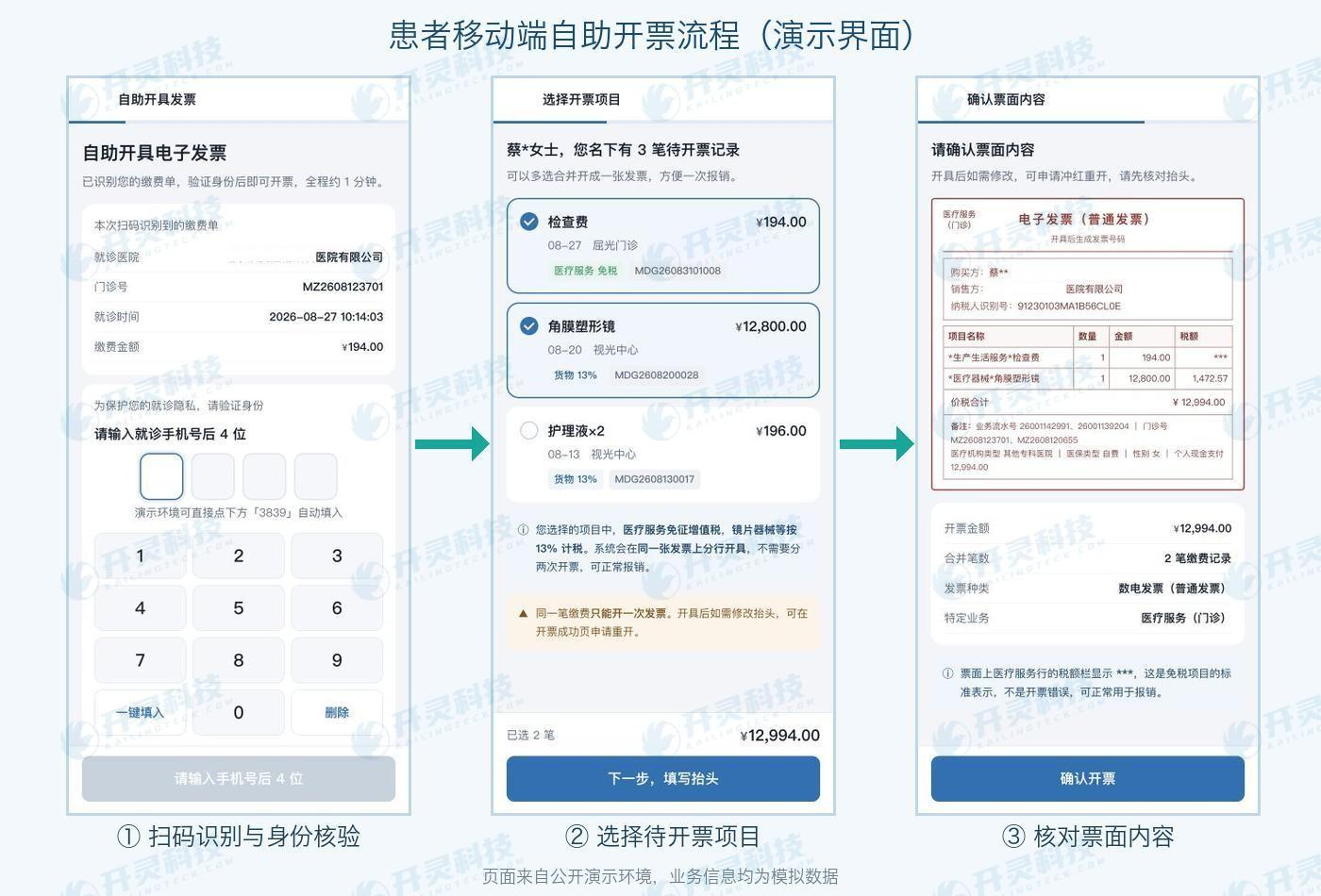
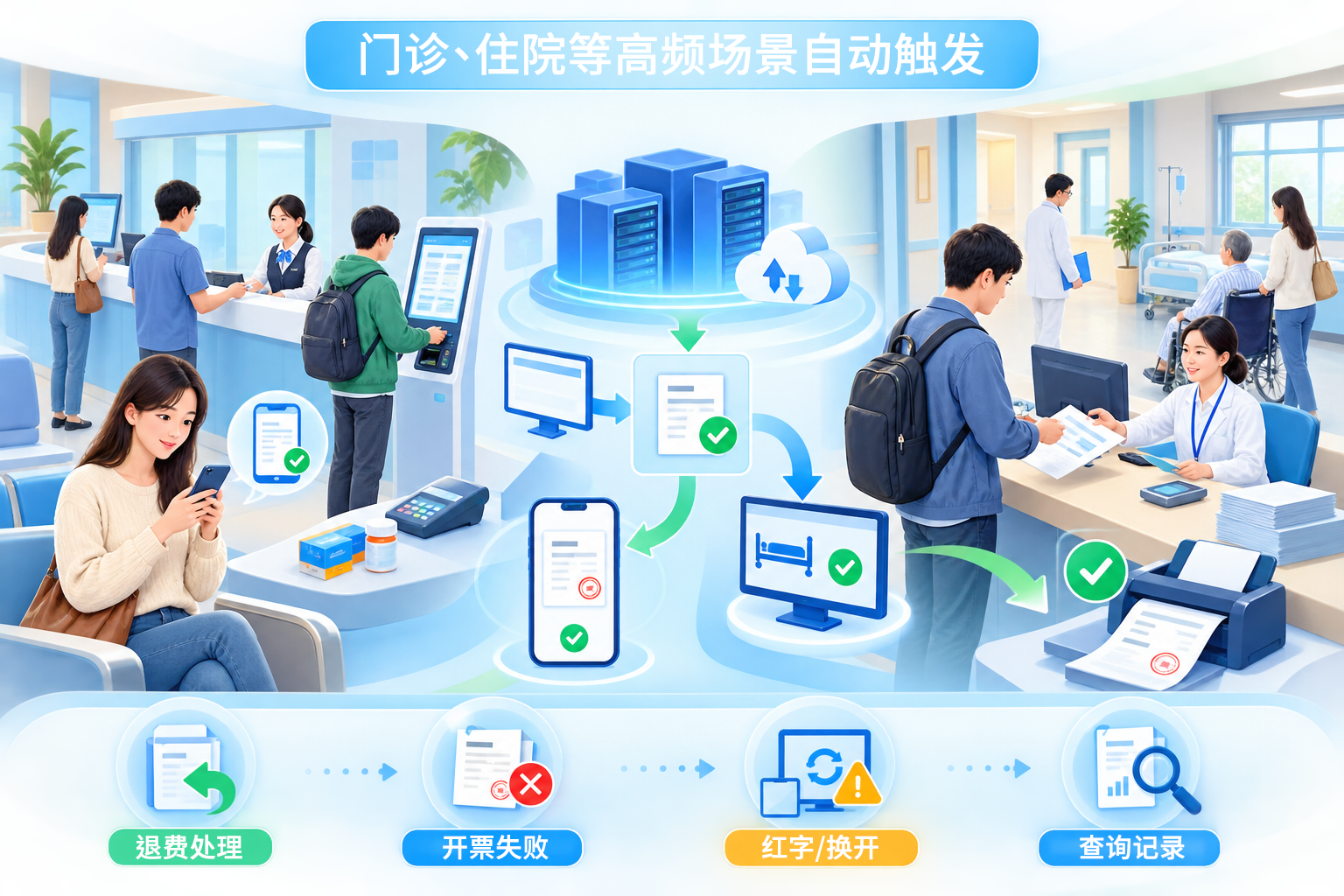
In outpatient scenarios, after patients complete registration, diagnosis and treatment, examinations, or medication payment, the HIS can automatically trigger invoicing according to rules set by the hospital. Patients can scan the QR code on the payment receipt to fill in or confirm invoice information and query and obtain the fully digitalized e-invoice that has been issued.
In the inpatient scenario, after a patient completes discharge settlement, the system generates invoicing data based on the final settlement result. After the charge items, settlement amount, and payment status are verified, the system completes invoice issuance and returns the result to the inpatient settlement interface, reducing the need for counter staff to switch between multiple systems.
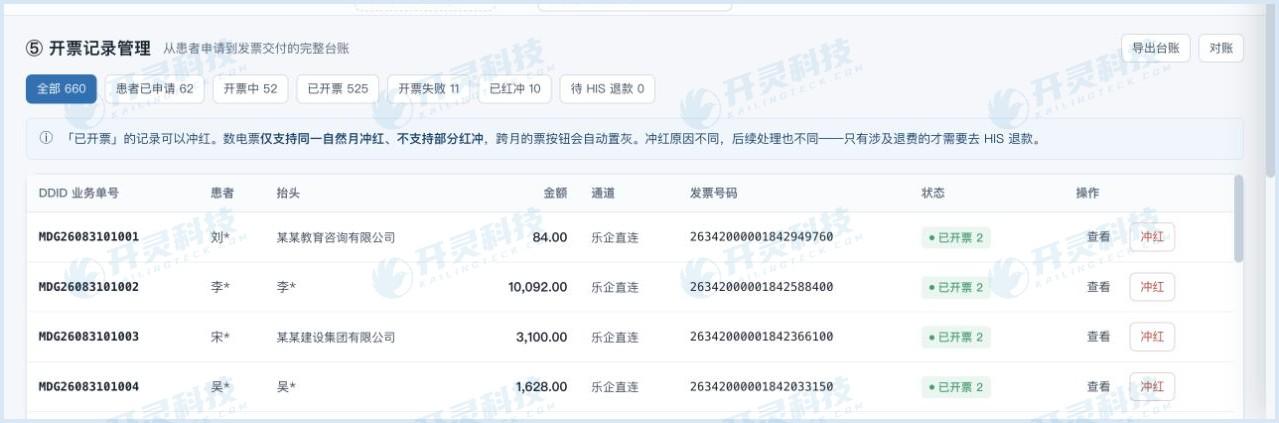
For special businesses such as refunds, invoicing failures, duplicate applications, red-letter invoices, and re-issuance, the platform retains complete processing records and prevents duplicate invoicing through status control. Staff can query business documents, invoicing results, and exception reasons in a unified interface.
VI. From Reducing Repetitive Operations to Business-Invoice Data Collaboration
After the project goes live, hospital billing staff no longer need to copy patient information and billing details one by one, and finance staff no longer need to frequently check invoicing progress, download files, or manually fill in invoice numbers. Once a correspondence is established between billing data and invoice data, the hospital can query and compile statistics by billing document, date, amount, and invoice status, providing a unified data foundation for daily reconciliation and exception handling.
For patients, invoices can be obtained through channels provided by the hospital immediately after payment, reducing the need to return to the cashier window for inquiries or printing. For those who are not comfortable using online channels, hospitals can still provide offline delivery methods such as free printing, balancing digital efficiency with actual medical needs.
From ordinary fully digitalized e-invoice interface connection to Leqi Direct Connection, Kailing Technology is gradually forming a multi-channel invoicing service system for different types of hospitals. In the future, Kailing Technology will continue to improve capabilities for automatic issuance, Leqi Direct Connection access, invoice delivery, exception handling, and data management around hospital HIS, charging and settlement, financial management, and patient service scenarios, helping more medical institutions promote the digital upgrade of charging and invoicing operations.
About Kailing Technology
As a national high-tech enterprise, Kailing Technology focuses on the digital and intelligent transformation of enterprise business-finance-tax and operations management, providing software products, system integration, implementation and delivery, and operational services for various government agencies, institutions, group enterprises, and SMEs.
The company has now formed ten core product lines, including: AI digital employee system, enterprise expense control management system, customer relationship management system, reverse invoicing management system, invoice issuance for individuals management system, electronic archives management system, tax fully digitalized e-invoice Leqi system, tax invoice management system, group tax filing system, and AI OCR recognition system. It is committed to connecting enterprise business, finance, tax, funds, and archive data to help customers improve operational efficiency, business-finance-tax compliance capabilities, and digital management levels.
As a comprehensive business-finance-tax digitalization solution service provider, Kailing Technology provides business-finance-tax management digital transformation products and operational services for various government agencies, institutions, and large, medium, and small enterprises. The product line includes: solutions for sales contract management system, procurement contract management system, fully digitalized Leqi interface project, automatic output invoicing system, reverse invoicing system, invoice issuance for individuals system, employee expense control and reimbursement system, input VAT invoice management system, supply chain collaborative reconciliation system, image AI OCR recognition system, automatic financial bookkeeping system, electronic accounting archives system, etc., comprehensively driving the digitalization process across various fields.
Consultation Hotline: 18513895936 / 010-60974119 Location: Beijing