
Reverse invoicing makes waste paper recycling more convenient and industry development more standardized: Kailing Technology resource recycling reverse invoicing compliant invoice acquisition with five-flow integration and ledger traceability
Reverse invoicing makes waste paper recycling more convenient and industry development more standardized: Kailing Technology resource recycling reverse invoicing compliant invoice acquisition with five-flow integration and ledger traceability
Waste paper recycling is one of the most inconspicuous yet most regulation-needing businesses in the city. The supply mostly comes from waste pickers, community recycling points, and individual peddlers who roam the streets; they are neither enterprises nor able to issue VAT invoices. Meanwhile, recycling companies that bale and resell waste paper still have to issue output VAT invoices and pay output VAT. The "output-only, no-input" input VAT gap in the middle has long been covered by cash and scattered small receipts, squeezing profits and making the entire industry appear fragmented, chaotic, and hard to regulate.Reverse invoicing is precisely a key move that makes this business more convenient and the industry more standardized. Qualified recycling enterprises issue VAT invoices compliantly in reverse to natural-person sellers, filling back in the invoice that individual sellers cannot issue; combined with five-flow consistency ledger traceability, every input invoice corresponds to a real receipt of goods. What Kailing Technology's resource recycling reverse invoicing aims to do is turn this path of "compliant invoice acquisition + five-flow consistency ledger traceability" into daily operations that enterprises dare to use and find easy to use.
▍Why reverse invoicing makes waste paper recycling more convenient and the industry more standardized
In the past, when talking about waste paper recycling, there was no avoiding three words: unable to get invoices. Individual sellers are natural persons; they take the cash and leave, unable to issue special VAT invoices, so the receiving stage for recycling enterprises became a long-term "black hole" of missing invoices—missing input VAT erodes profits through taxes, costs without invoices are difficult to deduct before tax, and books not matching reality become impossible to explain in an audit. This is not just the trouble of one enterprise, but a common pain point of the entire renewable resource industry: the further upstream, the more cash transactions and the harder it is to leave a trace, and the harder the industry is to regulate.
Reverse invoicing reverses the invoicing direction and clears this bottleneck, and the changes it brings can be summarized as "one convenience, one standardization."
- More convenient recycling: For input VAT invoices that individual suppliers cannot issue, the recycling enterprise can issue them in reverse with one click to fill the gap immediately. Receiving, invoicing, and payment are connected in one line in the system, no more back-and-forth hassle over documents for a truck of waste paper.
- A more standardized industry: Every purchase leaves complete evidence of real-name identity, contract, goods note, invoice, and receipt; cash transactions are replaced by bank-enterprise direct connection payments, and individual seller transactions change from "unexplainable" to "clearly verifiable," and the tax order of the entire industry is standardized accordingly.
This is also the intent behind the state's continued optimization of the reverse invoicing policy. "State Taxation Administration Announcement No. 5 of 2024" established the path for resource recycling enterprises to issue reverse invoices to individuals, and No. 12 of 2026 and NDRC Environmental Resources [2025] No. 1745 further reduced burdens and drove the expansion of renewable resource recycling. These are all favorable background conditions, but what recycling enterprises truly hold in their hands and can use are still those input VAT invoices that can be produced, deducted, and verified.
▍Kailing Technology resource recycling reverse invoicing: turning "compliant invoice acquisition" into four daily steps
For operators such as a certain waste paper recycling enterprise, no matter how good the policy is, it must be implementable at the daily receiving desk. Kailing breaks the entire resource recycling reverse invoicing chain into four steps: identify the person, record the goods, issue the invoice, and retain the trace. Each step leaves a trace in the system.
Step 1: Identify the person: individual suppliers scan code to create files, with verification and interception before invoicing
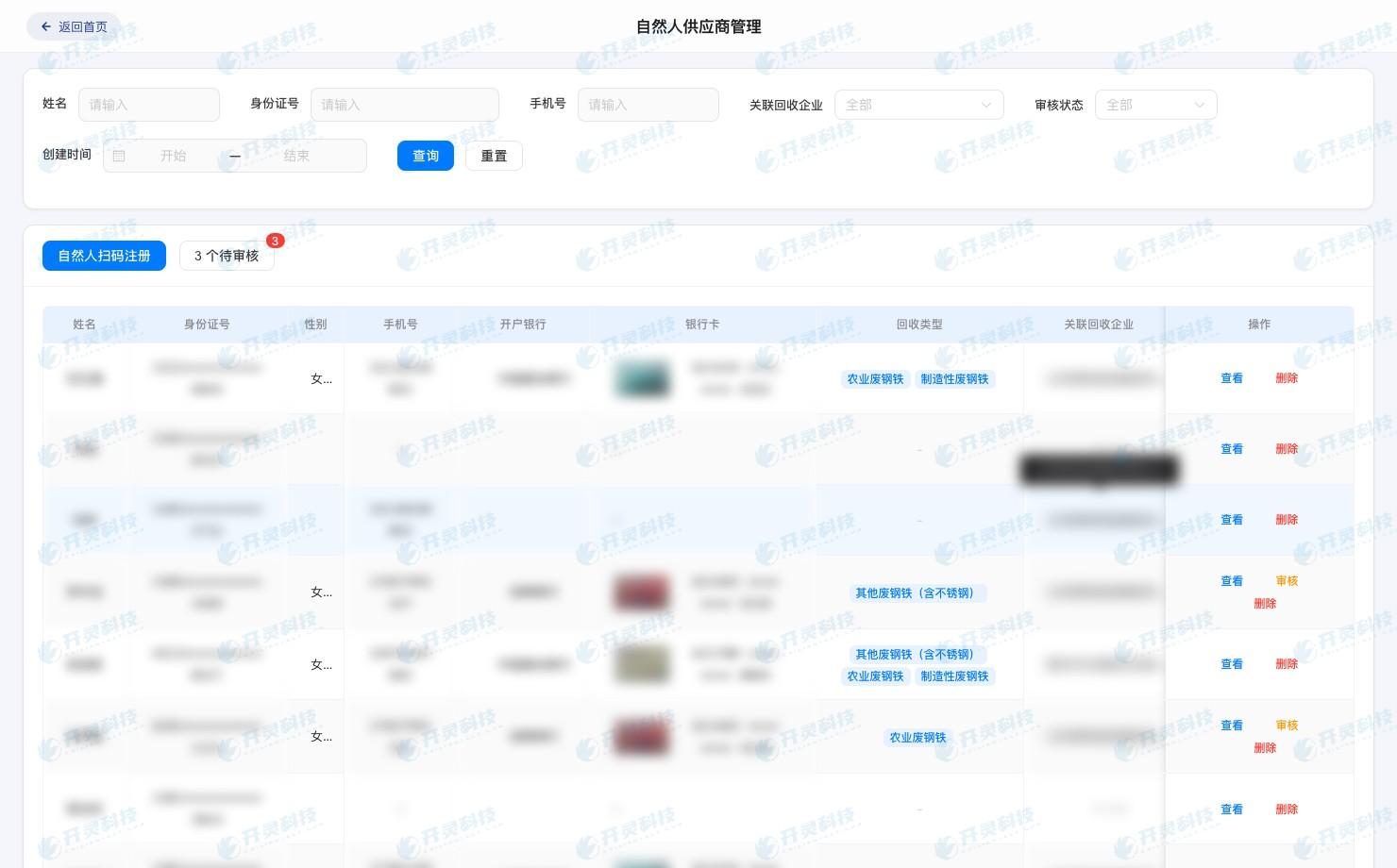
The starting point of the chain is not invoicing, but "identifying the person". When an individual seller arrives at the store, scanning a QR code completes natural-person supplier registration, filling in name, ID number, mobile number, account bank, and bank card, and checking the recycling type according to business scope — waste paper, scrap metal, etc. are clear at a glance. After submission, it enters pending review, and only after enterprise approval can they trade as a formal seller.
File creation is risk control. Reverse invoicing cannot be issued to just anyone: legal representatives, directors and supervisors, and registered individual businesses cannot act as individual sellers; invoicing the wrong party still means back taxes and penalties. The system pre-connects subject qualification verification at the filing stage, identifying and blocking these subjects, plugging the hidden risk of "invoicing the wrong party" from the source, so that every subsequent reverse invoice is issued with confidence.
Step 2: Record goods accurately — one truck, one order, making the "business flow" solid
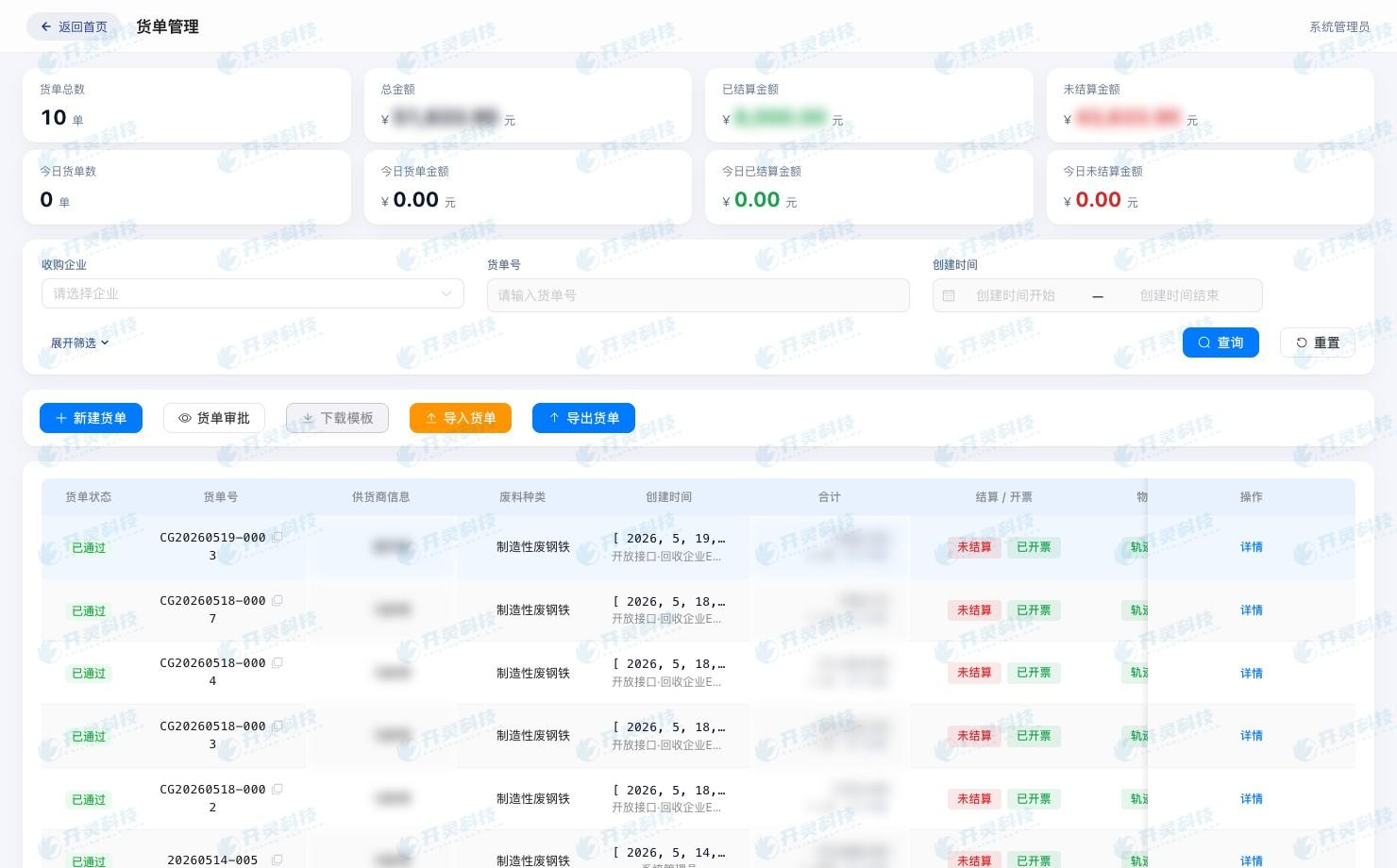
Once the person is verified, the next step is to accurately record the goods. Each time a truckload of waste paper is received, a goods ticket is generated in goods ticket management, with the goods ticket number, supplier, waste material type, total amount, net weight, and creation time recorded item by item, and goods ticket approval and logistics tracking can be handled, with new creation, import, and export supported. The top of the homepage summarizes in real time the total number of goods tickets, total amount, settled and unsettled amounts, making it clear at a glance how much has been received, how much has been settled, and how much is still owed.
This step turns "the goods were really received" from a verbal confirmation by the warehouse staff into a formal record in the system with time, quantity, and status—it is the foundation of the "business flow" among the five flows, and also the prerequisite for invoices and ledgers to correspond one-to-one.
Step 3 Issue the invoice: one-click reverse invoicing, input VAT invoice in hand immediately, source files complete
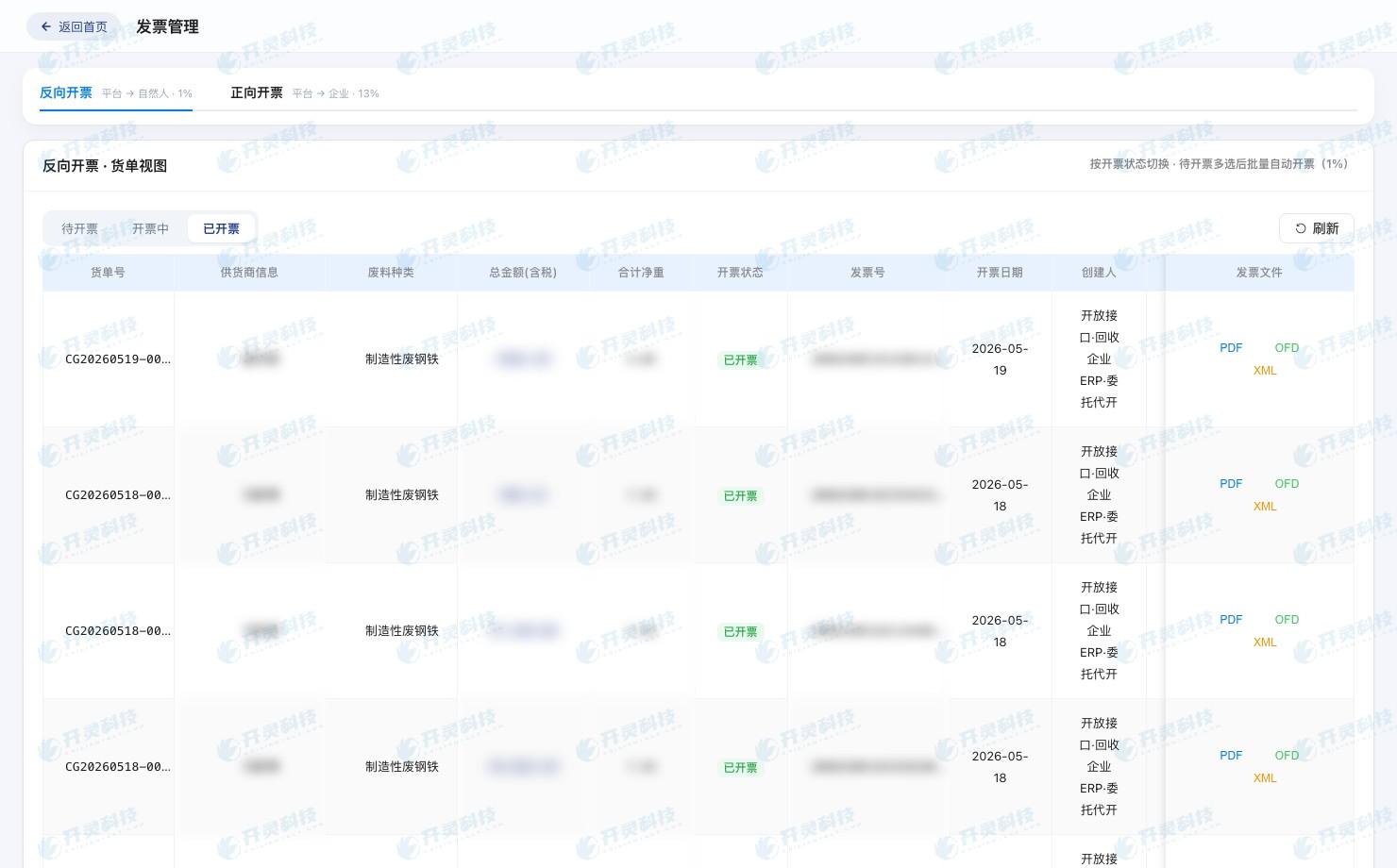
Once the cargo document is confirmed correct, it reaches the most critical invoicing stage. In invoice management, switch to Reverse Invoicing, select multiple pending cargo documents, and issue them automatically in batches. The electronic tax bureau interface is called without login throughout the process, and invoice status flows in real time among pending, issuing, and issued. For every invoice issued, the PDF, OFD, and XML source files are retained together.
For waste paper recycling enterprises, the input VAT that was always missing is now filled in one by one, in real time and compliantly, according to each goods receipt. Compliant invoice acquisition is no longer a last-minute scramble at month-end, but a daily action of issuing invoices as goods are received—recycling naturally becomes more convenient.
▍V. Five-flow unified ledger trail: make every input VAT invoice stand up to scrutiny
Having an invoice alone is not enough. To make input VAT truly deductible, ensure accounts match reality, and truly standardize the industry, the key lies in the five-flow integration ledger trail—automatically consolidating evidence scattered across each stage into one ledger around each reverse invoice. Kailing has turned the "three-flow integration" required by policy into a more complete "five-flow integration": self-certification flow, contract flow, business flow, tax flow, and capital flow—not one is missing.

After the five flows are collected, the ledger automatically checks evidence completeness around each reverse invoice: the individual, contract, goods order, and funds are aligned item by item, gaps are marked in red, and the "star-chain diagram" traces back along the evidence chain. Which link is missing for which invoice can be seen at a glance and filled in on the spot.
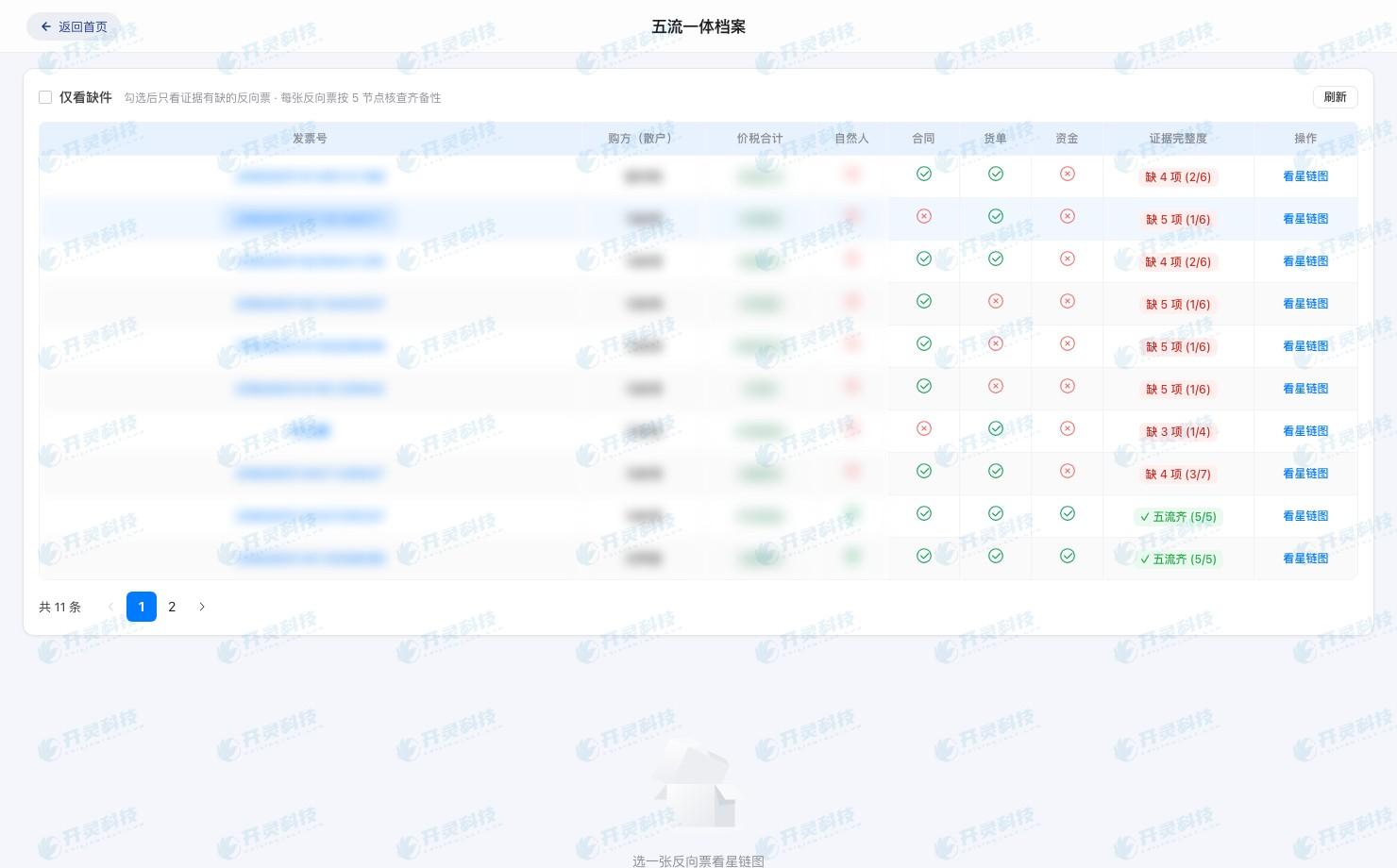
At this step, the closed loop is truly established: a reverse invoice can be traced forward to a contract, a goods note, and a real receipt, and backward to a bank-enterprise direct connection payment. Retail transactions change from "cash hand-to-hand" to "fully traceable, accounts matching reality." Kailing Technology's resource recycling reverse invoicing makes it more convenient for enterprises to receive invoices and also moves the old business of waste paper recycling toward standardization, traceability, and sustainability.
Want waste paper and renewable resource recycling to be more convenient and the industry more standardized? Welcome to learn about the Kailing Technology resource recycling reverse invoicing compliant invoice acquisition and five-flow integrated ledger traceability solution: www.kailingteck.com .
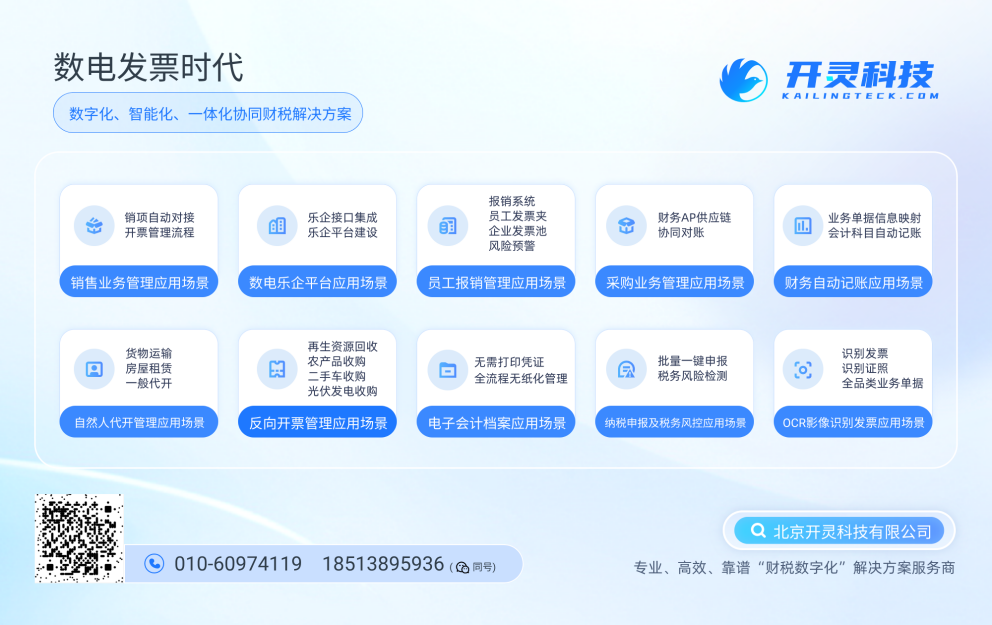
As a comprehensive business-finance-tax digitalization solution service provider, Kailing Technology provides business-finance-tax management digital transformation products and operational services for various government agencies, institutions, and large, medium, and small enterprises. The product line includes:
Solutions for businesses including sales contract management system, procurement contract management system, fully digitalized Leqi interface project, output automatic invoicing system, reverse invoicing system, invoice issuance for individuals system, employee expense control and reimbursement system, input VAT invoice management system, supply chain collaborative reconciliation system, image OCR recognition system, automatic financial bookkeeping system, and electronic accounting archives system, comprehensively driving the digitalization process across various fields.
If you have any business-finance-tax digital transformation needs, welcome to contact us. Beijing Kailing Technology will serve you wholeheartedly.
Keywords: Kailing Technology resource recycling reverse invoicing, compliant invoice acquisition, five-flow integration ledger traceability, waste paper recycling, reverse invoicing, account-reality consistency, individual supplier filing, renewable resource recycling
As a comprehensive business-finance-tax digitalization solution service provider, Kailing Technology provides business-finance-tax management digital transformation products and operational services for various government agencies, institutions, and large, medium, and small enterprises. The product line includes: solutions for sales contract management system, procurement contract management system, fully digitalized Leqi interface project, automatic output invoicing system, reverse invoicing system, invoice issuance for individuals system, employee expense control and reimbursement system, input VAT invoice management system, supply chain collaborative reconciliation system, image AI OCR recognition system, automatic financial bookkeeping system, electronic accounting archives system, etc., comprehensively driving the digitalization process across various fields.
Consultation Hotline: 18513895936 / 010-60974119 Location: Beijing