
How does a hospital HIS integrate with Kailing Technology automatic invoicing? Full-process breakdown of outpatient and inpatient services, refund red-letter reversal, and fully digitalized e-invoice delivery
After the national electronic tax bureau completed a unified upgrade in April 2026, the new rules for fully digitalized e-invoices for medical services were fully implemented. Public and private medical institutions follow the same invoicing standards, and regulatory verification has become noticeably stricter. Many hospitals still use manual invoicing: long queues at charging windows, manual splitting of inpatient details, settlement failures caused by missing medical insurance fields, and repeated rework of wrong and voided invoices. Connecting the HIS system to Kailing Technology's automatic invoicing, so that registration and payment, discharge settlement, refund and red-letter reversal, and invoice delivery run on the same chain, has become an unavoidable step for hospitals to reduce costs compliantly. This article explains policy requirements, invoicing models, business links and implementation steps all at once.
▍1. Four hard rules that cannot be avoided as the new medical fully digitalized e-invoice regulations take effect
Fully digitalized e-invoices and paper invoices have the same legal effect; medical insurance reimbursement, public medical care, and employee reimbursement can all be recorded normally; however, invoice validation in medical scenarios has several red lines that cannot be crossed compared with ordinary industries. Before integrating with Kailing Technology for automatic invoicing, these four rules must be fully understood.
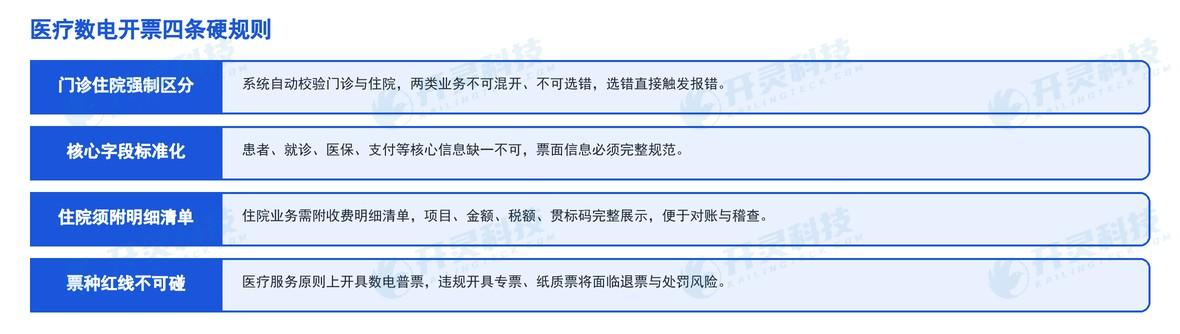
These four rules determine that: invoicing can no longer rely on cashiers manually filling in based on experience, but must be automatically assembled by the system according to business type and field standards. This is precisely the value starting point of HIS-integrated automatic invoicing—front-loading compliance verification to the data source, rather than waiting for invoices to be issued incorrectly and then reversing and redoing them.
▍II. Under manual invoicing, the five pitfalls hospital finance repeatedly falls into
After the new rules became stricter, the hidden costs of manual invoicing were further amplified. We grouped the problems most commonly reported by hospital finance into five categories, almost every one of which directly slows down counters and affects collections.

The common root of these problems is that billing data and invoicing actions are manually re-handled. Every additional manual data entry increases the chance of error and delay. To solve this, the confirmed billing results in the HIS should directly drive invoicing, with humans only performing necessary reviews.
▍3. HIS connects to Kailing Technology automatic invoicing: how the three business chains run through
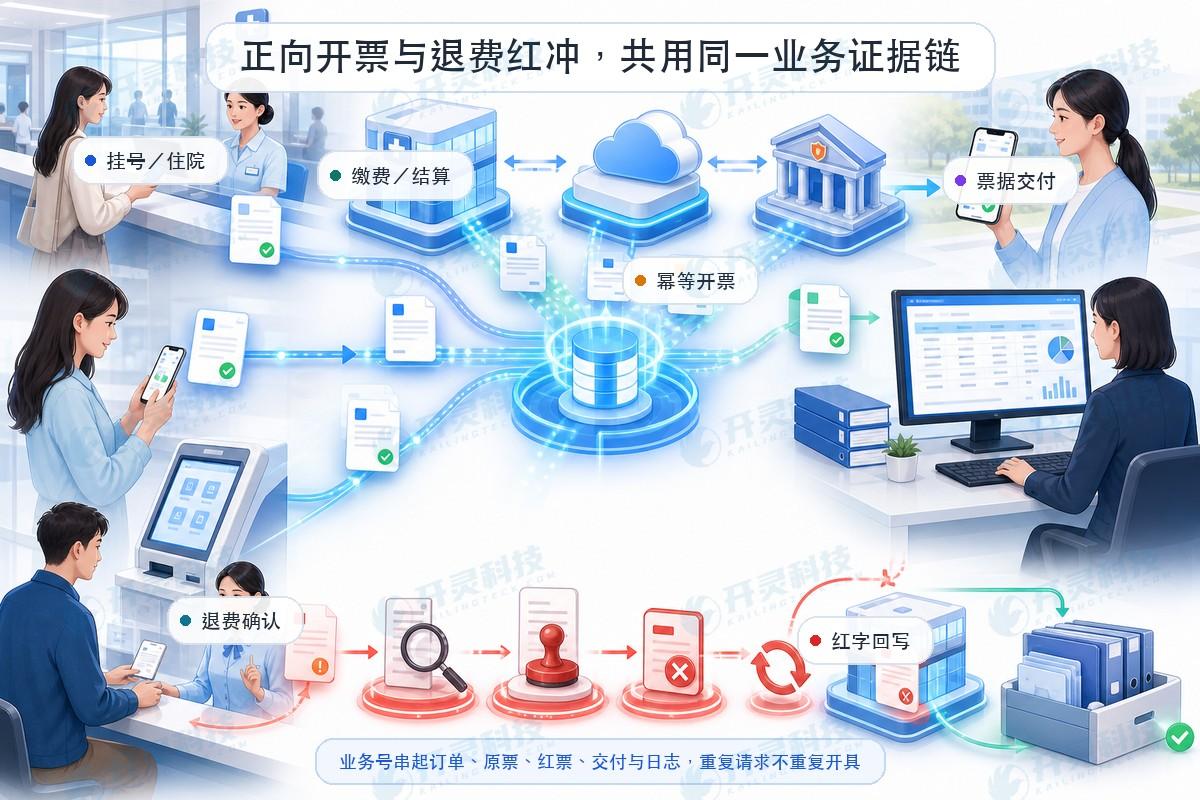
Automatic invoicing is often simplified into the phrase "call the interface after payment." The real difficulty lies beyond the interface: when settlement is considered complete, whether duplicate callbacks will issue two invoices, and how the original invoice should be handled after a refund. It becomes clear if the business is broken down into forward and reverse directions and three chains. The Kailing Technology automatic invoicing platform sits between the HIS/charging system and fully digitalized e-invoicing capabilities, handling preprocessing, review, issuance, write-back, red-letter handling, and delivery, but it does not replace the HIS in judging whether the business is complete.

The key to all three chains lies in idempotency and state consistency: when the same event arrives repeatedly, only update the state or return the original order, and never create a new document; refunding money and changing an invoice are two actions, but they must be mutually verified through the same refund number. When issuance succeeds but the HIS write-back fails, the platform retains the success record and triggers a write-back retry or manual supplementary write, and will not reissue.
▍IV. Three invoicing implementation models: hospitals choose flexibly by scenario
Different departments and different patient structures have very different invoice collection habits. Kailing Technology supports three delivery modes, and hospitals can combine them by scenario without forcing everything into a single entry point.
- Mobile online self-service (specialist/outpatient clinics with mostly online payment): Patients pay online via the official account or mini-program, bind their medical visit card or ID card, select the bill, fill in their mobile phone number or email, and submit; the system automatically issues and pushes the invoice, with no need to go to the window throughout the process.
- Self-service terminal scan (general hospitals equipped with self-service kiosks): Patients swipe their cards at self-service machines to pay, and the receipt comes with an invoicing QR code; scanning it with WeChat or Alipay and filling in the invoice receipt information allows real-time download, diverting offline foot traffic.
- Manual counter upgrade (institutions with mostly middle-aged and elderly customers that retain counters): After cashiers complete charging, they can issue invoices with one click, and invoices are automatically pushed via SMS and the official account; receipts include a QR code for scanning and retrieval at any time; historical orders can also be re-invoiced at any time in the official account.
Whichever mode is used, when patients enter any channel they should query the same valid status: pending issuance shows progress, issued provides the currently valid file, red-flushed clearly indicates the original invoice is invalid, and exceptions provide a customer service path. The channel is only the outlet; there is only one invoicing result.
▍V. Document delivery and financial reconciliation speak through the same status
Official accounts, self-service machines, counters, SMS, and email are only delivery channels and should not each maintain invoicing results separately. The system queries unified orders according to authorization and records the delivery channel, time, and result. Different entrances use different identity verification: official accounts are based on bound patients, self-service machines read medical cards or settlement vouchers, and counters are verified by staff according to regulations.
The finance side verifies charges, payments, invoicing, and refunds daily or per shift: cases such as payment successful but no order, order successful but not written back, amount mismatch, refund completed but no red-letter invoice automatically enter the exception list; after personnel handle them, reasons and results are recorded, preventing problems from scattering in chat records. Electronic files, issuance records, red-letter relationships, and interface logs are archived and retained according to applicable regulations; whether they can be used for reimbursement and booking is subject to current regulations and receiving unit requirements.
▍VI. Data security: multiple lines of defense for patient privacy
What hospitals worry about most is the leakage of medical visit information. The integration solution builds defenses across five dimensions—transmission, isolation, permissions, fields, and backup—so that invoicing only takes the part of the data it should take.
- Encrypted transmission: National cryptographic algorithms combined with HTTPS encrypted channels; fee data is transmitted in ciphertext, not in plaintext.
- Internal and external network isolation: Firewalls and security gateways isolate the external network, protecting the hospital's HIS and medical record databases.
- Tiered permissions: Fees, finance, and administrator roles are authorized separately, with full-process logs retained and traceable for operations.
- Minimum fields: Only the amount and charge items required for invoicing are synchronized; patient medical records and health privacy are not uploaded.
- Bidirectional backup: Dual archiving on in-house local servers and the cloud, ensuring long-term document retention without loss.
- Minimized collection of sensitive information, tiered authorization, transmission encryption, and access traceability—security is not an add-on to invoicing, but a prerequisite for integration.
▍FAQ
Q: Is an invoice issued immediately after successful registration and payment?
A: The HIS/charging system must confirm the invoiceable status. If payment is successful but medical insurance settlement is undetermined, or there is cancellation or field conflict, the system should wait or transfer to manual review, and cannot uniformly issue immediately.
Q: Will repeated interface pushes cause duplicate invoicing?
A: No. The platform performs idempotency checks using business numbers and payment/settlement numbers; duplicate events return the original order or update status without creating a new order.
Q: When is the appropriate time to issue invoices for inpatient services?
A: Usually issue after discharge settlement is completed and a unique settlement number is generated, confirming the final personal burden amount after deposit offset, supplementary payment or refund, and medical insurance settlement, avoiding mistaken issuance based on the deposit.
Q: How is the original invoice handled for partial refunds?
A: HIS first confirms the refund amount, the platform verifies the original invoice and the cumulative processed range, then handles the red-letter invoice according to the actual invoice type rules, and links the original invoice, red-letter invoice and refund number.
Q: Can SMS, email, and self-service terminals deliver simultaneously?
A: Yes, it can be combined according to hospital capabilities, but all channels query the same valid status, and appropriate identity verification and minimized data display are used, with links subject to validation and expiration.
Keep registration and payment, refund red-letter reversal, invoice delivery, and financial ledgers in the same state. Kailing Technology accompanies hospitals in making the interface a closed loop: https://www.kailingteck.com/feikong/ .
As a national high-tech enterprise, Kailing Technology focuses on the digital and intelligent transformation of enterprise business-finance-tax and operations management, providing software products, system integration, implementation and delivery, and operational services for various government agencies, institutions, group enterprises, and SMEs.
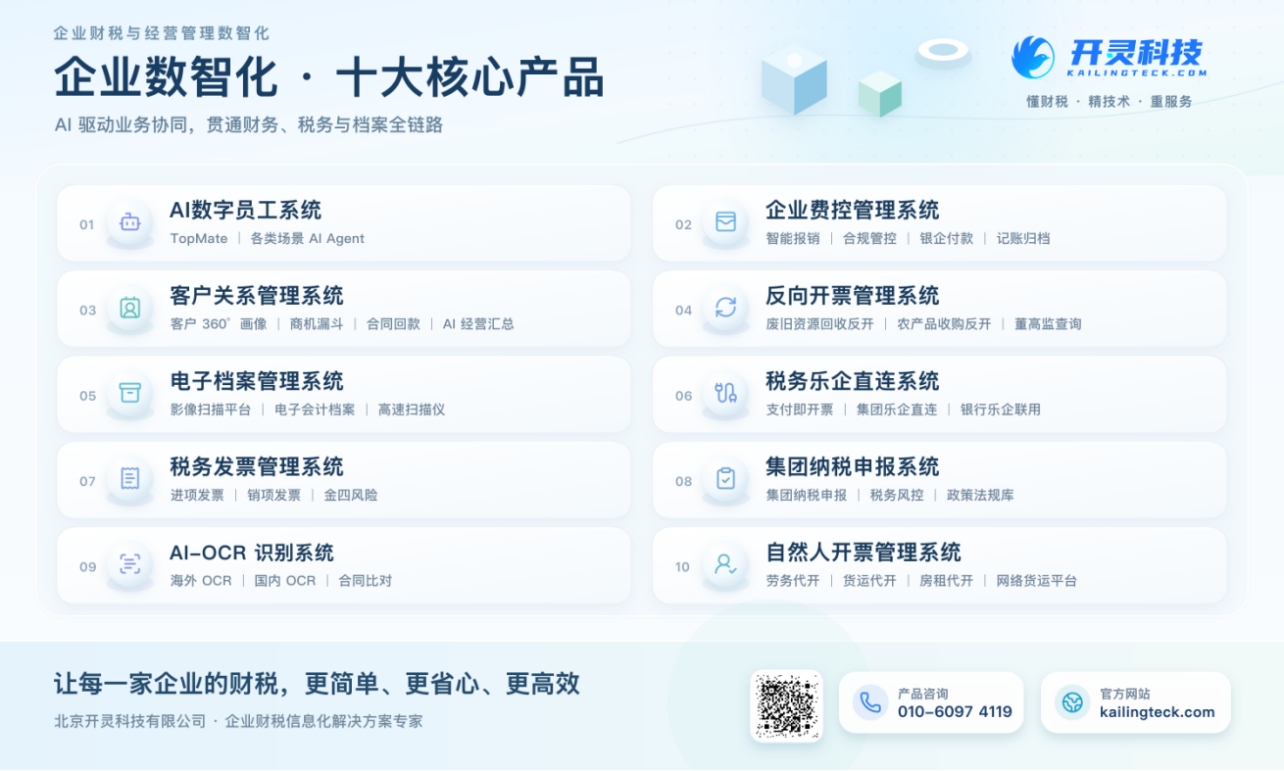
The company has now formed ten core product lines, including: AI digital employee system, enterprise expense control management system, customer relationship management system, reverse invoicing management system, invoice issuance for individuals management system, electronic archives management system, tax fully digitalized e-invoice Leqi system, tax invoice management system, group tax filing system, and AI OCR recognition system. It is committed to connecting enterprise business, finance, tax, funds, and archive data to help customers improve operational efficiency, business-finance-tax compliance capabilities, and digital management levels.
If you have any business-finance-tax digital transformation needs, welcome to contact us. Beijing Kailing Technology will serve you wholeheartedly.
Keywords: Hospital HIS integration, automatic invoicing interface, registration and payment invoicing, refund red-letter reversal, fully digitalized e-invoice delivery, Kailing Technology automatic invoicing
As a comprehensive business-finance-tax digitalization solution service provider, Kailing Technology provides business-finance-tax management digital transformation products and operational services for various government agencies, institutions, and large, medium, and small enterprises. The product line includes: solutions for sales contract management system, procurement contract management system, fully digitalized Leqi interface project, automatic output invoicing system, reverse invoicing system, invoice issuance for individuals system, employee expense control and reimbursement system, input VAT invoice management system, supply chain collaborative reconciliation system, image AI OCR recognition system, automatic financial bookkeeping system, electronic accounting archives system, etc., comprehensively driving the digitalization process across various fields.
Consultation Hotline: 18513895936 / 010-60974119 Location: Beijing