
How to deduct VAT on agricultural product purchase invoices? A complete guide
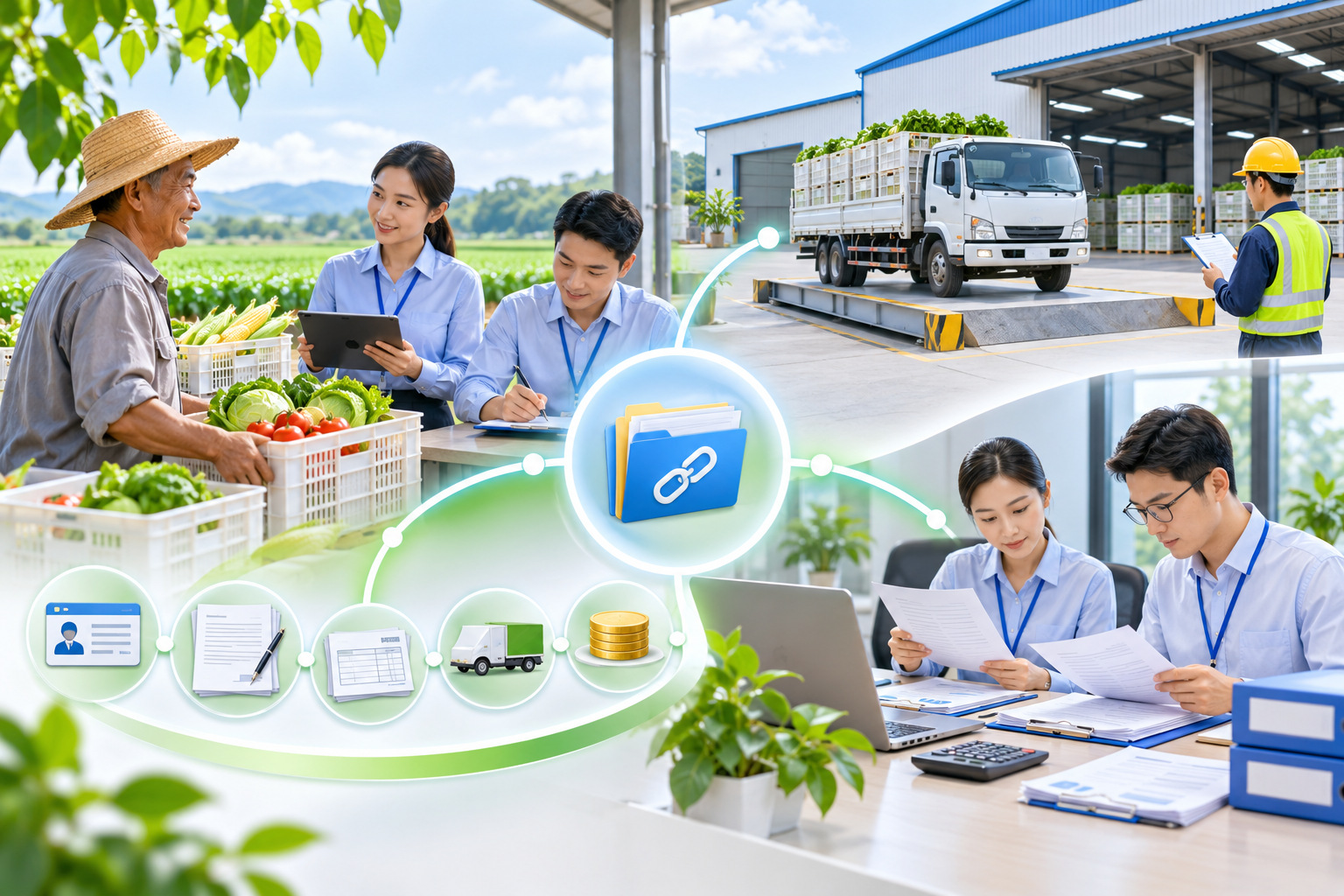
How to deduct VAT on agricultural product purchase invoices? A complete guide
Whether an agricultural product purchase invoice can be deducted does not depend only on the name on the invoice. Enterprises need to simultaneously verify taxpayer identity, self-production attributes of agricultural producers, voucher type, purchase price, actual use and whether assessed deduction applies. Any system can only help collect and keep records; it cannot replace the enterprise's judgment on business authenticity and tax applicability conditions.
The State Taxation Administration's public position clarifies: when a general VAT taxpayer purchases self-produced agricultural products sold by agricultural producers and obtains or issues agricultural product sales invoices or purchase invoices, input VAT is usually calculated at the purchase price stated on the invoice and a 9% deduction rate; for agricultural products purchased for production or commissioned processing of goods subject to the 13% tax rate, an additional 1% is applied as prescribed when conditions are met. Where assessed deduction of input VAT on agricultural products has been implemented, the assessed deduction provisions shall apply. Specific filing should still be based on current policy and the competent tax authority's position.
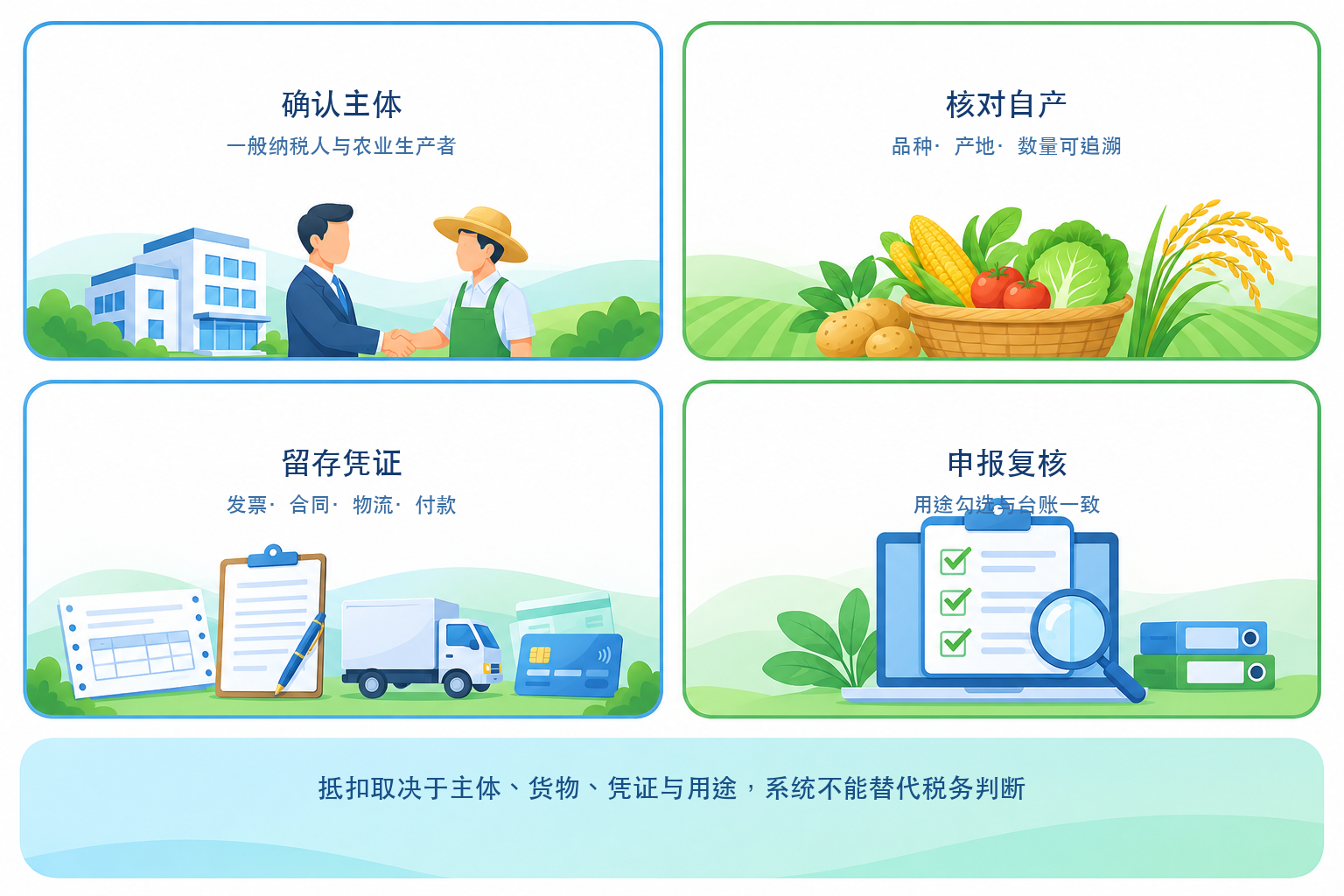
▍1. First confirm who purchased and from whom
The deduction entity should be a qualifying general VAT taxpayer, and the transaction counterparty and vouchers must be consistent with the actual procurement relationship. "Engaging in agriculture-related operations" cannot be directly equated with being an agricultural producer, nor can goods be presumed self-produced based solely on identity documents. Enterprises should verify against the supplier's identity, production and operation status, variety, place of origin, and delivery records.
▍2. Then confirm whether it is self-produced agricultural product
Policy conditions emphasize that agricultural producers sell self-produced agricultural products. Ordinary invoices obtained from purchasing tax-exempt vegetables at the wholesale or retail stage are not automatically eligible for deduction calculated as agricultural product sales invoices. The procurement ledger should correspond to records such as variety, quantity, time, place of origin, acceptance, and weighing, and abnormal scale or frequency should have a review mechanism.
▍3. Vouchers and purchase price must be consistent with business evidence
The purchase price used for calculation should be mutually corroborated with compliant agricultural product procurement invoices or sales invoices, contracts, acceptance, logistics, and payment records. When the purchaser issues procurement invoices itself, it is even more important to prevent issues such as issuing invoices for non-self-produced goods, inconsistency between quantity and amount and physical flow, and duplicate issuance for the same business. Invoices are deduction vouchers but cannot replace real transactions.
▍4. Handle deduction and additional deduction according to actual use
In general cases, calculate according to the current deduction rate; for agricultural products used to produce or commission processing of goods subject to the 13% tax rate, handle the additional deduction at the prescribed stage such as actual use when conditions are met. Enterprises should ensure that procurement, inventory, production use and filing ledgers connect with each other, and must not apply the additional deduction across the board at procurement without distinguishing use.
▍5. Enterprises under assessed deduction follow a different calculation logic
Taxpayers that use purchased agricultural products as raw materials to produce and sell liquid milk and dairy products, alcohol and ethanol, vegetable oil and other products already included in the assessed deduction scope, as well as other enterprises included in the pilot by the competent tax authority according to regulations, should handle matters under the assessed deduction method. Whether it applies, which method to use and filing requirements should be confirmed in light of local policy and the competent tax authority; software cannot automatically choose for the enterprise.
▍What should digital tools do, and what should they not promise?
Kailing Technology's capabilities related to reverse invoicing, AI OCR and electronic accounting archives can be configured per project to assist in collecting supplier, contract, weighing, logistics, payment and invoice materials, build linked ledgers and retain operation traces. However, the judgment of "self-production", deduction eligibility and filing results still require review by business, finance and tax personnel; OCR recognition results also do not mean bookkeeping or deduction has been completed.
Policy basis: Interim Regulations of the People's Republic of China on Value-Added Tax, Cai Shui [2017] No. 37, Announcement No. 39 of 2019 by the Ministry of Finance, the State Taxation Administration and the General Administration of Customs, and the relevant provisions on assessed deduction of input VAT for agricultural products. This article provides general information and does not replace tax judgment for specific transactions.
Keywords: Agricultural product purchase invoice, VAT deduction, self-produced agricultural products, input VAT on agricultural products, assessed deduction, reverse invoicing, Kailing Technology
As a comprehensive business-finance-tax digitalization solution service provider, Kailing Technology provides business-finance-tax management digital transformation products and operational services for various government agencies, institutions, and large, medium, and small enterprises. The product line includes: solutions for sales contract management system, procurement contract management system, fully digitalized Leqi interface project, automatic output invoicing system, reverse invoicing system, invoice issuance for individuals system, employee expense control and reimbursement system, input VAT invoice management system, supply chain collaborative reconciliation system, image AI OCR recognition system, automatic financial bookkeeping system, electronic accounting archives system, etc., comprehensively driving the digitalization process across various fields.
Consultation Hotline: 18513895936 / 010-60974119 Location: Beijing