
Kailing Technology bank Leqi combined application solution: How can banks rely on their own systems to provide fully digitalized e-invoice services to corporate customers?
The corporate business department of a city commercial bank obtained the Leqi joint-use qualification. Half a year later, business is still zero. The qualification certificate proves that this bank is capable of connecting to the STA's Leqi platform, but it does not answer several more practical questions: which merchants is it for? What tools do merchants use to issue invoices? How does transaction data flow from the acquiring system to the invoicing step? Who bears the invoicing compliance responsibility? Until these are resolved, the qualification is just a piece of paper.
Leqi is a service platform opened by the State Taxation Administration to eligible enterprises, providing direct tax-enterprise connection, commonly known as "head-to-head" connection, through direct connection between the tax system and the enterprise's own information system, with open rules and unified standards. Among these, "joint use" refers to direct connection entities relying on their own systems to provide invoicing services for non-affiliated enterprise customers that conduct transactions on their systems. Banks' acquiring and aggregated payment systems carry a large number of real merchant transactions, which is precisely the business foundation for the joint use scenario.
Kailing Technology bank Leqi combined application solution What needs to be filled is the gap between qualification and business: for those who have not yet obtained the qualification, help write the application materials correctly and reduce rejections; for those who already have the qualification, fill in the four blocks of industry scenarios, merchant-side products, technical integration, and operational implementation, turning the qualification into an expandable merchant business.

▍I. Why now: a policy window with a clear point in time
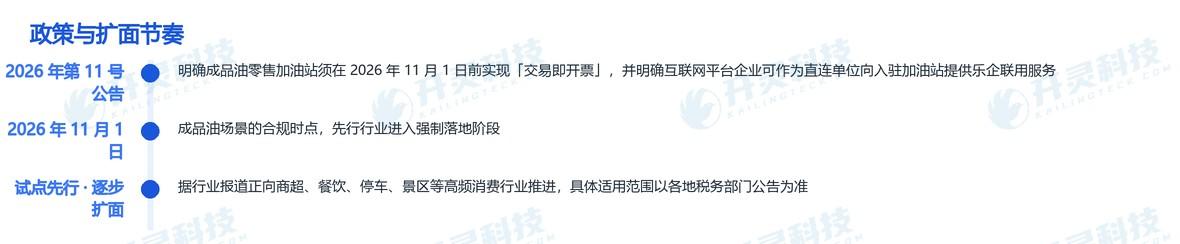
The direct basis for promoting this matter is the State Taxation Administration Announcement No. 11 of 2026. The announcement requires refined oil retail gas stations to achieve "invoicing at transaction" before November 1, 2026, and clarifies that internet platform enterprises can serve as direct connection units to access the Leqi platform and provide Leqi joint-use services to onboarded gas stations. For banks, the significance of this statement lies in: entering the gas station scenario as a joint-use operator, the path is policy-recognized, and the timing is clear.
The scope is still expanding. "Invoicing at transaction" is being advanced on a pilot-first, gradual-expansion basis. According to industry reports, it is extending from refined oil to high-frequency consumer industries such as supermarkets, catering, parking, and scenic areas. The specific scope is subject to announcements by local tax authorities. These are exactly the existing merchants acquired by banks—there is no need to acquire customers again, only to add one capability to existing merchants.
From the perspective of banks' own operations, the value of this matter goes beyond compliance services. According to public case feedback from a local branch of ICBC, implementing "payment triggers invoicing" helps with account opening, customer growth, transaction volume improvement, fund deposits, and intermediary business income growth, and drives acquiring transaction volume. Payment itself is a low-stickiness entry point. With invoicing added, what banks reach is the merchant's business process, not just the collection action.
▍II. Why can't it be implemented even with qualifications: the four pieces banks generally lack
Leqi Joint Use qualification is a general back-end access capability; it does not include front-end business. For banks doing this business, four aspects usually need to be filled in.
- Lack of industry scenarios— Qualifications are universal, but there is no ready-made playbook for which industries, which merchants, and what high-frequency invoicing scenarios to target, and the invoicing rhythm and data structure vary greatly across industries.
- Lack of merchant-side product— What merchants really want is a ready-made tool that "automatically issues an invoice upon successful payment." Banks do not have a merchant-side product that can be directly distributed to merchants for use.
- Lack of technical integration— Leqi has many capabilities, many interfaces, and fast updates. Pre-assigned codes, dynamic credit limits, red-letter reversal, and key security all need to be handled, and it also needs to connect downward with retail management, cashier, and acquiring. Self-development requires large investment and a long cycle.
- Lack of operations and customer acquisition— How to develop merchants, how to install, how to train, and how to reconcile accounts require a replicable operational process; otherwise, even if the system goes live, it cannot run.
Kailing Technology's bank Leqi combined application solution fills exactly these four gaps. On the merchant side, it provides a white-labelable "invoicing upon payment" product. After a merchant's aggregated payment or cashier collection succeeds, a fully digitalized e-invoice is automatically issued based on the real transaction and pushed to the consumer's phone and WeChat card package—merchants need no invoicing staff and will not miss or misissue invoices, consumers need not fill in invoice titles and receive invoices in seconds, and banks can white-label it as their own brand and distribute it to merchants.
On the scenario side, solutions are provided by industry and delivered in three modes: the lightweight mode can go live by simply replacing the payment QR code, suitable for small restaurants and community payments; the standard integration connects the business, payment, and invoicing ends, suitable for chain retail, hotels, scenic spots, and parking lots; the compliance special mode emphasizes the three-flow integration and data traceability, used for refined oil, agriculture-related, and corporate scenarios. On the technology side, it connects upward to the Leqi platform and tax authorities, and downward to zero-management, cashier, and bank acquiring aggregated payment; complex points such as multiple interfaces, pre-assigned codes, dynamic credit limits, red-letter reversal, keys, and data security are handled by Kailing. On the operations side, it provides merchant development processes, real-name authentication and filing for invoicing personnel, installation training, reconciliation, and risk control support.

▍3. Two implementation models: clearly define the invoicing compliance entity
What most needs to be clarified in advance for bank Leqi joint use is not technology, but the boundary of responsibility. Kailing provides two models based on the bank's own qualification conditions and business willingness, and the compliant invoicing entity is specified in the solution to avoid unclear disputes later.
Mode 1: Bank as joint operation party
After the bank meets the joint-use qualification conditions, it serves as the operating entity for Leqi Direct Connection and joint use, with Kailing providing Leqi integration, invoicing middleware, and industry scenario capabilities behind it. In this model, the bank is the compliant invoicing entity, and Kailing is the technical and operational support party. Qualification conditions typically include paid-in registered capital of over 10 million, own-system transaction revenue of over 100 million in the 12 months before access, and tax credit rating of A or B in the past three years; the specific criteria are subject to the actual requirements of the competent tax authority. ICBC has precedents of government-bank cooperation for reference.
Mode 2: Kailing as joint operation party
Kailing acts as the Leqi joint-use operator to connect with the tax bureau, while the bank provides acquiring and aggregated payment entry points as well as a merchant network, and invoices are delivered to consumers through bank channels. The invoicing operating entity is Kailing. This model is suitable for banks that temporarily do not plan to build joint-use capabilities themselves but want to quickly enter pilot validation of the business.

The common compliance gateway for both models is invoicer management. Before invoicing for a merchant, the merchant's invoicer must complete real-name authentication and filing on the Leqi platform, and the interface performs strong verification of the invoicer during invoicing—a bank having qualifications does not mean the merchant can invoice at will; Kailing helps the bank manage this gateway well. In addition, the scope must be distinguished: a bank invoicing for merchants whose transactions occur through its acquiring system falls under the category of Leqi joint use; purely providing external invoicing services falls under other use. The specific qualification and filing scope shall be subject to local tax authorities.
▍IV. Not yet qualified: the high-rejection zones in application materials
Many bank cards are at the application stage. Materials required for Leqi joint-use direct connection access include: the joint-use direct connection access (change) information form, the Leqi joint-use commitment letter, the project report, the direct connection platform network address filing form, proof of fixed dedicated use, and software copyright or usage rights and authorization certificates.
Among them, the project report is a high-incidence area for rejection. It consists of three parts—a business situation statement, a technical situation statement (which must include an MLPS security plan), and a tax-related risk prevention and control plan. It requires the applicant to both explain the business logic clearly and provide a technical plan and risk control measures that meet MLPS requirements. Banks often lack people internally who are familiar with both Leqi rules and tax compliance standards to write it.
In the "Renovation Method" field of the information form, third-party renovation can be selected, with Kailing filled in as the service provider to endorse the professionalism and compliance of the materials. Specific assistance includes: drafting the three-piece project report set, sorting out network address filing and the IPs and ports of production and test environments, checking material completeness and predicting rejection reasons, and using qualification thresholds to help banks judge whether the application can pass. The application materials for Leqi joint use are similar to those for Leqi self-use; Kailing has handled a large number of Leqi self-use and direct connection applications and integrations. The specific materials, qualification conditions, and the criteria under which access conditions may be appropriately optimized are subject to the actual requirements of the competent tax authorities.
▍V. Which industries to target first: high frequency, strong regulation, and difficulty for consumers to obtain invoices
There is a simple criterion for choosing scenarios: high transaction frequency, clear regulatory requirements, and inconvenience for consumers to request invoices. Merchants that satisfy all three generally have a higher willingness to launch pay-and-invoice.
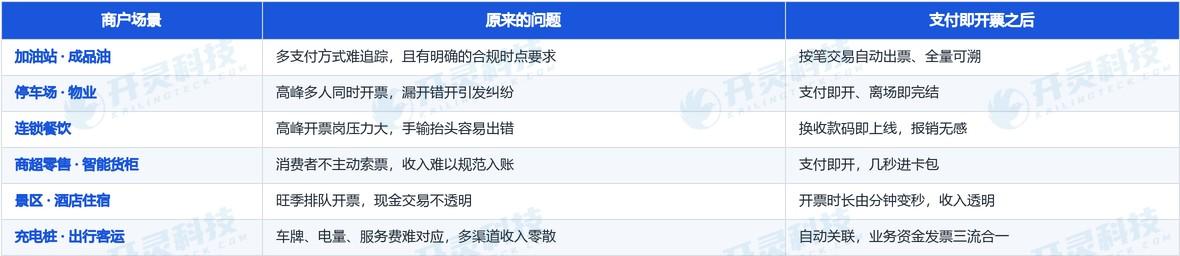
Pharmacies, medical clinics, auto 4S stores and repair shops, and e-commerce and live streaming platforms are also within this scope. Among them, e-commerce and live streaming platforms are the original intended scenario for Leqi joint use—the platform uniformly provides invoicing capability to affiliated merchants on the platform.
▍VI. Banks already doing this: local branches plus aggregated payment plus fully digitalized e-invoices
There are already several publicly reported implementation cases at local branches of Industrial and Commercial Bank of China, with highly consistent paths: local sub-branches, aggregated payment, and fully digitalized e-invoices combined. The Pingtan Free Trade Zone Branch implemented it at gas stations, automatically pushing electronic invoices after consumers pay fuel fees via aggregated payment, and plans to expand to supermarkets, cultural tourism, and catering and accommodation; the Panzhihua Branch implemented "invoicing upon payment" in dining scenarios, compressing invoicing time from several minutes to seconds; the Changzhou New District Sub-branch carried out forward invoicing in hotel scenarios, expected to drive annual acquiring transaction volume growth of more than one million yuan; the Pingliang Branch promoted the launch at 25 private gas stations in its jurisdiction, with cumulative invoicing of more than 5,500 invoices and an amount of more than 1.4 million yuan.

The value of these cases lies in validating the feasibility of the path, and this path is equally applicable to city commercial banks and rural commercial banks—it relies on local merchant relationships and acquiring entry points, not a nationwide network. Banks are closest to merchants' transactions, which is a natural positional advantage for Leqi integrated use.
▍FAQ
Q: What is the difference between Leqi shared use and Leqi self-use? Which type should a bank apply for?
A: Self-use means an enterprise issues invoices for its own operations. Joint use means a direct connection unit relies on its own system to provide invoicing services for non-affiliated enterprise customers whose transactions occur on its system. A bank issuing invoices for acquiring merchants falls under joint use. The application material structures for the two are similar, but joint use requires additional explanation of service recipients and responsibility boundaries.
Q: Once the bank has direct connection qualification, can merchants issue invoices freely?
A: No. Before invoicing for merchants, the merchant's invoicer must complete real-name authentication and filing on the Leqi platform, and the interface performs strong verification of the invoicer at the time of invoicing. Qualification addresses the bank's access permission, while invoicer compliance is a separate gate that requires ongoing management in operations.
Q: We do not want to build our own connected-use capability for now; can we try it first?
A: Yes, Model 2 can be used. Kailing acts as the Leqi Direct Connection co-operation operator to connect with the tax bureau, the bank provides acquiring and aggregated payment entry points and a merchant network, invoices are delivered to consumers through bank channels, and the invoicing operating entity is Kailing. It is suitable for validating the business in a small number of scenarios first before deciding whether to build it in-house.
Q: Does the merchant side need to install any additional equipment or systems?
A: It depends on the delivery model. In the lightweight model, it can go live by replacing the payment QR code, and merchants do not need to transform their existing checkout. The standard integration model requires connecting the merchant's business system, payment, and invoicing ends, suitable for scenarios such as chain retail, hotels, scenic areas, and parking lots.
Q: Can this solution be delivered to merchants under the bank's own brand?
A: Yes. The merchant-side "invoice upon payment" product supports white labeling. Banks can distribute it as their own branded merchant service, while Kailing provides Leqi Direct Connection, invoicing middleware, and operational support on the backend.
From qualification application to merchant implementation, turning Leqi joint use into an expandable merchant business. Kailing accompanies you step by step to connect: https://www.kailingteck.com/leqi-bank/ .
As a national high-tech enterprise, Kailing Technology focuses on the digital and intelligent transformation of enterprise business-finance-tax and operations management, providing software products, system integration, implementation and delivery, and operational services for various government agencies, institutions, group enterprises, and SMEs.
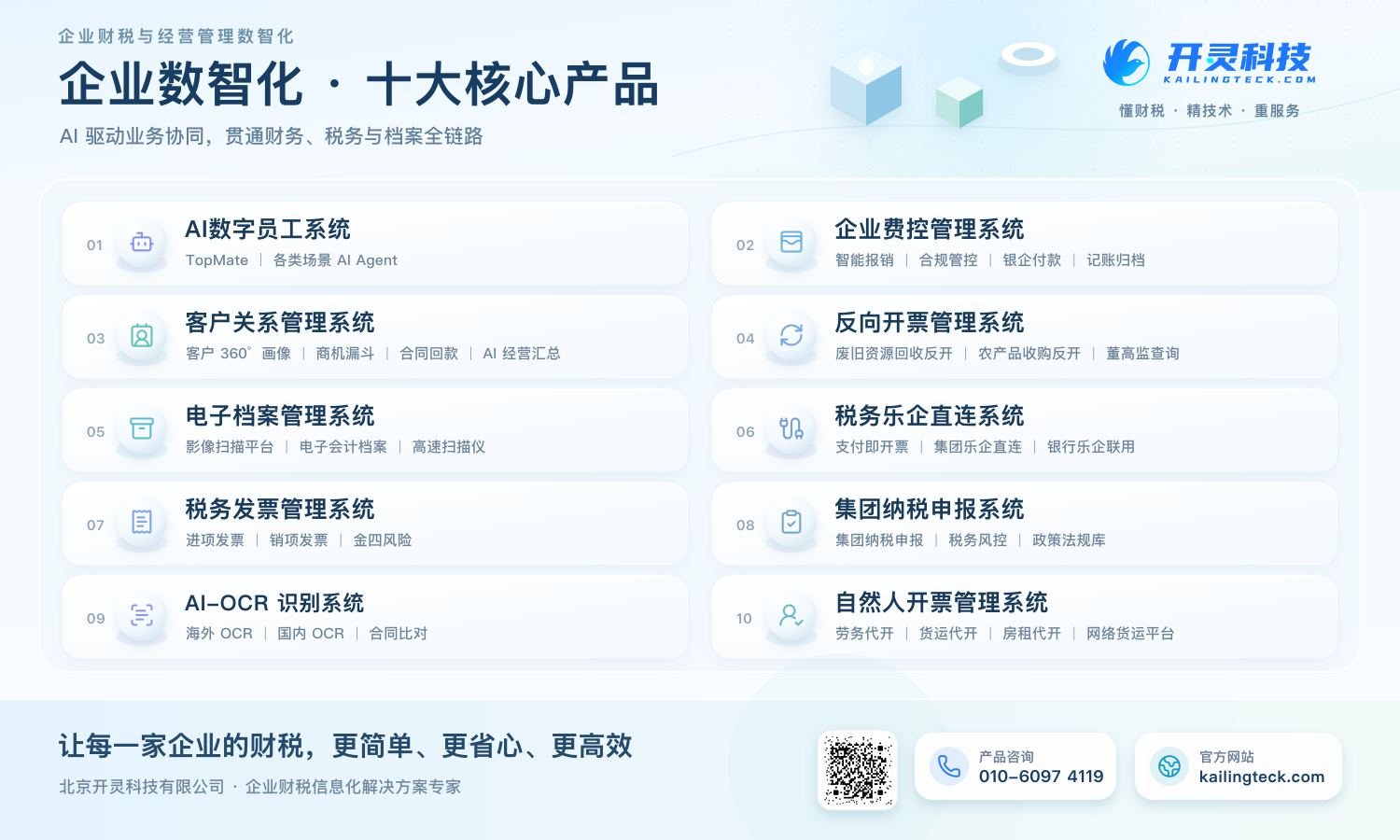
The company has now formed ten core product lines, including: AI digital employee system, enterprise expense control management system, customer relationship management system, reverse invoicing management system, invoice issuance for individuals management system, electronic archives management system, tax fully digitalized e-invoice Leqi system, tax invoice management system, group tax filing system, and AI OCR recognition system. It is committed to connecting enterprise business, finance, tax, funds, and archive data to help customers improve operational efficiency, business-finance-tax compliance capabilities, and digital management levels.
If you have any business-finance-tax digital transformation needs, welcome to contact us. Beijing Kailing Technology will serve you wholeheartedly.
Keywords: Kailing Technology bank Leqi combined application solution, bank Leqi combined application, Leqi combined application qualification, invoicing upon payment, fully digitalized e-invoice, Leqi Direct Connection, bank acquiring, invoicing upon transaction, merchant-side invoicing, direct tax-enterprise connection
As a comprehensive business-finance-tax digitalization solution service provider, Kailing Technology provides business-finance-tax management digital transformation products and operational services for various government agencies, institutions, and large, medium, and small enterprises. The product line includes: solutions for sales contract management system, procurement contract management system, fully digitalized Leqi interface project, automatic output invoicing system, reverse invoicing system, invoice issuance for individuals system, employee expense control and reimbursement system, input VAT invoice management system, supply chain collaborative reconciliation system, image AI OCR recognition system, automatic financial bookkeeping system, electronic accounting archives system, etc., comprehensively driving the digitalization process across various fields.
Consultation Hotline: 18513895936 / 010-60974119 Location: Beijing