
How to deduct and file agricultural product purchase invoices? Explained clearly in one article
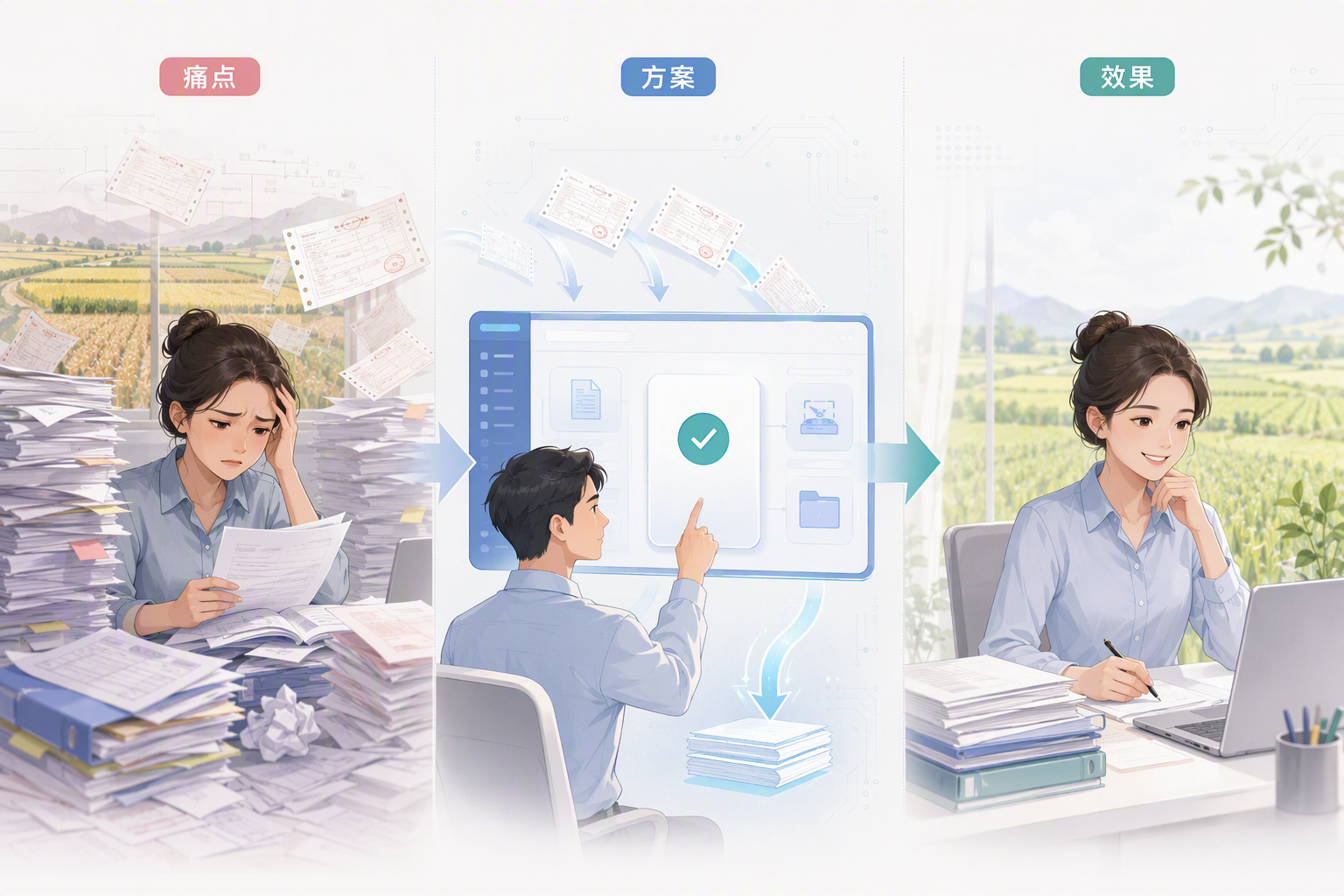
How to deduct and file agricultural product purchase invoices? Master the rules and tools to reduce burdens compliantly without pitfalls
Many finance staff get headaches whenever they encounter agricultural product purchase invoices: what is the deduction rate? How should the declaration form be filled in? How should vouchers be retained? With the slightest carelessness, input tax transfer-out, tax supplements, and fines follow one after another. In fact, as long as you grasp the two key points of "self-produced agricultural products" and "acquisition invoices," and then use digital tools to standardize the process, you can easily resolve the problem. Kailing Technology's reverse invoicing, AI OCR, and input VAT invoice management products were born exactly for this.
"For agricultural product purchase invoice deduction, the core lies in compliance, the difficulty lies in vouchers, and the key lies in digitalization." |

▍1. What are the deduction rules for agricultural product purchase invoices?
According to the Notice of the Ministry of Finance and the State Taxation Administration on Policies Concerning the Simplification and Merger of VAT Rates (Caishui [2017] No. 37), where a taxpayer purchases agricultural products and obtains an agricultural product purchase invoice or sales invoice, the input VAT may be calculated based on the agricultural product purchase price stated on the invoice and a deduction rate of 9%; if used for producing goods subject to a 13% tax rate, an additional 1% deduction may be applied. However, the premise is that the purchase target must be an individual producing self-produced agricultural products, and the invoice must be issued in accordance with regulations and retained for inspection. In practice, many enterprises have suffered heavy losses when tax authorities required input VAT transfer-out due to non-compliant vouchers.
▍II. How does the filing process work? Four steps
Step 1: Issue purchase invoices. The purchasing enterprise needs to issue agricultural product purchase invoices to individuals, mark "agricultural product purchase" on the invoice, and establish a purchase ledger. Kailing Technology's reverse invoicing product supports "invoicing upon purchase" and automatically generates a five-flow-in-one ledger, ensuring consistency of business flow, capital flow, invoice flow, contract flow, and logistics flow. Step 2: Certification and deduction. After obtaining the invoice, fill in Column 6 of the "Supplementary Information to the VAT and Additional Tax Return (II)" in the VAT return, and calculate the input tax at purchase price × 9%. Step 3: Retain for inspection. Purchase vouchers, payment records, weighbridge tickets, transport documents, etc. must be kept. Kailing AI OCR can automatically recognize and archive these documents, achieving "scan to store, recognize to archive." Step 4: Filing and comparison. Kailing input VAT invoice management connects directly to the tax bureau, automatically obtains all invoice sources, verifies and checks for duplicates, and prevents duplicate or missed filings.
▍III. What are the common risk points? How to prevent them?
Risk 1: The purchase target does not meet the conditions. If a purchase invoice is issued to an operator of non-self-produced agricultural products, there will be a risk of false invoicing. Kailing reverse invoicing automatically verifies tax identity and employment information before invoicing, intercepting anomalies. Risk 2: Missing vouchers. The electronic accounting archives system can scan vouchers into the archive, link them into volumes, and allow retrieval at any time. Risk 3: Filing errors. The group tax filing system supports automatic data retrieval and tax calculation across multiple organizations, and directly connects to the tax bureau for login-free filing, reducing the error rate. Risk 4: Tax audits. Tax risk control products provide compliance scanning of filing data and early warning of risk indicators.
▍IV. How do digital tools support compliance?
Kailing Technology's reverse invoicing product is designed specifically for agricultural product procurement scenarios, achieving "invoicing upon procurement and five-flow-in-one ledger" to ensure compliance from the source. AI OCR intelligent recognition technology automatically extracts key information such as invoices, contracts, and weighing slips, booking upon recognition and reducing manual entry errors. Input VAT invoice management directly connects to the tax bureau, automatically obtains all input VAT invoices, and verifies and checks duplicates to ensure accurate deduction data. The electronic accounting archives system enables scanning vouchers into storage, archiving upon recognition, and binding into volumes upon association, keeping reference materials complete and orderly. Used together, these tools make deduction filing for agricultural product procurement invoices simple, compliant, and efficient.
Keywords: agricultural product procurement invoice, deduction filing, reverse invoicing, input VAT, AI OCR, electronic accounting archives, tax compliance, Kailing Technology
As a comprehensive business-finance-tax digitalization solution service provider, Kailing Technology provides business-finance-tax management digital transformation products and operational services for various government agencies, institutions, and large, medium, and small enterprises. The product line includes: solutions for sales contract management system, procurement contract management system, fully digitalized Leqi interface project, automatic output invoicing system, reverse invoicing system, invoice issuance for individuals system, employee expense control and reimbursement system, input VAT invoice management system, supply chain collaborative reconciliation system, image AI OCR recognition system, automatic financial bookkeeping system, electronic accounting archives system, etc., comprehensively driving the digitalization process across various fields.
Consultation Hotline: 18513895936 / 010-60974119 Location: Beijing