
Kailing Technology authoritative plain-language interpretation: How is tax calculated for agricultural product reverse invoicing?
Kailing Technology authoritative plain-language interpretation: How is tax calculated for agricultural product reverse invoicing?
I. First understand: what is reverse invoicing
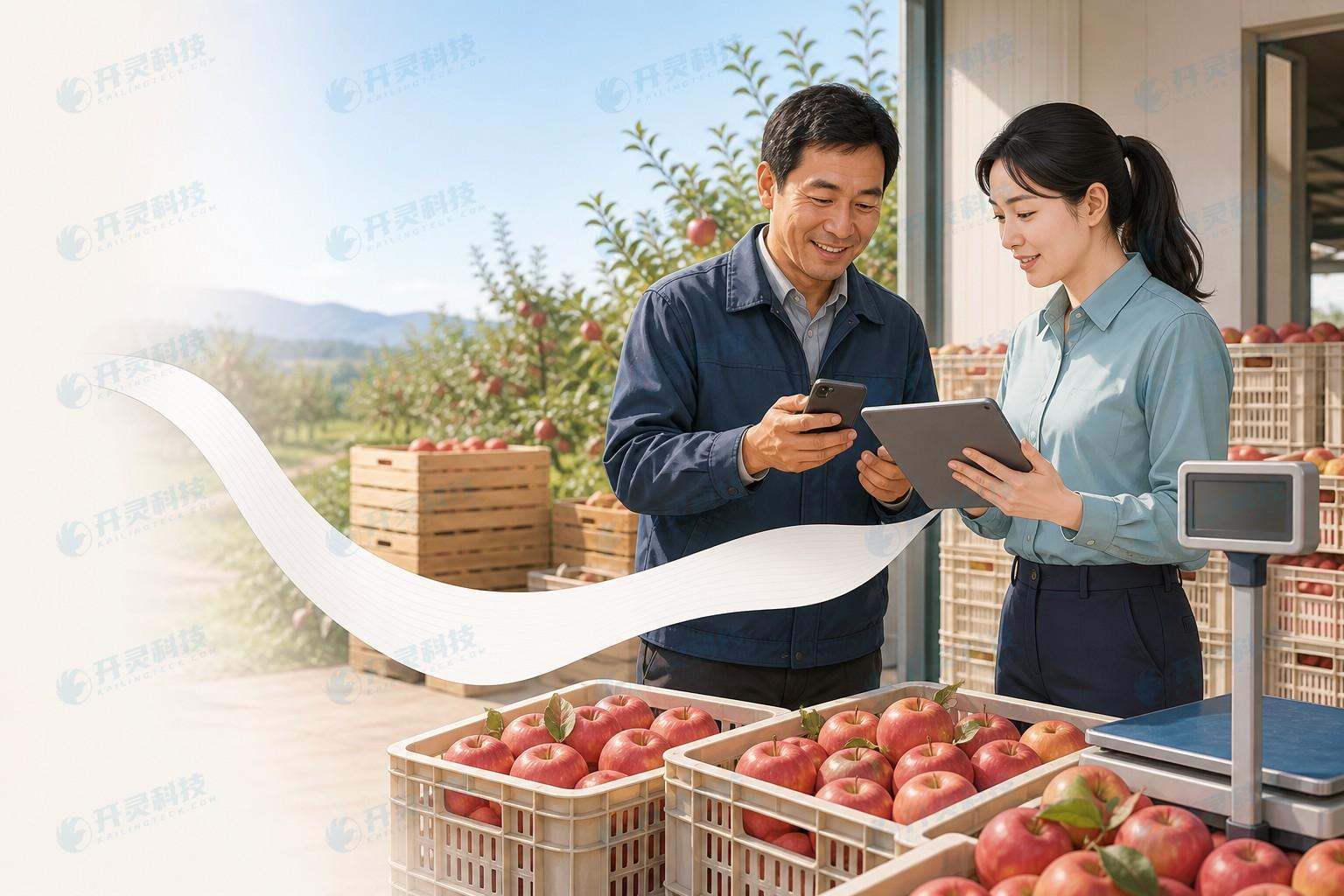
Old Wang, an apple grower, sold two thousand jin of Red Fuji apples to a purchasing company. The company's finance team was stumped: Old Wang is an individual and cannot issue an invoice, so this purchase cost had no voucher and the accounts could not be recorded.
The solution of the tax system is: normally the seller issues an invoice to the buyer, but now it is reversed—the purchasing enterprise issues an agricultural product purchase invoice to the natural person agricultural producer. Uncle Wang does not need to visit the tax bureau, and the enterprise obtains a compliant voucher (marked with "Agricultural Product Purchase" on the invoice), so the tax bureau can clearly see every transaction. Here the seller can only be a qualifying natural person agricultural producer; during filing and invoicing, verification of tax identity and employment information must be passed. If there are other disallowed employment identities such as legal representative, director, or supervisor, the system will directly block it, and the person cannot serve as the seller for reverse invoicing.
So how is tax calculated on this "reverse-issued" invoice? When Uncle Wang sells self-produced primary agricultural products, if the conditions are met, VAT and individual income tax on "four industries" income can enjoy preferences; after the purchasing enterprise obtains a compliant purchase invoice, the input is calculated according to the current 2026 standards.
II. VAT: Exempt, and enterprises also have a hidden benefit
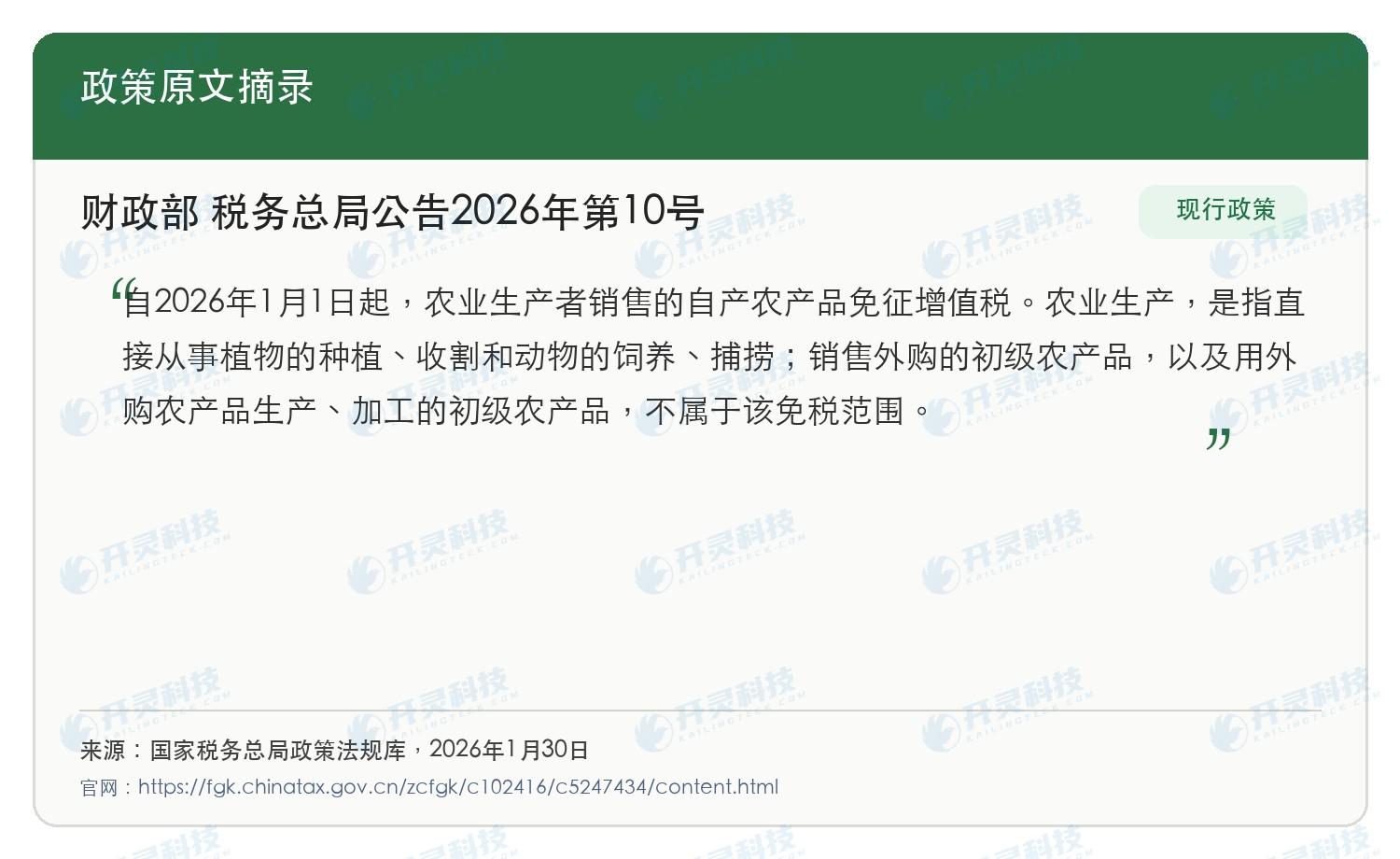
National policy is clear: agricultural producers selling self-produced agricultural products are exempt from VAT. Uncle Wang selling apples he grew himself is a typical case of self-production and self-sales, and the tax rate column on the invoice is directly marked "Tax Exempt."
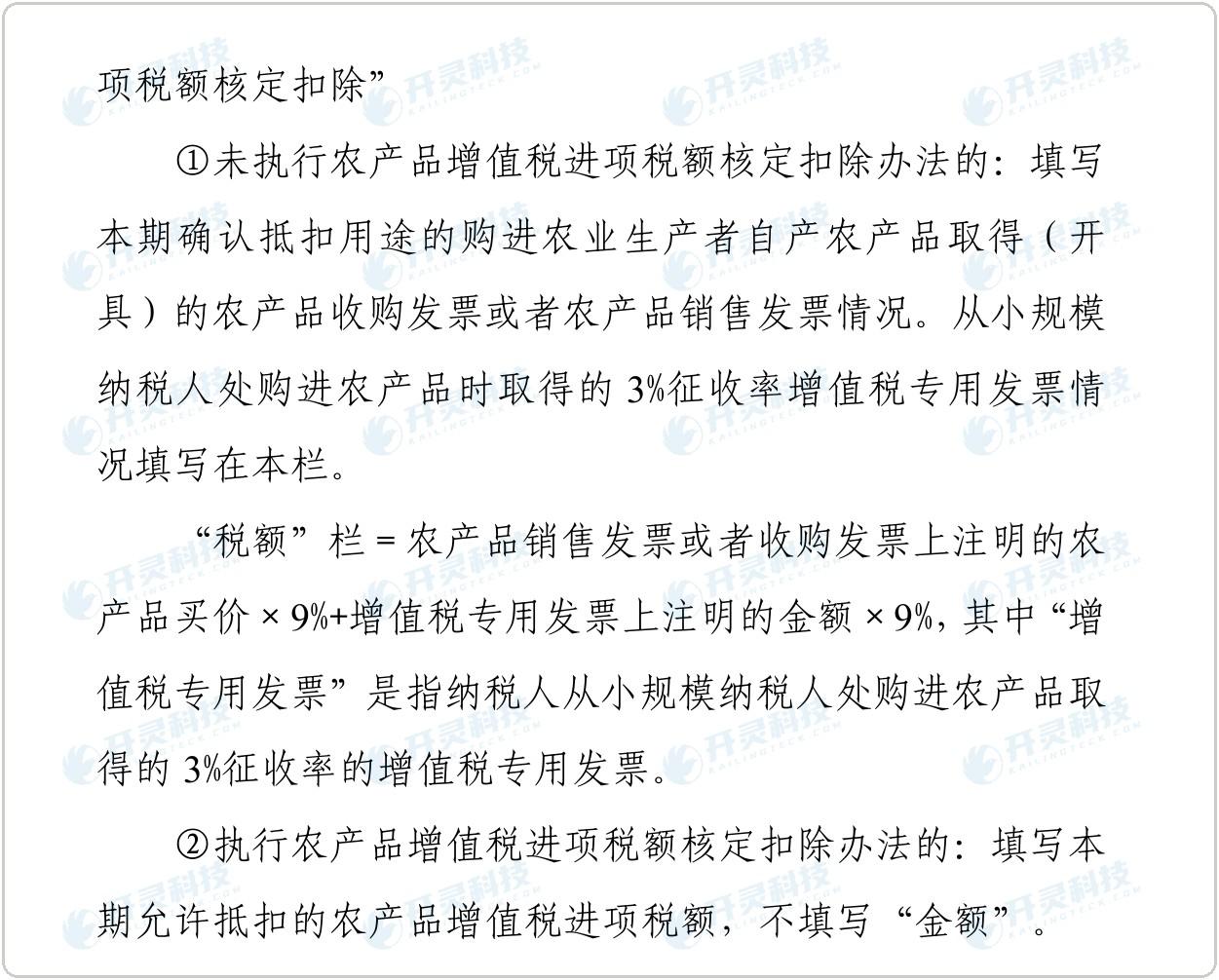
There is also a benefit on the enterprise side that many people do not know about: for general taxpayers that have not implemented the approved deduction method for the input VAT of agricultural products, based on compliant agricultural product purchase invoices or sales invoices, the input tax amount is calculated at 9% of the purchase price stated on the invoice. Under the current unified standard in 2026, it is calculated at 9%, and for use in producing goods subject to a 13% tax rate, an additional 1 percentage point is no longer added. In other words - farmers who meet the conditions can be exempt from tax, and enterprises calculate input tax at 9%. This mechanism is a real benefit for both parties. (Policy basis: Ministry of Finance and State Taxation Administration Announcement No. 10 of 2026 and the current filing instructions for declaration materials)
III. Individual income tax: also exempt
Uncle Wang selling apples he grew himself falls under the "four industries" income from self-production and self-sales obtained by an individual directly engaged in planting. Under the current individual income tax preferential treatment, individual income tax is temporarily not levied. Therefore, when the enterprise pays, it does not need to withhold individual income tax on this qualifying self-produced agricultural income, and the individual income tax withholding client is not involved. If it is actually resale after purchase, sale after processing, or other operating income, the tax exemption cannot be applied merely based on the label "farmer."
IV. Since both are exempt, where is the difficulty? In the proof
Tax exemption has prerequisites, and two things must be made clear:
First, the goods must genuinely be grown by him. Under the current business channel's filing and verification requirements, farmers must upload the main page and personal page of their household registration booklet and a planting and breeding (production and operation) certificate issued by the village committee; at the same time, the variety, output, purchase order, weighing and warehousing, and payment records must corroborate each other. The specific image document names and codes are subject to the local tax authority and the current interface version.
Second, the person must genuinely be a natural person agricultural producer who meets the requirements for acquisition invoices. Tax rules limit the seller in this business to qualifying natural persons, and employment identity must be verified during filing and invoicing; if there are other disallowed employment identities such as legal representative, director, supervisor, or senior executive, it is non-compliant, the system will directly block it, and the person cannot serve as the seller for reverse invoicing of agricultural products. This is not an additional risk control added by the enterprise itself, but an invoicing access condition.
V. How to issue invoices in the electronic tax bureau? What to do when the filing period arrives?
Invoicing (each transaction): Log in to the new Electronic Tax Bureau, go to [I Want to Handle Taxes] → [Invoicing Business] → [Issue Blue-Letter Invoice], click "Issue Invoice Now", and select "Agricultural Product Purchase" under "Specific Business". The seller can only be the agricultural producer themselves who has passed natural person identity and employment verification; detail lines must truthfully state the agricultural product name, quantity, and amount. The system issues the invoice on a tax-exempt basis, with "Agricultural Product Purchase" marked in the upper-left corner of the invoice.
Collection period (handled according to the acquiring enterprise's own tax filing deadline):
VAT: Issuing an agricultural product purchase invoice does not mean the purchasing enterprise files the tax-exempt self-produced sales amount on behalf of Uncle Wang. The purchasing enterprise only declares its own output and input in its own VAT filing form; for general taxpayers that have not implemented deemed deduction, eligible purchase invoices are used to calculate input tax at purchase price × 9% and are filled in line 2A04 of Appendix II to the VAT and Surcharge Filing Form. Enterprises that implement the deemed deduction method for agricultural product input tax shall file according to the deemed deduction rules and cannot mechanically apply purchase price × 9%.
Individual income tax: exempt, the enterprise has no withholding obligation, and no individual income tax withholding client operation is involved (that client is used for paying wages and labor service remuneration, and has nothing to do with this).
One sentence: for the agricultural products line, the action during the tax period is for the enterprise to verify and declare eligible input VAT in its own tax return; the farmer's tax-exempt sales of self-produced agricultural products are not the purchasing enterprise's sales, and the enterprise does not fill them into its own tax-exempt sales column on behalf of the farmer. A standardized platform can generate invoicing lists and input VAT ledgers monthly, and finance verifies against them.
VI. Need to connect to the "Leqi Joint Use" interface? This is how tax fields are transmitted
Enterprises that complete docking with the Leqi joint-use channel (such as connecting to the corresponding payment platform) can link invoicing during the payment process. The tax standards that technical staff need to monitor can still be retained in the interface, but field names, enumeration values, attachment codes, and required rules shall be subject to the current interface documentation and joint debugging results:
① Reduced taxation type (jazslxDm) → pass the "VAT exemption" option. It determines what is printed in the tax rate column of the invoice; if "normal taxation" is passed, an exempt invoice becomes a taxed invoice.
② Individual income tax item (grsdsxm) → pass "business income". Passing "remuneration for labor services" is equivalent to treating farmers as employees, and the tax-exemption criteria will not match at all.
③ Tax and fee bearer (sfcdf) → pass "individual bears" or "enterprise bears" according to the commercial agreement. It determines from whom taxes and fees are deducted if they arise.
Two supporting points must not be missed: the real-name registration interface for individuals uploads materials such as the household register cover page (hkbhzy), the household register personal page (hkbbry), and the village committee production and operation certificate (cwhscjyzm) per the current version; at the same time, tax identity and employment verification must be performed, and if there are disallowed other employment identities such as legal representative, director, supervisor, or senior executive, it must be directly blocked and cannot proceed to invoicing. Product details must also carry the correct tax classification code; status codes such as "81 = tax-exempt" and attachment codes are subject to the current channel version.
Seven, the last line of defense: the transaction must be real
Tax exemption + invoice issuance for individuals is the easiest place to be tempted into tricks, so tax audits recognize only one iron rule: three-flow consistency—acquisition order (transaction flow), bank payment (fund flow), and invoice (invoice flow) correspond one to one, supplemented by weighbridge records and on-site photos as evidence. No matter how beautifully the invoice is issued, if the three flows do not match, it is false invoicing.
Final thoughts
The benefits of reverse invoicing for agricultural products are tangible: farmers save effort, enterprises obtain compliant vouchers and calculate input tax under the current 9% standard, and costs are properly recorded. The hard part has never been calculating tax; it is getting the verification of natural person and employment status, self-production proof, input tax filing, and three-flow evidence retention right for every single transaction.
Kailing Technology has built these standards into system defaults: farmers scan a code to create a file in one minute, tax exemption standards are automatically locked, invoicing occurs upon payment, and the three flows are automatically reconciled. For compliance, the best thing is to "get it right while doing it naturally".
Policy basis and official links
[1] Ministry of Finance and State Taxation Administration Announcement No. 10 of 2026: VAT exemption for self-produced agricultural products, boundary for excluding purchased products, and 2026 policy transition View official website
[2] Instructions for Filling in VAT and Surcharge Filing Materials: agricultural product purchase price × 9% and attached materials (II) Column 2A04 View official website
[3] Tax and Fee Policy Q&A of the Liaoning Provincial Tax Service of the State Taxation Administration: agricultural product purchase invoices should be issued to individual agricultural producers View official website
[4] State Taxation Administration Tax and Fee Preferential Policy Guidelines: individual income tax preferences for income from the four occupations of planting, breeding, raising, and fishing View official website
[5] Hot Q&A of the Tianjin Municipal Tax Service of the State Taxation Administration: qualification filing for agricultural product purchasing enterprises and actual purchaser requirements View official website
As a national high-tech enterprise, Kailing Technology focuses on the digital and intelligent transformation of enterprise business-finance-tax and operations management, providing software products, system integration, implementation and delivery, and operational services for various government agencies, institutions, group enterprises, and SMEs.
The company has now formed ten core product lines, including: AI digital employee system, enterprise expense control management system, customer relationship management system, reverse invoicing management system, invoice issuance for individuals management system, electronic archives management system, tax fully digitalized e-invoice Leqi system, tax invoice management system, group tax filing system, and AI OCR recognition system. It is committed to connecting enterprise business, finance, tax, funds, and archive data to help customers improve operational efficiency, business-finance-tax compliance capabilities, and digital management levels.
If you have any business-finance-tax digital transformation needs, welcome to contact us. Beijing Kailing Technology will serve you wholeheartedly.
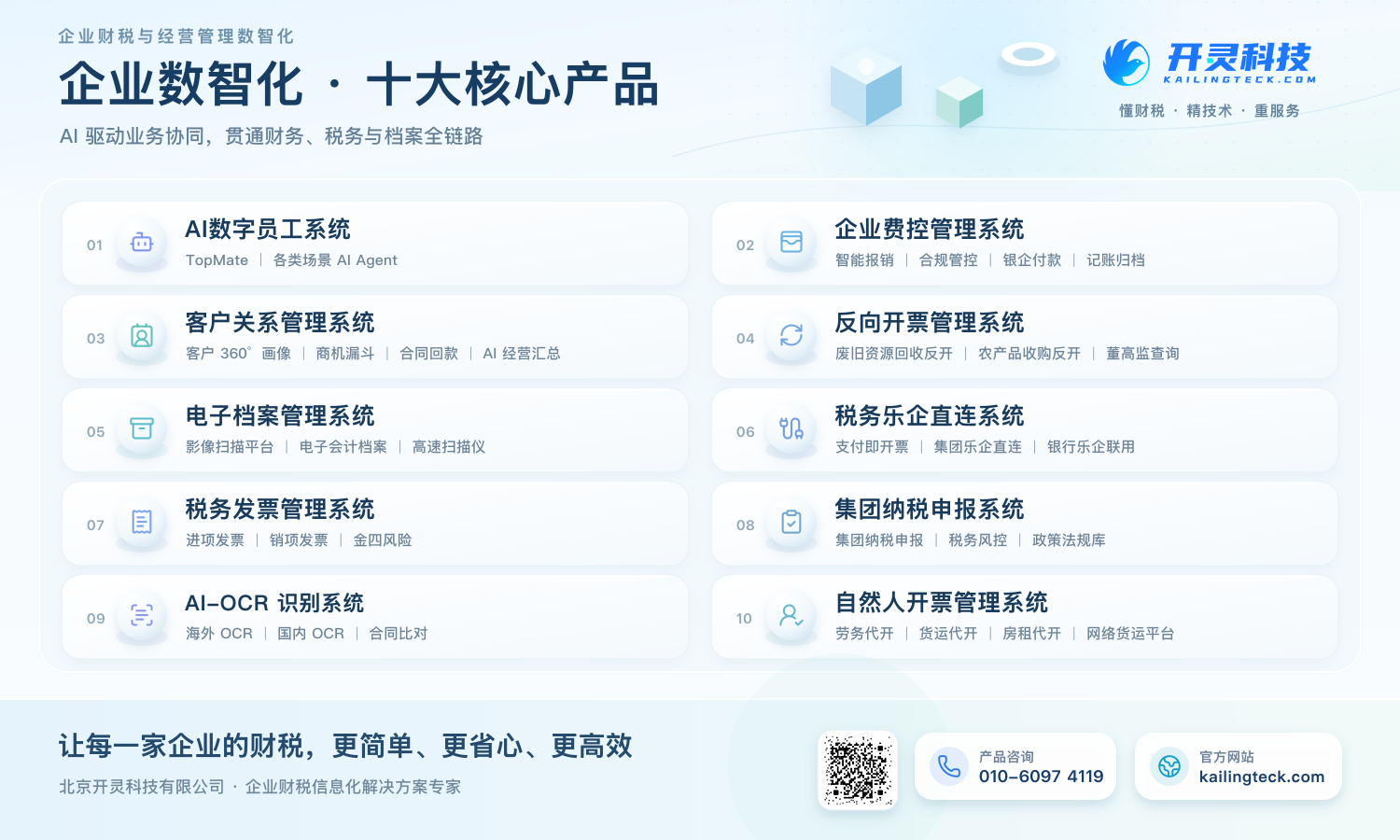
As a comprehensive business-finance-tax digitalization solution service provider, Kailing Technology provides business-finance-tax management digital transformation products and operational services for various government agencies, institutions, and large, medium, and small enterprises. The product line includes: solutions for sales contract management system, procurement contract management system, fully digitalized Leqi interface project, automatic output invoicing system, reverse invoicing system, invoice issuance for individuals system, employee expense control and reimbursement system, input VAT invoice management system, supply chain collaborative reconciliation system, image AI OCR recognition system, automatic financial bookkeeping system, electronic accounting archives system, etc., comprehensively driving the digitalization process across various fields.
Consultation Hotline: 18513895936 / 010-60974119 Location: Beijing