
Different difficulties in purchasing scrap steel, waste paper, and waste plastics? Kailing Technology resource recycling reverse invoicing system connects weighing, payment, and five-flow evidence retention
Scrap steel, waste paper, and waste plastics may all appear to be renewable resources, but once they enter the purchasing site, the recording priorities differ: scrap steel business focuses more on weighing, goods category, and acceptance results; waste paper business needs goods receipt records to correspond to actual measurement; waste plastics also require clear records of category and acceptance status. If an enterprise only solves "how to invoice" on the finance side, while goods receipt, weighing, payment, and archiving remain scattered, it will later be difficult to quickly answer "who sold it, what was received, how it was measured and accepted, how the invoice was issued, how payment was made, and where the evidence is."Kailing Technology Resource Recycling Reverse Invoicing System Starting from the actual procurement chain, integrate Individual profile creation、goods receipt and acceptance, reverse invoicing, bank payment and five-flow evidence retention are connected into the same business mainline, allowing different scrap categories to retain their own on-site record priorities while entering a unified compliance management framework.

▍1. Scrap steel, waste paper, and waste plastic each have their own difficulties—why can't we just manage "getting the invoice issued"?
Announcement No. 5 of 2024 of the State Taxation Administration clarifies the reverse invoicing arrangement for resource recycling business: within the applicable scope, enterprises may issue invoices to natural persons for scrapped products they sell. Enterprises therefore need to simultaneously manage seller identity, genuine transactions, invoicing and payment, and document retention.
Scrap steel purchasing starts with weighing and acceptance. If natural person information, weighing results, and invoicing data are scattered across different ledgers, even after invoices are issued, goods documents, invoices, and payments may not easily correspond.
Waste paper purchasing must record category, measurement, acceptance results, and seller. If only simple receipts are kept on site and finance supplements the materials at month-end, information is prone to gaps or inconsistency.
There are many categories of scrap plastic. On site, the focus is on goods and acceptance; in settlement, the focus is on the payee; in finance, the focus is on invoice materials. Each position keeps its own ledger, so the same transaction must be repeatedly checked.
Therefore, reverse invoicing in resource recycling is not an isolated invoicing button, but a complete process in which the seller, goods, funds, invoices, and evidence correspond to one another.
▍II. How does one acquisition main chain simultaneously handle three types of business
The three types of waste do not need to use the same on-site record form, but they can share one main business chain:Individual profile creation Verification,Goods receipt weighing or acceptance, reverse invoicing, or red-letter reversal,Bank-enterprise direct connection Payment, finally completed Five-flow archiving。
The first step is to confirm "who sold it." Enterprises establish seller files and verify the entity before invoicing, identifying and intercepting in advance situations that do not meet the criteria for individual sellers.
Step 2 records "what was received and how it was measured and accepted." Scrap steel focuses on weighing, scrap paper focuses on category and measurement, and scrap plastic focuses on specific category and acceptance; each goods order must be linked to the corresponding individual and transaction.
Step 3 handles “how to issue the invoice.” Once subject verification and business basis are complete, the system can call the electronic tax bureau interface for one-click reverse invoicing without login; when returns or adjustments occur, red-letter reversal is handled according to the process.
Step 4 explains "how the payment is made".Bank-enterprise direct connection Associate payment recipients and payment actions with the corresponding acquisitions and invoices.
Step 5 addresses "how evidence is retrieved." After self-certification, contract, business, tax, and fund materials are archived around the same transaction, goods documents, invoicing, payments, and retained materials can be viewed from the business records.
▍III. How the Kailing Technology resource recycling reverse invoicing system connects weighing, payment, and five-flow evidence retention
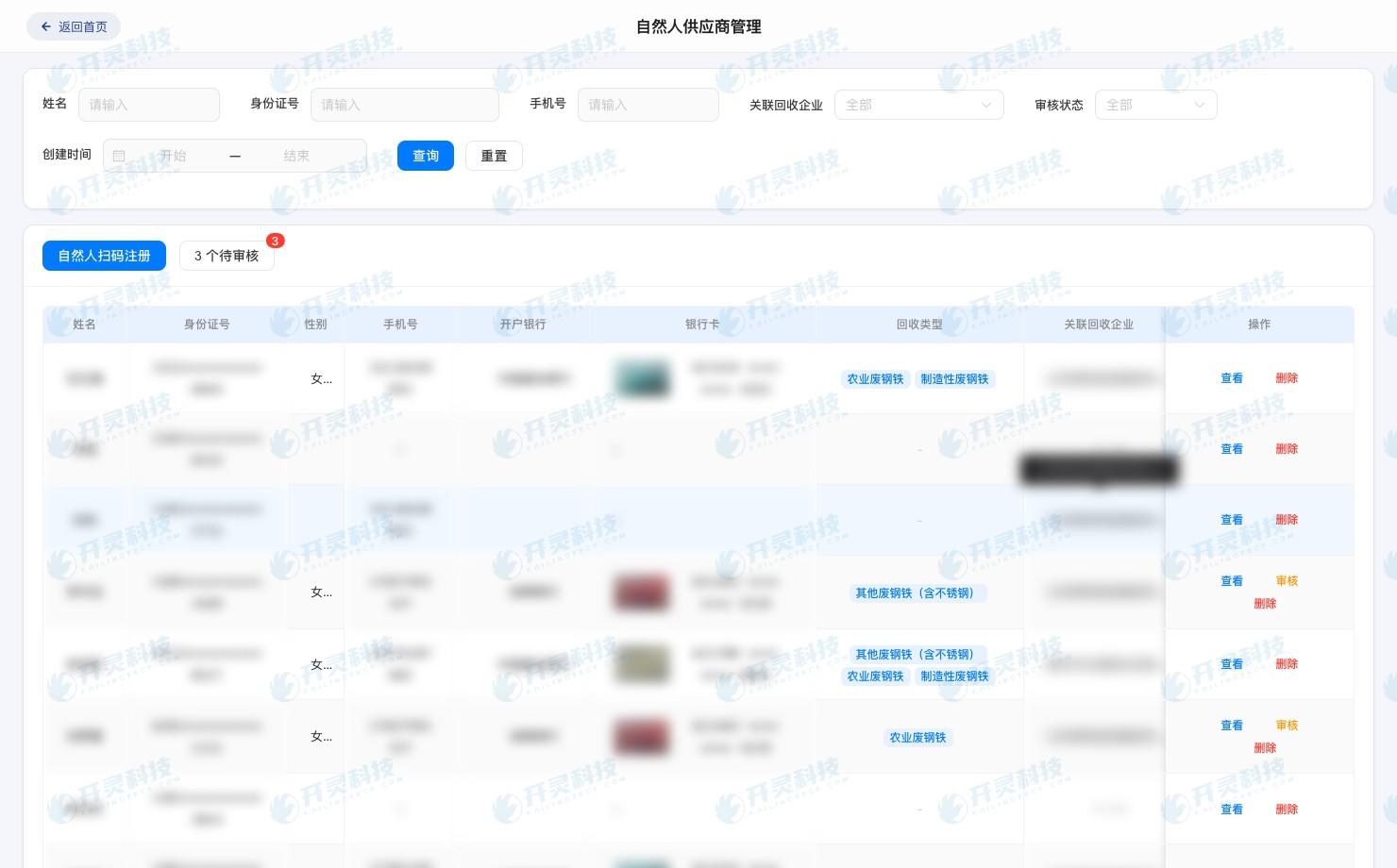
Kailing Technology Resource Recycling Reverse Invoicing System First, place control points at the business entry. After individual information is filed, the system automatically verifies the entity before invoicing and intercepts entities that do not meet the criteria for individual sellers. Compared with manual screening by finance after business completion, this approach helps handle problems before invoicing.
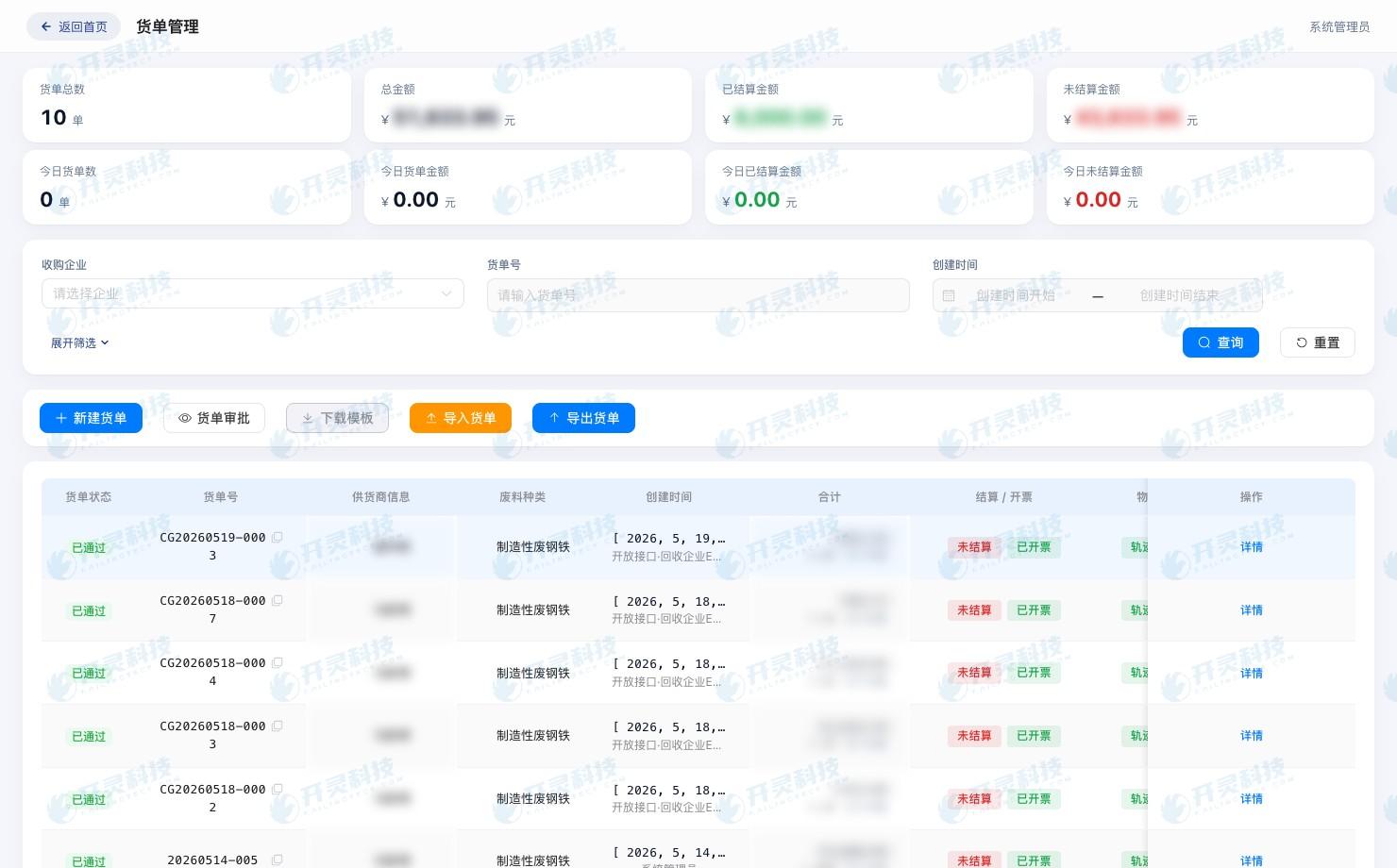
In the goods receipt stage, enterprises can form corresponding goods notes based on the business characteristics of scrap steel, waste paper, and waste plastics, linking sellers, goods, measurement, and acceptance records. Weighing is no longer just an on-site document, but a business basis jointly referenced by subsequent invoicing, payment, and archiving.
After entering the invoicing stage, the system supports one-click issuance and red-flushing without login through the electronic tax bureau interface, and reuses existing archives and business records to reduce duplicate transcription across multiple positions. Enterprises still need to review materials according to internal systems.
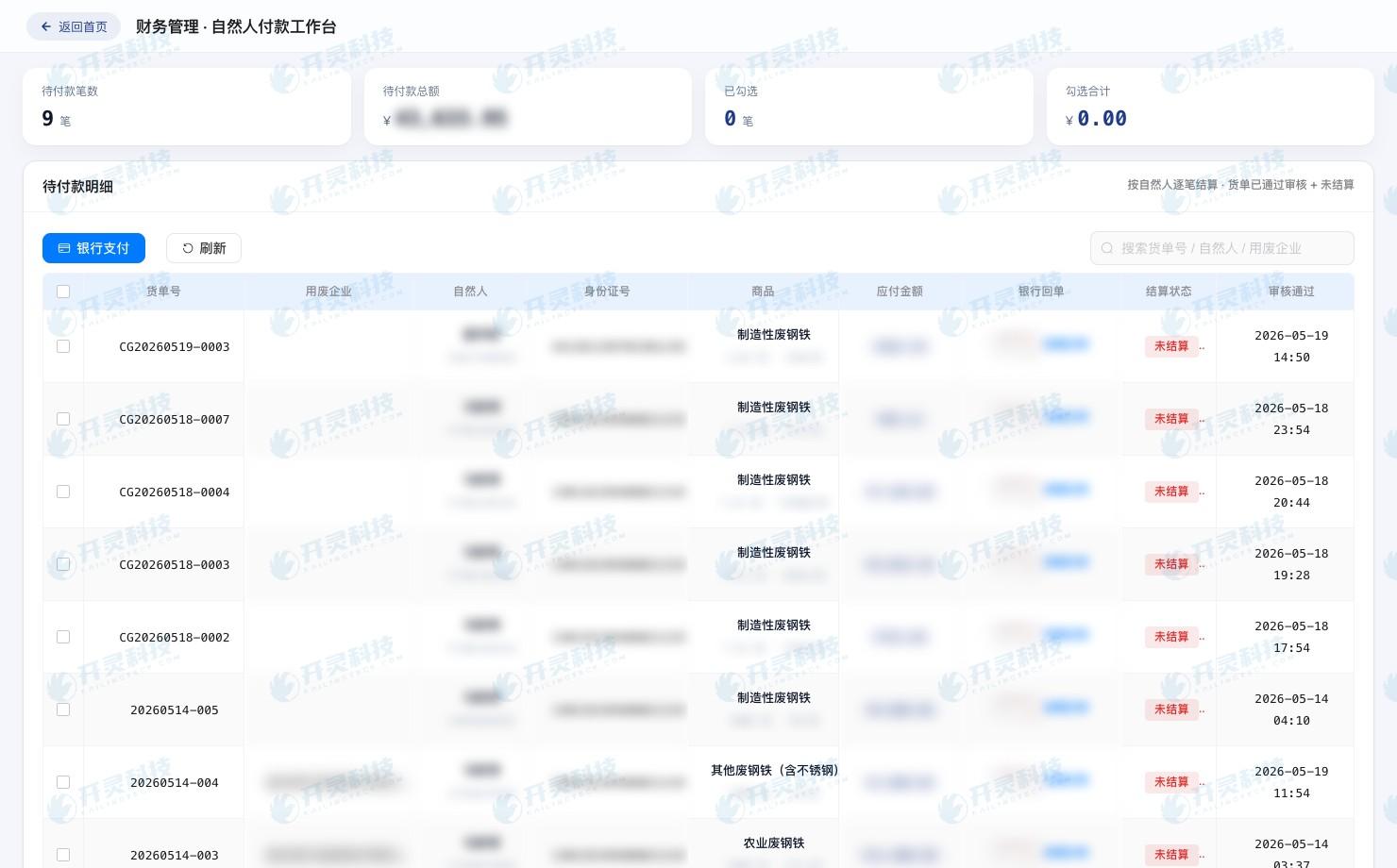
The payment step goes through Bank-enterprise direct connection Connect business data so that payments, procurement business, and invoices can be verified against the same record.
In the archiving process, Kailing Technology's reverse invoicing forms self-verification flow, contract flow, business flow, tax flow, and capital flow.Five flows in one Ledger. When facing daily reconciliation or data retrieval, enterprises can view the complete context along a single business transaction, without having to search back and forth among paper documents, financial files, and multiple business systems.
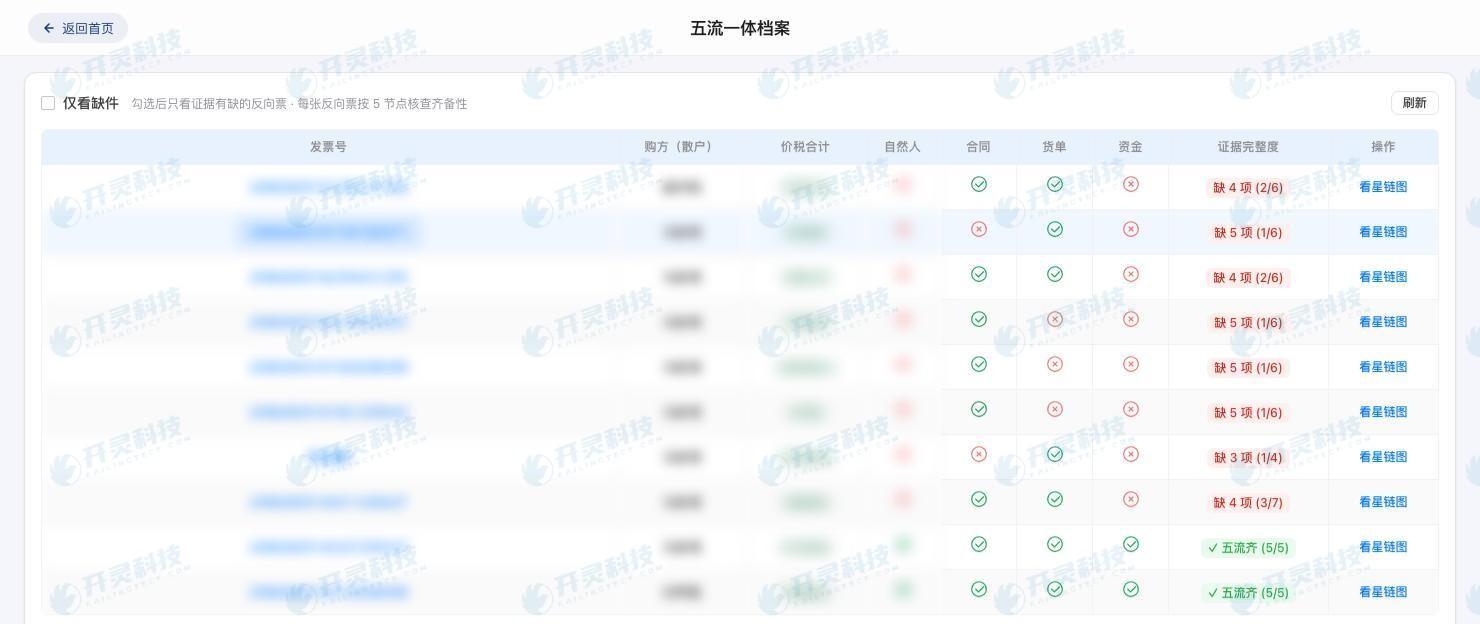
▍IV. Which evidence should be retained at the time of business occurrence for each of the three types of sites
At the scrap steel site, natural person files, goods, weighing, acceptance results, and settlement counterparties should be able to correspond. A scrap metal recycling enterprise used to keep records separately at the site, settlement, and finance, requiring cross-position searches during verification; after unifying the process, weighing records can flow along the goods document into invoicing, payment, and archiving.
At the waste paper site, continuous records can be formed around "seller - category - measurement and acceptance - settlement and invoicing," so that finance sees complete business with seller and goods receipt evidence.
For scrap plastic on site, attention should be paid to keeping category records consistent with the transaction entity and payee. If one batch of business involves multiple on-site records, ensure that each record can be traced to the corresponding individual and subsequent invoice and payment information, avoiding archiving materials from different sellers and different goods together.
The common principle is to let evidence form along with the business. On-site records capture the source information needed for invoicing and payment, and finance completes review, invoicing, and archiving along the business chain.
▍V. Before go-live, verify five conditions: qualifications, entity, goods order, payment, and archiving
First, verify the enterprise's qualifications. Enterprises can first check whether they have completed the filing as a renewable resource recycling operator, and then, in light of their business scope, check hazardous waste operation permits or qualifications related to end-of-life motor vehicle recycling and dismantling to confirm whether they meet the conditions.
Second, verify the seller entity. It should be clarified Individual profile creation Information needs to be collected and reviewed, and pre-invoicing entity verification should be set as a necessary step. When a entity that does not meet the criteria for a natural person seller is found, system interception is only the first step; the enterprise still needs to return to the business side to confirm the handling method that should be adopted.
Third, check the contents of the goods order. Separately organize the receipt fields for the three types of waste materials, so that the goods order explains the goods, measurement and acceptance, and is linked to the natural person profile; fields may differ, but the process should not be fragmented.
Fourth, verify the payment path. The payment recipient should correspond to the transaction entity, and the fund records must also be able to link to the goods documents and invoices. Adopt Bank-enterprise direct connection when, enterprises should simultaneously clarify internal review and payment authority, so that business processes and management systems are implemented together.
Fifth, verify the archiving rules. Clarify the source, confirmer, and collection identifier of the five categories of materials so that the five-flow ledger continuously accumulates along with the business.
System construction should not force the three types of waste materials into one business type; instead, it should preserve on-site differences while unifying the logic for entity verification, invoicing, payment, and archiving.
▍FAQ
Q: Which resource recycling enterprises can carry out reverse invoicing?
A: According to current policy interpretations, enterprises need to meet conditions related to resource recycling. When judging, check based on business scope whether the corresponding filing has been completed, or whether they hold hazardous waste operation permits or end-of-life motor vehicle recycling and dismantling qualifications; specific transactions must also meet the applicable requirements for reverse invoicing.
Q: Must scrap steel, waste paper, and waste plastic use exactly the same goods note?
A: Not necessary. The three types of business can set different recording priorities based on the characteristics of goods and on-site acceptance, but all goods documents should be associated with seller, goods, measurement and acceptance, invoicing, and payment information, and enter a unified archiving chain.
Q: Why must the natural person entity be verified before reverse invoicing?
A: Reverse invoicing has clear applicable entity standards. Entities that do not meet the individual seller standard, such as legal representatives, directors and senior executives, and registered individual businesses, need to be identified and intercepted before invoicing. Placing verification at the front end of the business helps reduce situations that must be handled after incorrect invoicing.
Q: What is the difference between five-flow evidence retention and saving only invoices?
A: Saving only invoices mainly preserves tax results and can hardly independently explain the entire acquisition business. Five-flow evidence archiving files self-verification, contract, business, tax, and fund materials around the same transaction, and can be used to answer questions such as who the seller is, what the goods are, how acceptance was performed, how invoicing was done, and how payment was made.
From individual profile creation and weighing upon receipt to payment, invoicing, and five-flow archiving, Kailing accompanies you through every transaction in resource recycling: https://www.kailingteck.com/fxzy/ .
As a comprehensive business-finance-tax digitalization solution service provider, Kailing Technology provides business-finance-tax management digital transformation products and operational services for various government agencies, institutions, and large, medium, and small enterprises. The product line includes:
Solutions for businesses including sales contract management system, procurement contract management system, fully digitalized Leqi interface project, output automatic invoicing system, reverse invoicing system, invoice issuance for individuals system, employee expense control and reimbursement system, input VAT invoice management system, supply chain collaborative reconciliation system, image OCR recognition system, automatic financial bookkeeping system, and electronic accounting archives system, comprehensively driving the digitalization process across various fields.
If you have any business-finance-tax digital transformation needs, welcome to contact us. Beijing Kailing Technology will serve you wholeheartedly.
Keywords: Scrap steel reverse invoicing, waste paper reverse invoicing, waste plastics reverse invoicing, resource recycling reverse invoicing system, Kailing Technology reverse invoicing, five-flow evidence retention, bank-enterprise direct connection
As a comprehensive business-finance-tax digitalization solution service provider, Kailing Technology provides business-finance-tax management digital transformation products and operational services for various government agencies, institutions, and large, medium, and small enterprises. The product line includes: solutions for sales contract management system, procurement contract management system, fully digitalized Leqi interface project, automatic output invoicing system, reverse invoicing system, invoice issuance for individuals system, employee expense control and reimbursement system, input VAT invoice management system, supply chain collaborative reconciliation system, image AI OCR recognition system, automatic financial bookkeeping system, electronic accounting archives system, etc., comprehensively driving the digitalization process across various fields.
Consultation Hotline: 18513895936 / 010-60974119 Location: Beijing