010-6097 4119Book a Demo


Must-read! Officially and authoritatively released by the tax bureau: Summary of input VAT deduction rules for agricultural productsPublished: 2025-12-15 17:43 Content timeliness statement (updated 2026-08-29) This article was originally published on 2025-12-15. The following are changes to current regulations related to this article since publication:
I. Term explanationAgricultural products refer to the primary products of various plants and animals produced by crop farming, animal husbandry, forestry, animal husbandry, and fisheries. The scope of taxation for agricultural products includes: plant category (grain, vegetables, tobacco leaves, tea leaves, horticultural plants, medicinal plants, oil plants, fiber plants, sugar plants, forestry products, other plants); animal category (aquatic products, livestock products, animal hides, animal wool and down, other animal tissues). Policy basis: Notice of the State Taxation Administration on Issuing the Annotations on the Scope of Taxation of Agricultural Products (Cai Shui Zi [1995] No. 52)
II. Policy Aggregation(1) Where purchased agricultural products are used for situations other than production and sales or entrusted and commissioned processing of goods subject to the 13% tax rate, input tax shall be deducted according to the following provisions: 1. Obtaining a VAT special invoice issued by a general taxpayer or a customs import VAT special payment certificate: the input tax amount is the VAT amount indicated on the VAT special invoice or customs import VAT special payment certificate. 2. Where VAT special invoices issued at a 3% levy rate are obtained from small-scale taxpayers that pay VAT under the simplified tax calculation method: input tax shall be calculated based on the amount stated on the VAT special invoice and a 9% deduction rate. (Special reminder:Until December 31, 2027, taxable sales income of small-scale VAT taxpayers subject to the 3% levy rate shall be subject to VAT at a reduced levy rate of 1%. When general taxpayers purchase agricultural products and obtain special VAT invoices issued by small-scale taxpayers at the 1% levy rate, they can only deduct 1%, not 9%.) 3. For agricultural product sales invoices obtained: The input VAT is calculated based on the agricultural product purchase price stated on the agricultural product sales invoice and a 9% deduction rate. (sales invoice refers to the general invoice issued by agricultural producers for the sale of self-produced agricultural products under the VAT exemption policy. The same below) 4. For issuing agricultural product purchase invoices: the input tax amount is calculated based on the agricultural product purchase price stated on the agricultural product purchase invoice and a 9% deduction rate. (II) Purchased agricultural products used for production and sales or commissioned processing of goods subject to the 13% tax rate shall have input tax deducted according to the following provisions: 1. Obtaining a VAT special invoice issued by a general taxpayer or a customs import VAT special payment certificate: (1) When purchasing agricultural products: the input tax amount is the VAT amount stated on the special VAT invoice or the customs import VAT special payment certificate; (2) When agricultural products are used: an additional 1% input VAT deduction. 2. Where VAT special invoices issued at a 3% levy rate are obtained from small-scale taxpayers that pay VAT under the simplified tax calculation method: (1) When purchasing agricultural products: the input tax amount is calculated based on the amount stated on the special VAT invoice and a 9% deduction rate; (2) When agricultural products are used: an additional 1% input VAT deduction. (Special reminder: when a general taxpayer purchases agricultural products and obtains a special VAT invoice issued by a small-scale taxpayer at a 1% levy rate, only 1% can be deducted, not 9%, and additional deduction cannot be applied.) 3. For agricultural product sales invoices obtained:(1) When purchasing agricultural products: the input tax amount is calculated based on the agricultural product purchase price stated on the agricultural product sales invoice and a 9% deduction rate; (2) When agricultural products are used: an additional 1% input VAT deduction. 4. For those issuing agricultural product purchase invoices:(1) When purchasing agricultural products: the input tax amount is calculated based on the agricultural product purchase price stated on the agricultural product purchase invoice and a 9% deduction rate; (2) When agricultural products are used: an additional 1% input VAT deduction. (3) Purchased agricultural products used both for producing and selling or entrusting processing of goods subject to the 13% tax rate and for producing and selling other goods and services: 1. The input VAT on agricultural products used for the production and sale, or commissioned or entrusted processing, of goods subject to the 13% tax rate and other goods and services shall be accounted for separately. 2. If not separately accounted for, the input tax amount shall be uniformly based on the VAT amount indicated on the VAT special invoice or the customs import VAT special payment statement, or calculated based on the agricultural product purchase price indicated on the agricultural product purchase invoice or sales invoice and a 9% deduction rate. (4) Reminders for important matters 1. Ordinary invoices obtained by taxpayers from purchasing vegetables and certain fresh meat and eggs that are eligible for VAT exemption at the wholesale and retail stages shall not be used as vouchers for calculating input tax deductions. 2. VAT ordinary invoices obtained from small-scale taxpayers that calculate and pay VAT at a 3% levy rate under the simplified tax calculation method shall not be used as vouchers for calculating input tax deductions. 3. Taxpayers included in the pilot scope of the approved deduction of input VAT on agricultural products shall still calculate input VAT in accordance with the approved deduction management measures when purchasing agricultural products. 4. The input tax amount of the following items shall not be deducted from the output tax amount: (1) Purchased goods, processing, repair and replacement labor, services, intangible assets, and real estate used for projects taxed under the simplified tax calculation method, VAT-exempt projects, collective welfare, or personal consumption. Among these, the fixed assets, intangible assets, and real estate involved refer only to fixed assets, intangible assets (excluding other equity intangible assets), and real estate exclusively used for the above projects. Taxpayers' social entertainment consumption belongs to personal consumption. (2) Purchased goods with abnormal losses, as well as related processing, repair and replacement services, and transportation services. (3) Purchased goods (excluding fixed assets), processing, repair and replacement services, and transportation services consumed by work-in-progress and finished goods with abnormal losses. (4) Real estate subject to abnormal losses, as well as purchased goods, design services, and construction services consumed for such real estate. (5) Purchased goods, design services, and construction services consumed for real estate under construction subject to abnormal losses. A taxpayer's new construction, reconstruction, expansion, repair, or decoration of real estate all constitute real estate under construction. (6) Purchased loan services, catering services, daily residential services, and entertainment services. (7) Other circumstances stipulated by the Ministry of Finance and the State Taxation Administration. Abnormal losses refer to situations where goods are stolen, lost, mildewed or deteriorated due to poor management, and where goods or real estate are confiscated, destroyed or dismantled according to law due to violation of laws and regulations.
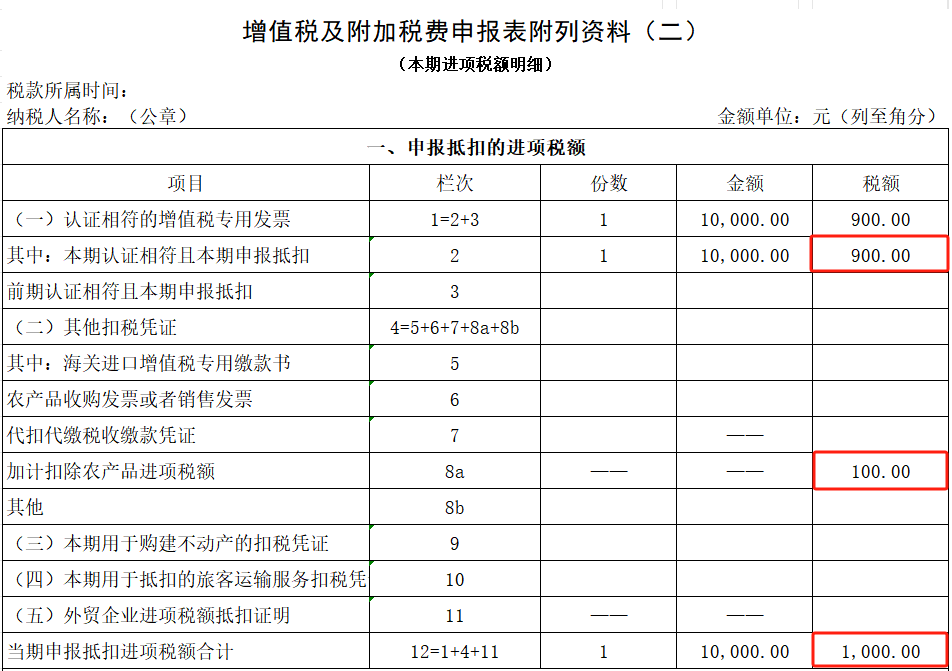
Note: 1. For purchased agricultural products used to produce and sell goods subject to a 13% tax rate or entrusted/commissioned processing, the input tax amount is calculated at a 10% deduction rate (that is, an additional 1% deduction on top of the 9% deduction rate). (Special reminder: when a general taxpayer purchases agricultural products and obtains a special VAT invoice issued by a small-scale taxpayer at a 1% levy rate, only 1% can be deducted, not 9%, and no additional deduction is allowed.) 2. For agricultural products purchased for both the production and sale or commissioned processing of goods subject to the 13% tax rate and for the production and sale of other goods and services, the input VAT on agricultural products used for the production and sale or commissioned processing of goods subject to the 13% tax rate and other goods and services shall be accounted for separately. If not accounted for separately, the input VAT shall be uniformly calculated based on the VAT amount indicated on the VAT special invoice or customs import VAT payment certificate, or based on the agricultural product purchase price indicated on the agricultural product purchase invoice or sales invoice and the 9% deduction rate. III. Case AnalysisScenario 1 A general VAT taxpayer A, a nursery stock sales enterprise, purchased nursery stock from general VAT taxpayer B and obtained a special VAT invoice issued by Enterprise B, with the amount stated on the invoice being 1 million yuan and the tax amount being 90,000 yuan. So Enterprise A can deduct the input tax amount based on the tax amount of 90,000 yuan stated on the special VAT invoice. Scenario 2 A general VAT taxpayer A, a fruit sales enterprise, purchased fruit from overseas, with the customs duty-paid value being 1 million yuan, and the tax amount stated on the Customs Import VAT Special Payment Statement being 90,000 yuan. So Enterprise A can deduct the input tax amount based on the tax amount of 90,000 yuan stated on the customs import special VAT payment certificate. Scenario 3 A general VAT taxpayer A, a flower sales enterprise, purchased flowers from small-scale taxpayer B. It obtained a special VAT invoice issued by B at a 3% levy rate, with the amount stated on the invoice being 1 million yuan and the tax amount being 30,000 yuan.. So Enterprise A can calculate the input tax amount based on the amount stated on the special VAT invoice and a 9% deduction rate. The deductible input tax amount is 1 million yuan * 9% = 90,000 yuan. Scenario 4 A general VAT taxpayer A, a flower sales enterprise, purchased flowers from small-scale taxpayer B. It obtained a special VAT invoice issued by B at a 1% levy rate, with the amount stated on the invoice being 1 million yuan and the tax amount being 10,000 yuan.. So Enterprise A can deduct the input tax amount based on the tax amount of 10,000 yuan stated on the special VAT invoice. Scenario 5 A general VAT taxpayer A, a nursery stock sales enterprise, purchased self-produced nursery stock from agricultural producer B and obtained an agricultural product sales invoice self-issued by B, with the purchase price being 1 million yuan. So Enterprise A can calculate the input tax amount based on the agricultural product purchase price stated on the agricultural product sales invoice and a 9% deduction rate. The deductible input tax amount is 1 million yuan * 9% = 90,000 yuan. Scenario 6 A general VAT taxpayer A, a nursery stock sales enterprise, purchased nursery stock grown by individual B, and Enterprise A issued an agricultural product purchase invoice, with the purchase price being 1 million yuan. So Enterprise A can calculate the input tax amount based on the agricultural product purchase price stated on the agricultural product purchase invoice and a 9% deduction rate. The deductible input tax amount is 1 million yuan * 9% = 90,000 yuan. Scenario 7 A certain general VAT taxpayer Jia purchased tax-exempt agricultural products such as vegetables, eggs, and meat from a wholesale market and obtained a VAT ordinary invoice, with an amount stated on the invoice of 1 million yuan. So the deductible input tax amount for Enterprise A is 0. Scenario 8 A general VAT taxpayer A, a fruit canned food production and sales enterprise, purchased fruit from general VAT taxpayer B and obtained a special VAT invoice issued by Enterprise B, with the amount stated on the invoice being 1 million yuan and the tax amount being 90,000 yuan. Because a general taxpayer produces and sells canned fruit, the applicable tax rate is 13%. Therefore, when Enterprise A purchases this batch of fruit, it may deduct the input VAT of 90,000 yuan indicated on the special VAT invoice; at the same time, when the fruit is used in production, an additional 1% input VAT deduction may be added (100*1%=10,000 yuan), for a total deductible input VAT of 100,000 yuan. Scenario 9 A general VAT taxpayer A, a fruit canned food production and sales enterprise, purchased fruit from small-scale taxpayer B and obtained a special VAT invoice issued by Enterprise B, with the amount stated on the invoice being 1 million yuan and the tax amount being 30,000 yuan. Because a general taxpayer produces and sells canned fruit, the applicable tax rate is 13%. Therefore, when Enterprise A purchases this batch of fruit, it may calculate the input VAT based on the amount indicated on the special VAT invoice and the 9% deduction rate (100*9%=90,000 yuan). At the same time, when the fruit is used in production, an additional 1% input VAT deduction may be added (100*1%=10,000 yuan), for a total deductible input VAT of 100,000 yuan. Scenario 10 A general VAT taxpayer A, a fruit canned food production and sales enterprise, purchased fruit from small-scale taxpayer B and obtained a special VAT invoice issued by Enterprise B, with the amount stated on the invoice being 1 million yuan and the tax amount being 10,000 yuan. When a general taxpayer purchases agricultural products and obtains a VAT special invoice issued by a small-scale taxpayer at a 1% levy rate, only 1% may be deducted, not 9%, and no additional deduction may be applied. Therefore, the deductible input tax amount is 10,000 yuan. Scenario 11 A general VAT taxpayer A, a fruit canned food production and sales enterprise, engages in fruit sales business in addition to producing canned food. It purchased fruit from small-scale taxpayer B and obtained a special VAT invoice self-issued by Enterprise B, with the amount stated on the invoice being 1 million yuan and the tax amount being 30,000 yuan. A did not separately account for the input VAT corresponding to canned food production and sales and direct fruit sales. Because a general taxpayer produces and sells canned fruit, the applicable tax rate is 13%, while the applicable tax rate for selling fruit is 9%. The VAT corresponding to these two businesses was not separately accounted for. Therefore, when Enterprise A purchases this batch of fruit, it may only deduct the input VAT of 30,000 yuan indicated on the special VAT invoice, and at the same time cannot enjoy the additional 1% deduction preference. IV. Report filling1. A general taxpayer enterprise A purchased beef tails from a small-scale taxpayer B in March 2024 for the production of scoured wool (13% tax rate), and obtained a VAT special invoice issued by B itself, with a face amount of 10,000 yuan, a levy rate of 3%, a tax amount of 300 yuan, and a total price and tax of 10,300 yuan, all of which were issued for production use in the same month. (Assume enterprise A has already completed the input tax deduction selection and confirmation for this invoice during the filing period.) Parsing: 1. When enterprise A purchases beef tails, it may calculate the deductible input tax based on the amount stated on the VAT special invoice issued by enterprise B and a 9% deduction rate. Deductible input tax amount = 10000*9% = 900 (yuan). 2. Because it is used for the production and sale of goods subject to a 13% tax rate, an additional 1% input tax deduction may be claimed when put into production use. Additional deductible input tax amount = 10000*1% = 100 (yuan). Total deductible input VAT = 900 + 100 = 1000 (yuan). The Supplementary Information to the VAT and Surcharge Return (Form 2) is filled out as follows:
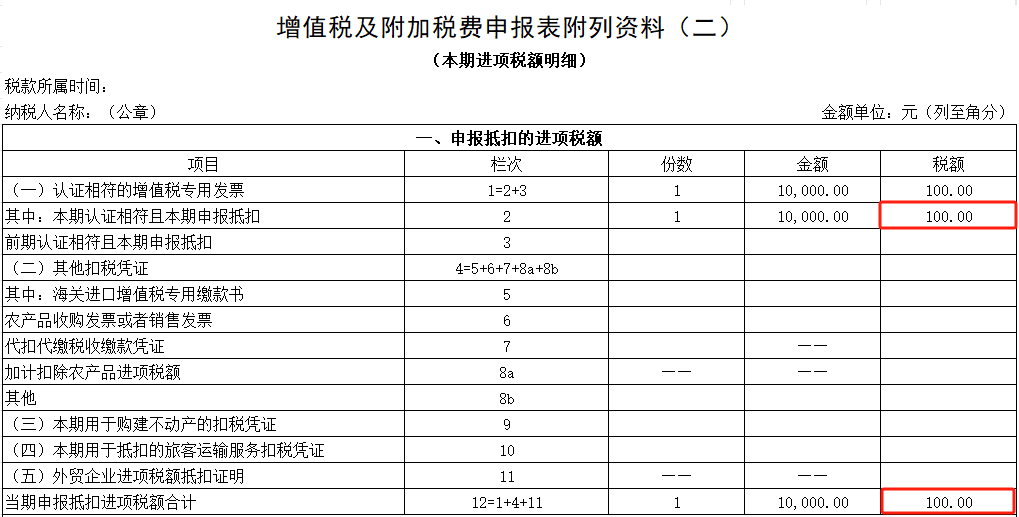
2. A certain general taxpayer enterprise C purchased oxtail from small-scale taxpayer D in March 2024 for the production of scoured wool (13% tax rate), obtained a VAT special invoice self-issued by B, with a face amount of 10,000 yuan, a levy rate of 1%, a tax amount of 100 yuan, and a total price and tax of 10,100 yuan, all of which were issued from the warehouse for production use that month. (Assume that enterprise C has already checked and confirmed the input tax deduction for this invoice during the filing period.) Parsing: When a general taxpayer purchases agricultural products and obtains a VAT special invoice issued by a small-scale taxpayer at a 1% levy rate, only 1% may be deducted, not 9%, and no additional deduction may be applied. Therefore, the deductible input tax amount is 100 yuan. The Supplementary Information to the VAT and Surcharge Return (Form 2) is filled out as follows:
Source: Hunan Tax As a comprehensive business-finance-tax digitalization solution service provider, Kailing Technology provides business-finance-tax management digital transformation products and operational services for various government agencies, institutions, and large, medium, and small enterprises. The product line includes: Sales contract management system, procurement contract management system, fully digitalized Leqi interface project, output automatic invoicing system,Reverse invoicing system,Solutions for the invoice issuance for individuals system, employee expense control and reimbursement system, input VAT invoice management system, supply chain collaborative reconciliation system, image AI OCR recognition system, automated financial bookkeeping system, electronic accounting archives system, and other businesses, comprehensively advancing the digitalization process across various fields. If you have any business-finance-tax digital transformation needs, welcome to contact us. Beijing Kailing Technology will serve you wholeheartedly.
|