010-6097 4119Book a Demo


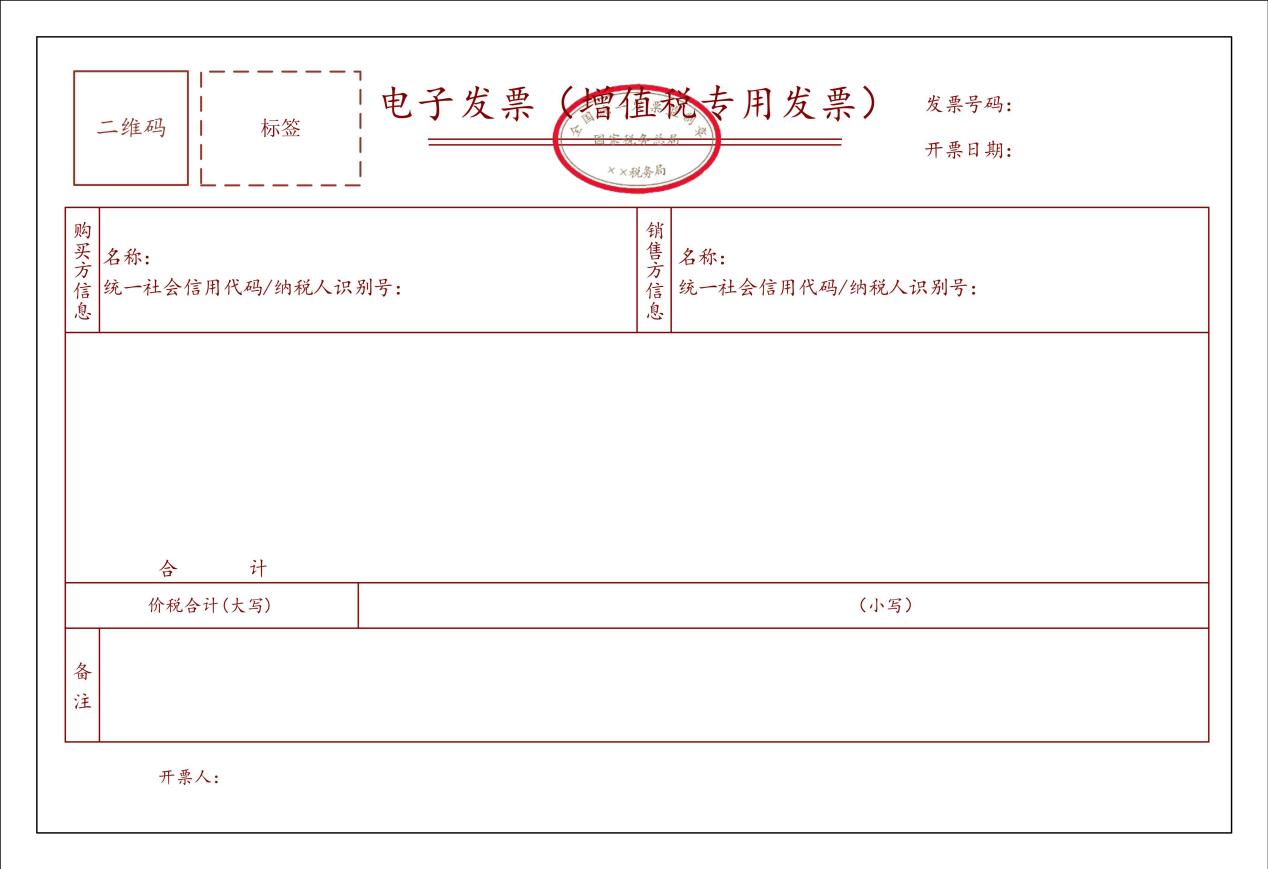
[Official] The most complete on the internet! A summary display of sample invoices across all industries for fully digitalized e-invoices by the State Taxation AdministrationPublished: 2025-12-12 20:08 Announcement of the State Taxation Administration on Promoting the Application of Fully Digitalized E-InvoicesHistorical evolutionNovember 12, 2024 Announcement of the State Taxation Administration on Promoting the Application of Fully Digitalized E-Invoices State Taxation Administration Announcement No. 11 of 2024, effective December 1, 2024 BodyTo implement the requirements clearly stated in the Opinions on Further Deepening the Reform of Tax Collection and Administration by the General Office of the CPC Central Committee and the General Office of the State Council to "steadily implement the reform of invoice electronicization" and "basically achieve electronicization of invoices in all fields, all links, and all elements, and strive to reduce institutional transaction costs," since the pilot implementation of fully digitalized e-invoices (hereinafter referred to as fully digitalized e-invoices) in Guangdong Province, Shanghai Municipality, and Inner Mongolia Autonomous Region on December 1, 2021, the pilot areas have gradually expanded to the whole country. The pilot implementation work has been smooth and orderly, achieving positive results in optimizing the business environment, enhancing administrative efficiency, and facilitating the digital transformation of the economy and society. The State Taxation Administration has decided to officially promote the application of fully digitalized e-invoices nationwide, and the relevant matters are hereby announced as follows: I. Fully digitalized e-invoice is a type of "electronic invoice" in the "Measures of the People's Republic of China for the Administration of Invoices" is a type of "electronic invoice" in which all invoice face elements are fully digitalized, numbers are uniformly assigned nationwide, invoicing quotas are intelligently granted, and information is automatically circulated between tax authorities and taxpayers through tax digital accounts and other means. Fully digitalized e-invoices have the same legal effect as paper invoices. II. Fully digitalized e-invoices have a single copy and exist in digital form. Categories include electronic invoice (VAT special invoice), electronic invoice (general invoice), electronic invoice (air transport electronic passenger ticket itinerary), electronic invoice (railway electronic passenger ticket), electronic invoice (motor vehicle sales unified invoice), electronic invoice (used vehicle sales unified invoice), etc. Fully digitalized e-invoices can generate invoices for specific businesses such as construction services, refined oil, and scrapped product acquisition based on specific business tags. (See Attachment 1 for the format.) III. The basic contents of a fully digitalized e-invoice include: invoice name, invoice number, invoicing date, buyer information, seller information, project name, specification and model, unit, quantity, unit price, amount, tax rate/levy rate, tax amount, subtotal, total amount including tax, remarks, invoicer, etc. IV. The number of a fully digitalized e-invoice is 20 digits, of which: the 1st-2nd digits represent the last two digits of the Gregorian calendar year, the 3rd-4th digits represent the provincial tax bureau regional code where the issuer is located, the 5th digit represents information such as the issuance channel, and the 6th-20th digits are the sequential code. V. Tax authorities shall build a nationally unified electronic invoice service platform to provide free fully digitalized e-invoice issuance and usage services. For those that do not use online tax handling as required, do not have network conditions, or present major tax-related risks, services may be temporarily not provided, and the specific circumstances shall be determined by provincial tax authorities. VI. Tax authorities grant a total invoice quota through the electronic invoice service platform based on factors such as the taxpayer's tax risk level, tax credit rating, and actual business situation, and implement dynamic adjustment. The total invoice quota refers to the upper limit of the total amount of invoices issued by a taxpayer (excluding VAT) within one natural month. If a taxpayer needs to adjust the total invoice quota due to changes in actual business conditions, it shall be adjusted after confirmation by the competent tax authority. VII. According to theMeasures of the People's Republic of China for the Administration of Invoices》《Implementing Rules for the Measures of the People's Republic of China for the Administration of Invoices" and other relevant provisions, the issuance of fully digitalized e-invoices requires identity verification through real-person authentication and other means. Eight, after a blue-letter fully digitalized e-invoice is issued, if sales returns (including full returns and partial returns), incorrect invoicing, suspension of taxable services (including full suspension and partial suspension), sales discounts, and other circumstances occur, a red-letter fully digitalized e-invoice shall be issued in accordance with regulations. (1) If the blue fully digitalized e-invoice has not undergone purpose confirmation and accounting confirmation, the issuer initiates the red-offset process and directly issues a red fully digitalized e-invoice. For agricultural product purchase invoices, scrapped product purchase invoices, photovoltaic purchase invoices, etc., regardless of whether purpose confirmation or accounting confirmation has been carried out, the issuer initiates the red-offset process and directly issues a red fully digitalized e-invoice. (II) Where the blue-letter fully digitalized e-invoice has already undergone purpose confirmation or accounting confirmation (those used for export tax refund selection and confirmation shall still follow current regulations), either the invoicing party or the invoice recipient may initiate the red-letter reversal process, and after the other party confirms the Confirmation Form for Red-Letter Invoice Information (hereinafter referred to as the Confirmation Form, see Appendix 2), the invoicing party shall issue the red-letter fully digitalized e-invoice. If the Confirmation Form is not confirmed within 72 hours after initiation, it shall automatically become void. If the blue-letter fully digitalized e-invoice has been used for export tax refund selection and confirmation, the purchase voucher information must be returned and confirmed as passed, after which the invoicing party shall initiate the red-letter reversal process and directly issue the red-letter fully digitalized e-invoice. If the invoice recipient has already used the fully digitalized e-invoice for VAT declaration and deduction, it shall temporarily transfer the VAT amount listed in the Confirmation Form out of the current period's input tax; after obtaining the red-letter fully digitalized e-invoice issued by the issuer, it shall be used together with the Confirmation Form as an accounting voucher. IX. Issued fully digitalized e-invoices are automatically delivered through the electronic invoice service platform. The invoicing party may also deliver fully digitalized e-invoices via email, QR code, download and print, and other methods. If the download and print delivery method is chosen, the face of the fully digitalized e-invoice will automatically be marked and display the "download count" and "print count." 10. After the invoice recipient obtains a fully digitalized e-invoice, if it needs to be used to declare and deduct VAT input tax, refined oil consumption tax, or to apply for export tax refund, tax refund on behalf of others, or to select refined oil inventory, the purpose shall be confirmed through the tax digital account. If the confirmed purpose is incorrect, an application for correction may be made to the competent tax authority. 11. Units and individuals may log in to their own tax digital accounts and the Individual Income Tax APP to freely query, download, print, and export fully digitalized e-invoices they have issued or received; they may mark whether fully digitalized e-invoices have been recorded in accounts through the tax digital account; they may use the electronic invoice service platform orNational VAT Invoice Verification Platform, free verification of fully digitalized e-invoice information. 12. This announcement shall take effect on December 1, 2024. Hereby announced. Fully digitalized e-invoice formatsElectronic invoice (VAT Special Invoice) sample
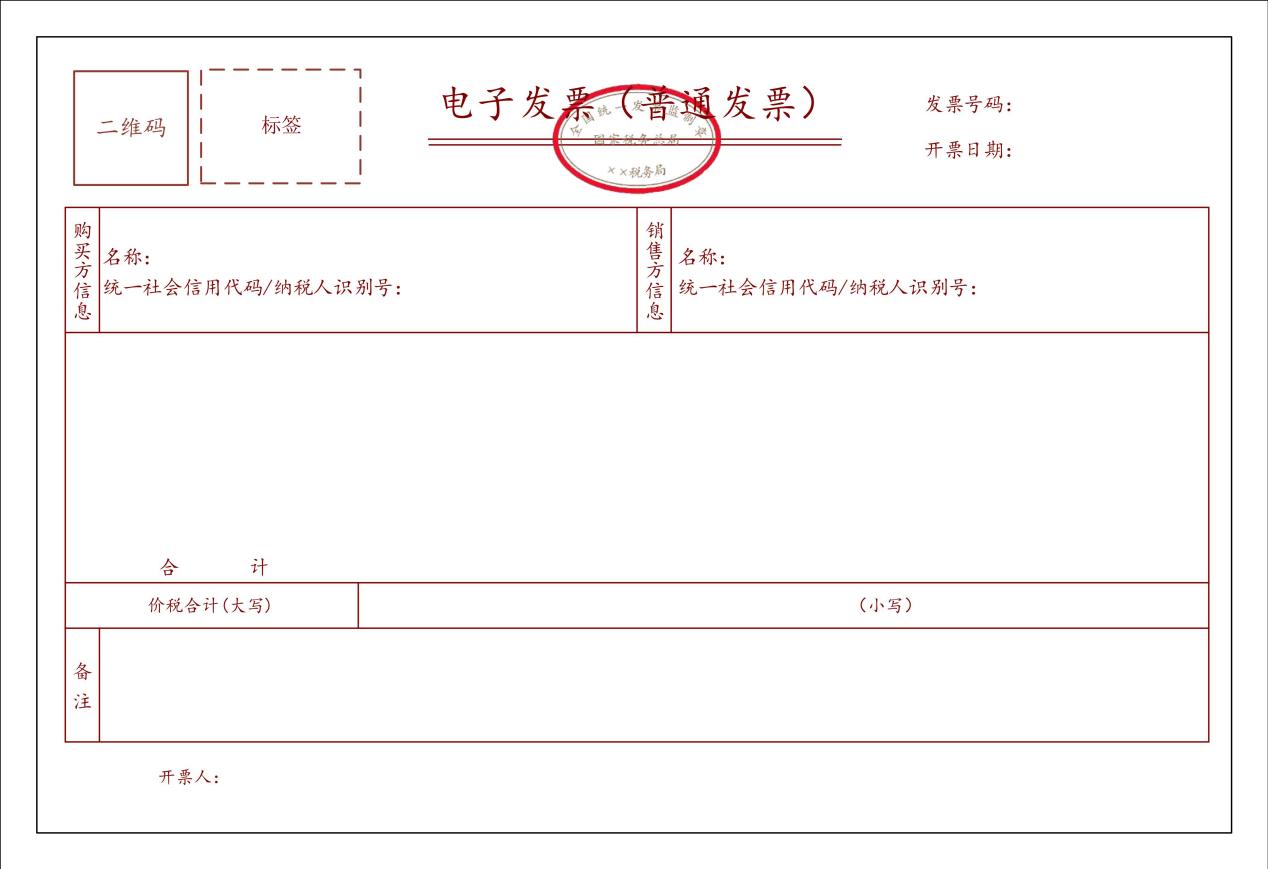
Electronic invoice (General Invoice) sample
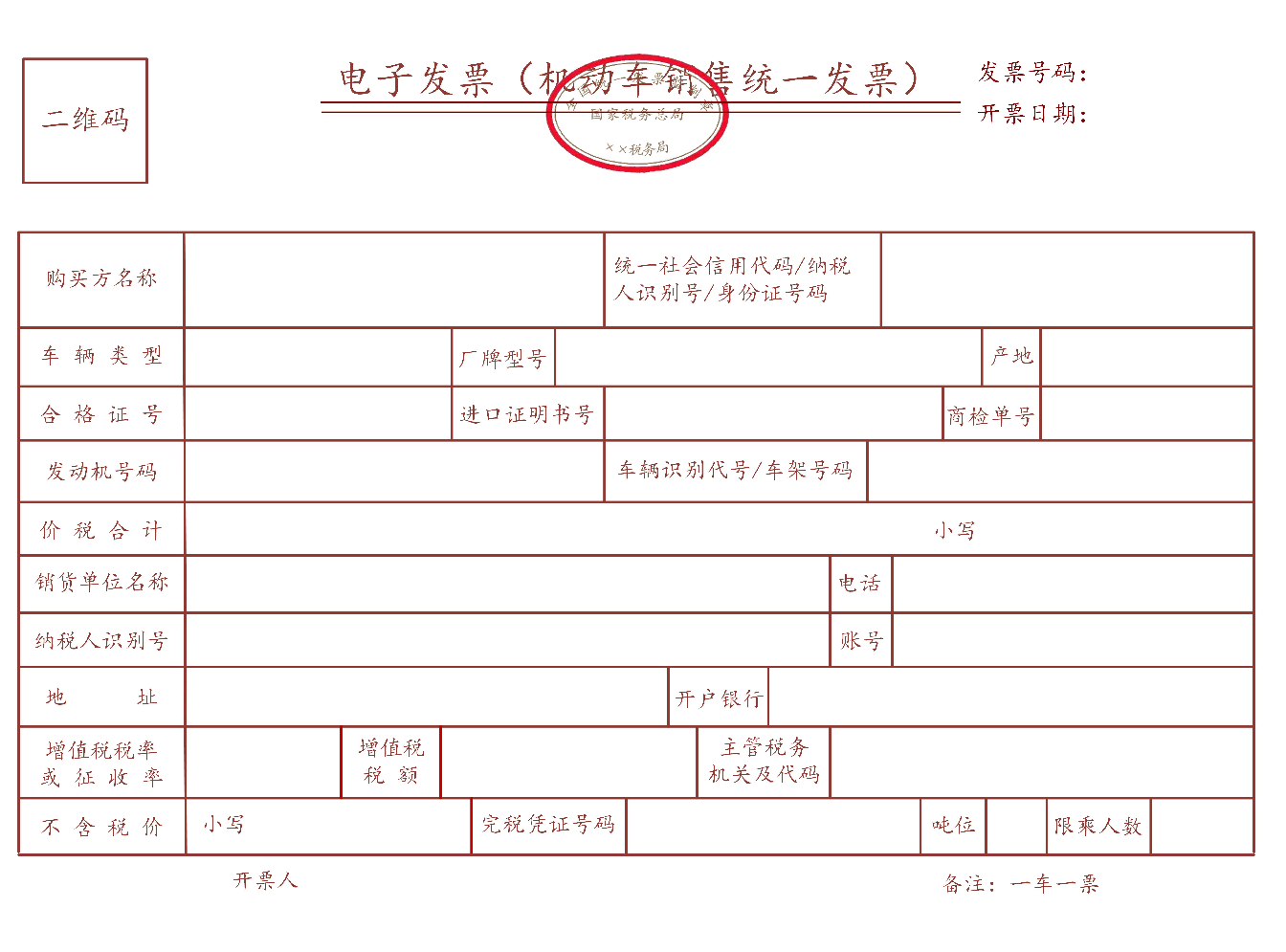
Electronic invoice (Motor Vehicle Sales Unified Invoice) sample
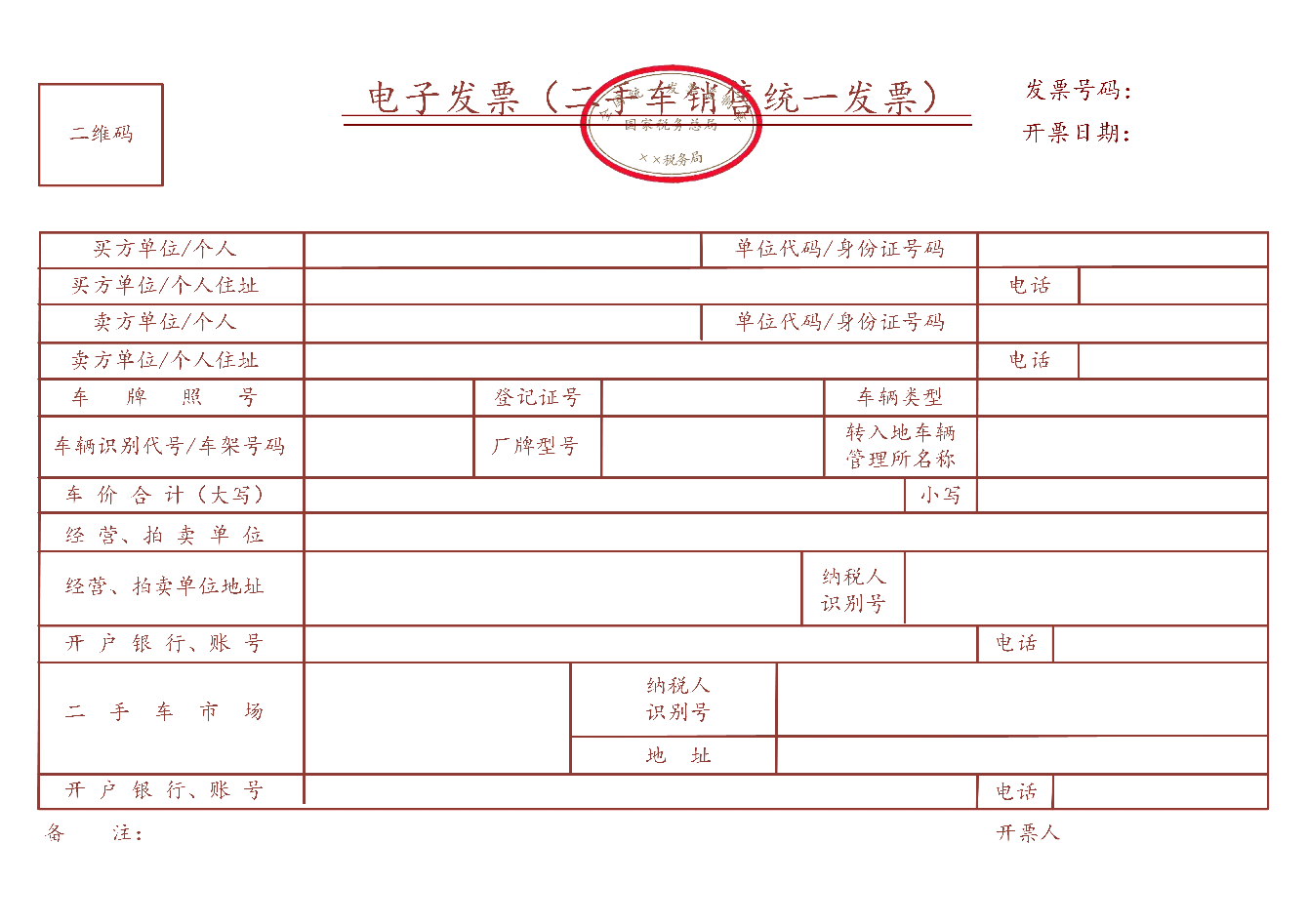
Electronic invoice (Used Car Sales Unified Invoice) sample
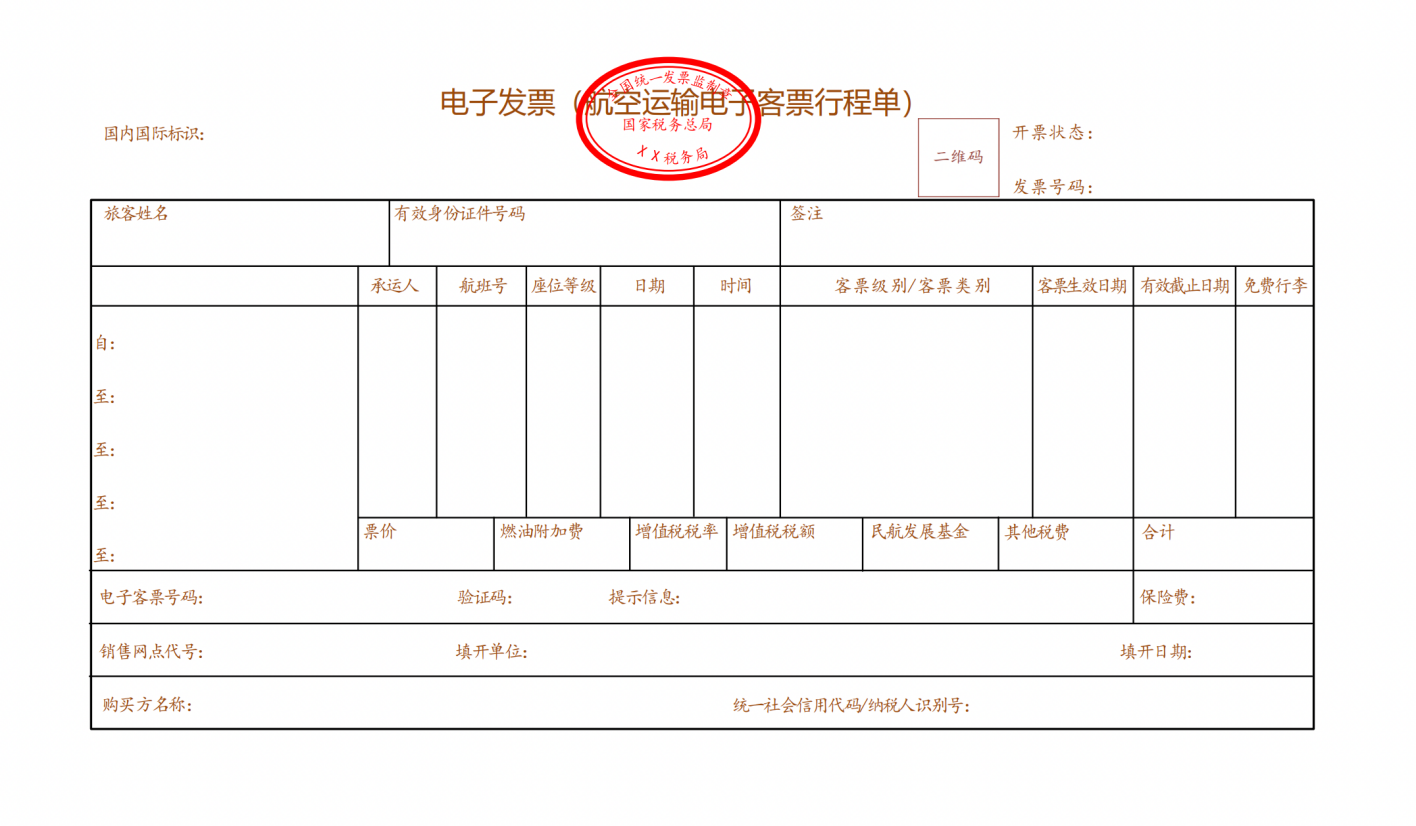
Electronic invoice (Air Transport Electronic Ticket Itinerary) sample
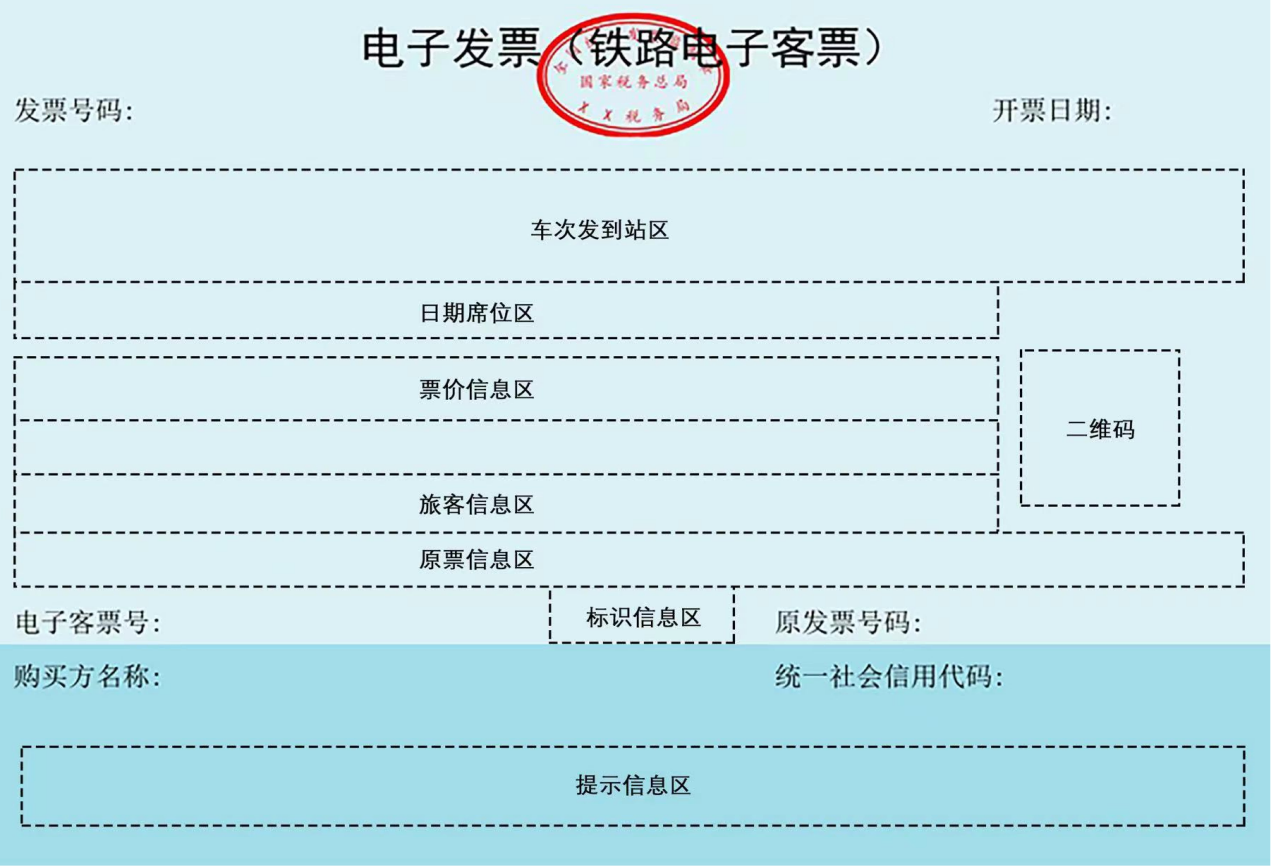
Electronic invoice (railway electronic ticket) sample
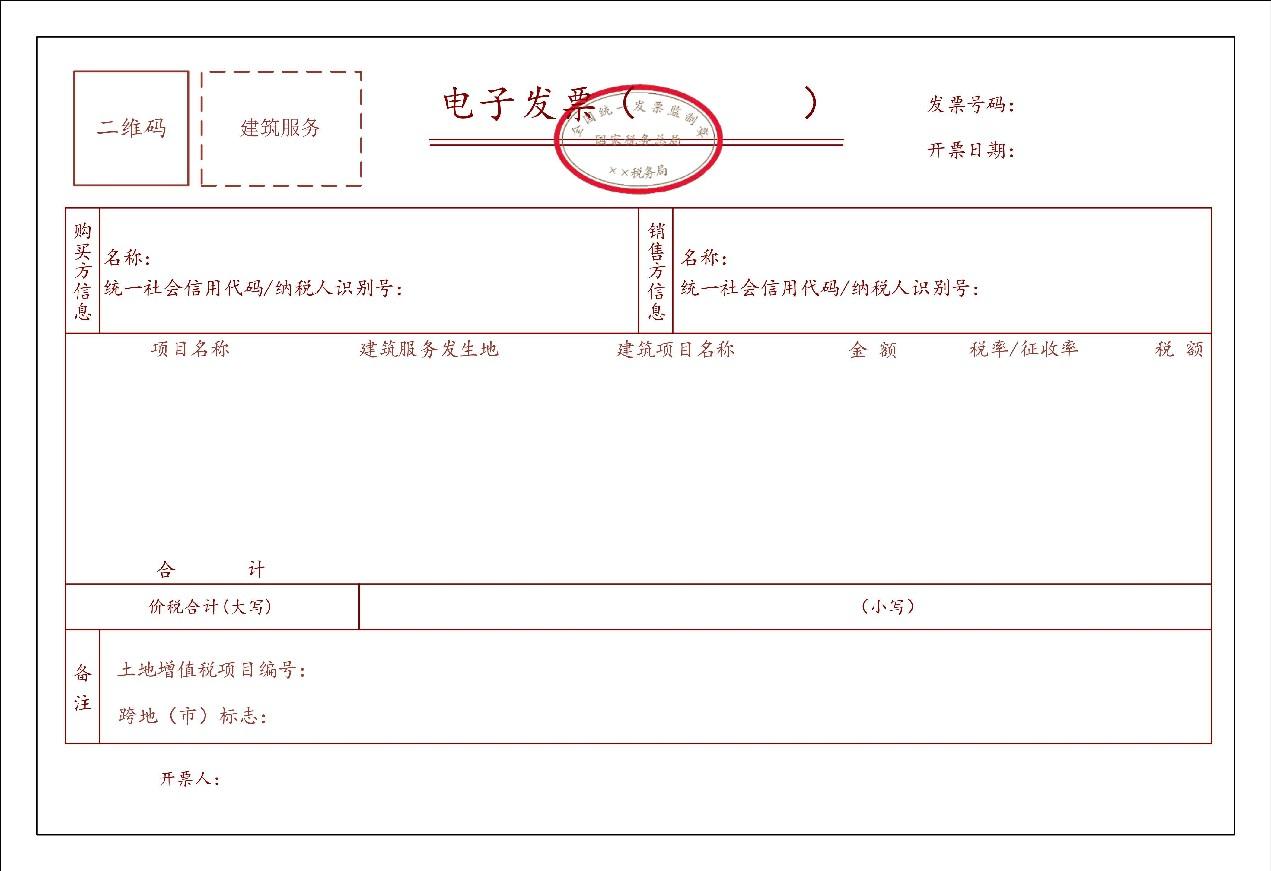
Construction service invoice sample
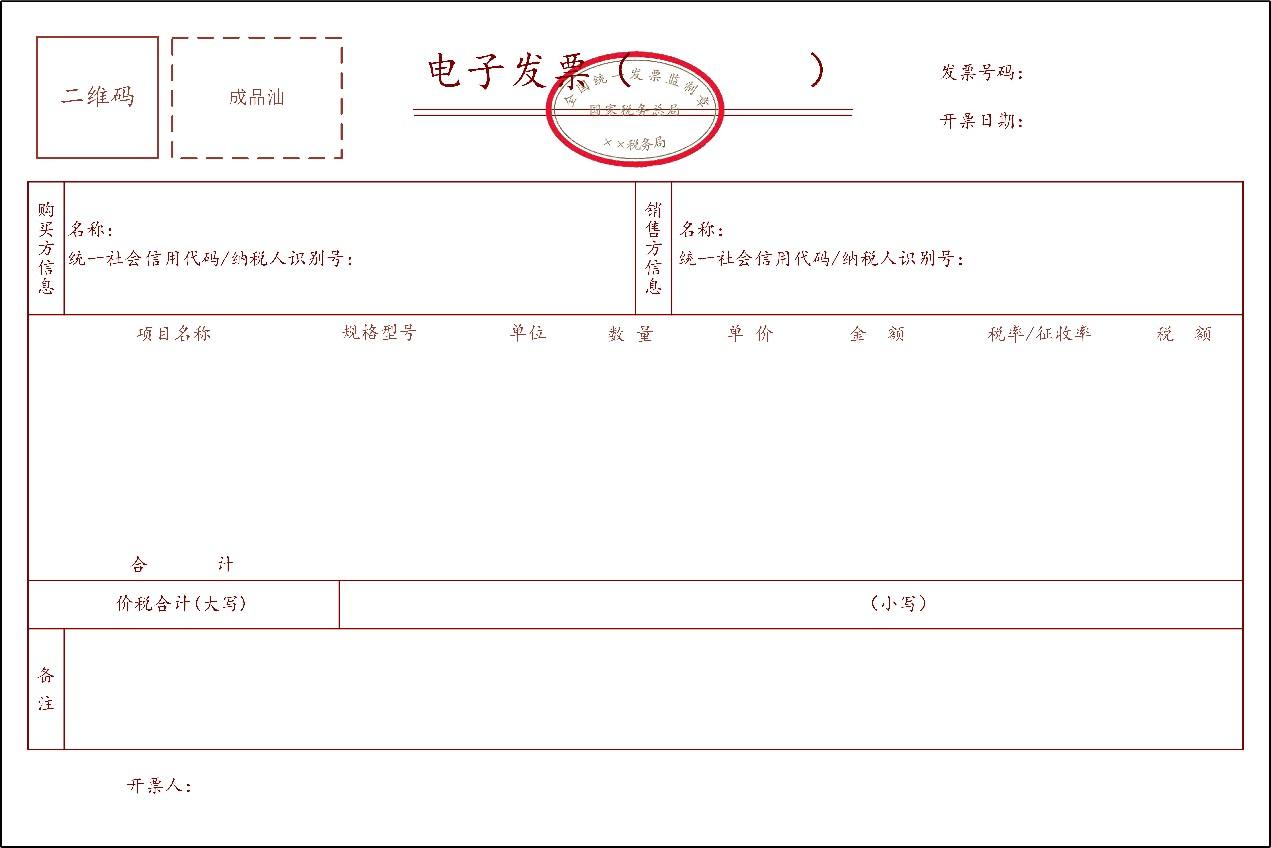
Refined oil invoice sample
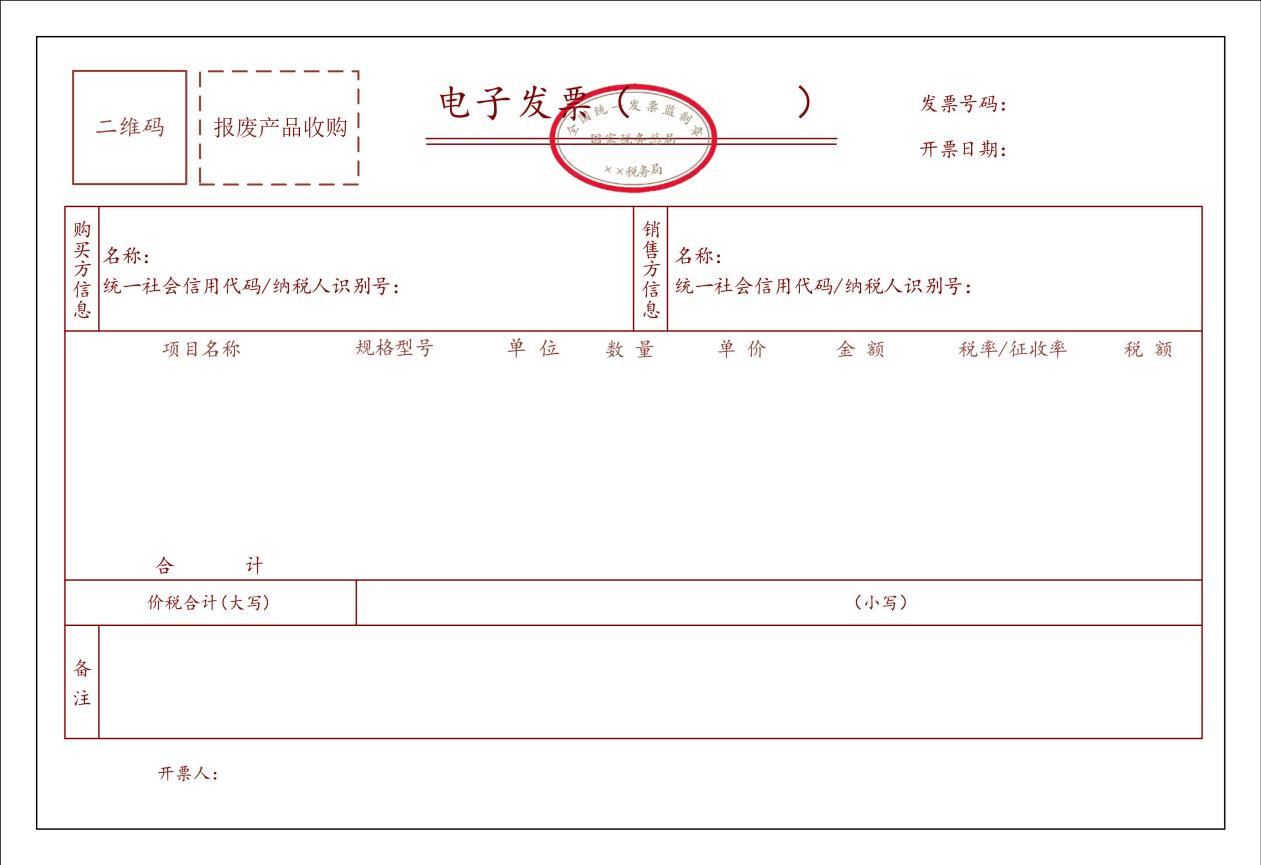
Scrap product purchase invoice sample
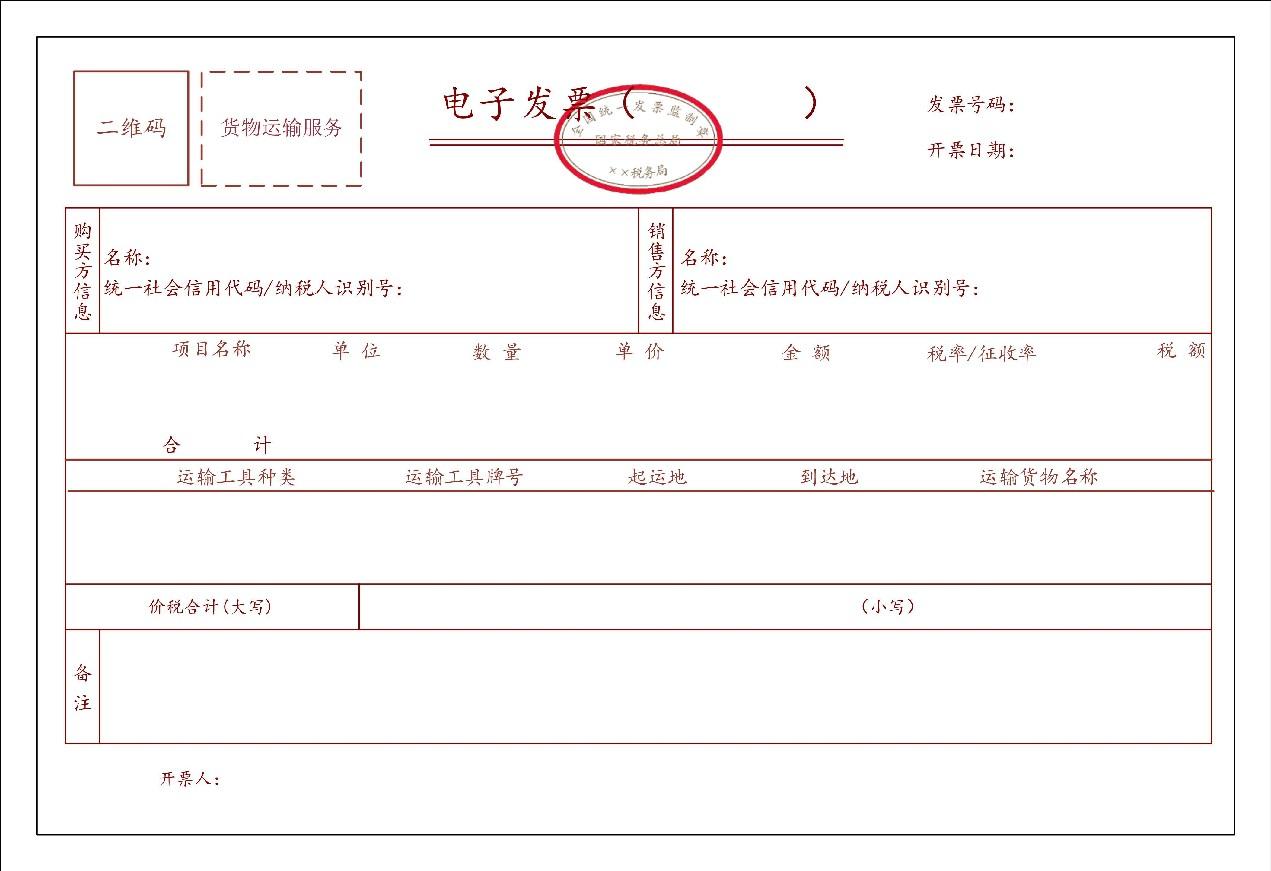
Sample invoice for goods transportation services
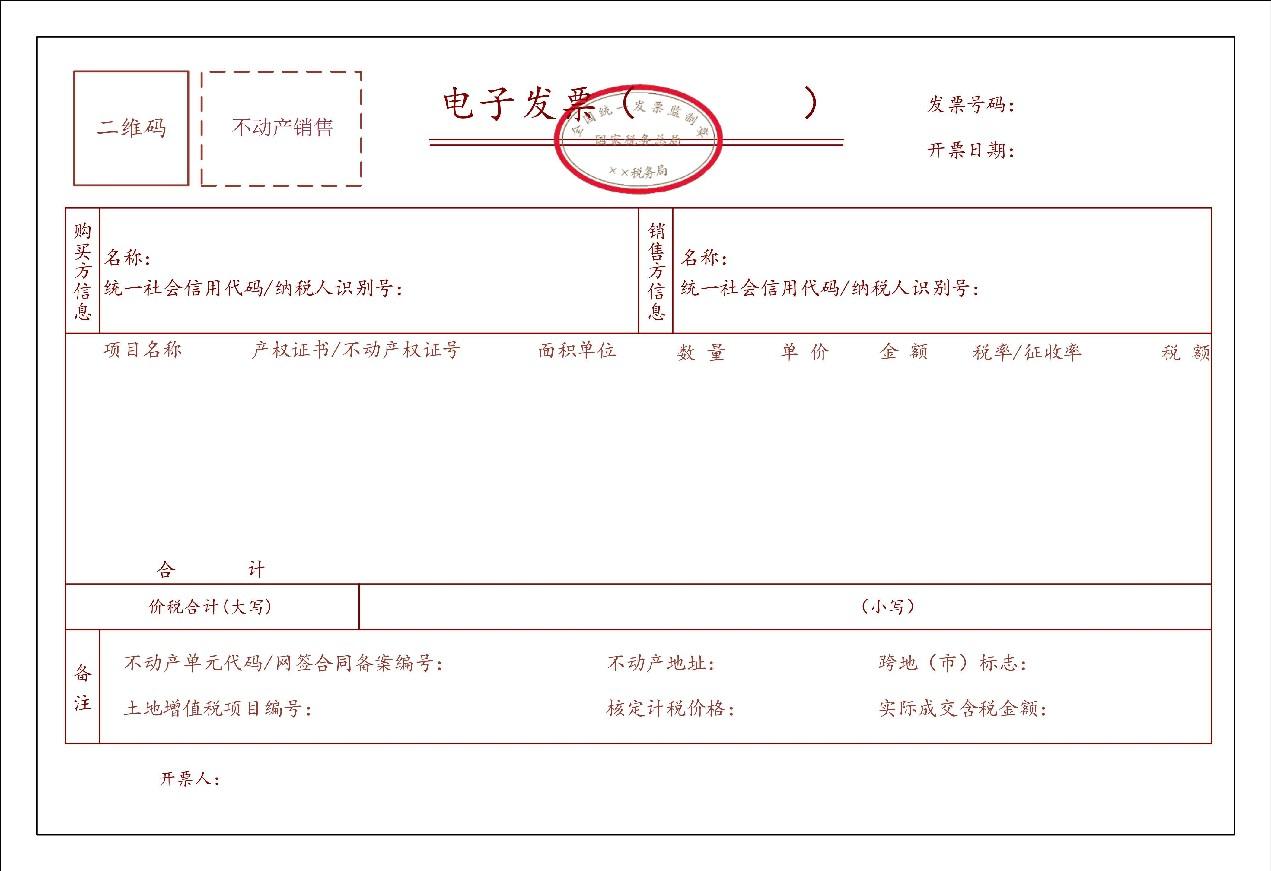
Real Estate Sales Invoice Sample
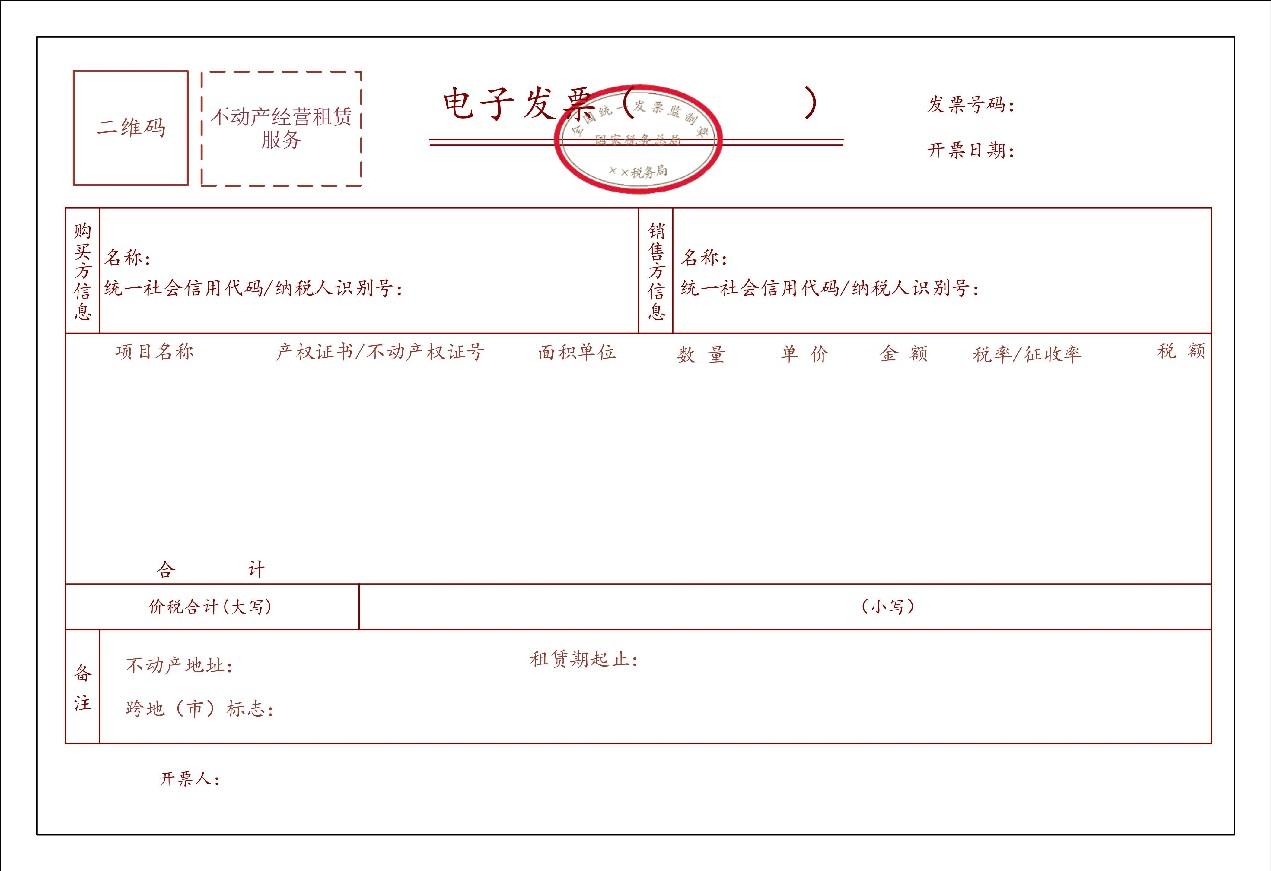
Sample invoice for real estate operating lease services.
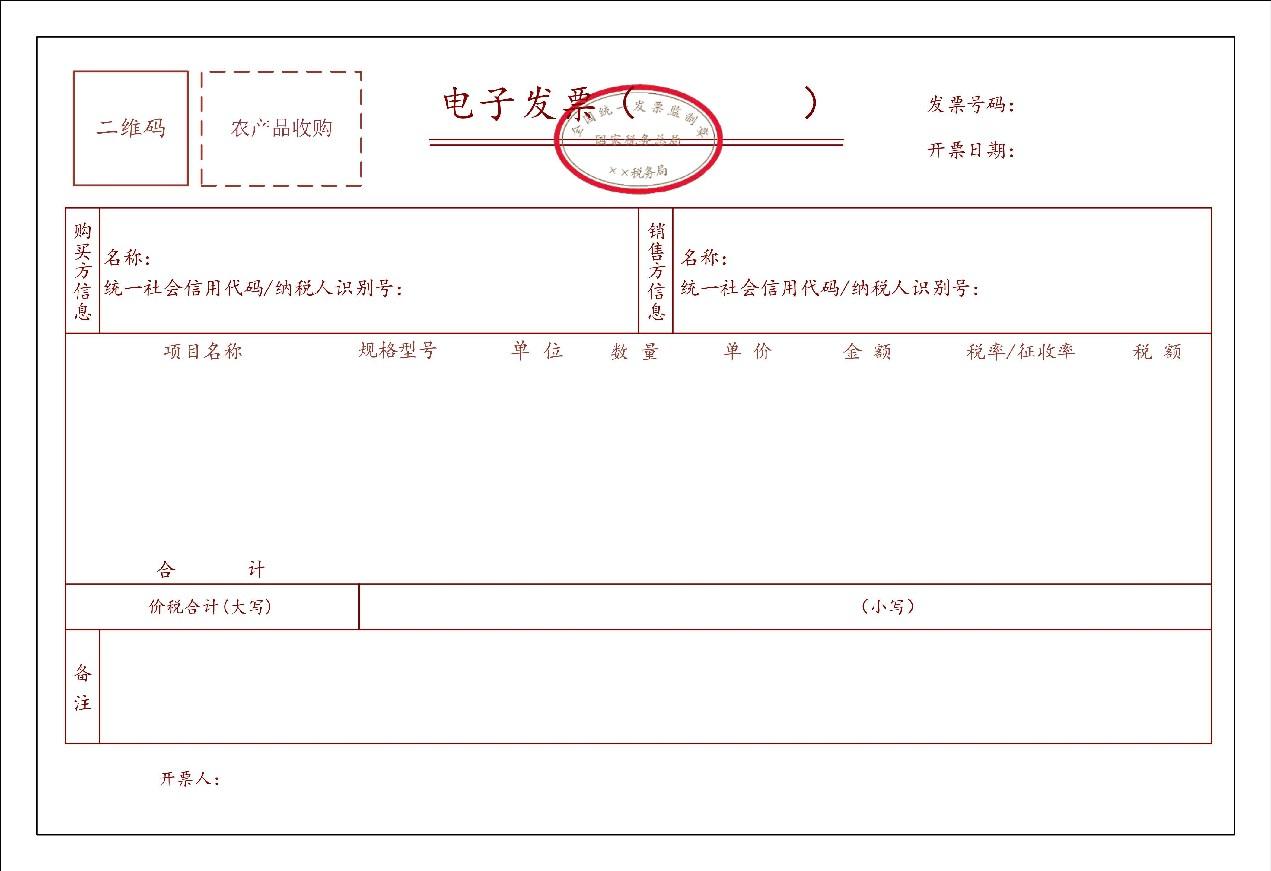
Sample of agricultural product purchase invoice
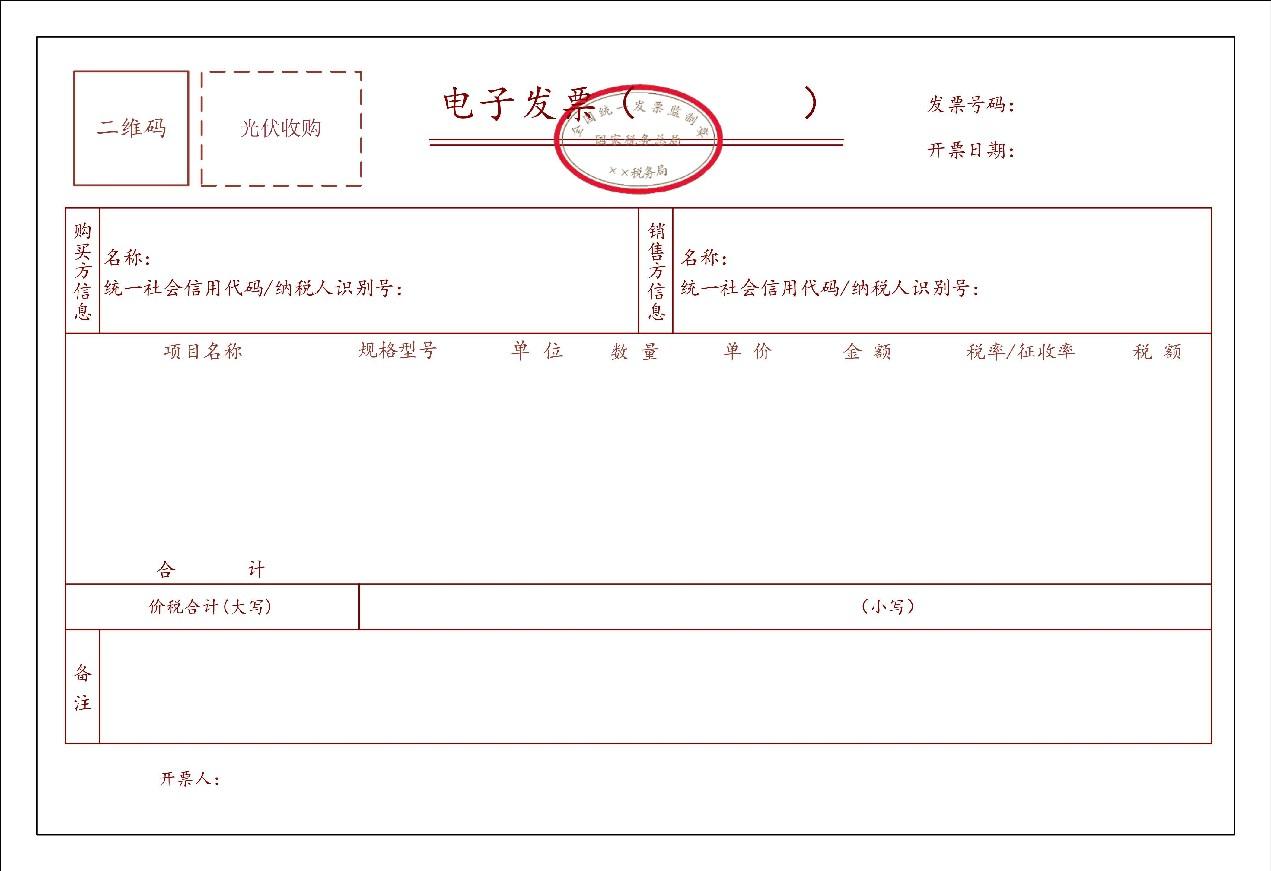
Photovoltaic acquisition invoice sample
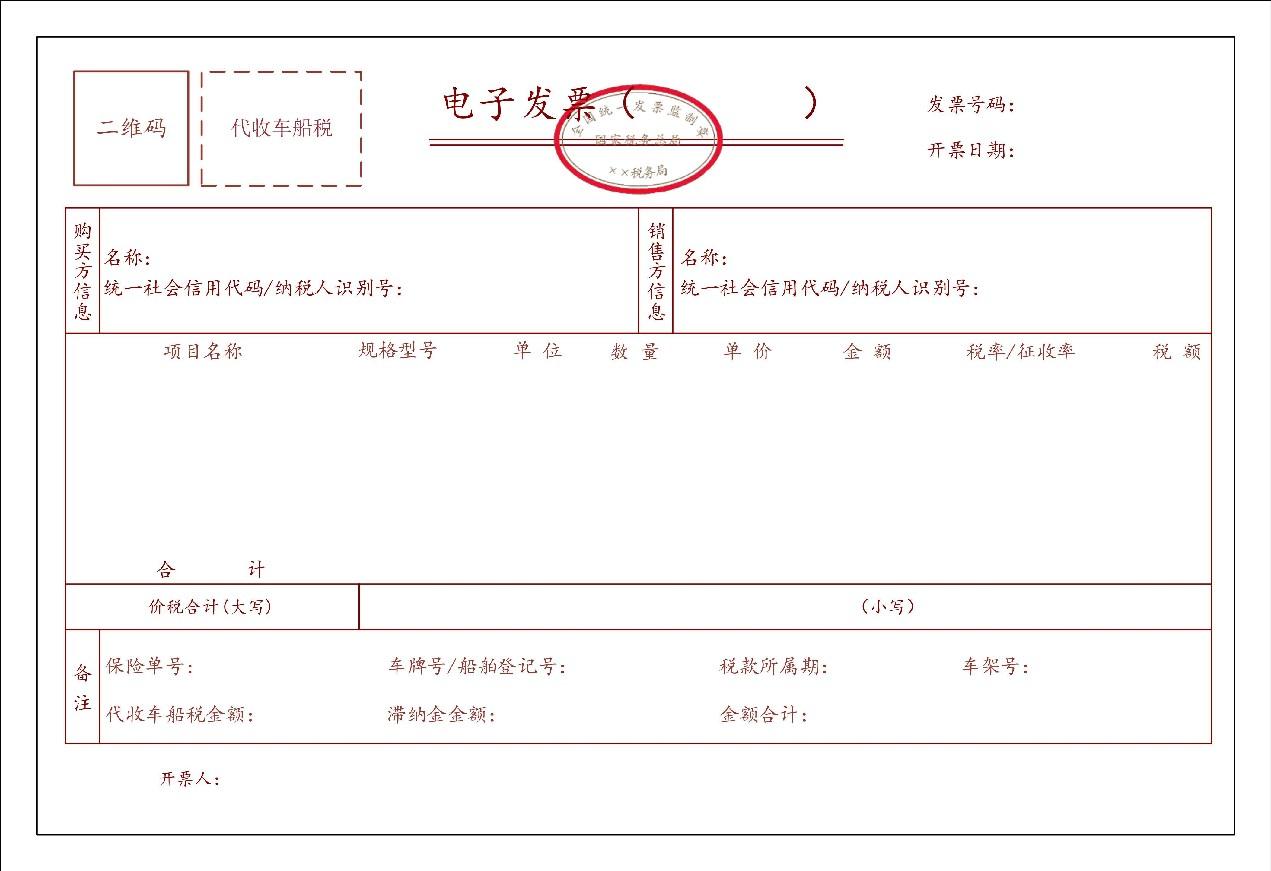
Sample invoice for vehicle and vessel tax collected on behalf
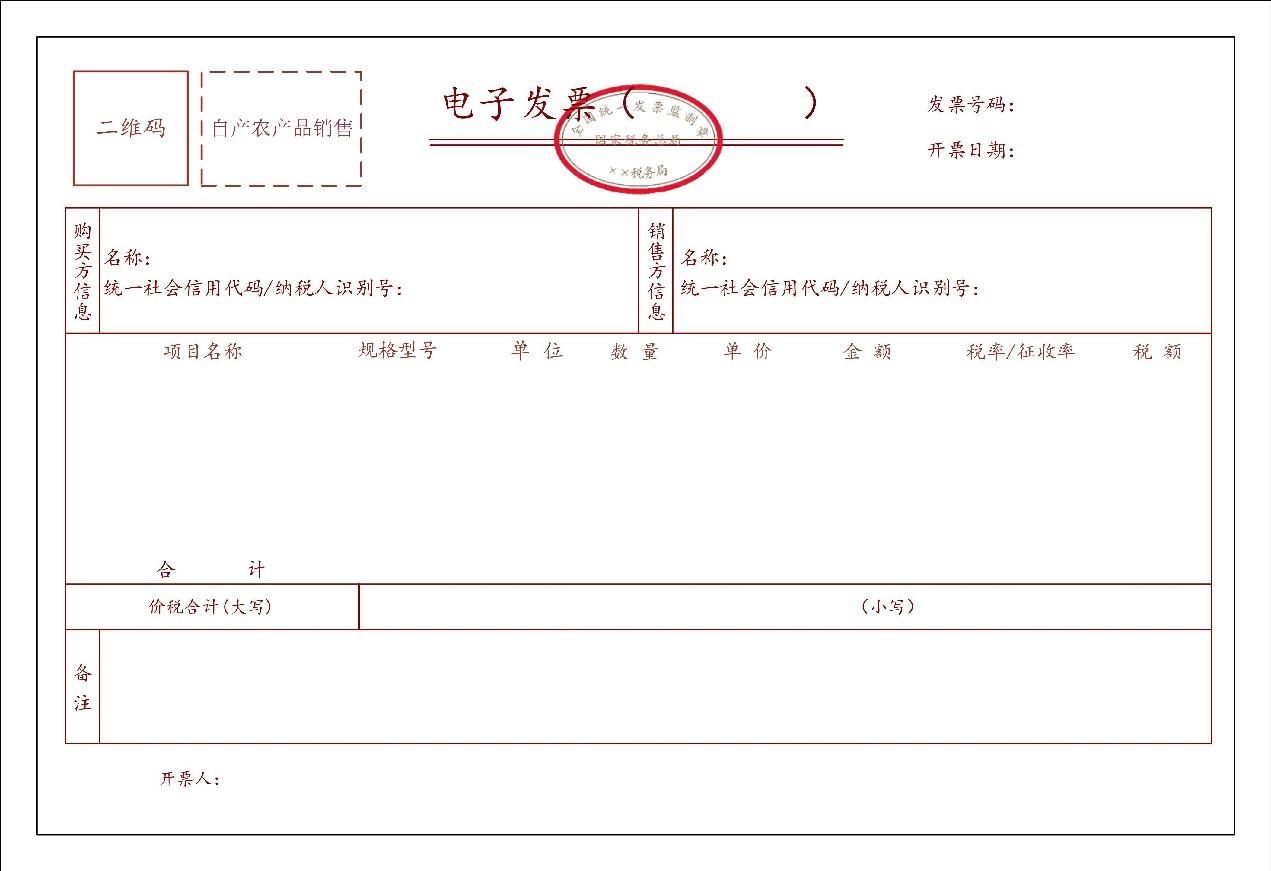
Sample of self-produced agricultural product sales invoice
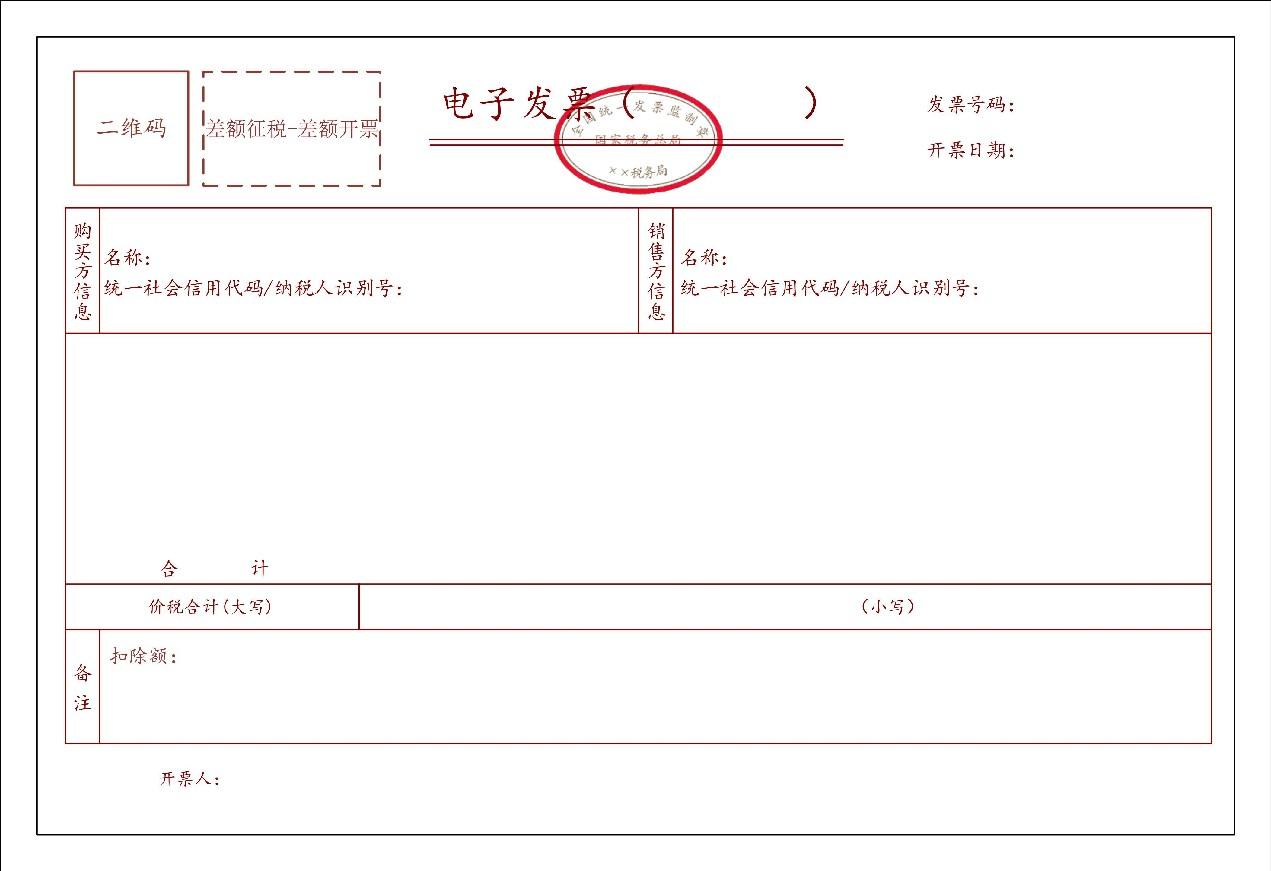
Sample invoice for differential taxation Sample invoice for differential taxation (differential invoicing)
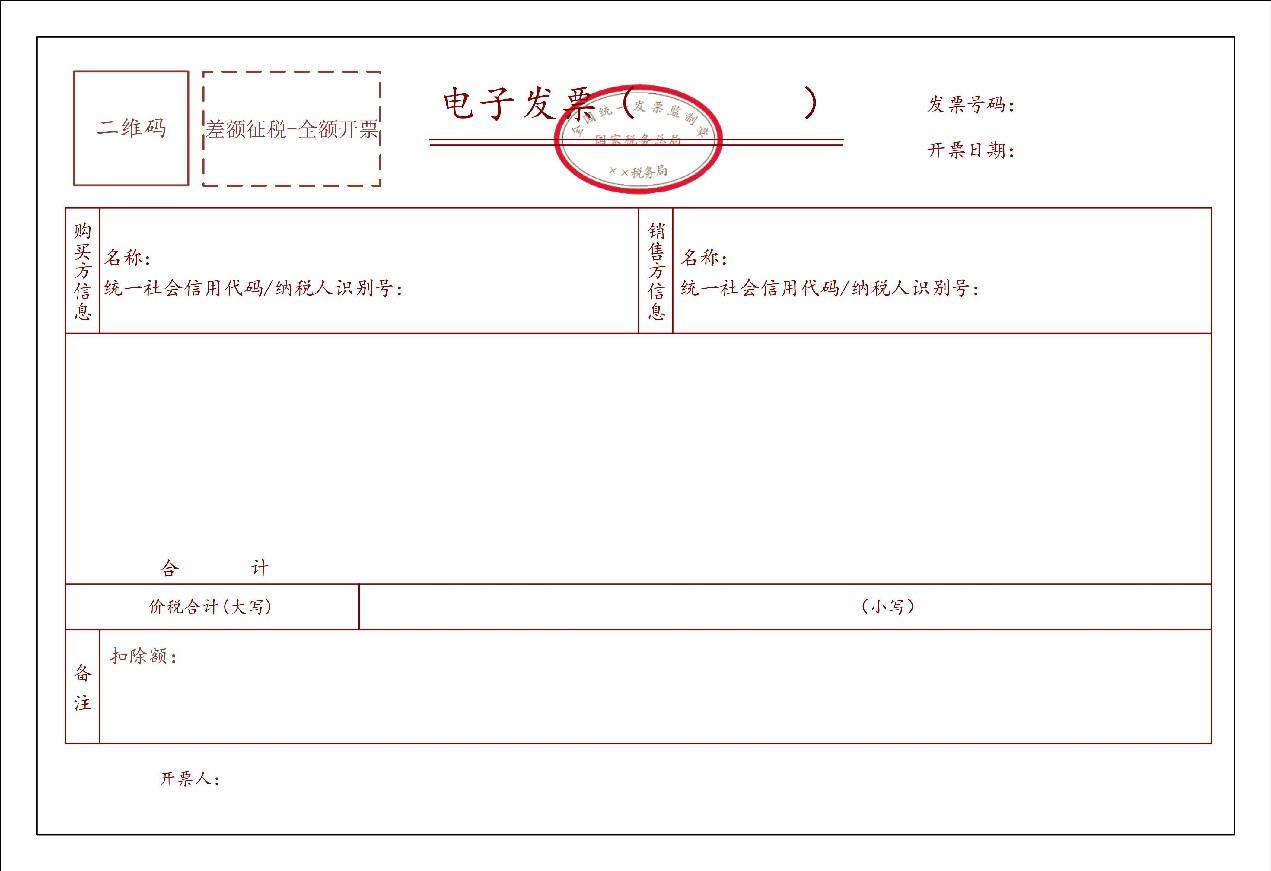
Sample invoice for differential taxation (full-amount invoicing)
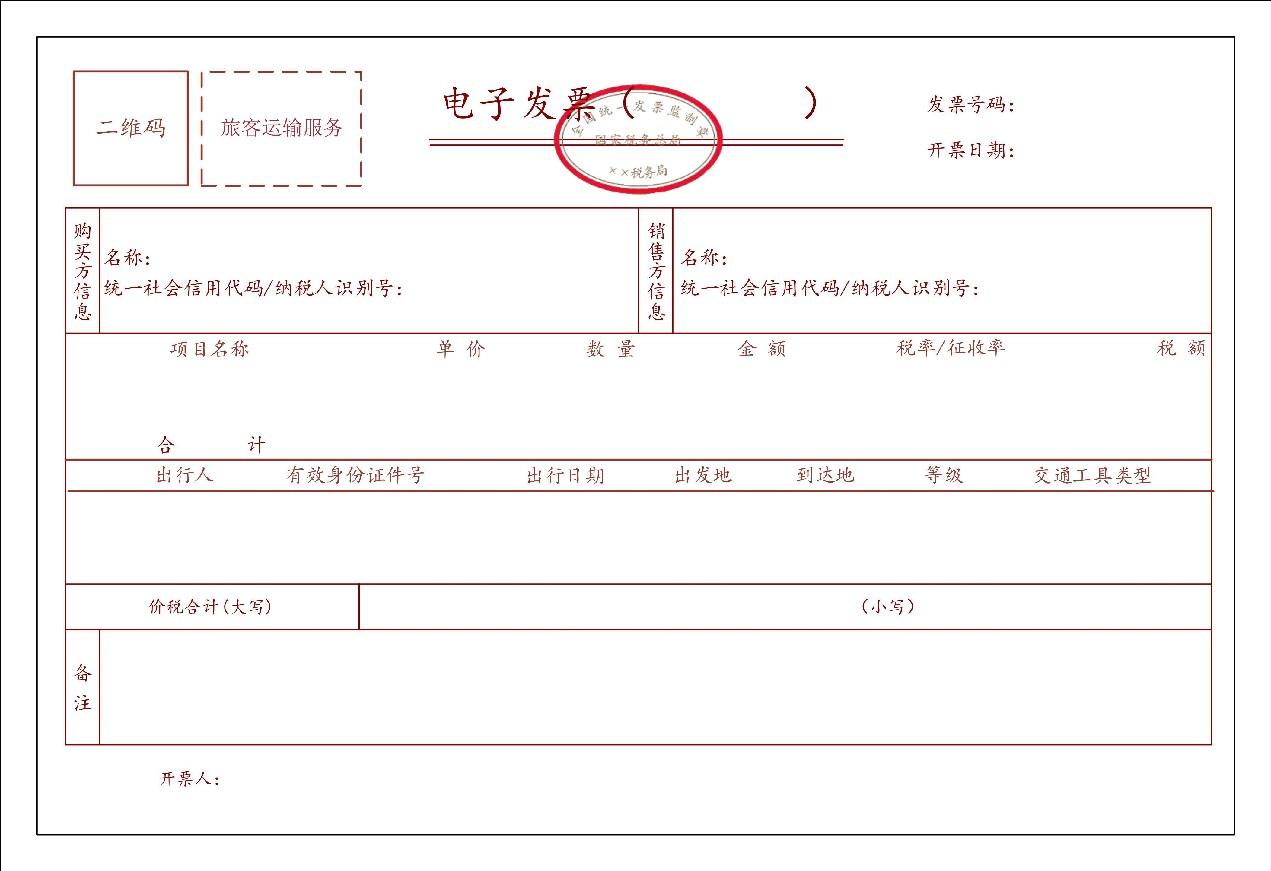
Passenger transport service invoice sample
Specimen of VAT Special Invoice for Motor Vehicles
Sample Invoices for Other Second-Hand Car-Related Invoices Sample Unified Invoice for Second-Hand Car Sales (Reverse Issuance)
Sample Second-Hand Car Invoice
Agency issuance invoice sample Sample of Tax Authority-Issued Invoice
Sample invoice for entrusted issuance
Sample of consolidated invoice issuance for individuals
Toll invoice sample Toll (non-taxable) invoice sample
Toll (taxable) invoice sample
Medical Service Invoice Sample Medical Services (Outpatient) Invoice Sample
Medical Services (Inpatient) Invoice Sample
Sample invoice for tractors and combine harvesters
Rare earth invoice sample
Policy InterpretationInterpretation of the Announcement of the State Taxation Administration on the Nationwide Promotion and Application of Fully Digitalized Electronic Invoices November 12, 2024 Department of Tax Administration and Technology Development To implement the requirements of the "Opinions on Further Deepening the Reform of Tax Collection and Administration" issued by the General Office of the CPC Central Committee and the General Office of the State Council and to further advance the reform of invoice electronification, the State Taxation Administration issued the "Announcement of the State Taxation Administration on Promoting the Application of Fully Digitalized E-Invoices" (hereinafter referred to as the "Announcement"). The interpretation is as follows: I. What is the background of the formulation and issuance of the Announcement?To implement the requirements of the "Opinions on Further Deepening the Reform of Tax Collection and Administration" issued by the General Office of the CPC Central Committee and the General Office of the State Council, which clearly state "steadily implement the reform of invoice electronification" and "basically achieve electronification of invoices in all fields, all links, and all elements, and strive to reduce institutional transaction costs," since the pilot rollout of fully digitalized e-invoices (hereinafter referred to as fully digitalized e-invoices) in Guangdong Province, Shanghai Municipality, and Inner Mongolia Autonomous Region on December 1, 2021, the pilot areas have gradually expanded to the whole country. The pilot rollout has been smooth and orderly, achieving positive results in optimizing the business environment, improving administrative efficiency, and facilitating the digital transformation of the economy and society. The newly issued "Measures of the People's Republic of China for the Administration of Invoices" and its implementing rules further clarify the legal status of electronic invoices, and fully digitalized e-invoices now meet the conditions for promotion from provincial pilots to nationwide application. To this end, the State Taxation Administration issued this "Announcement." II. What advantages do fully digitalized e-invoices have?Compared with anti-counterfeiting tax control invoices, fully digitalized e-invoices change multiple copies into a single copy, change dependence on paper form to dependence on digital form, and change offline application and collection of media before use to online real-person authentication before use. The main advantages are as follows: (1) Simpler invoice collection process Fully digitalized e-invoices achieve 'medium elimination', and taxpayers no longer need to obtain dedicated tax control equipment in advance; through the 'code assignment system', the application for specific invoice number ranges is cancelled, and after invoice information is generated, the system automatically assigns a unique invoice number; through the 'quota system', the total invoice quota is automatically granted to taxpayers. Based on this, eligible newly established taxpayers can basically 'issue invoices as soon as they start business'. (II) More convenient invoicing and invoice use Taxpayers may log in to the nationally unified and standardized Electronic Tax Bureau and use the "Invoice Business" function on its integrated electronic invoice service platform to perform a series of operations such as invoice issuance, delivery, verification, and purpose selection, enjoying "one-stop" services and no longer needing to log in to multiple platforms to complete related operations. If taxpayers encounter problems during invoicing or receiving invoices, they may use the "Taxpayer-Tax Authority Interaction" function to enjoy intelligent consultation and Q&A services; if they have objections to the total invoice quota granted, they may also raise them with the tax authority through "Taxpayer-Tax Authority Interaction". Fully digitalized e-invoices have removed the fixed format, added the XML data message format for convenient delivery, while retaining formats such as PDF and OFD, reducing invoice usage costs and enhancing taxpayers' convenience and sense of gain in using invoices. The style of fully digitalized e-invoices can be displayed differently according to different businesses, providing taxpayers with better personalized services. (3) Integrated entry and archiving By issuing electronic invoice data specifications and introducing national electronic invoice standards, full-process digital circulation of fully digitalized e-invoices is achieved. At the same time, fully digitalized e-invoices downloaded through the tax digital account contain digital signatures and can be booked and archived without affixing a special invoice seal. III. Which specific business invoices are included in fully digitalized e-invoices?Under the two categories of fully digitalized e-invoices, electronic invoice (VAT special invoice) and electronic invoice (ordinary invoice), according to specific business labels, specific business invoices are currently set for construction services, refined oil, scrapped product acquisition, passenger transport services, freight transport services, real estate sales, real estate operating lease services, agricultural product acquisition, photovoltaic acquisition, collected vehicle and vessel tax, self-produced agricultural product sales, differential taxation, motor vehicles, second-hand vehicles, invoice issuance, tolls, medical services, tractors and combine harvesters, rare earths, etc. IV. How to adjust the total invoice quota?There are four methods for dynamically determining the total invoice quota, including beginning-of-month quota adjustment, temporary quota adjustment, periodic quota adjustment, and manual quota adjustment. (1) Monthly Beginning Quota Adjustment Month-beginning quota adjustment refers to the information system automatically adjusting the taxpayer's total invoice quota at the beginning of each month. (II) Temporary Adjustment of Credit Limit Temporary quota adjustment means that when a taxpayer with good tax credit has their invoiced amount for the month reach a certain proportion of the monthly total invoice quota for the first time, the information system automatically temporarily increases their monthly total invoice quota once. Example 1: Company A, established in early August 2024, had an initial invoice quota of 7.5 million yuan. Scenario 1: In mid-August 2024, Company A's sales increased. By August 20, the actual used quota reached 6 million yuan (reaching a certain proportion of the total invoice quota for the month). After the information system automatically scanned for risks with no problems, the total invoice quota for the month was temporarily increased to 9 million yuan for Company A. Scenario 2: In mid-August 2024, Company A's sales increased. By August 20, the actual used quota reached 5.8 million yuan, which did not trigger a temporary adjustment by the information system. On August 21, due to operational needs, Company A needed to issue one fully digitalized e-invoice with an amount of 2 million yuan. When filling in the invoice information, because the cumulative amount reached 7.8 million yuan (reaching a certain proportion of the total invoice quota for the month), after the information system automatically scanned for risks with no problems, the total invoice quota for the month was temporarily increased to 9 million yuan for Company A. (3) Periodic adjustment of credit limit Regular quota adjustment means the information system automatically adjusts the taxpayer's monthly total invoice quota. Example 2: Company B, established in early July 2023, had an initial invoice quota of 7.5 million yuan. Based on Company B's actual operating conditions and its monthly invoice quota usage from July to December, the information system adjusted its total invoice quota for the current month to 8.5 million yuan in early January 2024. (4) Manual quota adjustment Manual quota allocation adjustment means that a taxpayer applies to adjust the total invoice quota due to changes in actual business conditions, and if the competent tax authority confirms that no abnormality is found, it adjusts the total invoice quota for the taxpayer. Example 3: Company C had a total invoice quota of 7.5 million yuan in early July 2024. Due to increased sales, the information system temporarily increased Company C's total invoice quota for the current month to 9 million yuan, but this still could not meet Company C's invoicing needs for the month. Based on its actual operating conditions, Company C applied to the competent tax authority to increase the total invoice quota for the current month to 12 million yuan. After the competent tax authority confirmed that no abnormalities were found, it correspondingly increased Company C's total invoice quota for the current month. V. How can a taxpayer use the current month's total invoice quota during the VAT filing period?During the VAT filing period, before completing the VAT filing, a taxpayer may issue invoices within the scope of the previous month's remaining invoice quota and not exceeding the current month's total invoice quota. After the taxpayer completes the VAT filing as required and the comparison is passed, it may issue invoices according to the current month's remaining invoice quota. Example 4: Taxpayer Company D is a general taxpayer filing monthly. Its total invoice quota in July 2024 was 7.5 million yuan. As of July 31, it had actually used 4 million yuan of the quota, with a remaining invoice quota of 3.5 million yuan. Scenario 1: On August 1, the information system automatically calculated its total invoice quota for August as 7.5 million yuan. If Company D completes the VAT filing for the July period at 9:00 on August 11 and passes the comparison, then before 9:00 on August 11 (i.e., before completing the VAT filing for the July period), Company D's usable quota is 3.5 million yuan (July remaining invoice quota 3.5 million yuan < August total invoice quota 7.5 million yuan). From August 1 to 9:00 on August 11, if Company D's actual used quota is 200,000 yuan, then the remaining invoice quota after 9:00 on August 11 (i.e., after completing the filing) is 7.3 million yuan (7.5 million yuan - 200,000 yuan = 7.3 million yuan). Scenario 2: On August 1, based on factors such as the taxpayer's risk level, tax credit rating, and actual operating conditions, the information system automatically calculated and adjusted the total invoice quota for August to 2.5 million yuan. If Company D completes the VAT filing for the July period at 9:00 on August 11 and passes the comparison, then before 9:00 on August 11 (i.e., before completing the VAT filing for the July period), Company D's usable quota is 2.5 million yuan (July remaining invoice quota 3.5 million yuan > August total invoice quota 2.5 million yuan). From August 1 to 9:00 on August 11, if Company D's actual used quota is 200,000 yuan, then the remaining invoice quota after 9:00 on August 11 (i.e., after completing the filing) is 2.3 million yuan (2.5 million yuan - 200,000 yuan = 2.3 million yuan). Example 5: Taxpayer Company E is a small-scale taxpayer filing quarterly. Its total invoice quota in August 2024 was 100,000 yuan. As of August 31, it had actually used 50,000 yuan of the quota, with a remaining invoice quota of 50,000 yuan. On September 1, the information system automatically calculated and readjusted the total September invoice quota to 100,000 yuan. Because Company E is a taxpayer filing quarterly, it does not need to complete the VAT filing for the August period in September, so the usable quota after September 1 is 100,000 yuan (i.e., the total September invoice quota). From September 1 to 30, Company E's actual used quota is 80,000 yuan, and the remaining invoice quota is 20,000 yuan. On October 1, the information system automatically calculated and readjusted the total October invoice quota to 100,000 yuan. If Company E completes the VAT filing for the third quarter of 2024 at 9:00 on October 6 and the comparison is passed, then before 9:00 on October 6 (that is, before completing the VAT filing for the third quarter), the usable quota is still 20,000 yuan (remaining September invoice quota 20,000 yuan < total October invoice quota 100,000 yuan). From October 1 to October 6 at 9:00, if Company E has actually used a quota of 20,000 yuan, then after 9:00 on October 6 (that is, after completing the filing), the remaining invoice quota is 80,000 yuan (100,000 yuan - 20,000 yuan = 80,000 yuan). Six, How does a taxpayer issue a red-letter fully digitalized e-invoice?If a taxpayer needs to issue a red-letter fully digitalized e-invoice or red-letter paper invoice through the electronic invoice service platform due to circumstances such as incorrect invoicing, sales return, service suspension, or sales discount, the following provisions shall apply: (1) If the invoice recipient has not confirmed the use or accounting entry, after the invoice issuer fills out the "Red-Letter Invoice Information Confirmation Form" (hereinafter referred to as the "Confirmation Form") on the electronic invoice service platform, the electronic invoice service platform shall issue a full or partial red-letter fully digitalized e-invoice based on the Confirmation Form, or the invoice issuer shall issue a full or partial red-letter paper invoice, without confirmation by the invoice recipient. The Confirmation Form must match the information of the corresponding blue-letter invoice. Example 6: On June 10, 2024, Company F (a taxpayer that has used fully digitalized e-invoices) discovered that a paper special invoice issued to Company G (a taxpayer that has used fully digitalized e-invoices) on May 31, 2024 contained errors. Through the electronic invoice service platform, it found that Company G had not confirmed the use of the obtained invoice or recorded the invoice in its accounts. After Company F contacted Company G to retrieve the relevant copies of the invoice, it filled in and uploaded the Confirmation Form through the electronic invoice service platform. Without confirmation by Company G, Company F may choose on its own to issue a red-letter fully digitalized e-invoice or a red-letter paper invoice in full or in part. If a red-letter fully digitalized e-invoice is chosen, the electronic invoice service platform issues it in full or in part based on the Confirmation Form; if a red-letter paper invoice is chosen, Company F issues it itself in full or in part. Example 7: In April 2024, Company H (a taxpayer that has used fully digitalized e-invoices) provided processing services to Company I (a taxpayer that has not used fully digitalized e-invoices). On April 18, 2024, Company H issued to Company I a fully digitalized e-invoice bearing the words "VAT Special Invoice". On April 20, the services were terminated for objective reasons. Company I had not previously confirmed the use of the invoice or recorded it in its accounts. Company H filled in the Confirmation Form through the electronic invoice service platform. Without confirmation by Company I, Company H, based on the verified and correct information in the Confirmation Form, issues a red-letter fully digitalized e-invoice in full or in part. (2) Where the invoice recipient has already confirmed the use or recorded it in the accounts (those selected and confirmed for export tax refund shall still follow current regulations), if the invoice recipient is a taxpayer that already uses fully digitalized e-invoices, either the invoicing party or the invoice recipient may fill in and submit the Confirmation Form on the electronic invoice service platform, and after confirmation by the other party on the electronic invoice service platform, the invoicing party may issue a full or partial red-letter fully digitalized e-invoice or red-letter paper invoice; if the invoice recipient is a taxpayer that does not use fully digitalized e-invoices, the invoicing party shall fill in and submit the Confirmation Form on the electronic invoice service platform, or the invoice recipient shall fill in and submit it on the VAT invoice comprehensive service platform, and after confirmation by the other party, a full or partial red-letter fully digitalized e-invoice or red-letter paper invoice shall be issued. Among them, the Confirmation Form needs to match the information of the corresponding blue-letter invoice. If the invoice recipient has already used the invoice for VAT declaration and deduction, it shall temporarily transfer the VAT amount listed in the Confirmation Form out of the current period's input tax; after obtaining the red-letter invoice issued by the issuer, it shall be used together with the Confirmation Form as an accounting voucher. Example 8: In October 2023, Company J (a taxpayer that has used fully digitalized e-invoices) sold a batch of clothing to Company K (a taxpayer that has used fully digitalized e-invoices) and issued a fully digitalized e-invoice bearing the words "VAT Special Invoice", and Company K confirmed the use of the obtained invoice. In November 2023, a sales return occurred for this batch of clothing. Scenario 1: Company K's finance personnel fill out the Confirmation Form through the electronic invoice service platform, select the reason and the corresponding blue-letter invoice information, and enter the amount and tax amount. After Company J's finance personnel complete confirmation through the electronic invoice service platform, Company J's finance personnel issue a red-letter fully digitalized e-invoice based on this. Scenario 2: Company J's finance personnel fill out the Confirmation Form through the electronic invoice service platform, select the reason and the corresponding blue-letter invoice information, and enter the amount and tax amount. After Company K's finance personnel complete confirmation through the electronic invoice service platform, Company J's finance personnel issue a red-letter fully digitalized e-invoice based on this. Example 9: In November 2023, Company L (a taxpayer that has used fully digitalized e-invoices) sold a batch of toys to Company M (a taxpayer that has not used fully digitalized e-invoices) and issued a fully digitalized e-invoice bearing the words "VAT Special Invoice", and Company M confirmed the use. In December 2023, a sales return occurred for this batch of toys. Scenario 1: Company L's finance personnel fill out the Confirmation Form through the electronic invoice service platform, select the reason and the corresponding blue-letter invoice information, and enter the amount and tax amount. After Company M's finance personnel complete confirmation through the VAT invoice comprehensive service platform, Company L's finance personnel issue a red-letter fully digitalized e-invoice based on this. Scenario 2: Company M's finance personnel initiate the Confirmation Form through the VAT invoice comprehensive service platform, select the reason and the corresponding blue-letter invoice information, and enter the amount and tax amount. After Company L's finance personnel complete confirmation through the electronic invoice service platform, Company L's finance personnel issue a red-letter fully digitalized e-invoice based on this. Seven, How to issue red-letter invoices for used car business?(1) When a used car trading market acts only as the invoicing party and issues, for the buyer and seller actually engaging in a used car transaction, a paper red-letter Unified Used Car Sales Invoice or a red-letter fully digitalized e-invoice bearing the words "Unified Used Car Sales Invoice": 1. If the seller is a natural person or a unit that has not completed tax information confirmation, and the buyer has not confirmed the booking, either party of the buyer and seller applies to the invoicing party for issuing a red-letter invoice, and after the invoicing party fills in and submits the "Confirmation Form", the invoicing party issues the red-letter invoice, without confirmation. Example 10: Individual N sells a used car to individual O, and used car trading market P issues a fully digitalized e-invoice bearing the words "Unified Invoice for Used Car Sales" on the electronic invoice service platform. When a red-letter invoice needs to be issued, N or O applies to P to issue the red-letter invoice; after P fills out and submits the Confirmation Form, P issues the red-letter invoice, with no confirmation required. 2. If the seller is a natural person or a unit that has not completed tax information confirmation, and the buyer has already confirmed the accounting entry, the buyer or the invoicing party shall fill out and submit the "Confirmation Form". After confirmation by the other party (the buyer or the invoicing party), the invoicing party shall issue a red-letter invoice. Example 11: Individual N sells a used car to enterprise Q, and through used car trading market P issues a fully digitalized e-invoice bearing the words "Unified Invoice for Used Car Sales" on the electronic invoice service platform. Q has completed accounting confirmation. When a red-letter invoice needs to be issued, Q or P fills out and submits the Confirmation Form, and after confirmation by P or Q, P issues the red-letter invoice. 3. If the seller is a entity or individual industrial and commercial household that has completed tax information confirmation, and the buyer has not completed booking confirmation, the seller fills out and submits the Confirmation Form, after which the invoicing party issues a red-letter invoice. Example 12: Enterprise Q sells a used car to enterprise R, and through used car trading market P issues a fully digitalized e-invoice bearing the words "Unified Invoice for Used Car Sales" on the electronic invoice service platform. If R has not completed accounting confirmation and a red-letter invoice needs to be issued, Q fills out and submits the Confirmation Form, and then P issues the red-letter invoice. 4. If the seller is a entity or individual industrial and commercial household that has completed tax information confirmation, and the buyer has confirmed the accounting entry, both the seller and buyer may fill out and submit the Confirmation Form; after confirmation by the other party, the issuer issues the red-letter invoice. Example 13: Enterprise Q sells a used car to enterprise R, and through used car trading market P issues a fully digitalized e-invoice bearing the words "Unified Invoice for Used Car Sales" on the electronic invoice service platform. If R has completed accounting confirmation and a red-letter invoice needs to be issued, Q or R fills out and submits the Confirmation Form, and after confirmation by R or Q, P issues the red-letter invoice. (II) When a used car trading market sells used cars under its own name, acting simultaneously as the invoicing party and the seller, and issues to the buyer a paper red-letter unified used car sales invoice or a red-letter fully digitalized e-invoice bearing the words "unified used car sales invoice": 1. If the buyer has not confirmed the booking, the used car trading market fills in and submits the "Confirmation Form" to issue a red-letter invoice, without confirmation. Example 14: Used car trading market P sells a used car to individual N, and P issues a fully digitalized e-invoice bearing the words "Unified Invoice for Used Car Sales" on the electronic invoice service platform. When a red-letter invoice needs to be issued, P fills out and submits the Confirmation Form, and then P issues the red-letter invoice. 2. If the buyer has already confirmed the accounting entry, both parties may fill out and submit the "Confirmation Form". After confirmation by the other party, the used car trading market shall issue a red-letter invoice. Example 15: Used car trading market P sells a used car to enterprise Q, and P issues a fully digitalized e-invoice bearing the words "Unified Invoice for Used Car Sales" on the electronic invoice service platform. If Q has completed accounting confirmation and a red-letter invoice needs to be issued, P or Q fills out and submits the Confirmation Form, and after confirmation by Q or P, P issues the red-letter invoice. (3) When a used car trading market purchases a used car and acts as both the invoicing party and the purchaser, issuing a paper red-letter used car sales unified invoice on behalf of the seller, or a red-letter fully digitalized e-invoice bearing the words "used car sales unified invoice": 1. If the seller is a natural person or a unit that has not completed tax information confirmation, the used car trading market fills in and submits the "Confirmation Form" before issuing a red-letter invoice. Example 16: Individual N sells a used car to used car trading market P, and P issues a fully digitalized e-invoice bearing the words "Unified Invoice for Used Car Sales" on the electronic invoice service platform. When a red-letter invoice needs to be issued, P fills out and submits the Confirmation Form, and then P issues the red-letter invoice. 2. If the seller is a unit or individual industrial and commercial household that has completed tax information confirmation, and the used car trading market has not confirmed the accounting entry, the seller shall fill out and submit the "Confirmation Form", and the used car trading market shall issue a red-letter invoice. Example 17: Enterprise Q sells a used car to used car trading market P, and P issues a fully digitalized e-invoice bearing the words "Unified Invoice for Used Car Sales" on the electronic invoice service platform. If P has not completed accounting confirmation and a red-letter invoice needs to be issued, Q fills out and submits the Confirmation Form, and then P issues the red-letter invoice. 3. If the seller is a entity or individual industrial and commercial household that has completed tax information confirmation, and the used car trading market has completed booking confirmation, both parties may fill out and submit the Confirmation Form; after confirmation by the other party, the used car trading market issues a red-letter invoice. Example 18: Enterprise Q sells a used car to used car trading market P, and P issues a fully digitalized e-invoice bearing the words "Unified Invoice for Used Car Sales" on the electronic invoice service platform. If P has completed purpose confirmation or accounting confirmation and a red-letter invoice needs to be issued, Q or P fills out and submits the Confirmation Form, and after confirmation by P or Q, P issues the red-letter invoice. Eight, What changes are there in the process for taxpayers not using fully digitalized e-invoices to issue red-letter invoices?(1) The Comprehensive VAT Invoice Service Platform provides invoice recipient taxpayers with functions such as initiating, receiving, and confirming the Confirmation Form; the electronic invoice service platform provides taxpayers who already use fully digitalized e-invoices with the function of filling out and submitting the "Information Form for Issuing Red-Letter VAT Special Invoices" (hereinafter referred to as the "Information Form"). (II) Where a taxpayer falls under the circumstances stipulated in Article 1 of the Announcement of the State Taxation Administration on Issues Concerning the Issuance of Red-Letter VAT Invoices (State Taxation Administration Announcement No. 47 of 2016) and Article 7 of the Announcement of the State Taxation Administration on Matters Concerning the Implementation of Electronic VAT Special Invoices for Newly Established Taxpayers (State Taxation Administration Announcement No. 22 of 2020), and the seller has not used fully digitalized e-invoices but the buyer has used fully digitalized e-invoices, the buyer may fill out and submit the Information Form through the Electronic Invoice Service Platform; where the seller has used fully digitalized e-invoices but the buyer has not used fully digitalized e-invoices, the buyer may fill out and submit the Confirmation Form through the VAT Invoice Comprehensive Service Platform, or confirm the received Confirmation Form. Example 19: In May 2024, Company S (a taxpayer not using fully digitalized e-invoices) sold a batch of clothing to Company T (a taxpayer already using fully digitalized e-invoices), and issued a special VAT invoice through the VAT invoice management system; Company T completed purpose confirmation. In June 2024, a sales return occurred for this batch of clothing. Company T filled out the Information Form through the electronic invoice service platform, and Company S's finance personnel issued a red-letter special invoice based on it. IX. What precautions should be taken when issuing red-letter invoices through the electronic invoice service platform?(1) If a red letter invoice needs to be issued, issue the red letter invoice within the amount range of the corresponding blue letter invoice. (II) If a red-letter fully digitalized e-invoice is issued in the same month as the blue-letter fully digitalized e-invoice, the electronic invoice service platform will simultaneously increase the remaining invoice quota; if the red-letter fully digitalized e-invoice is issued across months, the electronic invoice service platform will not increase the remaining invoice quota. (3) If a red-letter paper invoice is issued in the same month as the blue-letter paper invoice, or if an issued blue-letter paper invoice is voided, the electronic invoice service platform shall simultaneously increase its remaining invoice amount; if a red-letter paper invoice is issued across months, the electronic invoice service platform shall not increase its remaining invoice amount. Example 20: Taxpayer Company U had a total invoice quota of 7.5 million yuan in October 2024. From October 1 to 5, 2024, Company U issued invoices totaling 1 million yuan. On October 6, it issued a red-letter fully digitalized e-invoice of 100,000 yuan (corresponding to a blue-letter fully digitalized e-invoice issued on August 25, 2024, amounting to 100,000 yuan). On October 7, it issued a red-letter fully digitalized e-invoice of 500,000 yuan (corresponding to a blue-letter fully digitalized e-invoice issued on October 3, 2024, amounting to 500,000 yuan). Then the remaining invoice quota on October 8 is 7 million yuan (7.5 million yuan - 1 million yuan + 500,000 yuan = 7 million yuan). Since issuing a red-letter fully digitalized e-invoice across months does not increase the remaining invoice quota, the 100,000 yuan red-letter fully digitalized e-invoice issued on October 6 is not included in the calculation of the remaining invoice quota. 10. Can an issued fully digitalized e-invoice be voided?Where a taxpayer needs to void a fully digitalized e-invoice due to reasons such as an invoicing error, it shall issue a full-amount red-letter fully digitalized e-invoice through the electronic invoice service platform. 11. After a taxpayer issues an invoice through the electronic invoice service platform or selects and confirms the purpose of an invoice, how should the VAT and surtax declaration form be filled out? (1) When a VAT general taxpayer issues a fully digitalized e-invoice bearing the words "VAT Special Invoice" or "General Invoice" through the electronic invoice service platform, the amount and tax amount shall be filled in the relevant columns of "VAT Special Invoice Issued" or "Other Invoices Issued" in the "VAT and Additional Tax Return Supplementary Information (I)" (Details of Current Period Sales). Where a VAT general taxpayer obtains a fully digitalized e-invoice issued through the electronic invoice service platform and checks it for input deduction, its number of copies, amount, and tax amount shall be entered in the relevant column of "Input tax amount declared for deduction" in the "VAT and Additional Tax and Fee Filing Form Attachment (II)" (details of input tax amount for the current period). Where a VAT general taxpayer obtains a fully digitalized e-invoice bearing the words "VAT special invoice" issued through the electronic invoice service platform and has already used it for VAT filing deduction, the VAT amount listed in the corresponding Confirmation Form shall be entered in the relevant column of "Input tax amount transferred out" in the "VAT and Additional Tax and Fee Filing Form Attachment (II)." (II) For fully digitalized e-invoices issued by small-scale VAT taxpayers through the electronic invoice service platform, the amount and tax amount shall be filled into the relevant columns of the "VAT and Surcharge Tax Return (Applicable to Small-Scale Taxpayers)" under "VAT special invoice sales amount excluding tax" or "other VAT invoice sales amount excluding tax." Where the VAT exemption policy applies, they shall be filled into relevant columns such as "tax-exempt sales amount" and "export tax-exempt sales amount" as required. 12. A taxpayer needs to select and confirm the invoice purpose; through what channel is this handled?After the Announcement is issued, taxpayers can use the invoice purpose confirmation, risk alerts, information download and other functions available on the VAT Invoice Comprehensive Service Platform through their tax digital accounts. If a taxpayer obtains fully digitalized e-invoices bearing the words "VAT Special Invoice", fully digitalized e-invoices bearing the words "General Invoice", and other VAT deduction vouchers that meet provisions, and needs to use them to file for deduction of input VAT or apply for export tax refund or tax refund on behalf, it shall confirm the purpose through the tax digital account or the VAT Invoice Comprehensive Service Platform. Taxpayers not using fully digitalized e-invoices shall continue to use relevant VAT deduction voucher functions through the VAT Invoice Comprehensive Service Platform. Where they obtain fully digitalized e-invoices bearing the words "VAT special invoice," fully digitalized e-invoices bearing the words "ordinary invoice," and other VAT deduction vouchers that meet regulations, and use them to declare and deduct VAT input tax or apply for export tax refunds or tax refunds on behalf of others, they shall confirm the purpose through the VAT Invoice Comprehensive Service Platform. Where a taxpayer incorrectly confirms the invoice purpose, it may apply to the competent tax authority for correction. 13. After a taxpayer incorrectly confirms the invoice purpose, how does it apply to the competent tax authority for correction?Where a taxpayer incorrectly confirms the invoice purpose as for filing deduction and has already filed for deduction, and wishes to change it to for filing export tax refund or agency tax refund, it may apply to the competent tax authority for correction. After the competent tax authority verifies and confirms that the relevant input tax has been transferred out, it adjusts the invoice purpose for the taxpayer. Where a taxpayer incorrectly confirms the invoice purpose as for export tax refund or agency tax refund, it may apply to the competent tax authority for correction. If the taxpayer has not yet filed for export tax refund, after confirmation by the competent tax authority, the invoice information may be returned to the electronic invoice service platform, and the taxpayer may reconfirm the invoice purpose; if the taxpayer has already filed for export tax refund, it may apply to the competent tax authority for issuance of a certificate for transferring export goods to domestic sales. 14. How can a taxpayer calculate the input tax on agricultural products and the additional deduction of input tax on agricultural products through the tax digital account?Where a taxpayer purchases agricultural products and obtains compliant vouchers such as fully digitalized e-invoices bearing the words "Value-Added Tax Special Invoice", value-added tax special invoices, customs import value-added tax special payment statements, and agricultural product sales invoices, or issues compliant purchase invoices, it may confirm the purpose through the tax digital account and calculate the current input tax in accordance with relevant regulations. Among them, for agricultural products purchased by taxpayers for production or commissioned processing of goods subject to a 13% tax rate, the competent tax authority may enable the function for confirming the additional deduction of input VAT on agricultural products, calculate the current input VAT according to relevant provisions, and transfer the details of vouchers whose use has been confirmed into the pending confirmation of additional deduction of input VAT on agricultural products. In the current period when taxpayers use purchased agricultural products for production or commissioned processing, they may select the corresponding vouchers through the tax digital account and calculate and fill in the additional deduction of input VAT on agricultural products for this time according to provisions. Taxpayers that obtain vouchers meeting the above provisions and not yet used for additional deduction of input VAT on agricultural products may go to a tax service venue to apply for supplementary recording. 15. How do I query, download, and export issued or received fully digitalized e-invoices through the tax digital account and the Individual Income Tax APP?Entities and individual industrial and commercial households may log in to their own tax digital accounts and, by selecting conditions such as bill category, invoice source, invoice type, and invoice number, query, download, print, and export invoice-related information. Natural persons may log in to their own Individual Income Tax APP personal invoice folder to view, download, export, and reject fully digitalized e-invoices obtained or applied for issuance through the electronic invoice service platform, and may use functions such as scan-to-invoice, invoice header information maintenance, and red-letter invoice reminders. 16. What matters should a taxpayer pay attention to when issuing and obtaining a fully digitalized e-invoice for reimbursement, accounting, and archiving?Where a taxpayer issues and obtains a fully digitalized e-invoice for reimbursement, accounting, and archiving, it shall comply with relevant regulations such as the Notice of the Ministry of Finance and the National Archives Administration on Regulating the Reimbursement, Accounting, and Archiving of Electronic Accounting Vouchers (Cai Kuai [2020] No. 6) and the Measures for the Administration of Accounting Archives (Order No. 79 of the Ministry of Finance and the National Archives Administration). 17. For fully digitalized e-invoices with "Motor Vehicle" displayed in the upper left corner and the words "Special VAT Invoice," and electronic invoices (Uniform Invoice for Motor Vehicle Sales), is their use and management governed by the Measures for the Use of Motor Vehicle Invoices? For fully digitalized e-invoices and electronic invoices (unified invoice for motor vehicle sales) that display "Motor Vehicle" in the upper left corner and bear the words "Special VAT Invoice," their legal effect and basic use are the same as existing motor vehicle invoices (including unified invoices for motor vehicle sales and special VAT invoices bearing the words "Motor Vehicle"), and their use and management shall refer to the Measures for the Use of Motor Vehicle Invoices and the relevant provisions on fully digitalized e-invoices. 18. If a taxpayer purchasing a taxable vehicle obtains a fully digitalized e-invoice bearing the words "Uniform Invoice for Motor Vehicle Sales," how should it handle vehicle purchase tax filing and other businesses? Taxpayers may, based on fully digitalized e-invoices bearing the words "Motor Vehicle Sales Unified Invoice", handle vehicle purchase tax filing and other business online through convenient methods such as the Electronic Tax Bureau. When a taxpayer handles vehicle purchase tax filing and other business on-site at the tax authority, it needs to provide the tax authority with relevant information of the fully digitalized e-invoice bearing the words "Motor Vehicle Sales Unified Invoice", and does not need to provide a paper printout of the fully digitalized e-invoice (except where the fully digitalized e-invoice information is abnormal). Specific requirements shall be implemented in accordance with the Announcement of the State Taxation Administration on Handling Vehicle Purchase Tax Business Using Electronic Information of Motor Vehicle Sales Unified Invoices (State Taxation Administration Announcement No. 3 of 2020). As a comprehensive business-finance-tax digitalization solution service provider, Kailing Technology provides business-finance-tax management digital transformation products and operational services for various government agencies, institutions, and large, medium, and small enterprises. The product line includes: Sales contract management system, procurement contract management system, fully digitalized Leqi interface project, output automatic invoicing system,Reverse invoicing system,Solutions for the invoice issuance for individuals system, employee expense control and reimbursement system, input VAT invoice management system, supply chain collaborative reconciliation system, image AI OCR recognition system, automated financial bookkeeping system, electronic accounting archives system, and other businesses, comprehensively advancing the digitalization process across various fields. If you have any business-finance-tax digital transformation needs, welcome to contact us. Beijing Kailing Technology will serve you wholeheartedly.
|