010-6097 4119Book a Demo


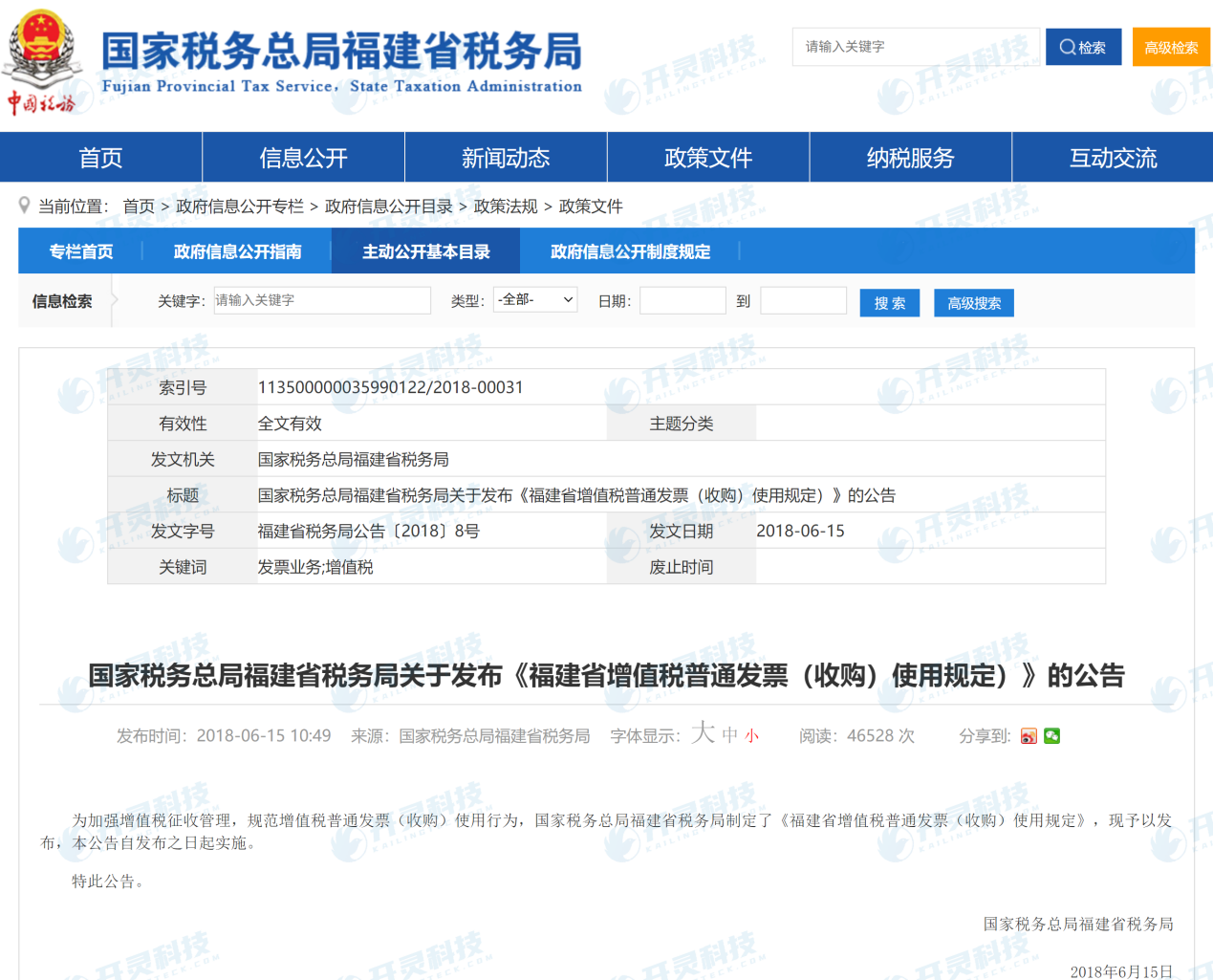
Kailing Technology's wood recycling reverse invoicing solution: Solving the pain points of wood recycling enterprises, achieving both compliance and cost reductionPublished: 2025-09-22 17:46 I. Policy Background: The Compliance Cornerstone of Reverse Invoicing for Wood RecyclingIn recent years, the national level has continued to issue policies regulating invoicing processes in the agricultural product and resource recycling fields, providing a clear policy basis for reverse invoicing in wood recycling and promoting the industry's transformation from "disorderly operations" to "compliance." - Underlying institutional support:In June 2018, the Fujian Provincial Tax Service of the State Taxation Administration issued the Provisions of Fujian Province on the Use of VAT Ordinary Invoices (Purchase) (Fujian Provincial Tax Service Announcement No. 8 of 2018), clarifying the usage rules for VAT ordinary invoices (purchase) in the agricultural product purchase field and setting compliance boundaries for the invoicing behavior of wood and other agricultural product purchasing enterprises.
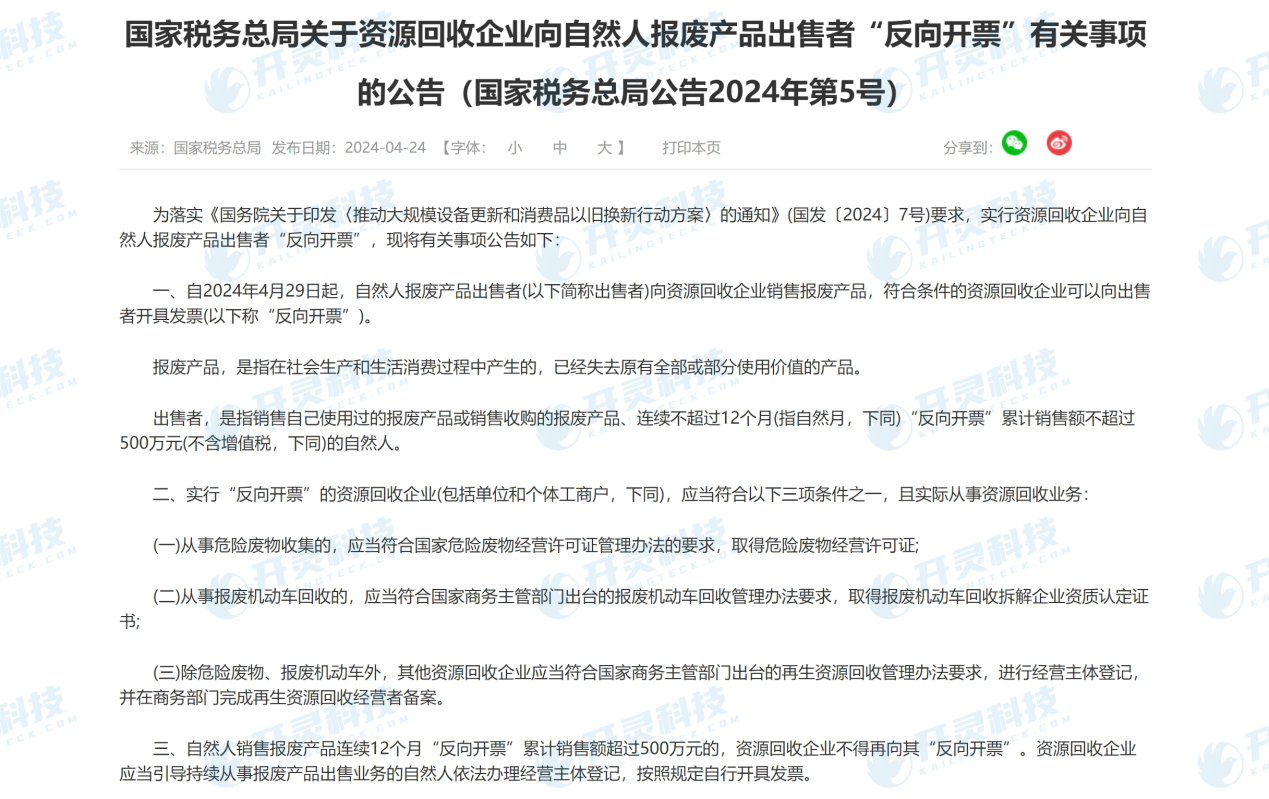
- Nationwide policy implementation:In March 2024, the State Council issued the "Action Plan for Promoting Large-Scale Equipment Renewal and Consumer Goods Trade-In", explicitly proposing to "promote the practice of resource recycling enterprises reverse invoicing to individuals selling scrapped products", extending reverse invoicing from the agricultural products field to the resource recycling field, and indirectly providing policy endorsement for reverse invoicing in wood recycling (which has both agricultural product and resource attributes); on April 24, 2024, the State Taxation Administration issued the "Announcement on Matters Concerning Resource Recycling Enterprises' "Reverse Invoicing" to Individuals Selling Scrapped Products" (No. 5 of 2024), refining the reverse invoicing operation process from six dimensions: "clarifying scope, clarifying deductions, clarifying preferences, increasing convenience, increasing standardization, and increasing efficiency", and clarifying that "individuals selling scrapped products (including wood waste, virgin wood, etc.) to enterprises, enterprises may issue invoices to individuals", completely solving the core problem of wood recycling enterprises being "unable to obtain compliant invoices when purchasing from individuals".
II. Wood Recycling Industry Pain Points: The Urgency and Necessity of Reverse InvoicingDue to the characteristics of "dispersed upstream, high-frequency transactions, and cash-based payments," the wood recycling industry has long faced the dual dilemma of business-finance-tax compliance and operational efficiency. The specific pain points are concentrated in the following four aspects: 1. Difficult invoice acquisition: the core obstacle of missing compliant vouchersThe upstream sellers in wood recycling are mostly individual farmers, small wood processing households, or natural persons. Such entities have no tax registration qualification and cannot issue VAT invoices themselves. When enterprises purchase wood from them, transactions can only be recorded through non-compliant vouchers such as "handwritten receipts" or "IOUs," which neither meet the tax authorities' regulatory requirements for "input vouchers" nor plant hidden risks for subsequent financial accounting. 2. Difficult tax deduction: the hidden burden of enterprise operating costsAccording to current tax law, if timber recycling enterprises cannot obtain compliant input VAT invoices, they cannot deduct VAT (agricultural product procurement may be deducted at 9% of the face amount, and 10% if used for deep processing) or corporate income tax, directly causing the enterprise's VAT burden rate to rise by 3-5 percentage points and annual profit to shrink by more than 10%. Taking a timber enterprise with annual procurement of 10 million yuan as an example, the lack of compliant invoices would result in more than 800,000 yuan in additional annual tax payments. 3.High tax audit risk: compliance hazards of "three flows not matching" The core of tax authorities' supervision of agricultural product purchases is the three-flow-in-one of "order flow, fund flow, and invoice flow." Under the traditional model, the order information, fund payments, and invoice records of timber enterprises are fragmented, making them easily deemed "false invoicing" or "expanding the purchase scope," facing tax audits, fines, or even criminal liability risks. In the past three years, more than 20% of enterprises in the industry were penalized for "three flows not matching." 4. Cumbersome financial operations: Inefficient consumption of labor costsTimber recycling transactions are high-frequency, small in individual amount, and scattered in counterparties. Under the traditional model, finance personnel need to manually record each transaction's farmer information, timber type, quantity, and amount, then pay one by one via cash or personal bank cards, which is not only time-consuming and labor-intensive, but also prone to problems such as "payment recipient inconsistent with transaction counterparty" and "amount entry errors." III. Kailing Technology Solutions: Full-process breakdown of reverse invoicing in timber recyclingBased on the characteristics of the wood recycling industry, Kailing Technology has built an integrated solution of "mini program + backend system + UnionPay Merchant Services + tax interface," with "payment as invoicing" at its core, achieving full-process digitalization of "order creation - confirmation - payment - invoicing - archiving" and ensuring the integration of three flows with controllable compliance. 1. Solution core architecture: four major modules working in coordination- Mini program: for timber recycling enterprises (purchasers) and individuals (sellers, farmers/self-employed), providing lightweight operations such as order creation, scan-code confirmation, payment and invoicing, and invoice viewing; - Backend system: enables order management, risk control scanning, fund transfers, invoice application and status tracking, and connects to the tax system to complete invoice issuance; - UnionPay Merchant Services: ensures funds reach individuals' bank cards directly, supporting full bank coverage, real-time arrival, and no transaction limits; - Tax interface: Connects to the State Taxation Administration system through the "Leqi" platform, automatically completing invoice issuance, upload, and archiving to ensure invoice compliance. 2. Key process: from "people running errands" to "data running errands"▪ Early preparation: user registration and onboarding - Individual registration: complete "mobile phone number login" via the mini program-Face recognition real-name authentication-The three-step operation of "identity selection" requires no complex materials and allows registration to be completed within 5 minutes; the system automatically retains the individual's identity information and bank card information, so subsequent transactions do not require repeated entry.
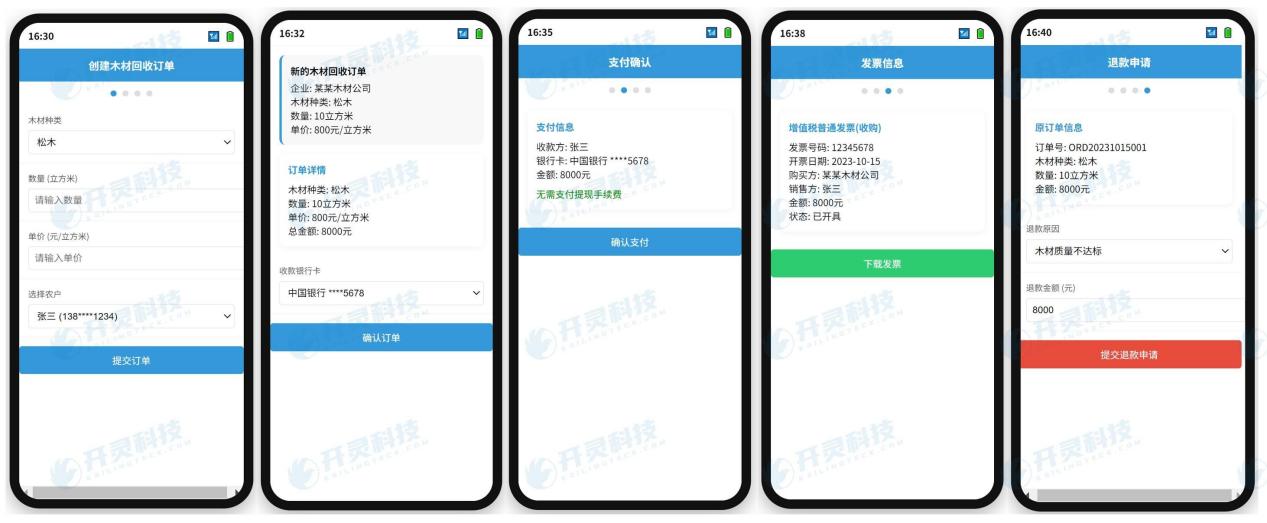
- Enterprise onboarding (wood recycling enterprises): Enterprises submit materials such as "business license, legal representative ID, enterprise tax number, business address" through the backend. After platform review approval, they need to log into the "Leqi" section of the electronic tax bureau to receive the joint-use invitation and complete QR code authorization by the legal representative/finance officer; after onboarding, the wood product library can be initialized to pave the way for subsequent order creation. ▪ Core transaction: full process of invoicing upon payment - Create order (enterprise side): the enterprise selects "timber recycling order" in the mini-program/backend, enters timber type, quantity, and unit price, selects a farmer with historical transactions (or adds a new farmer, and the system automatically matches a registered natural person), and submits the order; the system simultaneously performs "balance verification" (confirming that the enterprise's reserve fund account balance is sufficient) and "risk control scanning" (checking for abnormal orders, such as unit prices far above the industry average or abnormal recent transaction frequency of the farmer, etc.). - Confirm order (farmer side): the system pushes order information to farmers via mini-program notification or SMS; farmers scan the QR code (order QR code generated by the enterprise) or click the link, confirm the order details and receiving bank card information, and submit confirmation after verifying correctness. - Fund payment (UnionPay channel): after the enterprise confirms that the farmer has accepted the order, it initiates a payment instruction; the farmer does not need to pay a withdrawal fee, and the funds arrive in real time. - Automatic invoicing (connected to the tax system): after funds are paid successfully, the backend system automatically initiates a reverse invoicing application to the State Taxation Administration interface, filling in "purchaser (enterprise) information, seller (farmer) information, wood purchase details, amount" and other content; after the tax system approves, it generates a compliant "VAT ordinary invoice (purchase)" and synchronously pushes it to the mini-program accounts of the enterprise and the farmer (the enterprise can download it for deduction, and the farmer can view the transaction voucher). - Anomaly handling (cancellation/refund): If an order is canceled or a refund is required because timber quality does not meet standards, the enterprise initiates a refund application; after system review, funds are returned to the enterprise account via the original route, and a "red-letter invoice" is automatically requested from the tax system to offset the original invoice, ensuring consistency between the invoice flow and the fund flow.
3. Batch operations: improving high-frequency transaction efficiencyFor scenarios where an enterprise purchases multiple batches of timber in a single day, the solution supports batch order creation、Batch payment feature: enterprises can import an Excel-format list, and the system automatically generates multiple orders; after farmers confirm separately, the enterprise initiates batch payment with one click, with funds transferred separately by farmer dimension, and invoices automatically issued on the "one household, one invoice" principle。 IV. Solution core value: triple assurance of cost reduction, efficiency improvement, and complianceKailing Technology's wood recycling reverse invoicing solution creates real value for enterprises from three dimensions: "business-finance-tax compliance, operational efficiency, and cost control": 1. Business-Finance-Tax Compliance: Build a Solid "Three-Flow Integration" Firewall- Voucher compliance: automatically issued VAT ordinary invoices (acquisition) are tax-recognized input vouchers, solving the "no-invoice deduction" problem; enterprises can deduct VAT at 9% of the face amount (10% for deep processing), directly reducing tax burden; - Process compliance: order flow (system records), fund flow (UnionPay transfer records), and invoice flow (tax system invoices) are associated in real time, making every transaction traceable and auditable, completely avoiding the inspection risks of "false invoicing" and "inconsistency among the three flows," and ensuring enterprise business-finance-tax operations can withstand tax authority verification. 2.Operations efficiency improvement: from "manual and cumbersome" to "digital and efficient" - Reduced time cost: single transaction processing time compressed from 15-20 minutes to 3-5 minutes, batch processing efficiency increased by 80%; - Labor cost optimization: Finance personnel no longer need to manually bookkeep, reconcile accounts, or chase payments, and can shift their energy to cost analysis、For core work such as tax planning, enterprises can reduce financial position labor input by 20%-30%. 3. Fund optimization: safeguard the fund security of both transaction parties- Farmer side: funds arrive in real time, no withdrawal fees, avoiding losses from cash transactions、The problem of enterprises delaying payment for goods is addressed, enhancing farmers' willingness to cooperate; - Enterprise end: Manage funds through reserve fund accounts, avoiding compliance risks of personal bank card payments, while the system supports balance alerts、Automatic reconciliation of fund transaction records, improving the transparency of fund management. With a deep understanding of the field of business-finance-tax digitalization and mature technical delivery capabilities, Kailing Technology provides timber recycling enterprises with a one-stop, full-chain, compliant and reliable reverse invoicing solution. In the future, Kailing Technology will continue to follow policy and business changes in the timber recycling industry, iterate and optimize the solution, help more timber recycling enterprises achieve "compliant operation, cost reduction and efficiency improvement," and promote the digital transformation of the renewable resource industry. Relevant enterprises may consult Kailing Technology to obtain detailed customized solutions:https://www.kailingteck.com/h-col-127.html 。 As a comprehensive business-finance-tax digitalization solution service provider, Kailing Technology provides business-finance-tax management digital transformation products and operational services for various government agencies, institutions, and large, medium, and small enterprises. The product line includes: Solutions for sales contract management system, procurement contract management system, fully digitalized Leqi interface project, automatic output VAT invoicing system, invoice issuance for individuals system, employee expense control and reimbursement system, input VAT invoice management system, supply chain collaborative reconciliation system, imaging OCR recognition system, automatic financial bookkeeping system, electronic accounting archives system and other businesses, comprehensively advancing the digitalization process across various fields. If you have any business-finance-tax digital transformation needs, welcome to contact us. Beijing Kailing Technology will serve you wholeheartedly.
|