010-6097 4119Book a Demo


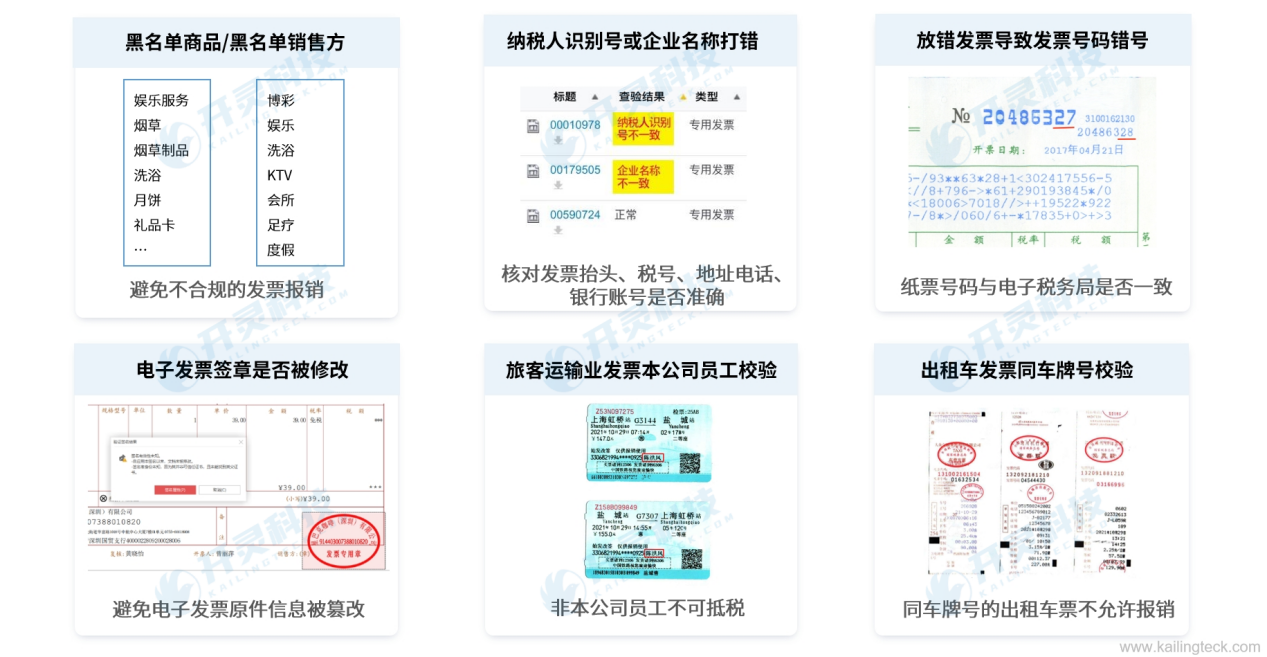
State Taxation Administration: How can enterprises do a good job in tax compliance? (with solutions)Published: 2025-02-28 16:39 Compliance is the foundation of a company's survival; only by operating in accordance with the law and regulations can a company achieve steady and long-term progress. Paying taxes in good faith in accordance with the law is an important aspect of corporate compliance. As the tax business environment continues to improve and the rule of law in taxation takes root, more and more companies realize that paying taxes in good faith in accordance with the law is an important guarantee for growing stronger and achieving high-quality development. National annual tax credit evaluation results show that in 2024, the number of trustworthy taxpayers nationwide reached 41.27 million, an increase of 3.78 million over 2023, among which the number of Grade A taxpayers, the highest tax credit rating, was nearly 3.35 million, an increase of 456,000 over last year, with the number of good-faith taxpaying enterprises growing steadily. I. The Important Significance of Tax ComplianceFrom the enterprise perspective.On one hand, financial data is highly likely to mislead enterprise management, resulting in a lack of clear understanding of the enterprise's competitive advantages or disadvantages; on the other hand, it means the enterprise may face risks such as tax supplements, late payment surcharges, or even fines in the future, bringing uncertain additional expenditures to business operations and also affecting the enterprise's credit rating and reputation. From an industry perspective.All industries face the need to optimize internal structures and balance internal competitive dynamics. If the level of tax compliance among enterprises in a given industry is generally low or varies widely, it becomes difficult to balance the competitive landscape within the industry, which is not conducive to forming a sound and healthy internal industrial structure. Social perspective.Improving the overall tax compliance level of enterprises is conducive to maintaining tax rule-of-law fairness, promoting social fairness, and boosting high-quality economic development. Generally speaking, compliant enterprises have high tax costs, while non-compliant enterprises have low tax costs in the short term. If tax compliance situations differ greatly among enterprises, a situation of "bad money driving out good money" is likely to appear, making fair competition among enterprises difficult to achieve. Therefore, tax compliance is not just a matter for a single enterprise, but has a very important impact on the industry, sector, and even the whole society in which the enterprise operates. II. Common misconceptions in enterprise tax compliance workMisconception 1:Taking whether tax violations will be discovered by tax authorities as the starting point for tax management. In practice, some enterprises take whether tax violations will be discovered by tax authorities as the starting point for tax risk management. These enterprises believe that whether an event is discovered itself carries corresponding uncertainty, thus generating a mentality of taking chances. In business management, enterprises should make every tax-related business point as standardized and accurate as possible. At the same time, the typical tax violation cases published by tax authorities also warn that all types of business entities should strictly abide by tax laws and not harbor any mentality of taking chances. Misconception 2:Because tax filing is accepted, it is assumed there is no problem. After tax authorities accept a tax filing, some enterprises mistakenly believe there is no issue with their tax payment. China implements a system in which tax filing and tax audits are separated. When enterprises file taxes, as long as the internal and inter-table reconciliation relationships in the filing forms are accurate, the tax filing can be accepted, but tax authorities still retain the right to conduct tax audits in the future. Misconception 3:One-sided reference and blind following in tax compliance. Some enterprises one-sidedly refer to the practices of other enterprises when conducting tax filing. Tax work is highly professional. Because each enterprise differs in operating conditions, business model, financial structure, and industry environment, seemingly identical tax treatment methods may produce different tax results across different enterprises. In the tax treatment process, enterprises must maintain independent judgment and must not blindly follow other enterprises' tax operations. They should deeply analyze the rationality and applicability of each tax decision based on their own characteristics, prudently determine tax management strategies, and avoid falling into tax risks. III. How to do a good job in tax compliance workAttach great importance to tax compliance work.Standardized tax treatment requires not only an accurate understanding of tax law but also a precise grasp of corporate accounting standards, and timely attention to tax law and its interactions with other laws. With the continuous emergence of new industries, new business forms, and new models, tax treatment in practice is becoming increasingly specialized and complex. Enterprises should pay more attention to strengthening tax compliance work and achieve tax compliance through specific and reasonable operations. Emphasize procedural law while also emphasizing substantive law.In tax management work, enterprise business-finance-tax professionals focus more on substantive laws such as the Enterprise Income Tax Law and the Value-Added Tax Law, and easily overlook procedural regulations such as the Tax Collection and Administration Law. For example, the Tax Collection and Administration Law stipulates that when tax authorities collect taxes, taxes take priority over unsecured claims, unless otherwise provided by law; if the tax owed by a taxpayer arises before the taxpayer sets up a mortgage or pledge on its property or before the taxpayer's property is liened, the tax shall be enforced before the mortgage, pledge, or lien. While enterprises pay more attention to the obligations imposed on taxpayers by procedural regulations, they should also grasp the rights and protections that procedural regulations provide to taxpayers. Effectively utilize resources from multiple parties.Based on the professional requirements of tax compliance, enterprises should comprehensively utilize resources from multiple parties. This includes resources provided by tax authorities, external expert consultant resources, and internal resources from the enterprise's business-finance-tax department, business department, sales department, etc. It is worth noting that tax management is not only the responsibility of the enterprise's finance department, but is also closely related to departments such as business and sales. Among them, the business department, as the core driver of enterprise operating activities, carries out every business activity, such as contract signing, business model selection, and transaction counterparty determination, all of which directly or indirectly affect the enterprise's tax situation. Enterprises should strengthen communication and collaboration among departments, improve the tax compliance awareness and awareness of paying taxes according to law among all employees, and encourage all departments to proactively consider tax factors in advance when carrying out business work, forming a good pattern in which all employees improve tax law compliance and jointly assume responsibility for tax compliance construction. When designing and planning a financial information system, it needs to be closely related to the enterprise's strategic goals, business processes, and financial functions, supporting the realization of the financial cycle and financial functions in the information system. The financial information system should cover everything from business system data collection to financial operation processing, management control, and the release of business decision information, comprehensively supporting the realization of the financial cycle and financial functions. In terms of business decision-making, this mainly includes production decisions, sales decisions, personnel decisions, and financial decisions. For production decisions, enterprises should rationally plan product development, variety, output, quality, production processes, technological transformation, production equipment, raw material consumption, energy consumption, product packaging, etc., to minimize product production costs and reduce tax burdens. For sales decisions, enterprises should rationally plan product pricing, sales channels, sales methods, sales timing and locations, promotional services, etc., to avoid unnecessary tax risks caused by excessive price competition and abuse of marketing tactics. For personnel decisions, enterprises should rationally plan labor organization, employee training, wages and benefits, etc., and strengthen human resource management and incentive mechanisms to enhance their core competitiveness and value-creating capacity. For financial decisions, enterprises should rationally plan the sources, use, and management of funds, comply with tax regulations, pay taxes in accordance with the law, and conduct scientific economic accounting and financial management to ensure normal operations and stable development. IV. Kailing Tax Risk Control Monitoring System Solution1. Pre-event invoice management: multi-dimensional invoice risk monitoringCheck whether the invoice header, tax number, address and telephone, and bank account number are accurate, and whether the paper invoice number is consistent with the electronic tax bureau. Avoid tampering with the original information of electronic invoices, and verify whether the electronic invoice signature is modified. Avoid non-compliant invoice reimbursement, such as blacklisted commodities (entertainment services, tobacco, tobacco products, bathing, mooncakes, gift cards, etc.) and blacklisted sellers (gambling, entertainment, bathing, KTV, clubs, foot massage, vacation, etc.). Passenger transport invoices of non-employees of the company are not deductible; taxi receipts with the same license plate number are not allowed for reimbursement, and taxi invoices with the same license plate number must be verified.
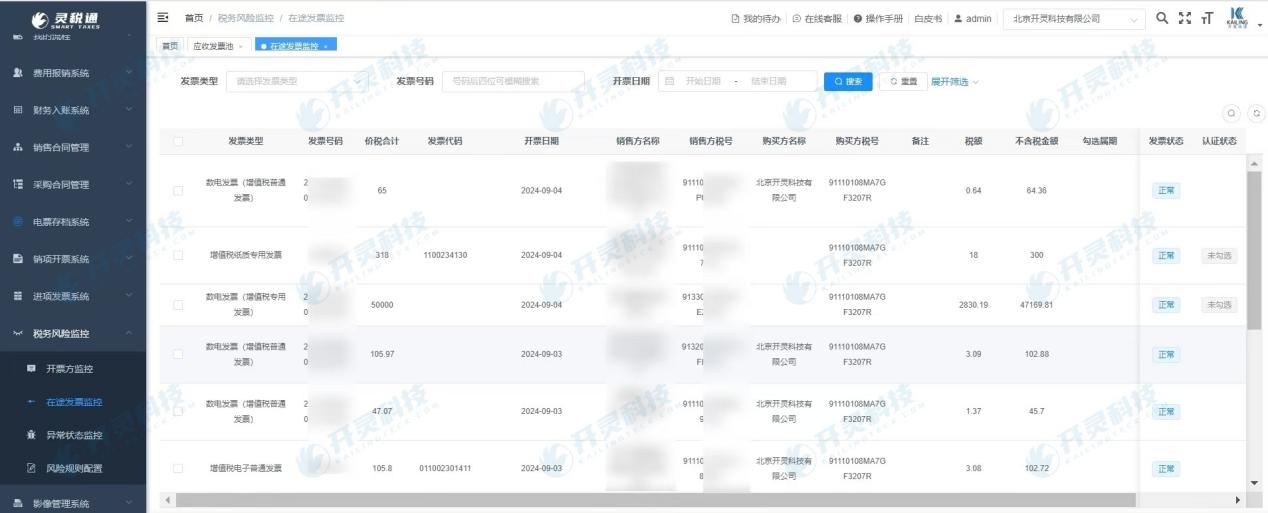
2. In-process invoice management: in-transit invoice monitoringThe accounts receivable invoice pool can synchronize invoice data (PDF, OFD, XML) source files and the latest invoice status with the tax bureau multiple times a day. The in-transit invoice pool is used to monitor invoices whose issuer title is the company title but which have not yet been received. Understand in-transit invoice status in real time, plan tax certification and deduction in advance, and reasonably plan the tax burden rate for tax planning. The tax burden rate formula is: tax burden rate = current VAT payable / current taxable sales revenue; current VAT payable = current output tax - actual deducted input tax; actual deducted input tax = beginning retained input tax + current period input tax - input tax transfer-out - export tax rebate - ending retained input tax. Finance staff can understand the invoice amounts about to be booked through the in-transit invoice pool, ensuring the authenticity and timeliness of financial statements.
3. Post-event invoice management: abnormal invoice monitoringFor invoices already reimbursed/recorded, monitor invoice status in real time daily to prevent invoices from being voided, red-flushed, marked abnormal, or out of control by the issuer.
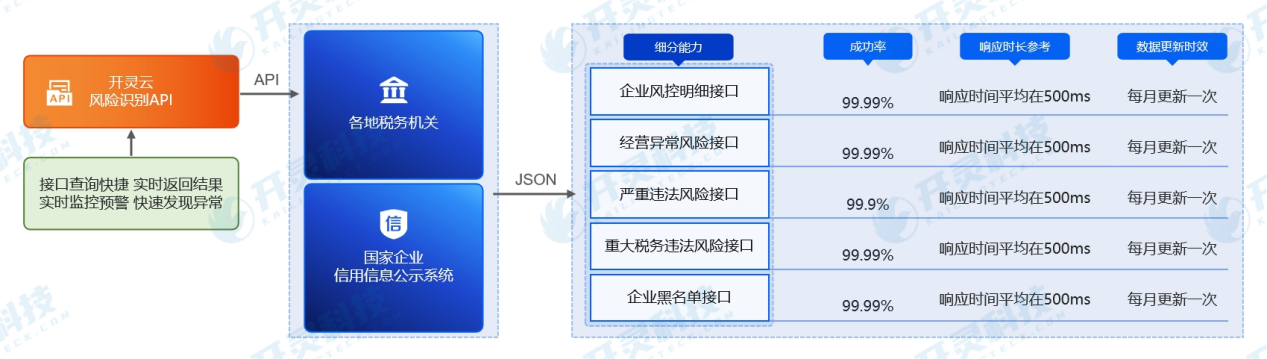
4. Multi-dimensional monitoring service for the invoicing partyThrough the Kailing Cloud risk identification API for interface queries, quickly return results in real time, monitor and warn in real time, and quickly discover anomalies. Obtain enterprise credit information from more perspectives as a basis for cooperation evaluation., monitor whether the issuer of input VAT invoices has been included in the tax blacklist. Efficiently prevent business risks:Reflect the enterprise's credit status, accurately understand the credit status of partner enterprises, and prevent potential risks of partner enterprises; Reduce labor costs:Interface-based integration can be integrated with customer systems, reducing manual query costs and improving customer enterprise work efficiency; Wide enterprise query coverage:Supports nationwide queries of enterprises with abnormal operations, major tax violations, and serious illegal and dishonest enterprises, with accuracy unaffected by manual operations。
Six, Comprehensive tax risk control report, scheduled health check serviceThe system has nearly a hundred built-in business-finance-tax risksMonitoringIndicators and risk control models, comprehensively analyzing enterprise financial indicators, tax indicators, related-party transactions, invoice input/output risks and other information, directly generating tax-related risk assessment reports through the online platform, helping enterprises promptly grasp enterprise risks and adjust response strategies.
The tax risk control monitoring system solution is an important safeguard for enterprise compliance operations and sustainable development. ThroughKailingTax Risk Control Monitoring System Solution, enterprises can promptly identify and resolve potential tax risks, improve financial management, reduce tax costs, and enhance market competitiveness. If your enterprise wants to learn more related information and tax solutions, welcome to contact Kailing Technology:https://www.kailingteck.com/h-col-114.html 。 As a comprehensive business-finance-tax digitalization solution service provider, Kailing Technology provides business-finance-tax management digital transformation products and operational services for various government agencies, institutions, and large, medium, and small enterprises. The product line includes: Solutions for sales contract management system, procurement contract management system, fully digitalized Leqi interface project, automatic output VAT invoicing system, invoice issuance for individuals system, employee expense control and reimbursement system, input VAT invoice management system, supply chain collaborative reconciliation system, imaging OCR recognition system, automatic financial bookkeeping system, electronic accounting archives system and other businesses, comprehensively advancing the digitalization process across various fields. If you have any business-finance-tax digital transformation needs, welcome to contact us. Beijing Kailing Technology will serve you wholeheartedly.
|