010-6097 4119Book a Demo


Interpretation of the Measures for the Management of Electronic Archives (II): Purpose, Definitions and RequirementsPublished on: 2024-11-08 17:16 Decree No. 22 of the National Archives Administration, the "Measures for the Management of Electronic Archives," officially took effect yesterday. To help everyone deeply understand the specific intent of the provisions, the scope of implementation, and practical operations of the "Measures," we have specially prepared a series of short articles interpreting and analyzing the "Measures for the Management of Electronic Archives." Today, we will continue to discuss "Chapter 1 of the Measures for the Management of Electronic Archives: purpose, definitions, and requirements, etc.," to help you grasp the general principles of electronic management.
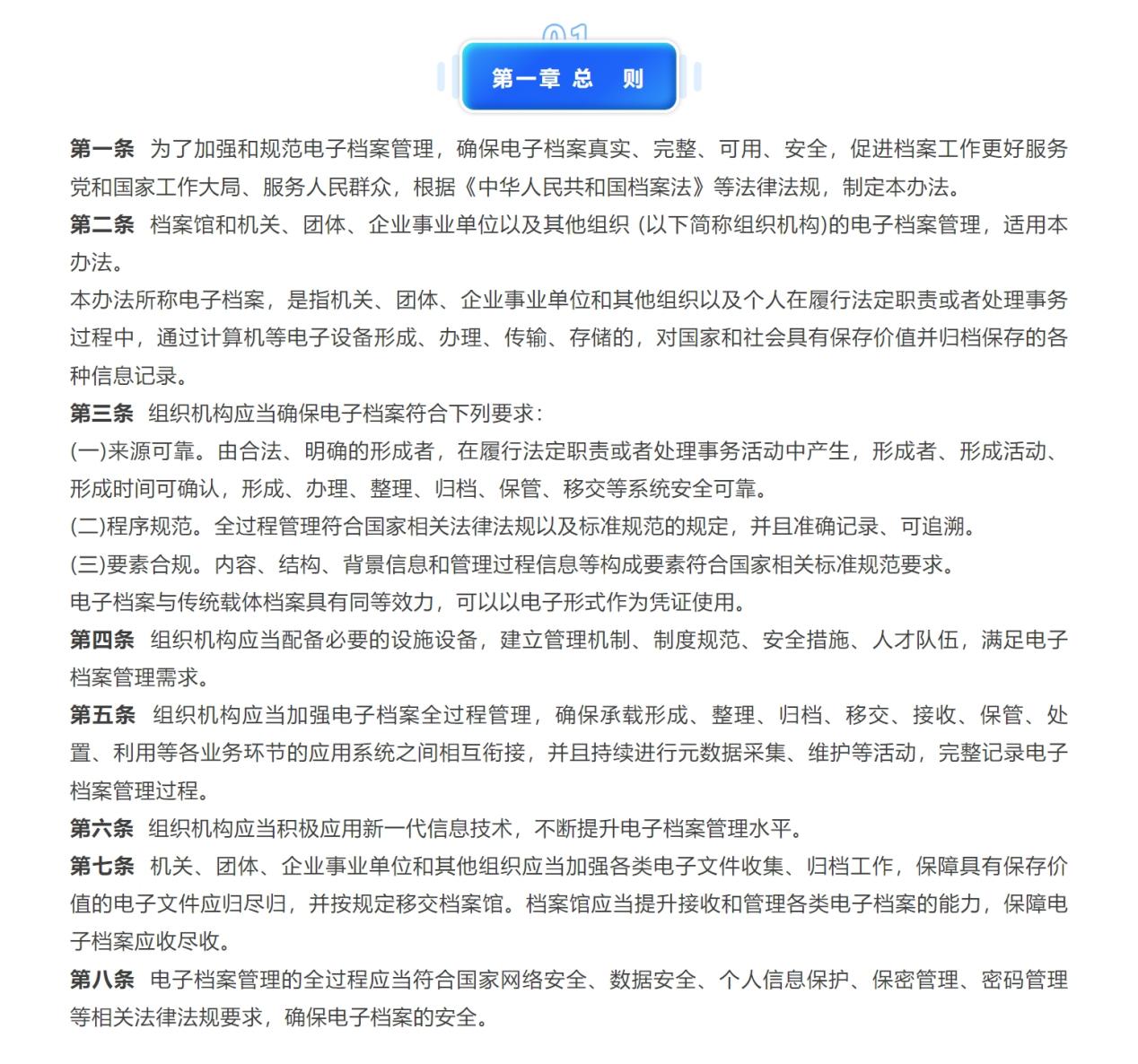
Interpretation of Chapter 1 of the Electronic Archives Management Measures - General Provisions Chapter 1, General Provisions, of the Measures for the Management of Electronic Archives sets out the basic principles, scope of application, operating specifications and security assurance requirements for electronic archives management. It emphasizes the authenticity, integrity, usability and security of electronic archives, and requires that the entire process of electronic archives management not only comply with laws and regulations but also incorporate new-generation technologies to meet the modernization needs of archives management. Article 1 - Purpose of formulation Article 1 clarifies the purpose of formulating the Measures for the Management of Electronic Archives, namely, by standardizing and strengthening electronic archive management, ensuring that electronic archives are authentic, complete, usable, and secure, and ensuring that archive work can serve the overall work of the Party and the state and the people. This emphasizes the importance of electronic archives in supporting national strategy and public services, and highlights the key role of electronic archives management in safeguarding social order and information security. Article 2 - Scope of application and definition of electronic archives Article 2 states that these Measures apply to the electronic archive management work of all "archives repositories and government agencies, organizations, enterprises, public institutions, and other organizations" (i.e., "organizations"). The "electronic archives" here refer to electronic information records formed in the course of an organization or individual performing statutory duties or handling affairs that have preservation value for the state and society. This definition emphasizes the legal status and preservation value of electronic archives, and covers the generation process, form, and preservation conditions of electronic archives through explicit descriptions such as "formed, processed, transmitted, and stored through electronic devices." Article 3 - Basic Requirements for Electronic Archives Article 3 further clarifies the basic requirements for electronic archives, includingReliable sources, standardized procedures, and compliant elements: 1. Reliable source: electronic archives must come from lawful and clearly defined creators, and the formation process must be traceable to ensure the authenticity and authority of the archives. This requirement clarifies the legality of the archive formation process and ensures that formation, handling, organization, and archiving are all safe and reliable. 2. Procedural standardization: The entire process of electronic archive management must comply with national laws, regulations, and standards to ensure process traceability and record accuracy. This standardization not only ensures the compliance of electronic archives during management but also ensures the completeness and verifiability of information records. 3. Element compliance: electronic archives should meet national standard requirements in terms of content, structure, background information, and management process information. This ensures the accuracy and consistency of electronic archive information, enabling it to achieve the same legal effect as traditional paper archives in actual use and to qualify for use as evidence. Article 4 - Facilities, Systems and Staffing Article 4 requires organizations to provide the necessary hardware equipment and informatization infrastructure for electronic archives management, and to establish management mechanisms, institutional standards, security safeguards and a talent team. This indicates that electronic archive management depends not only on technical facilities, but also requires systems, management standards, and talent support to ensure the comprehensive capability and systematic nature of electronic archive management. Article 5 - Full-process management Article 5 emphasizes full-process management of electronic archives, including systematic linkage of business stages from creation, organization, archiving, and transfer to utilization. Full-process management ensures the dynamic recording and validity of electronic archives, and continuously collects and maintains metadata, fully recording the archive management process. This management method ensures that every stage of archives from generation to use is rigorous and standardized, and can meet the requirements for archive completeness and traceability. Article 6 - Technical application Article 6 encourages organizations to actively apply the new generation of information technology and continuously improve the level of electronic archive management. This article explains that electronic archive management must keep pace with technological development, so as to improve the efficiency and quality of archive management as information technology continues to advance. Article 7 - Collection and Archiving of Electronic Documents Article 7 states that all types of organizations should strengthen the collection and archiving of electronic documents, ensuring that electronic documents with preservation value can be archived and transferred to archives. At the same time, archives institutions are required to improve their ability to receive and manage electronic archives, achieving "collect all that should be collected." This article sets clear requirements for the early collection and later archiving of electronic documents, helping ensure that documents with preservation value are not lost due to management oversights. Article 8 - Security assurance Article 8 emphasizes that full-process management of electronic archives shall comply with national laws and regulations on cybersecurity, data security, personal information protection, confidentiality management, and cryptography management to ensure the security of electronic archives. This article highlights the security requirements of electronic archives, especially in cases involving sensitive information, protecting the security and privacy of archives through compliant management. Summary Chapter 1, General Provisions, of the Measures for the Management of Electronic Archives sets out the basic principles, scope of application, operating specifications and security assurance requirements for electronic archives management. It emphasizes the authenticity, integrity, usability and security of electronic archives, and requires that the entire process of electronic archives management not only comply with laws and regulations but also incorporate new-generation technologies to meet the modernization needs of archives management. Source: internet As a comprehensive business-finance-tax digitalization solution service provider, Kailing Technology provides business-finance-tax management digital transformation products and operational services for various government agencies, institutions, and large, medium, and small enterprises. The product line includes: Solutions for businesses including sales contract management system, procurement contract management system, fully digitalized Leqi interface project, output automatic invoicing system, employee expense control and reimbursement system, input VAT invoice management system, supply chain collaborative reconciliation system, image OCR recognition system, automatic financial bookkeeping system, and electronic accounting archives system, comprehensively driving the digitalization process across various fields. If you have any business-finance-tax digital transformation needs, welcome to contact us. Beijing Kailing Technology will serve you wholeheartedly.
|