010-6097 4119Book a Demo


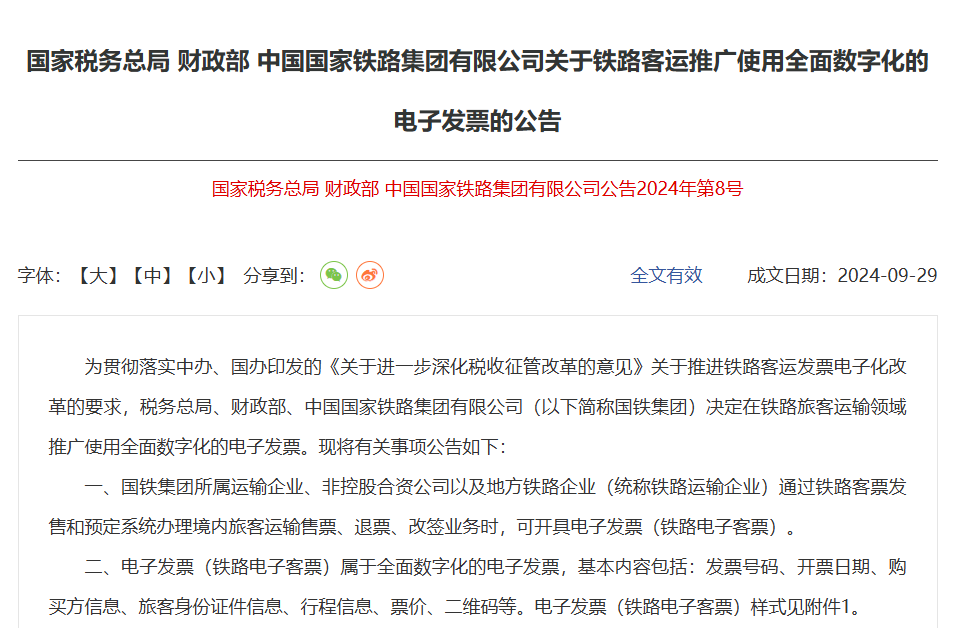
Fully digitalized e-invoices for railway are fully implemented! Practical questions arise regarding air tickets, refunds, changes, and more!Published: 2024-11-05 16:45 On October 18, the State Taxation Administration, the Ministry of Finance, and China State Railway Group Co., Ltd. issued the Announcement on Promoting the Use of Fully Digitalized Electronic Invoices in Railway Passenger Transport, announcing that paper railway tickets will no longer be used and will be replaced by electronic tickets. Effective from November 1! What about fully digitalized e-air tickets? Can refunds and changes be deducted as input? What are the points to note? (1)Fully digitalized e-invoice train tickets fully implemented!
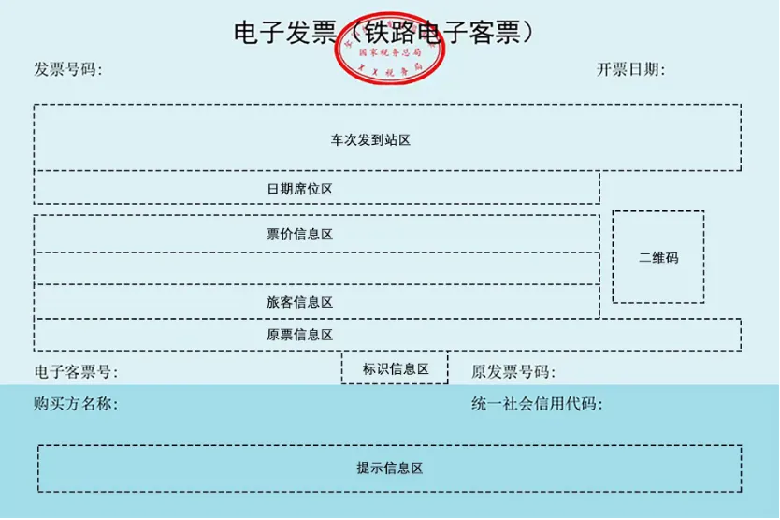
I. Transport enterprises affiliated with China Railway Group, non-controlling joint venture companies, and local railway enterprises (collectively referred to as railway transport enterprises) handle domestic passenger transport through the railway ticket sales and reservation systemFor ticket sales, refunds, and changes, electronic invoices (railway electronic tickets) can be issued。 II. Electronic invoices (railway electronic passenger tickets) are fully digitalized e-invoices,Basic content includes: invoice number, invoicing date, purchaser information, passenger identity document information, itinerary information, fare, QR code, etc. III. After the journey ends or after paying refund or change fees, passengers can use Railway 12306(including websites and mobile clients, the same below)Obtain electronic invoices (railway electronic passenger tickets) truthfullyRailway transport enterprises shall truthfully issue electronic invoices (railway e-tickets) based on the purchaser name, unified social credit code, and itinerary information provided by the passenger. IV. Railway transport enterprises shall deliver the electronic invoice (railway electronic ticket) to passengers via download from Railway 12306 or by email, etc.. Passengers can query, download, and print electronic invoices (railway electronic tickets) through Railway 12306. V. Passengers requiring reimbursement and accounting entry shall obtain an electronic invoice (railway electronic ticket).Purchasers are encouraged, after receiving electronic invoices (railway e-tickets), to achieve full-process paperless processing of electronic invoices (railway e-tickets) in accordance with the relevant requirements of the accounting data standards for electronic vouchers.For ride dates before September 30, 2025, railway tickets (paper reimbursement vouchers) obtained by passengers can still be reimbursed and recorded, and railway tickets (paper reimbursement vouchers) and electronic invoices (electronic railway passenger tickets) cannot be issued repeatedly. Six,If the purchaser is a VAT general taxpayer, for purchasing domestic railway passenger transport services, the electronic invoice (railway electronic ticket) shall be used as the VAT deduction voucher, and the input tax amount shall be determined according to current regulations.For railway tickets (paper reimbursement vouchers) with a ride date before September 30, 2025, the input tax amount shall still be determined in accordance with the provisions of Article 6, Item 1, Point 3 of the Announcement of the Ministry of Finance, State Taxation Administration, and General Administration of Customs on Policies for Deepening VAT Reform (No. 39 of 2019). (That is, if a taxpayer obtains a train ticket dated before September 30, 2025, they can still print a paper ticket and calculate the deduction.) Seven,After passengers obtain an electronic invoice (railway electronic ticket), if they need to reissue the electronic invoice (railway electronic ticket) due to errors in buyer information or other reasons, the railway transport enterpriseIssue red-letter e-invoices (railway e-tickets) according to the following provisions: (1) If the purchaser has not carried out purpose confirmation and accounting confirmation, the railway transport enterprise shall fill out the "Red Letter Invoice Information Confirmation Form" (hereinafter referred to as the "Confirmation Form", see Appendix 2) and issue a red electronic invoice (railway electronic ticket). (II) Where the buyer has already undergone purpose confirmation or accounting confirmation, the railway transport enterprise shall fill out the Confirmation Form, and after confirmation by the buyer, issue the red-letter electronic invoice (railway electronic ticket) based on the Confirmation Form. If the buyer has already used the electronic invoice (railway electronic ticket) for VAT filing deduction, the VAT amount listed in the confirmed Confirmation Form shall be temporarily transferred out from the current period's input tax, and after obtaining the red-letter electronic invoice (railway electronic ticket) issued by the railway transport enterprise, it shall be used together with the Confirmation Form as original vouchers. Eight,China Railway Group uploads electronic invoice (railway electronic ticket) information to the tax authorities as required, and the tax authorities synchronously transmit the electronic invoice (railway electronic ticket) to the buyer through the tax digital account of the electronic invoice service platform (hereinafter referred to as the tax digital account). The buyer can query, verify, download, print and confirm the use of the electronic invoice (railway electronic ticket) through the tax digital account, and can also throughNational VAT Invoice Verification Platform(https://inv-veri.chinatax.gov.cn) for verification. Passengers can query and download electronic invoices (railway electronic tickets) through the personal ticket folder in the Individual Income Tax APP. IX. This announcement shall take effect from November 1, 2024. Attached:Sample railway electronic ticket and red-letter invoice information confirmation form
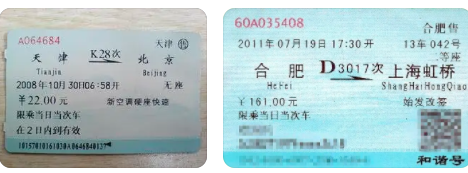
(II)Railway e-invoices are so convenient! Whether finance staff or business travelers, they have suffered from the little square railway train tickets for too long.
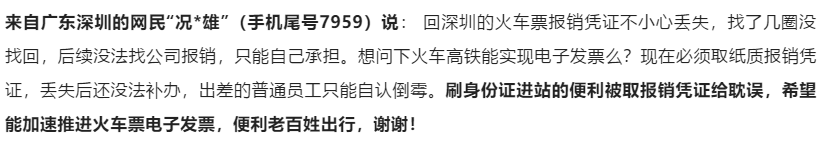
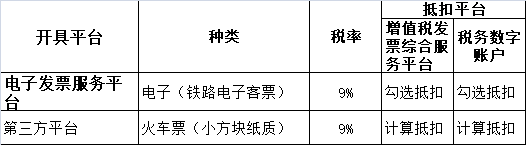
For reimbursement, one must go to a designated location specifically to print, and it is veryEasy to lose, and also very inconvenient to paste when reimbursing. Surprisingly, train tickets have not only become electronic,can also enable checkbox deduction, which is extremely convenient for tax filing。 For electronic train tickets obtained, we directly select them on the platform and then declare the deduction.
The deduction amount can be taken directly as the tax amount listed on the invoice; there is no need to calculate it yourself.
Selection and deduction leave traceable data. The tax bureau also does not need to worry about taxpayers arbitrarily filling in data for false deduction, because every piece of data can be checked against the invoice selection data. (Three)Detailed explanation of the fully digitalized e-invoice train fare policy! I. What services regarding e-invoices (railway electronic tickets) do railway transport enterprises provide to passengers?After the itinerary ends or payment of refund or change fees, passengers can log in to their railway 12306 account (including website and mobile client, the same below) within 180 days to truthfully obtain their own electronic invoice (railway electronic ticket); beyond 180 days, the agreement between the passenger and the railway transport enterprise applies. The railway transport enterprise truthfully issues the electronic invoice (railway electronic ticket) through railway 12306 and delivers it to the passenger via railway 12306 download or email. Passengers can query, download, and print the electronic invoice (railway electronic ticket) through railway 12306. Currently, railway transport enterprises that handle domestic passenger transport ticketing, refunds, and rebooking through the railway ticket sales and reservation system provide the service of issuing e-invoices (railway e-tickets), but for related business such as non-real-name tickets, emergency paper tickets, and China Railway UnionPay Card/E-card pass tickets, the service of issuing e-invoices (railway e-tickets) is temporarily not provided. II. After the promotion and use of electronic invoices (railway electronic passenger tickets), can railway tickets (paper reimbursement vouchers) still be used for reimbursement, bookkeeping, and tax deduction? Passengers who need reimbursement and booking shall obtain an electronic invoice (railway electronic ticket). Where the purchaser is a general VAT taxpayer, for domestic railway passenger transport services purchased, the electronic invoice (railway electronic ticket) shall be used as the VAT deduction voucher, and the input VAT amount shall be determined in accordance with current regulations. The purchaser may log in to the electronic invoice service platform to query the VAT amount corresponding to the electronic invoice (railway electronic ticket) obtained for domestic railway passenger transport services purchased, and determine the input VAT amount accordingly. To maintain a smooth transition, for railway tickets (paper reimbursement vouchers) issued through the railway ticket sales and reservation system with travel dates before September 30, 2025, passengers may still use the railway tickets (paper reimbursement vouchers) for reimbursement and booking, and purchasers may still determine input tax in accordance with the provisions of Article 6, Item 1, Point 3 of the "Announcement of the Ministry of Finance, State Taxation Administration, and General Administration of Customs on Policies for Deepening VAT Reform" (2019 No. 39). III. What services do tax authorities provide to taxpayers and passengers regarding e-invoices (railway e-tickets)?Tax authorities transmit e-invoices (railway e-tickets) synchronously to buyers through the tax digital account of the e-invoice service platform (hereinafter referred to as the tax digital account).The purchaser may inquire, verify, download, print, and confirm the use of electronic invoices (railway electronic tickets) through the tax digital account, or verify through the National VAT Invoice Verification Platform (https://inv-veri.chinatax.gov.cn). Passengers may inquire and download electronic invoices (railway electronic tickets) through the personal ticket folder of the Individual Income Tax APP. IV. After a VAT general taxpayer issues or obtains an electronic invoice (railway electronic passenger ticket), how should the VAT filing form be filled out?The amount and tax amount of electronic invoices (railway electronic tickets) issued by a general VAT taxpayer shall be filled in Columns 3 to 4 "Other Invoices Issued" of the VAT and Additional Tax Filing Form Annex (I) (Current Period Sales Details). For the input tax amount of electronic invoices (electronic railway tickets) claimed for deduction by a general taxpayer, when filing taxes, it shall be filled in the relevant columns of "VAT special invoices verified as compliant" in Appendix II of the VAT and Surcharge Tax Return (Details of Input Tax for the Current Period). Where a general VAT taxpayer has already used an electronic invoice (railway electronic ticket) for VAT filing deduction, after the invoicer initiates the red-letter reversal process, the VAT amount listed in the corresponding Red-Letter Invoice Information Confirmation Form shall be filled in Column 20 "Input Tax Specified in the Red-Letter Special Invoice Information Form" of the VAT and Additional Tax Filing Form Annex (II) (Current Period Input Tax Details). V. How is the electronic invoice (railway electronic ticket) reimbursed and recorded?If a taxpayer obtains an electronic invoice (railway electronic passenger ticket) for reimbursement and booking, it shall implement in accordance with the Notice of the Ministry of Finance and the National Archives Administration on Standardizing the Reimbursement, Booking, and Archiving of Electronic Accounting Vouchers (Cai Kuai [2020] No. 6), the Measures for the Management of Accounting Archives (Order No. 79 of the Ministry of Finance and the National Archives Administration), the Specifications for Accounting Informatization Work (Cai Kuai [2024] No. 11), the Basic Functions and Service Specifications of Accounting Software (Cai Kuai [2024] No. 12), and the Ministry of Finance's provisions on accounting data standards for electronic vouchers. (IV)When will fully digitalized e-invoices for flight tickets be implemented? In fact, fully digitalized e-tickets are already being implemented!
Currently, fully digitalized e-invoices bearing the words Aviation Transport Electronic Ticket Itinerary or Railway Electronic Ticket include the Buyer Name and its Unified Social Credit Code. If they are to be used for tax deduction, pre-tax deduction, and financial reimbursement, the information of the unit using the invoice for tax deduction, pre-tax deduction, and financial reimbursement should be filled in the Buyer Name and its Unified Social Credit Code fields, and after issuance, the invoice should be delivered directly to the corresponding unit's tax digital account, with relevant traveler information displayed in the passenger information column (section); rather than being pushed to the enterprise for reimbursement and booking through the invoice push function module under the tax digital individual account in the Individual Income Tax APP. Compared with previous paper itineraries, electronic itineraries achieve full-process paperless issuance, distribution, recording, and archiving, and can be generated and transmitted online directly, improving usage efficiency and avoiding the risk of loss. So how should an electronic itinerary be issued? For example, for an Air China ticket, passengers who purchase tickets on the Air China APP can select "All Services" on the APP homepage, then click "Reimbursement Voucher" under the ticket service options, then select "Electronic Itinerary", and finally complete the operation according to the prompts. Open the VAT Invoice Comprehensive Service Platform. On the invoice selection screen, when selecting the invoice type, under fully digitalized e-invoice in the invoice type there appearsElectronic invoice (Air Transport Electronic Passenger Itinerary).
I. Which flight tickets are currently deductible?Only with Finance and Tax Announcement No. 39 were different tax deduction vouchers and calculation methods for deductible input tax set according to different modes of transport. 1. Special VAT invoices (including electronic special VAT invoices); special VAT invoices are rarely obtained. 2. For itineraries that require indicating passenger identity information, calculate input tax according to (fare + fuel surcharge)/(1+9%)*9% on the itinerary. 3. For VAT electronic ordinary invoices issued under the company's title (no passenger identity required), with the major category abbreviated as *transportation services*, the input VAT is deducted according to the tax amount stated on the invoice. 4. Under fully digitalized e-invoices, if it is a fully digitalized special VAT invoice, it has the same effect as a VAT special invoice, and you can also select it for deduction. (The legal effect and basic use of fully digitalized e-invoices are the same as existing paper invoices. Among them, fully digitalized e-invoices bearing the words "VAT Special Invoice" have the same legal effect and basic use as existing VAT special invoices; fully digitalized e-invoices bearing the words "General Invoice" have the same legal effect and basic use as existing general invoices.) 5. For fully digitalized ordinary invoices, the effect is the same as VAT electronic ordinary invoices, and in theory deduction is calculated based on the tax amount on the face of the invoice. However, if issued with a passenger transport service tag, whether it can be checked and deducted remains to be verified in practice. 6. Fully digitalized e-invoices (air transport electronic passenger ticket itineraries) currently appear to be selectable for deduction. The legal effect and basic purpose of fully digitalized e-invoices bearing the words "Air Transport Electronic Passenger Ticket Itinerary" are the same as those of existing air transport electronic passenger ticket itineraries;
II. Can airline ticket refunds be deducted?
According to Article 2 of the Notice of the Ministry of Finance and the State Taxation Administration on VAT Policies Concerning Input VAT Deduction for Leased Fixed Assets (Caishui [2017] No. 90): "Income such as ticket refund fees and handling fees charged by a taxpayer to a customer for processing a refund shall be subject to VAT as "other modern services." Therefore, the taxpayer's ticket refund fee expenditure does not belong to what is referred to as "taxpayers purchasing domestic passenger transport services" in Article 6 of the Announcement of the Ministry of Finance, State Taxation Administration, and General Administration of Customs on Policies for Deepening VAT Reform (Announcement No. 39 of 2019 of the Ministry of Finance, State Taxation Administration, and General Administration of Customs),Input tax shall be deducted with VAT special invoices in accordance with current regulations. (That is, special invoices (including fully digitalized special e-invoices) must be obtained to deduct; if it is an ordinary invoice, then you are a brokerage agency service, which does not fall under the purchase of passenger transport services) III. Can airline ticket change fees be deducted?
Our company is a general VAT taxpayer. An employee on a business trip obtains an electronic ticket itinerary. The itinerary separately indicates a rebooking fee. Can the rebooking fee be calculated as purchased passenger transport services for input VAT deduction? Answer: Yes. The rebooking fee listed on the air transport electronic ticket itinerary and the rebooking fee listed on the railway ticket both fall within the scope of all fares and other charges obtained by taxpayers providing transport services, and the input VAT can be calculated and deducted in accordance with the relevant provisions of Article 6 of the Announcement of the Ministry of Finance, the State Taxation Administration, and the General Administration of Customs on Relevant Policies for Deepening the Reform of VAT (Announcement No. 39 of 2019 of the Ministry of Finance, the State Taxation Administration, and the General Administration of Customs). But in practice, some friends reported that after checking the box, the data in the VAT and Surcharge Tax Return Attachment (II) (Current Period Input Tax Details) was not brought out, and the tax bureau asked them to fill it in manually in the "Other" column. Source: internet As a comprehensive business-finance-tax digitalization solution service provider, Kailing Technology provides business-finance-tax management digital transformation products and operational services for various government agencies, institutions, and large, medium, and small enterprises. The product line includes: Solutions for businesses including sales contract management system, procurement contract management system, fully digitalized Leqi interface project, output automatic invoicing system, employee expense control and reimbursement system, input VAT invoice management system, supply chain collaborative reconciliation system, image OCR recognition system, automatic financial bookkeeping system, and electronic accounting archives system, comprehensively driving the digitalization process across various fields. If you have any business-finance-tax digital transformation needs, welcome to contact us. Beijing Kailing Technology will serve you wholeheartedly.
|