010-6097 4119Book a Demo


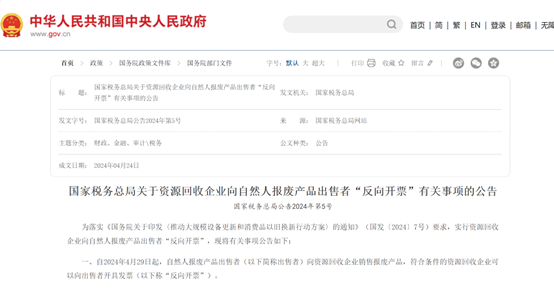
How to issue reverse invoices? A practical guide, explained in one articlePublished: 2024-08-30 17:12 China's "reverse invoicing" policy provides enterprises with effective support for optimizing tax management and improving industry transparency. By clarifying the tax responsibilities of both transaction parties, this policy simplifies the invoicing process and enhances the accuracy and traceability of financial data. It not only helps us conduct financial management more efficiently and ensures the correct implementation of tax policies, but also incentivizes compliant operations within the industry and provides solid business-finance-tax support for the sustainable development of the industry. One typical application scenario of "reverse invoicing" is the resource recycling industry. The resource recycling industry plays an important role in promoting the circular economy and environmental protection, but when front-end individuals in socialized resource recycling sell scrapped products to resource recycling enterprises, it is difficult for them to provide invoices, which hinders industry development. Resource recycling enterprises lack the "first invoice," and can neither deduct VAT input tax nor obtain vouchers for pre-tax deduction of cost expenses for corporate income tax. "Reverse invoicing" solves the industry's invoice difficulty.So how exactly is "reverse invoicing" operated? And what are the solutions to common problems? I. The reverse invoicing model emerged in response to this needOn April 25, 2024, the State Taxation Administration issued the "Announcement on Matters Concerning Resource Recycling Enterprises' "Reverse Invoicing" to Individuals Selling Scrapped Products",Clarify the specific measures and operating methods for resource recycling enterprises to issue "reverse invoices" to individual sellers of scrap products。
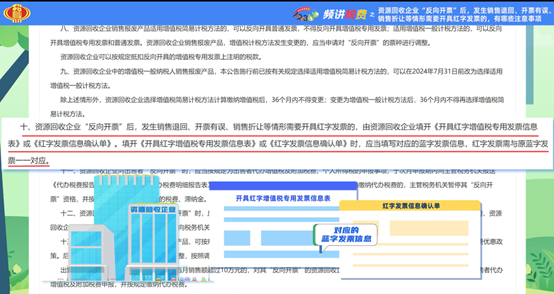
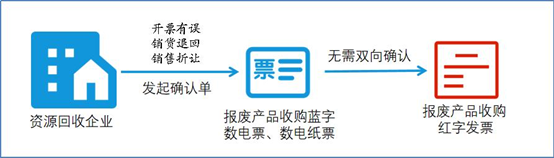
On July 29, 2024, the State Taxation Administration also explained the red-offset operation required after "reverse invoicing" by resource recycling enterprises. The resource recycling enterprise fills out the "Information Form for Issuing Red-Letter Special VAT Invoices" or the "Red-Letter Invoice Information Confirmation Form", and the red-letter invoice must correspond one-to-one with the information of the original blue-letter invoice.
WorthwhileIt is worth mentioning that,For reverse invoicing red-letter reversal, regardless of whether it has already been selected for deduction or recorded, a red-letter invoice can be issued without confirmation from the counterparty (the seller)。
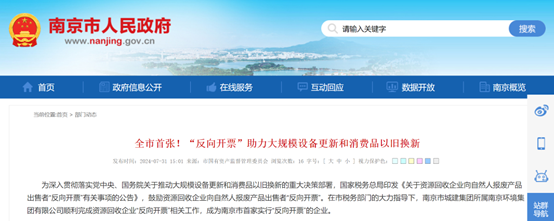
Local tax authorities actively promote policy implementation through various means, optimize system support, and strengthen supervision。On July 31, 2024, under the active guidance of the municipal tax authorities, Nanjing Environment Group Co., Ltd. successfully issued the city's first "reverse invoice."
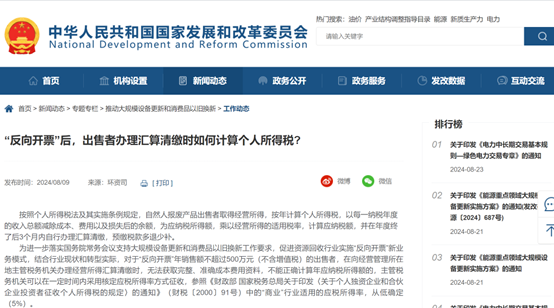
On August 9, 2024,The National Development and Reform Commission has made clear provisions on the issue of sellers calculating individual income tax after "reverse invoicing". The business income obtained by an individual seller of scrapped products is subject to individual income tax calculated on an annual basis. Specifically, the total income for each tax year minus costs, expenses, and losses is the taxable income. Then, multiply this taxable income by the applicable tax rate for business income to calculate the tax payable. In addition, within 3 months after the end of the year, the individual needs to handle the annual reconciliation themselves, with excess prepaid tax refunded and shortfall supplemented.
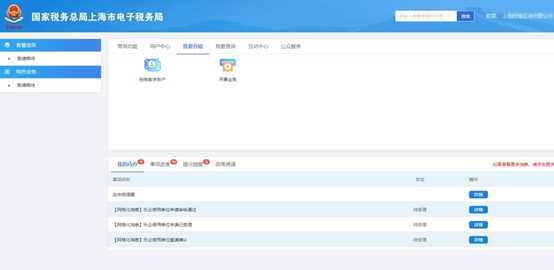
II. Reverse invoicing has obvious advantagesFor sellers: ① Simplified process:No need to issue invoices yourself, reducing cumbersome invoicing procedures and related costs. ② Timely collection:After the purchaser issues an invoice, the seller can settle and collect payment more quickly, improving capital turnover efficiency. ③ Compliance convenience:Avoids compliance issues that may arise from unfamiliarity with invoice issuance regulations, reducing tax risks. For buyers: ① Accurate cost accounting:Able to obtain invoices in a timely manner, accurately record procurement costs, and facilitate cost accounting and financial management. ② ③ Supply chain management optimization:Better grasp supply chain information and strengthen the management and control of resource recycling operations. How exactly do you operate in the electronic tax bureau system? III. How do I perform reverse invoicingStep 1:Log in to [Electronic Tax Bureau] — [I Want to Handle Taxes] — [Invoicing Business]
Step 2:Click [Blue-Letter Invoice Issuance] — [Issue Invoice Immediately]
Step 3:Select [Invoice Type], and in the [Specific Business] drop-down box, select "Scrap Product Purchase".
Step 4:Enter the invoicing page and, in the seller information section, fill in the individual's name, ID type, and unified social credit code (for an individual, enter their ID card number).
In the item name field, enter the specific name, unit, and amount of the recycled scrapped product, select the applicable tax rate, and click issue invoice.
Step 5:Click Invoice Issuance, review the prompt, and after confirming it is correct, click Continue Invoicing.
Step 6:"Invoicing successful" is displayed, indicating invoicing is complete.
Kailing Technology·Lingshuitong Smart Invoice Platform, actively explored and optimized business under this industry model of reverse invoicing,Supports enterprises in conveniently issuing reverse invoices, and the above operation steps can be completed on one interface. After selecting the "acquisition" invoice type in the system, buyer information will be automatically supplemented, and the tax rate will be set to "0% tax-free." These functions are all consistent with reverse invoicing scenarios, greatly improving the efficiency and accuracy of invoice management. IV. Ten Questions and Ten Answers on "Reverse Invoicing" for Resource Recycling Enterprises1. How is "scrap products" defined in the "reverse invoicing" policy for resource recycling enterprises? Answer:Scrap products refer to products that have lost all or part of their original use value and are generated in the process of social production and living consumption. 2. How to define the "seller" in the "reverse invoicing" policy for resource recycling enterprises? Answer:Seller refers to a natural person who sells used scrapped products or sells purchased scrapped products, and whose cumulative sales via reverse invoicing over no more than 12 consecutive months do not exceed 5 million yuan. 3. What conditions must resource recycling enterprises implementing "reverse invoicing" meet? Answer:Resource recycling enterprises (including units and individual businesses) implementing "reverse invoicing" shall meet one of the following three conditions and actually engage in resource recycling business: (1) Those engaged in the collection of hazardous waste shall meet the requirements of the national Measures for the Administration of Hazardous Waste Operating Licenses and obtain a hazardous waste operating license; (2) Those engaged in the recycling of scrapped motor vehicles shall meet the requirements of the Measures for the Administration of Scrapped Motor Vehicle Recycling issued by the national competent commerce department and obtain the qualification recognition certificate for scrapped motor vehicle recycling and dismantling enterprises; (3) Except for hazardous waste and scrapped motor vehicles, other resource recycling enterprises shall meet the requirements of the Measures for the Administration of Renewable Resource Recycling issued by the national competent commerce department, register as business entities, and complete the filing of renewable resource recycling operators with the commerce department. 4. Can resource recycling enterprises adjust the invoice quota for "reverse invoicing"? Answer:Resource recycling enterprises may, based on the actual operating needs of "reverse invoicing," apply to the competent tax authority according to regulations to adjust the invoice quota, or the maximum invoicing limit and number of invoices. 5. Can resource recycling enterprises that apply the simplified VAT calculation method issue VAT special invoices in reverse? Answer:If a resource recycling enterprise selling scrapped products applies the simplified VAT calculation method, it may issue ordinary invoices in reverse but must not issue special VAT invoices in reverse; if it applies the general VAT calculation method, it may issue both special VAT invoices and ordinary invoices in reverse. If the VAT calculation method for a resource recycling enterprise's sale of scrapped products changes, it shall apply to adjust the invoice type for "reverse invoicing." 6. Can resource recycling enterprises deduct input tax amounts based on special VAT invoices issued through reverse invoicing? Answer:Resource recycling enterprises may deduct the tax amount noted on special VAT invoices issued in reverse according to regulations. 7. After the policy is issued, can VAT general taxpayers among resource recycling enterprises that originally applied the VAT simplified taxation method choose to apply the VAT general taxation method instead? Answer:For general VAT taxpayers among resource recycling enterprises that sell end-of-life products and had chosen to apply the simplified VAT calculation method according to relevant provisions before this announcement took effect, they may change to the general VAT calculation method before July 31, 2024. Except for the above situations, after a resource recycling enterprise chooses the VAT simplified taxation method to calculate and pay VAT, it may not change within 36 months; after changing to the VAT general taxation method, it may not choose the VAT simplified taxation method again within 36 months. 8. After a resource recycling enterprise carries out "reverse invoicing," how are situations such as sales returns, incorrect invoicing, and sales allowances handled? Answer:After a resource recycling enterprise issues a "reverse invoice," if a red-letter invoice needs to be issued due to sales returns, invoicing errors, sales allowances, etc., the resource recycling enterprise shall fill out the Information Form for Issuing Red-Letter Special VAT Invoices or the Red-Letter Invoice Information Confirmation Form. When filling out the Information Form for Issuing Red-Letter Special VAT Invoices or the Red-Letter Invoice Information Confirmation Form, the corresponding blue-letter invoice information shall be filled in, and red-letter invoices must correspond one-to-one with the original blue-letter invoices. 9. Can sellers who sell scrapped products through "reverse invoicing" enjoy relevant tax and fee preferential policies? Answer:Sellers selling scrapped products via reverse invoicing may, per regulations, enjoy preferential tax policies such as VAT exemption for small-scale taxpayers with monthly sales of 100,000 yuan or less and VAT calculated and paid at a reduced levy rate of 1% instead of 3%. If the relevant tax preferential policies for small-scale taxpayers are subsequently adjusted, the adjusted policies shall apply. 10. What materials should resource recycling enterprises implementing "reverse invoicing" keep? Answer:Resource recycling enterprises implementing "reverse invoicing" shall, in accordance with the relevant provisions of the Law of the People's Republic of China on the Administration of Tax Collection and its implementation rules, keep materials that can prove the authenticity of the business, including purchase contracts or agreements for purchasing scrapped products, transport invoices or vouchers, cargo weighbridge tickets, transfer payment records, etc., and establish a purchase ledger to record in detail the time, place, seller and contact information, name, quantity, price, etc. of each purchase transaction for inspection. If the taxpayer's existing account books and systems can include the above content, there is no need to establish a separate ledger. Kailing Technology provides enterprise business-finance-tax digital product lines according to enterprise needs: Solutions for businesses including sales contract management system, procurement contract management system, fully digitalized Leqi interface project, output automatic invoicing system, employee expense control and reimbursement system, input VAT invoice management system, supply chain collaborative reconciliation system, image OCR recognition system, automatic financial bookkeeping system, and electronic accounting archives system, professionally and efficiently supporting the transformation and upgrading of enterprise business-finance-tax digital management. If you have any business-finance-tax digital transformation needs, welcome to contact us. Beijing Kailing Technology will serve you wholeheartedly.
|