010-6097 4119Book a Demo


What do large enterprises need to prepare to adapt to fully digitalized Leqi services?Published: 2024-02-28 13:50 Fully digitalized Leqi pilots continue to accelerate. Currently, all 36 provinces, autonomous regions and municipalities across the country have launched fully digitalized e-invoice pilots and issued normative guidelines for Leqi self-use services. For large enterprises, building Leqi well and fully enjoying the convenience of fully digitalized e-invoices has become a mandatory choice. But in the construction of Leqi, enterprises still have some questions, such as: Can Leqi and web invoicing run in parallel? What is the detailed operation process of the Leqi upgrade? What matters require enterprise cooperation during the Leqi upgrade process? What benefits does upgrading to Leqi bring to enterprises, especially in terms of risk control? Based on this, we summarizedSeveral key stages of Leqi construction to help you better plan your Leqi implementation. What changes does Leqi bring to enterprise management? Compared with past collection and management methods, digital tax collection and management in the Golden Tax Phase IV fully digitalized e-invoice era presents the following trends:
Basically establish a tax law enforcement risk informatization internal control and supervision system with comprehensive coverage, full-process prevention and control, and responsibility for all staff. At the same time, important progress has been made in the standardization of tax law enforcement, convenience of tax and fee services, and precision of tax supervision.
Shift from experience-based enforcement to scientific and precise enforcement;A shift from undifferentiated services to refined, intelligent, and personalized services; a shift from managing tax by invoices to "governing tax by data." In addition, by 2023, information systems will basically achieve automatic data extraction, automatic tax amount calculation, and automatic pre-filling of filings, and taxpayers and fee payers can submit online after confirmation or correction.。
Achieve electronification across all domains, all links, and all elements. At the same time, achieve intelligent aggregation of legal person tax and fee information in a "one-household" format, individual tax and fee information in a "one-person" format, tax authority information in a "one-bureau" format, and tax personnel information in a "one-member" format. Applied to Leqi development, this is a great opportunity for large enterprises. By incorporating Leqi Direct Connection, enterprises can achieve data-element-driven operations, using fully digitalized e-invoices to carry key business, financial, and tax information throughout the entire process and every link of invoice issuance, management, receipt, storage, and use. Through Leqi, enterprises can achieve comprehensive head-office-to-head-office direct tax-enterprise connection, realize group invoice and tax digital control and collaborative application. In the future, as the State Taxation Administration continuously opens capabilities such as direct filing and risk warnings on the Leqi platform, it will comprehensively drive the group's tax digital transformation. Specifically, through Leqi construction, enterprises can also achieve the following benefits:
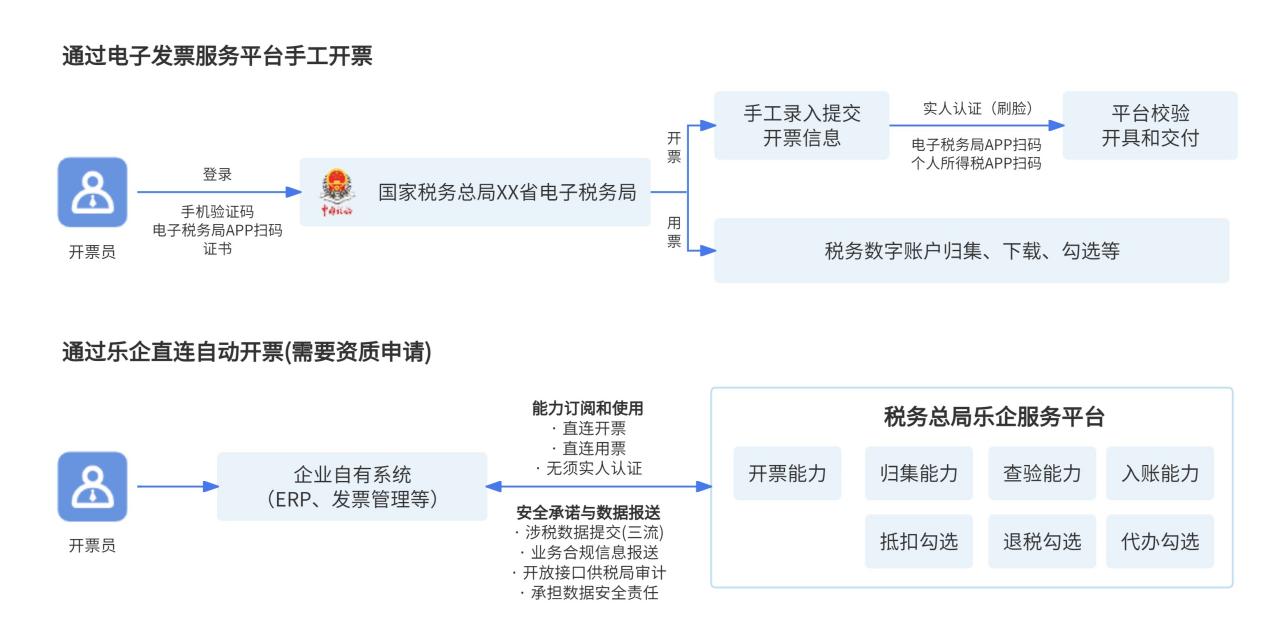
Taking the simplest fully digitalized e-invoice issuance as an example, the convenience for enterprises using Leqi and those not using Leqi is vastly different. We know that enterprises using fully digitalized e-invoices can already gain many conveniences. For example: no need to obtain dedicated equipment, seamless connection between business opening and invoicing; cancellation of the blank invoice application mechanism, with invoice numbers automatically assigned by the system; and fully digitalized e-invoices contain richer information, including basic elements, specific elements, and additional elements, support tag-based management, and can specifically classify e-invoice functions, status, and purposes. These are practical conveniences. In fact, at the regulatory level, the new fully digitalized e-invoice system is also more intelligent. It can determine the credit limit based on the taxpayer's actual production and operation conditions, support automatic and manual adjustment of the limit, and control the taxpayer's total invoicing amount through the credit limit. This is one of the changes we often call the shift from "controlling tax by invoices" to "governing tax by data". However, there is a small operational difficulty here, namelyReal-person authentication。 Currently, for enterprises to achieve issuance and usage of fully digitalized e-invoices, the invoicing clerk needs to log in to the unified electronic invoice service platform of the State Taxation Administration XX Provincial Electronic Tax Bureau via mobile phone verification codes, electronic tax bureau APP scanning, and other methods to achieve basic services such as invoicing and invoice usage. It should be noted that the electronic invoice service platform only supports manual issuance, which puts greater operational pressure on enterprises with large invoicing volumes, and in this process, real-person authentication (face scanning) is required, and invoice issuance and delivery can only be achieved after platform verification, creating a gap in automation. Through Leqi platform direct connection automatic invoicing, the invoicing clerk logs into the enterprise's own system (ERP, invoice management system, etc.) to achieve direct-connection invoicing and direct-connection invoice use, without the trouble of frequent face authentication, and can achieve seven core capabilities including invoicing, collection, verification, deduction selection, tax refund selection, agency selection, and booking, truly realizing automation and business-finance-tax integration.
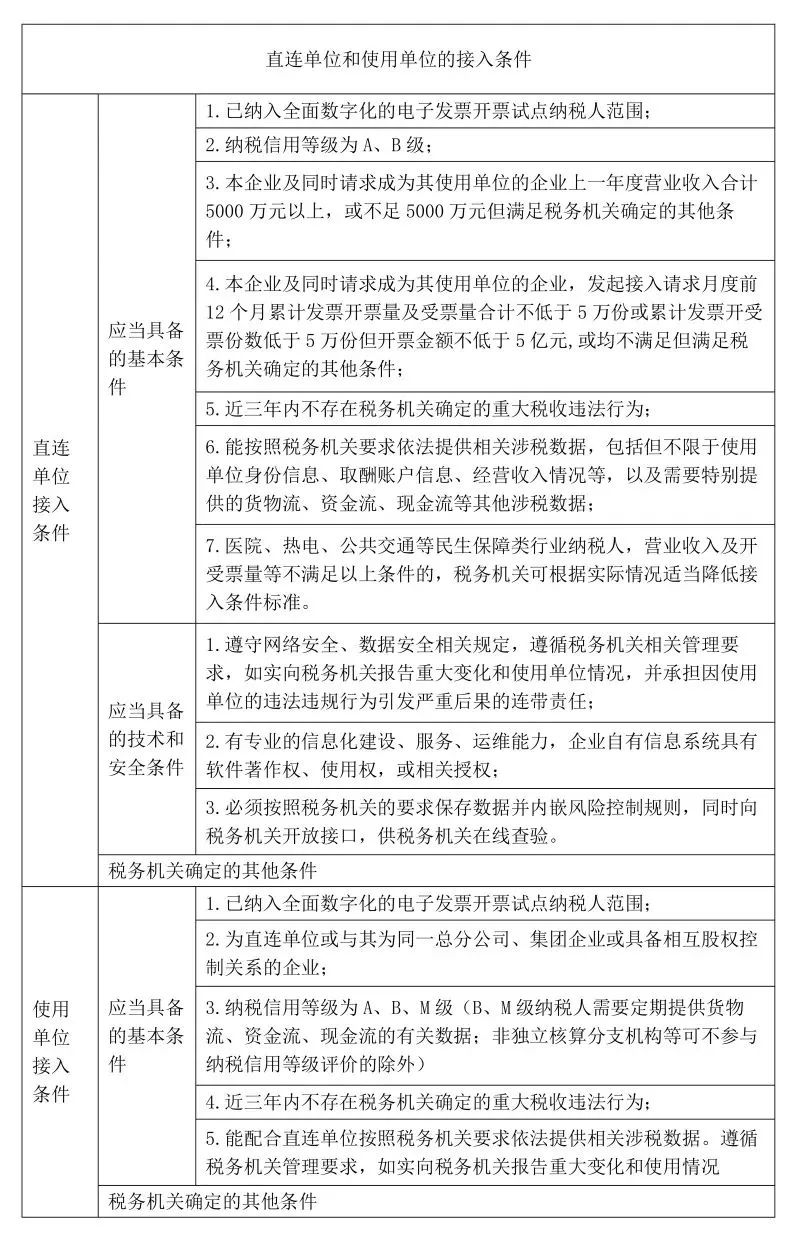
So for enterprises, building a Leqi platform to achieve efficient use of fully digitalized e-invoices is not only the far-sightedness required to complete the top-level design of digital upgrading, but also a practical need to help frontline operators, the entire finance department, and the company's transaction processes reduce costs and improve efficiency. This deserves high attention from all enterprises, and through reasonable planning, they can quickly complete Leqi application, system integration and testing, application, and other work. Leqi Construction Steps STEP1 Determine qualifications According to the Guidelines for Leqi Self-Use Service Specifications, there are three types of Leqi services: Leqi self-use, Leqi joint-use, and Leqi other-use. It should be noted that currently, the scope of Leqi pilot verification is limited to Leqi self-use.
Its qualification requirements for direct connection units and user units include hard rules such as taxation level, revenue, and invoicing volume, and also require that there have been no major tax violations determined by tax authorities in the past three years, which enterprises need to pay special attention to. At the same time, relevant tax-related data must be provided in accordance with tax authority requirements.
If your enterprise meets the basic requirements for Leqi application, then you can continue to learn about the detailed application process. STEP2 Choose path Before starting the application, you also need to confirm one thing: whether the enterprise will build its own Leqi platform or build a Leqi platform through cooperation with a third party, and the pros and cons of the two approaches. The many advantages of the Leqi platform listed above will bring qualitative improvements in fully digitalized e-invoice issuance, circulation, and business-finance-tax integration, helping enterprises advance tax digitalization upgrades. At the same time, rights and obligations are certainly reciprocal. Behind the convenient application of the Leqi platform is a consideration of enterprises' comprehensive capabilities. First, for an enterprise to activate the Leqi platform, qualification application is required; second, during use, interfaces must be opened for tax authority auditing, and responsibility for data security must be borne. Finally and most critically, Leqi is not a one-time task but requires continuous operation and upgrades. For enterprises, Leqi is not merely a change in invoicing and invoice-use channels, but more a driving force for enterprise business-finance-tax digital transformation and the foundation for fully leveraging the digital dividends of fully digitalized e-invoices. So if an enterprise wants to do Leqi integration well, it must not only have strong IT implementation capabilities to meet the needs of continuous operation and upgrades, but more importantly, have a global understanding and long-term plan for tax work, be able to consider Leqi services and enterprise digital construction as a unified goal, comprehensively consider organizational upgrading and process reengineering, build a good data foundation from the source, and prepare for future comprehensive digital upgrading. Based on this, we believe that for enterprises with sufficient digital experience, a strong IT team, and the ability to rapidly iterate products, self-building can be chosen. After all, as a group enterprise, its technical team consists of "insiders," and it has unique advantages in project planning, requirements research, internal coordination, system construction, project launch, and collaborative advancement, Correspondingly, if an enterprise is still in the system planning stage at the digital level and does not yet have mature experience, and needs to clarify the relationship between financial systems and business systems, tax systems, and digital systems, then choosing an experienced third party for assistance is also a good option. Choosing an experienced third-party service provider offers three major advantages. First, rich experience, able to use stones from other hills to polish jade.After all, Leqi is a new thing, and its system integration and launch have no precedent to follow. At the same time, the Leqi platform needs to realize the issuance and use of fully digitalized e-invoices, which are also a new thing. Many enterprises have not yet established fully digitalized e-invoice systems. By cooperating with experienced third parties, enterprises can draw on their successful experience to better complete the planning and launch of the fully digitalized Leqi platform. Second, the fully digitalized e-invoice Leqi platform is a systems project and requires holistic thinking.When we consider the fully digitalized Leqi platform, we cannot consider only invoicing and invoice-use issues, but must consider connectivity with business systems and financial systems. We should not artificially create data silos or data gaps, but should be committed to full-chain data connectivity, comprehensively improving data usage efficiency. Therefore, an experienced service provider cannot merely provide fully digitalized e-invoice issuance and use services, but must also have integration thinking and be able to help enterprises achieve business-finance-tax connectivity. Third, the fully digitalized e-invoice and Leqi upgrade is not a one-time project, but a continuous project.Service providers need rapid response, agile iteration, and continuous operations capabilities to provide enterprises with uninterrupted 7*24 service, ensuring the smooth launch and use of enterprises' fully digitalized Leqi platform. STEP3 Plan well and complete on schedule step by step Once the qualification issues and construction path issues are resolved, you can begin making a good Leqi construction plan. In the process of Leqi Direct Connection, if a team with rich practical experience intervenes, it may make every step of the planning clear and properly arranged, doing a good job in back-end deployment and upgrades without affecting current business, and providing full-group joint debugging capability to ensure coordinated go-live across multiple cities and multiple business segments, ultimately achieving financial digitalization upgrade. The Kailing fully digitalized e-invoice and Leqi solution covers Leqi platform connection and invoicing and invoice usage capabilities, with business experts personally guiding enterprises to quickly connect to the Leqi platform and fully enjoy the convenience of fully digitalized e-invoices.
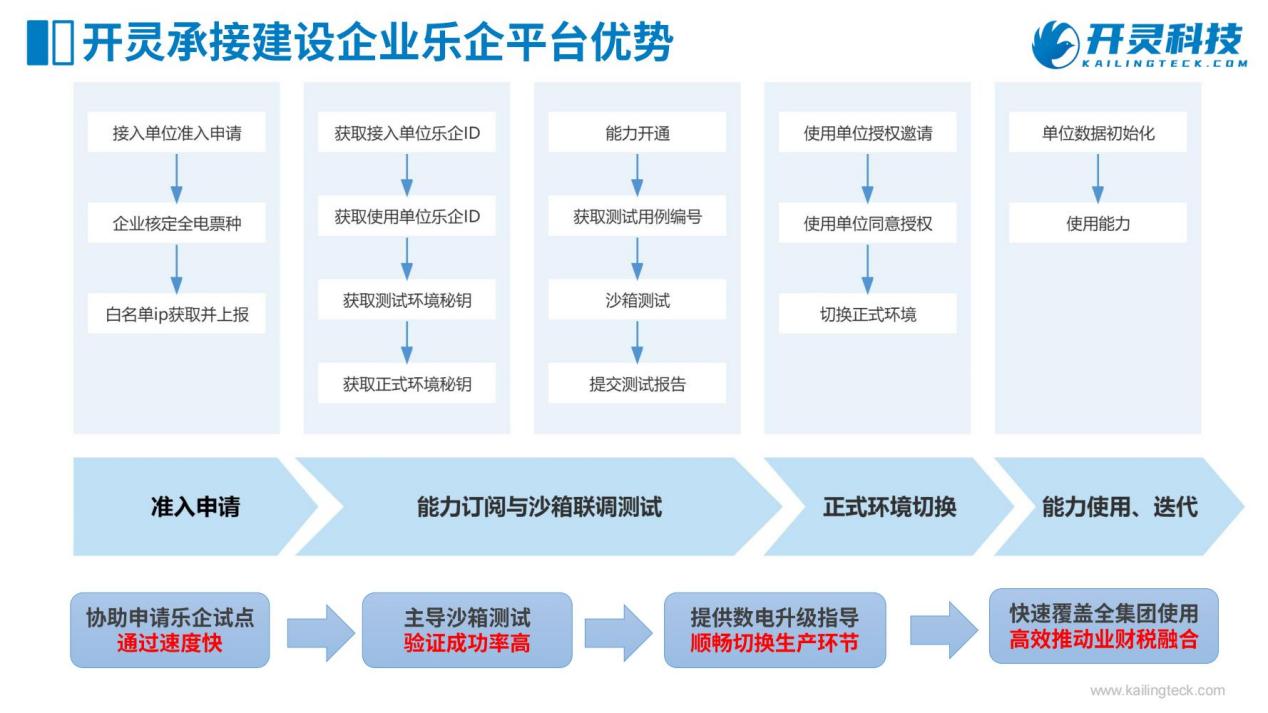
Leqi Platform connection process After completing the preliminary preparations, you can begin the Leqi application. Currently, both direct connection units and user units can apply online. The detailed process is shown in the figure. There are three key points here. First, the submitted application materials must be complete; second, the solution must be recognized by the local tax authority; third, it must pass environmental testing.
Kailing Technology can helpThe enterprise completes the Leqi application, platform connection, and e-invoice issuance, enabling full-process support to help enterprises quickly realize the Leqi application and the use of fully digitalized e-invoices. If your enterprise is preparing to launch the fully digitalized e-invoice Leqi platform, welcome to contactKailing Technology, and we will haveBusinessExperts guide you step by step to quickly connect to the Leqi platform, meeting the needs of the full lifecycle management of fully digitalized e-invoice issuance, circulation, and storage, and providing ongoing support for future full-chain digital upgrades. Beijing Kailing Technology Co., Ltd.——an enterprise business-finance-tax digitalization solution service provider. Kailing Technology provides solutions for sales management systems, procurement management systems, output invoicing systems, input invoice collection systems, imaging management systems, financial posting systems, electronic accounting archives, fully digitalized e-invoice and Leqi interfaces and other businesses according to enterprise needs, professionally and efficiently helping enterprises transform and upgrade their business-finance-tax digital management. If you have any business-finance-tax digital transformation needs, welcome to contact us. Beijing Kailing Technology will serve you wholeheartedly.
|