
How to handle mismatches between input and output invoices? 2026 compliance review and system solutions

How to handle mismatches between input and output invoices? 2026 compliance review and system solutions
"Input-output mismatch" may refer to differences in period, product name, quantity and amount, invoice face, or deduction purpose. First clarify which type of difference it is, then handle each separately; not all differences should be corrected by re-invoicing or transferred out. This article gives finance teams a troubleshooting sequence table: determine the comparison basis, reconstruct the real business, check each invoice, judge the tax treatment, and retain review records.
I. Period inconsistency: first check procurement and sales rhythm
An enterprise may purchase this month and sell next month, or receive prepayment first and issue invoices after performance. Place procurement receipt, production requisition, sales shipment, and invoice issuance dates on the same timeline to distinguish normal inventory turnover from abnormal suspense. Unequal input and output invoice amounts in a single month does not by itself indicate an invoice error or non-deductible input tax; the real transaction and applicable tax law must still be verified.
II. Product name or quantity inconsistency: explain by goods destination
For processing enterprises that purchase raw materials and sell finished products, or combine multiple batches of incoming goods into shipments, input and output invoices may not correspond one-to-one. Keep order, receipt, requisition for processing, shipment, and loss records by batch. If goods are resold as-is and differences in product name, specification, or quantity cannot be explained, suspend automatic matching and verify the actual goods; do not manually modify the ledger to create consistency.
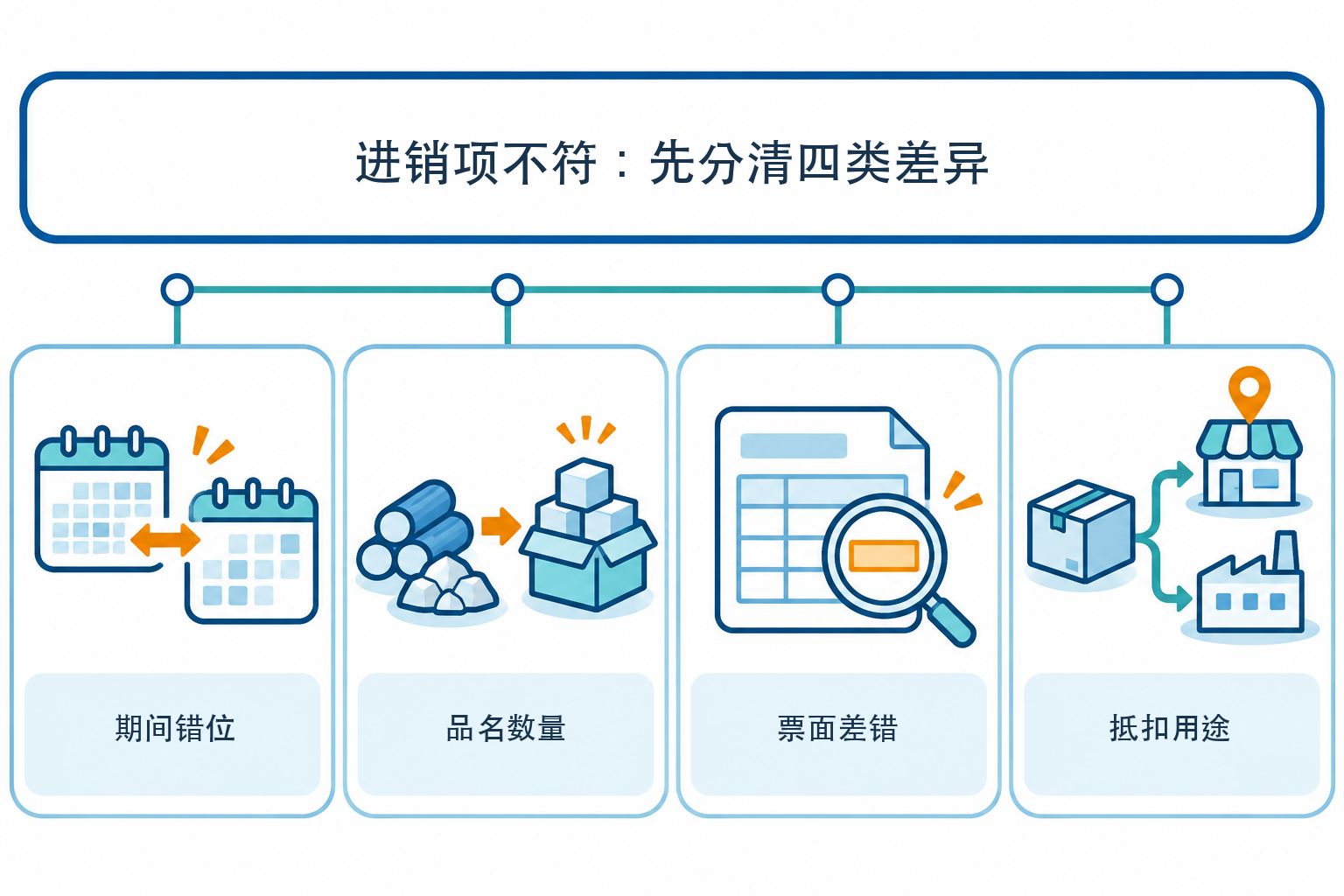
III. Invoice face errors: distinguish input and output treatment
Check invoice by invoice whether the transaction party, product or service name, amount, tax rate, and other items match the actual business. If an output fully digitalized e-invoice has been issued and circumstances such as invoicing errors as stipulated occur, handle the red-letter invoice and correct blue-letter invoice according to the State Taxation Administration's announcement on fully digitalized e-invoices; if an input invoice is issued incorrectly, contact the issuer to handle it according to law, and judge deduction only after obtaining the correct voucher. Do not demand a red-letter reversal of a correct invoice merely because the names on two invoices differ.
IV. Abnormal use or vouchers: then judge deduction and transfer-out
The Value-Added Tax Law of the People's Republic of China and its implementing regulations have separate provisions on non-deductible items, mixed use, and changes in use after deduction. First verify taxpayer status, tax deduction vouchers, purchase use, and current deduction status; if a notice of abnormal tax deduction vouchers is received, handle it according to the notice and applicable announcements. One cannot broadly stipulate that all differences be "immediately transferred out," nor treat a genuine transaction as the sole condition for deduction.
V. Record handling conclusions in a difference ledger
It is recommended that each difference record at least the business number, difference type, involved invoices, verification evidence, responsible person, handling action, tax impact, review date, and closure basis. The system can generate a pending-review list from invoices and business documents, but automatic rules only provide prompts; finance and tax personnel are responsible for conclusions. Kailing Technology's input, output, and risk management related products can be included in the pilot; specific invoice retrieval, comparison, and write-back capabilities are subject to the version, authorization, and project acceptance.
Verification Basis
Value-Added Tax Law of the People's Republic of China;Implementing Regulations of the Value-Added Tax Law of the People's Republic of China;State Taxation Administration announcement on the promotion and application of fully digitalized e-invoices;Announcement of the State Taxation Administration on the Administration of Abnormal VAT Tax Deduction Vouchers。
As a comprehensive business-finance-tax digitalization solution service provider, Kailing Technology provides business-finance-tax management digital transformation products and operational services for various government agencies, institutions, and large, medium, and small enterprises. The product line includes: solutions for sales contract management system, procurement contract management system, fully digitalized Leqi interface project, automatic output invoicing system, reverse invoicing system, invoice issuance for individuals system, employee expense control and reimbursement system, input VAT invoice management system, supply chain collaborative reconciliation system, image AI OCR recognition system, automatic financial bookkeeping system, electronic accounting archives system, etc., comprehensively driving the digitalization process across various fields.
Consultation Hotline: 18513895936 / 010-60974119 Location: Beijing