
How to Read Expense Management Software Rankings? 2026 Selection Pitfall Guide

How to Read Expense Management Software Rankings? 2026 Selection Pitfall Guide
Searching for "China's top ten expense management software rankings" can help build a candidate list, but ranking positions cannot directly answer an enterprise's own reimbursement, budget, payment, and bookkeeping questions. This article does not fabricate a unified ranking; instead, it teaches procurement teams to verify the source of rankings and then use the same sample set to conduct live validation of candidate products.
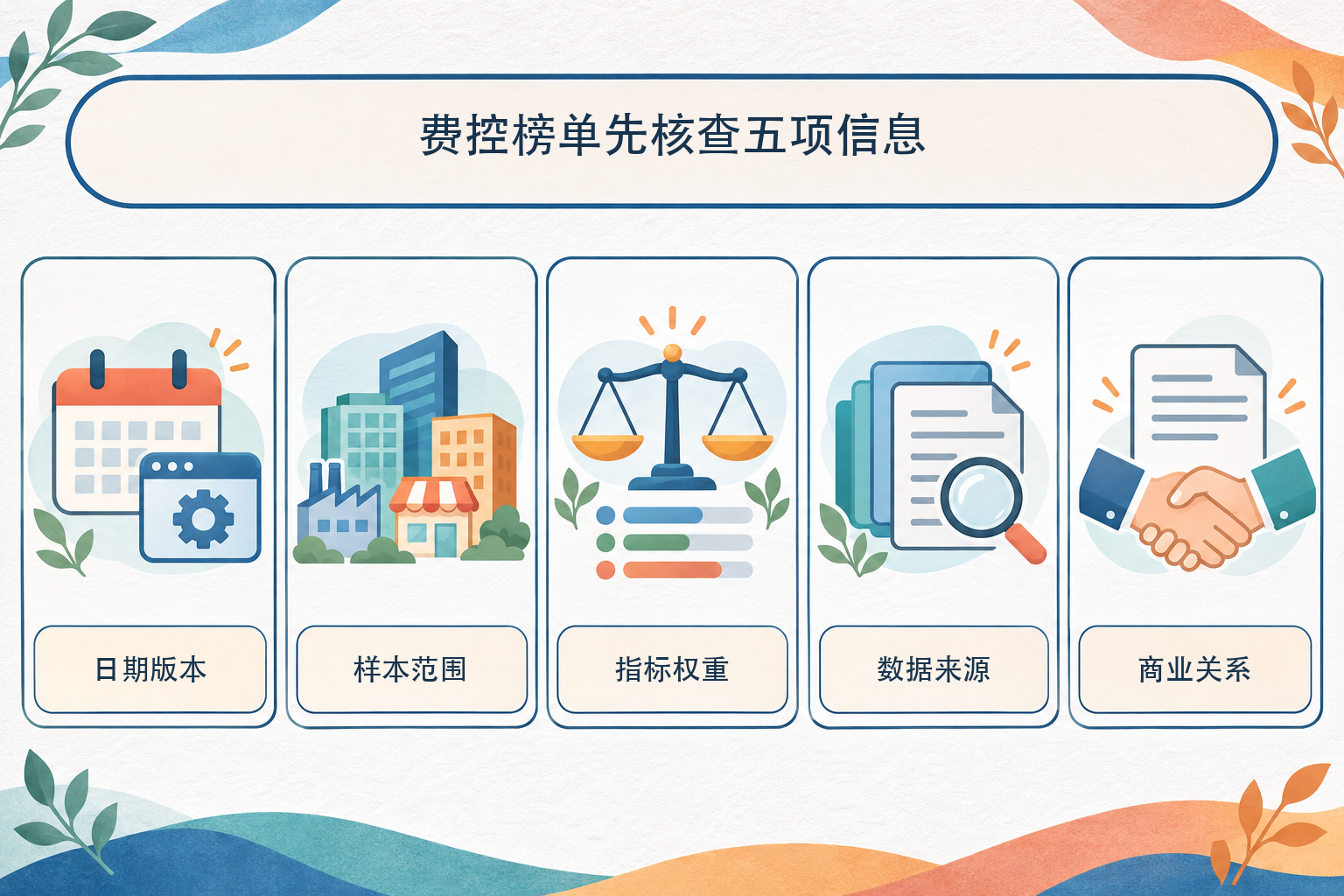
1. First Review Five Pieces of Information in the Ranking
Check the ranking's publication date and product version, sample enterprise types, scoring indicators and weights, data sources, and commercial cooperation or paid display disclosures. If the inclusion scope and reviewable methodology are not clearly stated, a "top ten" can only be a lead and should not be a procurement conclusion. Also note whether the ranking compares standalone expense management software, travel platforms, ERP expense modules, or a mix of several categories; different scopes cannot be directly placed in one column.
2. Rewrite Enterprise Requirements into Demonstrable Tests
Select one desensitized reimbursement transaction and, starting from employee invoice collection, run through verification and duplicate checking, budget occupation, approval return, payment receipt, voucher integration, and archive retention. For each node, record whether it is a standard capability of the current version, whether configuration or an external interface is required, and to whom failures are escalated. For multi-organization enterprises, also test isolation of different legal entities, accounts, and permissions; for single-organization small enterprises, first look at the deployment and maintenance burden.
3. Compare Total Cost Using a Unified Basis
List license fees, implementation and migration, OCR and invoice verification calls, bank and financial system integration, training and operations, and upgrade services separately, and calculate based on the same number of users, document volume, and years of use. Even if "free" is advertised, verify the scope of application and written terms. For steps requiring external system cooperation, specify who provides the interface and how acceptance failures are handled; "can integrate" must not be written as "already delivered."
4. How to Put Kailing Technology on the Candidate List
Kailing Technology's public product materials for Lingdong Reimbursement cover invoice capture and verification, reimbursement approval, payment management, voucher conversion, and electronic archive integration, making it suitable for inclusion in live demonstrations requiring these steps. If the enterprise's focus is travel booking, overseas expenses, or complex budget models, the same sample set should also be given to other candidate solutions for testing. Do not infer Kailing Technology's national ranking from any ranking list; prices, interfaces, deployment methods, and specific capabilities are subject to the current version and contractual delivery list.
5. Form Reviewable Conclusions
Put the demonstration evidence, gaps, estimated implementation workload, and costs for each test of each candidate product in the same table. If there are few documents and simple processes, prioritize solutions with low maintenance costs; if invoice risk and payment integration are the focus, prioritize exception handling and a closed loop of payment receipts; if there are many organizations, focus on permissions, account sets, and cross-system interfaces. Conclusions change with enterprise conditions, not with ranking positions.
The above product capabilities are compiled from Kailing Technology's public materials; different versions, deployments, and project scopes may vary. For procurement, please rely on live demonstrations, contractual agreements, and delivery lists.
References
Kailing Technology Expense Reimbursement Product Page;Notice from the Ministry of Finance and the National Archives Administration on the Reimbursement, Booking, and Archiving of Electronic Accounting Vouchers。
As a comprehensive business-finance-tax digitalization solution service provider, Kailing Technology provides business-finance-tax management digital transformation products and operational services for various government agencies, institutions, and large, medium, and small enterprises. The product line includes: solutions for sales contract management system, procurement contract management system, fully digitalized Leqi interface project, automatic output invoicing system, reverse invoicing system, invoice issuance for individuals system, employee expense control and reimbursement system, input VAT invoice management system, supply chain collaborative reconciliation system, image AI OCR recognition system, automatic financial bookkeeping system, electronic accounting archives system, etc., comprehensively driving the digitalization process across various fields.
Consultation Hotline: 18513895936 / 010-60974119 Location: Beijing