
How to build a purchase and sales contract management ledger? Five-flow integration to prevent missed records

How to build a purchase and sales contract management ledger? Five-flow integration to prevent missed records
A purchase and sales contract ledger should not merely register "contract name, amount, signing date." A truly useful ledger must continuously answer: which version the contract is currently on, how much has been performed, how receipt/shipment and invoice/payment correspond, who handles discrepancies, and where the basis is. The following uses general purchase and sales business as an example to provide implementable fields and a monthly review method; documents and approval rules for different businesses should be adjusted according to the actual process.
1. Build the contract master record first, then the performance details
The master record records the internal unique ID, contract number, counterparty, signing entity, validity period, currency, amount, owner, and current version. The contract number is suitable for queries, but cross-entity or external contracts may have duplicate numbers, so a unique ID should also be retained in the system. Supplementary agreements and changes should not overwrite the original; instead, record the version, effective date, change amount, and approval basis. Performance details are split by contract terms or line items to facilitate batch delivery and partial settlement.
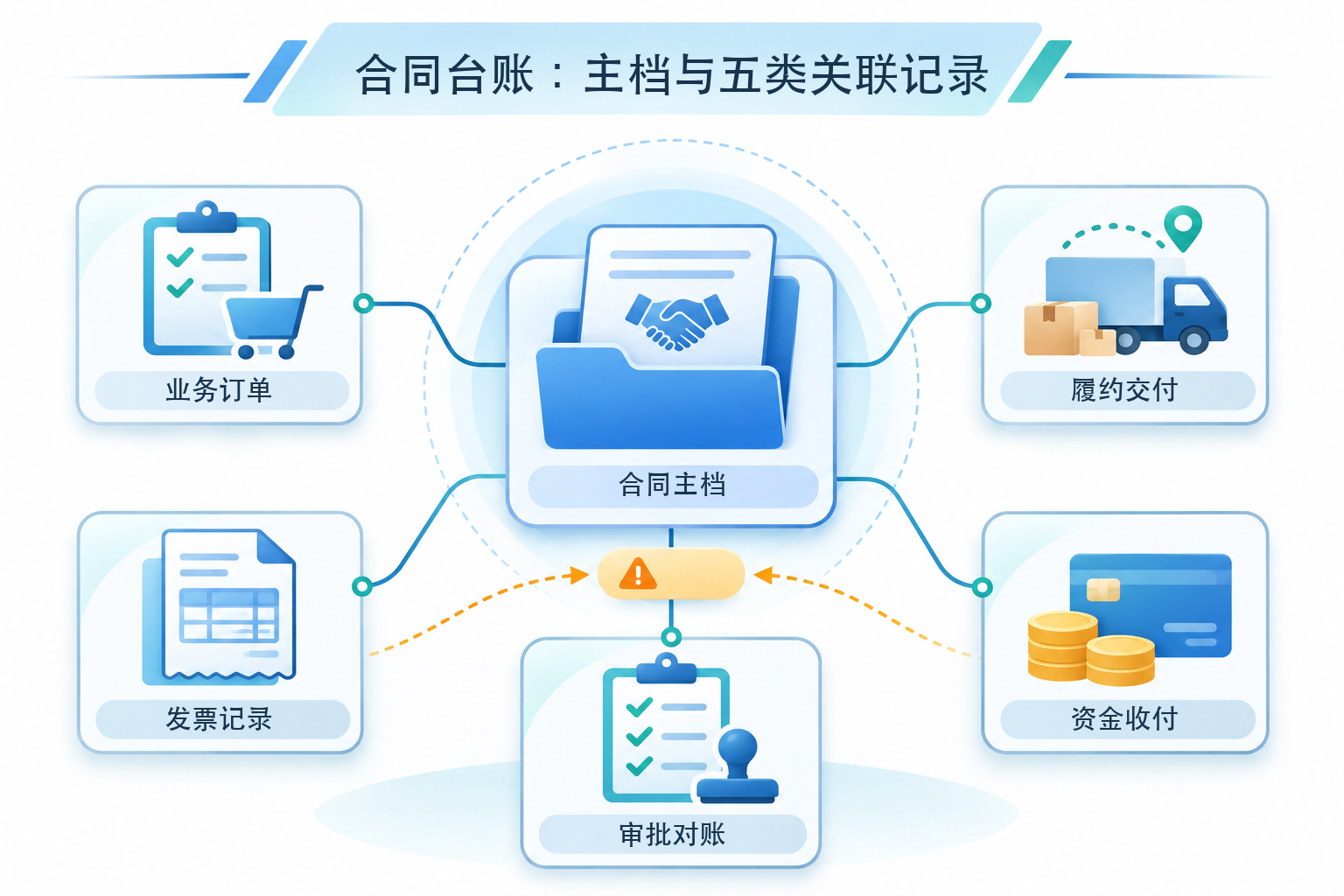
2. Link the five types of records by business relationship
Contracts can be linked with business documents, goods or service performance records, fund receipts and payments, invoices, and approval or reconciliation information. In procurement scenarios, look at orders, receipt or acceptance, input VAT invoices, and payments; in sales scenarios, look at orders, shipment or acceptance, output VAT invoices, and collections. If one invoice corresponds to multiple contracts, or one payment offsets multiple invoices, use a linkage detail table to record allocated amounts, rather than forcing all documents into the same row of the ledger. The so-called "five-flow integration" should clarify the definition and linkage keys of each flow in the project.
3. Set up to-dos for discrepancies, rather than just flagging them in red
Summarize contract terms, actual performance, invoiced amounts, and received/paid amounts separately, and classify discrepancies by cause such as "not performed, performed but not invoiced, invoiced but not collected, amount mismatch, missing documents." Each discrepancy should have an owner, deadline, handling action, and closure evidence. Partial delivery, returns, price and tax adjustments, and cross-period matters must retain the original documents and change chain, and cannot be concealed by manually changing the total amount.
4. Accept month-end review and archiving separately
At month-end, spot-check the correspondence between contract versions and approvals, performance documents, invoices, and receipt/payment records, and verify outstanding balances and the basis for closing exceptions. Contract archives should register conclusion, performance, changes, and termination in accordance with applicable rules. Electronic materials that constitute accounting vouchers should additionally be kept as originals and related information per the archiving requirements for electronic accounting vouchers; successful ledger linkage alone does not equal meeting all archiving conditions.
5. Start the system pilot with three samples
First select a normally completed contract, a contract with multiple deliveries and invoicing in installments, and a contract with a supplementary agreement or return. Use the samples to verify field recognition, version retention, document linkage, allocated amounts, and exception closure. Kailing Technology's contract recognition, five-flow linkage, and electronic accounting archives related products can be included as candidate solutions; specific functions, recognition accuracy, and system integration scope shall be subject to the product version and project acceptance.
Verification Basis
Ministry of Finance Application Guidelines for Enterprise Internal Control No. 16 - Contract Management;Ministry of Finance and National Archives Administration Notice on Standardizing the Reimbursement, Booking, and Archiving of Electronic Accounting Vouchers。
As a comprehensive business-finance-tax digitalization solution service provider, Kailing Technology provides business-finance-tax management digital transformation products and operational services for various government agencies, institutions, and large, medium, and small enterprises. The product line includes: solutions for sales contract management system, procurement contract management system, fully digitalized Leqi interface project, automatic output invoicing system, reverse invoicing system, invoice issuance for individuals system, employee expense control and reimbursement system, input VAT invoice management system, supply chain collaborative reconciliation system, image AI OCR recognition system, automatic financial bookkeeping system, electronic accounting archives system, etc., comprehensively driving the digitalization process across various fields.
Consultation Hotline: 18513895936 / 010-60974119 Location: Beijing