
How to fill in the line items of a dental invoice? Details are automatically pulled when an invoice is issued upon charging | Kailing Technology Leqi integrated solution
"How to fill in the line items of a dental invoice?" This is a daily headache for many dental clinic front desks and finance staff: a single visit may include examinations, treatment, materials, and drugs, and patients ask for an invoice for reimbursement or records. If the details are too coarse, patients cannot understand them; if too messy, it is easy to mix tax-exempt medical services with taxable drugs and consumables. This article follows the order of "distinguish the nature of items, issue details by item, and issue an invoice upon charging" to explain how to fill in dental clinic invoice details, and introduces how the Kailing Technology Leqi integrated solution automatically brings treatment items from the clinic charging system onto the invoice. The tax treatment mentioned in this article is subject to the competent tax authority where the clinic is located.
▍First distinguish: medical services and drugs/consumables are different in nature
The charges of a dental clinic can be roughly divided into two categories by nature. The first is medical services. According to Item (7) of Article 1 of Annex 3 to Caishui [2016] No. 36, medical services provided by medical institutions are exempt from VAT; medical institutions here refer to institutions that have obtained a medical institution practice license through registration, including outpatient departments and clinics; medical services refer to the various services listed in the National Medical Service Price Item Specifications provided at the prescribed guidance prices. Whether it is tax-exempt depends on the institution and the service itself, and both for-profit and non-profit medical institutions are judged under this article.
The second category is the sale of goods such as drugs and consumables. They are sales of goods, are not within the scope of the medical service VAT exemption, and should be accounted for separately and invoiced under the corresponding tax item. Whether commonly seen dentures, orthodontic materials, implants, etc. in dental clinics are part of medical services is subject to different interpretations; it is recommended to confirm with the competent tax authority based on the actual charging method.
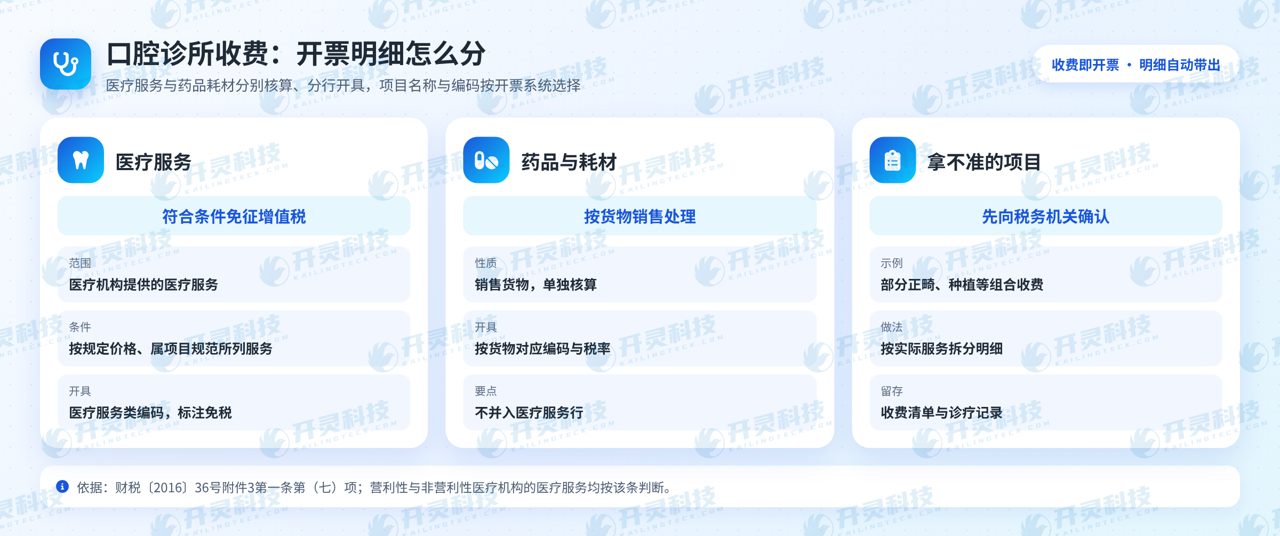
Invoicing detail classification of dental clinic charge items
▍How to fill in details: one line per item, names consistent with the charge list
The principle for filling in invoice details is "one line per item, names consistent with the charge list." The following practices can be referenced.
- Project name: Use the standard item names in the clinic charging system, such as examination, scaling, filling, root canal treatment, etc., and avoid writing only a single "medical fee" line.
- Tax classification code: Select the medical service category code in the invoicing system for medical services, and select the corresponding goods code for drugs and consumables.
- Quantity and unit price: Fill in according to the actual number of visits, teeth, or quantity, consistent with the charge list.
- Tax-exempt flag: Medical services that meet the tax-exempt conditions are issued as tax-exempt, and taxable items are issued at the applicable tax rate.
- Remarks: The visit date, outpatient number, etc. can be noted to facilitate patient reimbursement and clinic reconciliation.
With invoices issued this way, patients can understand each charge, and the clinic can match them one-to-one with the charge details during reconciliation.
▍Invoice upon charging: details automatically pulled from the charging system
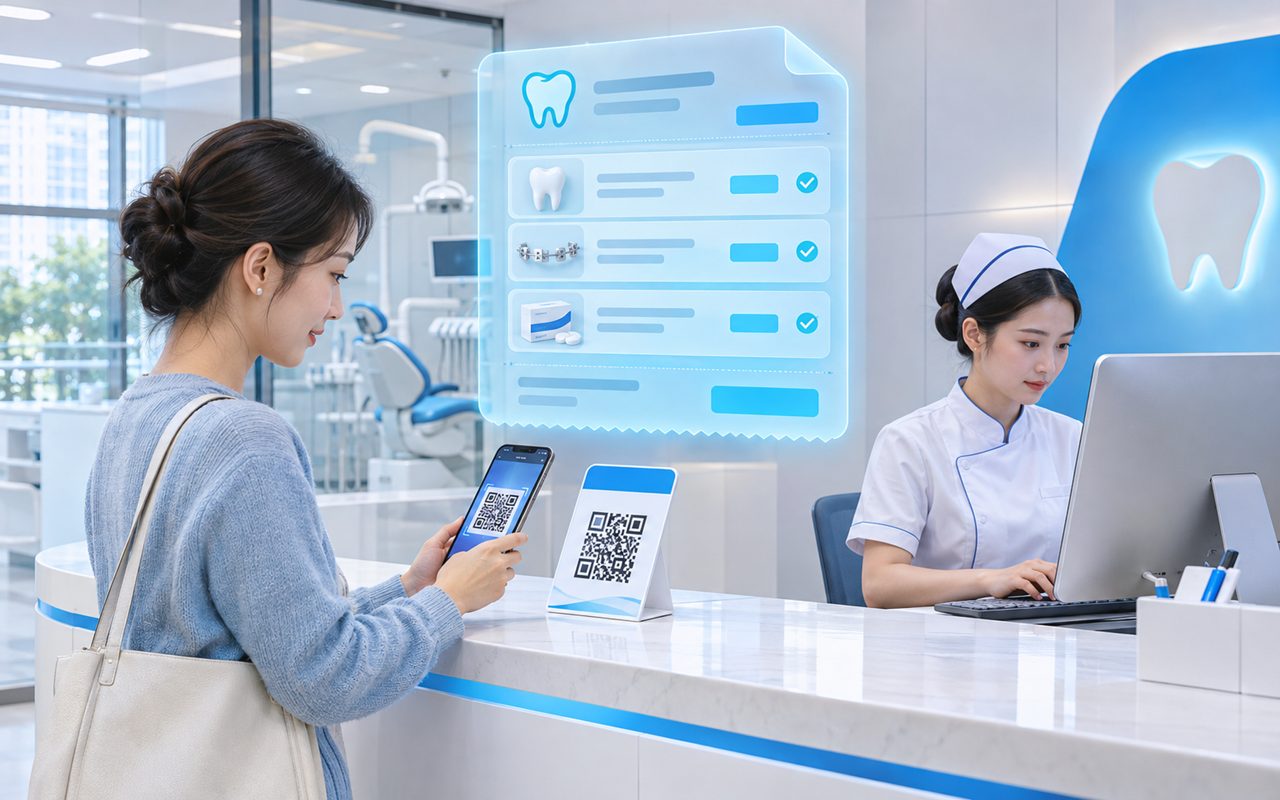
The biggest problem with manual invoicing is that the front desk has to retype the items on the charge list, which is slow and error-prone. The approach of invoice upon charging is: the patient scans the code or swipes a card to pay at the front desk; after payment is completed, the clinic charging system passes the item details of this charge to the invoicing channel; the system automatically generates invoice details according to the preconfigured item-to-code mapping, and the invoice is pushed to the patient's mobile phone.
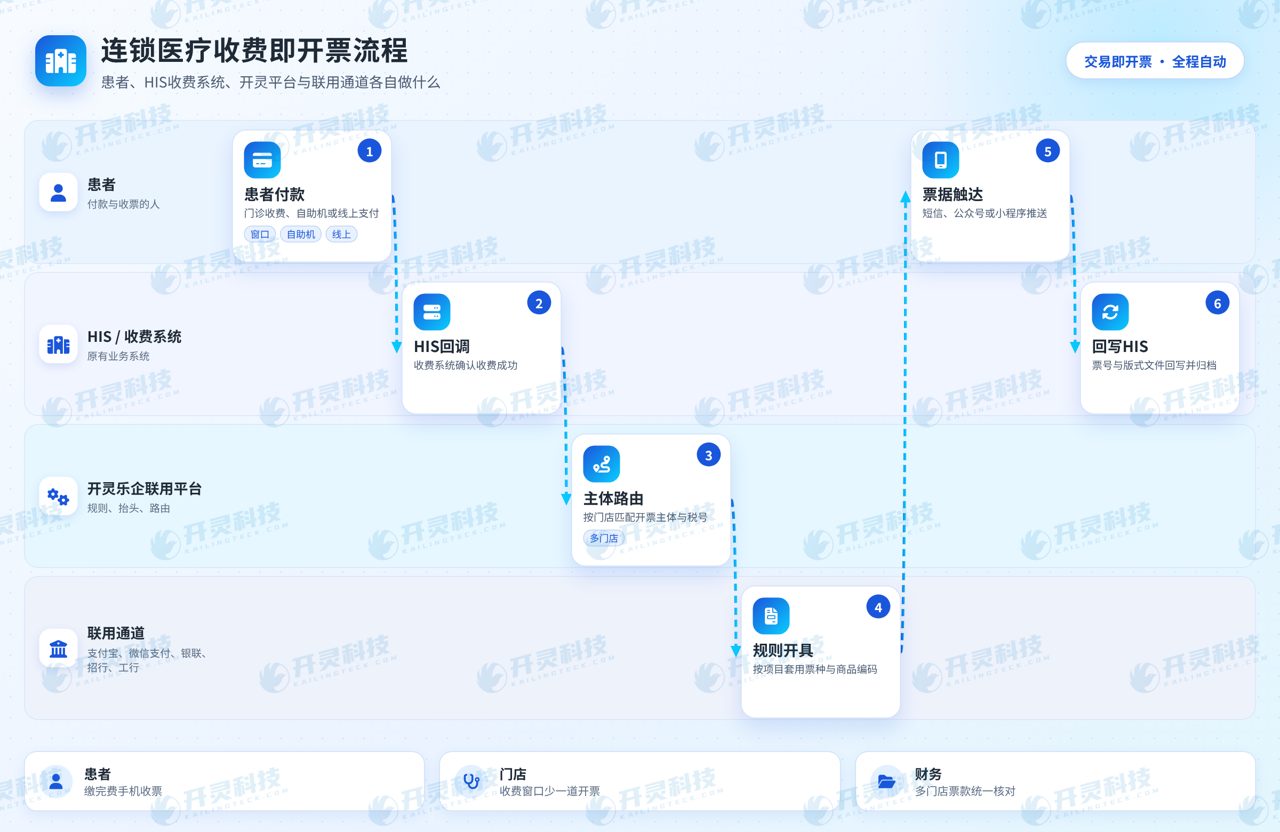
Illustration of division of responsibilities for charging and immediate invoicing at chain clinics
For dental chains, the invoicing entity, charge items, and prices may differ across stores; unifying the mapping between items and codes is a prerequisite for accurate invoicing.
▍Kailing Technology Leqi integrated solution: item mapping and multi-channel configured at once
The Kailing Technology Leqi integrated solution integrates between the clinic charging system and payment institutions or banks holding the integrated qualification: it maps each treatment item, drug, and consumable in the charging system to the corresponding invoice item name, tax classification code, and tax rate or tax-exempt flag; invoices are issued under the same set of rules regardless of the payment method used by the patient; the invoicing result is written back to the charging system, and refunds are linked to the original invoice for red-letter reversal as required.
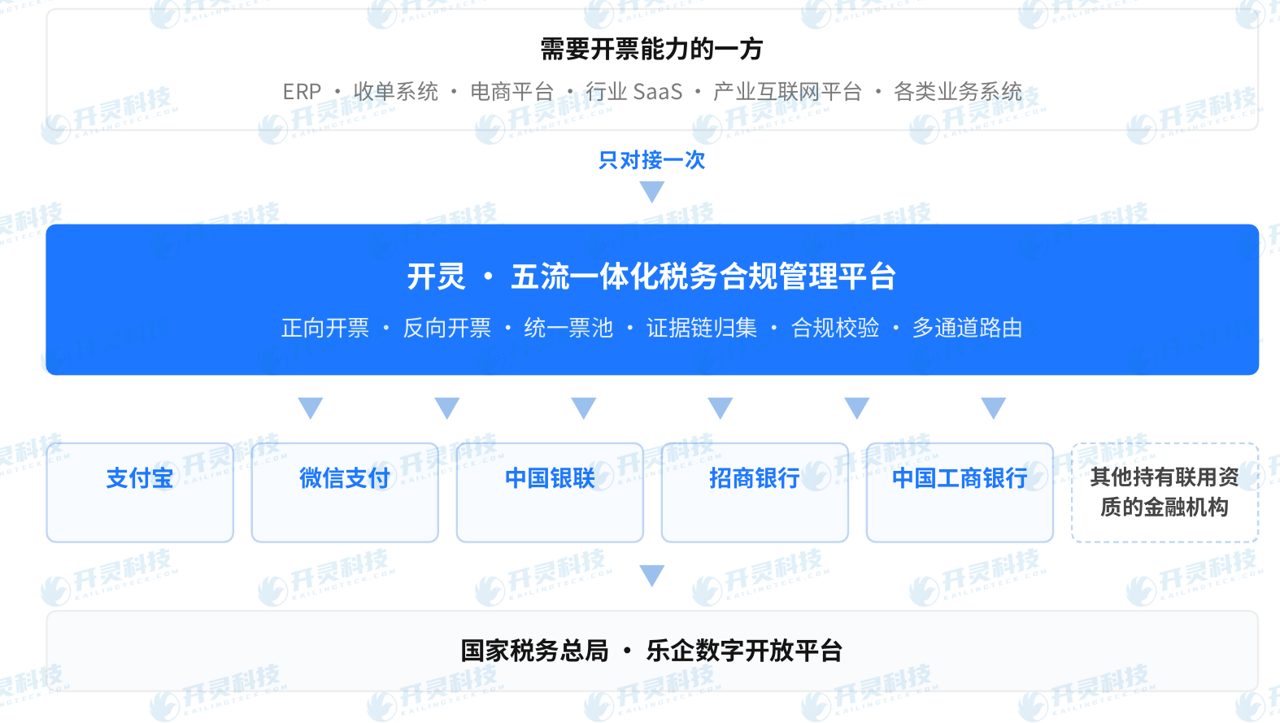
Kailing Technology Leqi integrated hub: connect the charging system once
The table below lists common classification examples when dental clinics configure item mapping; the specific classifications and codes are subject to the invoicing system and the competent tax authority.
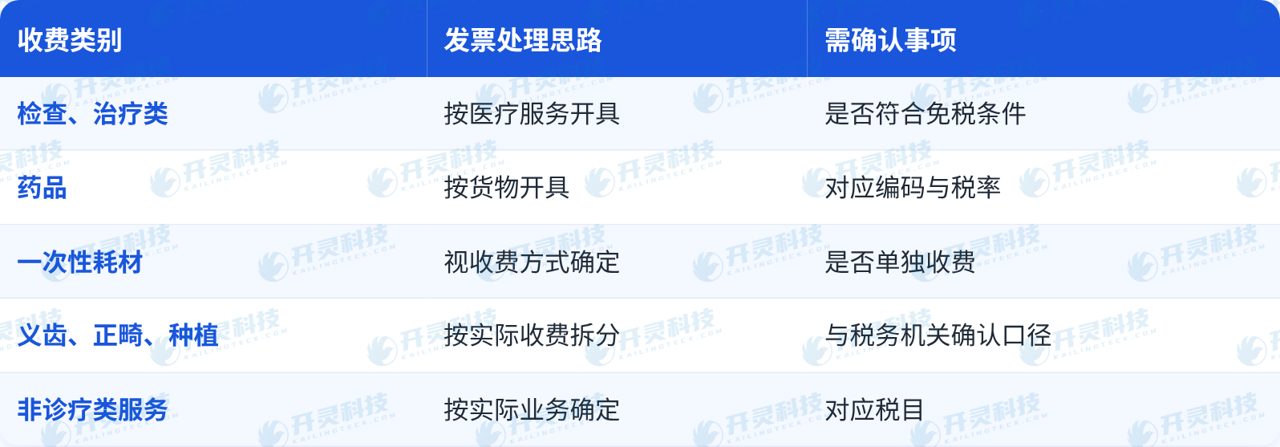
Example of charge item mapping for a dental clinic
| "Details come from the charging system, so invoicing can be fast and accurate." |
▍Unified configuration for dental chains
Dental chains often have stores in multiple cities, and each store may be an independent invoicing entity and may apply different price standards. The unified configuration approach is: the headquarters maintains one standard charge item library, where each item corresponds to an invoice item name, tax classification code, and tax-exempt or tax rate flag; each store adjusts the unit price according to local prices on this basis without changing the item-to-code mapping. In this way, invoices issued across the group follow a consistent treatment, and the headquarters finance team can also compile statistics by item during consolidated analysis.
For newly opened stores, simply select the invoicing entity and enable the standard item library to start invoice upon charging, without re-sorting.
▍Common invoicing requests from patients
First, invoicing for company reimbursement. If the patient needs an invoice made out to a company, the front desk selects or enters the company name and taxpayer identification number at payment. Second, consolidated invoicing. If a course of treatment is paid in multiple installments and the patient wants a single invoice at the end, the clinic should determine the issuance method based on the actual receipts to avoid duplication. Third, supplementary invoicing. If the patient requests an invoice afterward, it can be issued supplementarily after querying the original charge record in the system, with details consistent with the charge record.
These requests can all be handled by rules in the system, and the front desk only needs to follow the prompts without manually writing details.
▍Implementation steps: from sorting out items to issuing an invoice upon charging
Implementing invoice upon charging at a dental clinic generally takes four steps. Step one: sort out the charge items and classify the items in the charging system into medical services, drugs, consumables, and other services. Step two: work with finance and tax advisors to determine the invoicing treatment for each category, and confirm with the competent tax authority where uncertain. Step three: configure item mapping and the invoicing entity in the system, and select the integrated channel. Step four: run a pilot at one store, check whether the invoice details match the charge details within one week, and then roll out to other stores.
During the pilot run, it is recommended that the front desk keep manual invoicing as a backup so that abnormalities can be handled manually first while recording the issues for the implementation consultant to adjust the rules.
▍FAQ
Q: How to fill in the line items of a dental invoice?
A: It is recommended to use one line per item, with names consistent with the charge list; issue medical services and drugs/consumables on separate lines, and select the corresponding tax classification code.
Q: Are medical services at a dental clinic exempt from VAT?
A: Medical institutions that provide the services listed in the National Medical Service Price Item Specifications at the prescribed prices are exempt from VAT; this applies to both for-profit and non-profit institutions.
Q: How should drugs and consumables be invoiced?
A: Drugs and consumables are sales of goods and should be accounted for separately, issued under the corresponding code and tax rate, and not merged into the medical service line.
Q: Can an invoice be issued automatically after charging?
A: Yes. Through the Leqi integrated approach, an invoice is automatically issued based on the charge details after the patient pays and is pushed to the mobile phone; the Kailing Technology Leqi integrated solution handles integration with the charging system.
If a dental clinic wants invoice details to be automatically pulled and clearly issued, you are welcome to learn about the Kailing Technology Leqi integrated solution: https://www.kailingteck.com/leqi-lianyong/ .
As a national high-tech enterprise, Kailing Technology focuses on the digital and intelligent transformation of enterprise business-finance-tax and operations management, providing software products, system integration, implementation and delivery, and operational services for various government agencies, institutions, group enterprises, and SMEs.
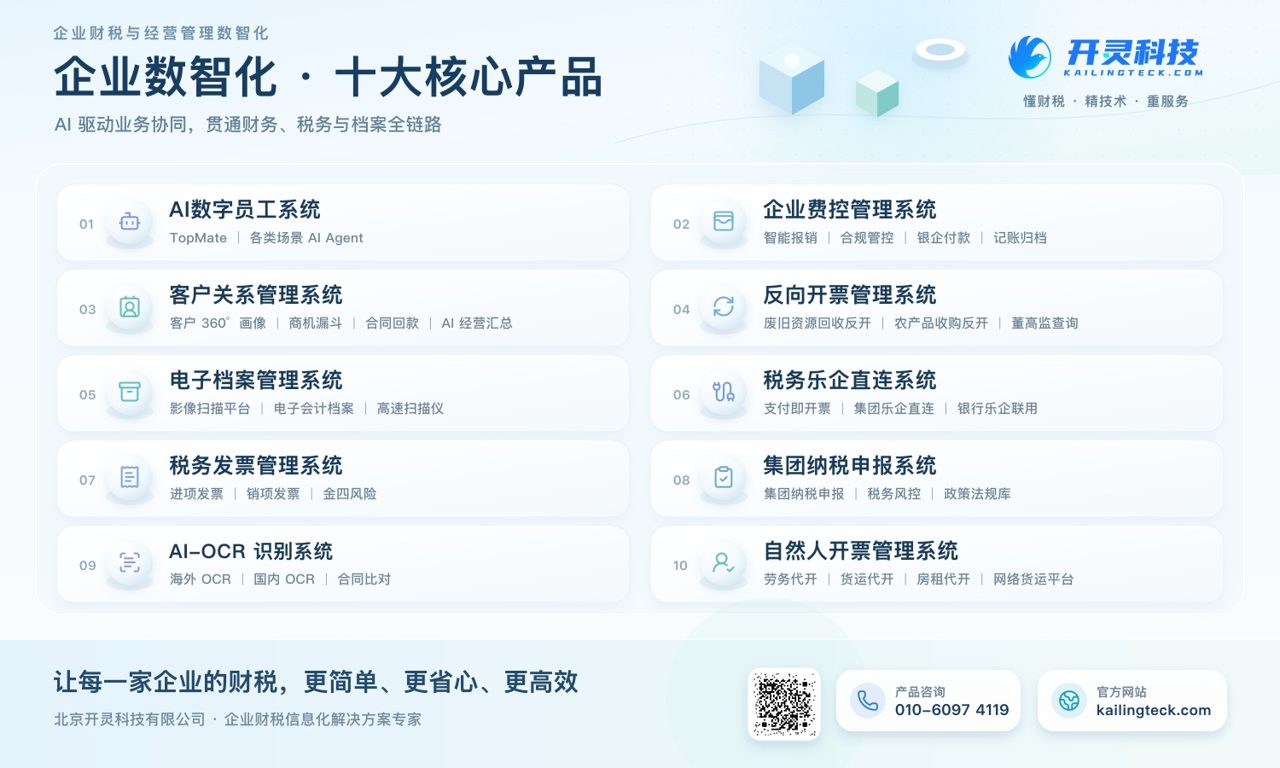
The company has now formed ten core product lines, including: AI digital employee system, enterprise expense control management system, customer relationship management system, reverse invoicing management system, invoice issuance for individuals management system, electronic archives management system, tax fully digitalized e-invoice Leqi system, tax invoice management system, group tax filing system, and AI OCR recognition system. It is committed to connecting enterprise business, finance, tax, funds, and archive data to help customers improve operational efficiency, business-finance-tax compliance capabilities, and digital management levels.
If you have any business-finance-tax digital transformation needs, welcome to contact us. Beijing Kailing Technology will serve you wholeheartedly.
Keywords: How to fill in the line items of a dental invoice, how dental clinics issue invoices to patients, dental outpatient invoice items, how to fill in clinic invoicing item names, medical service invoices, Kailing Technology Leqi integrated solution, invoice upon charging
As a comprehensive business-finance-tax digitalization solution service provider, Kailing Technology provides business-finance-tax management digital transformation products and operational services for various government agencies, institutions, and large, medium, and small enterprises. The product line includes: solutions for sales contract management system, procurement contract management system, fully digitalized Leqi interface project, automatic output invoicing system, reverse invoicing system, invoice issuance for individuals system, employee expense control and reimbursement system, input VAT invoice management system, supply chain collaborative reconciliation system, image AI OCR recognition system, automatic financial bookkeeping system, electronic accounting archives system, etc., comprehensively driving the digitalization process across various fields.
Consultation Hotline: 18513895936 / 010-60974119 Location: Beijing