
How is automatic VAT invoice issuance implemented? Five-step acceptance for 2026 fully digitalized e-invoices

How is automatic VAT invoice issuance implemented? Five-step acceptance for 2026 fully digitalized e-invoices
"Automatic issuance" should be split into five stages: transaction data retrieval, invoicing rule review, authorized issuance, delivery confirmation, and accounting treatment. Fully digitalized e-invoices have been rolled out nationwide, but not every enterprise can directly call tax interfaces; Leqi Direct Connection or joint use has access, authorization, testing, and regional rules. Successful invoicing does not mean accounting entry has been completed.
Step 1: Confirm real transactions and data sources
Read the buyer, transaction items, amount, and business occurrence time from the order, billing, or payment collection system, and verify refunds, discounts, installments, and duplicate orders. Invoices must correspond to real transactions; which node triggers invoicing—successful payment, order completion, or reconciliation confirmation—should be determined by business and finance according to the scenario. Unreviewed data cannot directly generate formal invoices.
Step 2: Configure and review invoicing rules
Configure invoice type, tax classification, applicable tax rate or levy rate, buyer information, and specific business elements according to actual business. Rules should retain version, approver, and effective time; re-review when policies, goods, or contracts change. Insufficient quota, abnormal identity permissions, and missing buyer information should enter manual to-do; verification must not be skipped in pursuit of automation.
Step 3: Issue through approved channels and handle failures
Enterprises can use invoice business functions in the electronic tax bureau; if system integration is required, the applicable conditions and authorization of specific Leqi self-use, joint use, or other lawful channels should be verified. The Shanghai tax authorities' 2026 Leqi joint use guidelines list access, invitation, and testing requirements for direct-connection units and user units; "having an interface" cannot be understood as any enterprise being able to connect directly. Save issuance results, failure reasons, and retry identifiers to prevent duplicate invoicing.
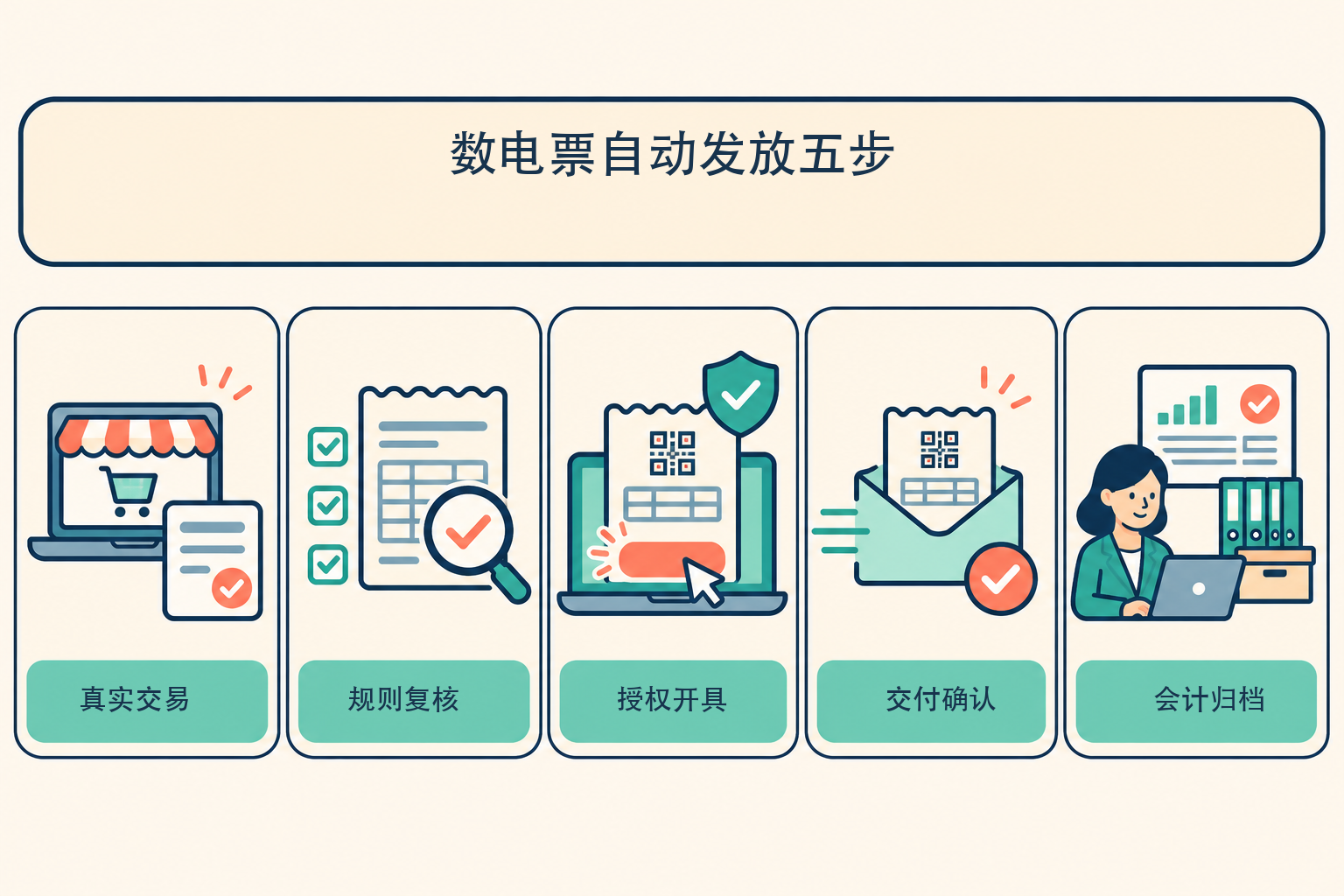
Step 4: Confirm that the recipient has received the invoice
After a fully digitalized e-invoice is successfully issued, the platform may automatically deliver it through the tax digital account according to conditions; when automatic delivery is not possible, it may be delivered by the enterprise itself via email, QR code, or electronic file methods provided by the platform. Invoice generated, message sent, and invoice received by the recipient are different statuses and should be recorded separately. When an invoicing error occurs, handle it according to the red-letter invoice rules for fully digitalized e-invoices and the recipient's confirmation status.
Step 5: Complete accounting treatment and archiving separately
Writing the invoice number and amount back to the business ledger only indicates that the invoicing result has been synchronized; accounting entry still requires verification of transaction facts, source documents, accounts, and periods, and necessary review. Electronic accounting vouchers that are reimbursed, booked, and archived only in electronic form must meet conditions such as legality and authenticity, secure transmission and storage, review and signing, prevention of duplicate booking, and archive management. "Invoicing means booking" and "scanning means archiving" cannot be treated as unconditional commitments.
Kailing Technology's output invoicing and finance-related products can be included in the above five-stage acceptance. Have the service provider demonstrate with samples of normal orders, refund orders, duplicate orders, insufficient quota, and delivery failure, and specify version, region, authorization, manual review, and failure fallback. After these conditions are met, gradually expand the scope of automatic invoicing.
Verification Basis
State Taxation Administration announcement on the promotion and application of fully digitalized e-invoices;Shanghai tax Leqi joint use specification guidelines;Notice from the Ministry of Finance and the National Archives Administration on the Reimbursement, Booking, and Archiving of Electronic Accounting Vouchers。
As a comprehensive business-finance-tax digitalization solution service provider, Kailing Technology provides business-finance-tax management digital transformation products and operational services for various government agencies, institutions, and large, medium, and small enterprises. The product line includes: solutions for sales contract management system, procurement contract management system, fully digitalized Leqi interface project, automatic output invoicing system, reverse invoicing system, invoice issuance for individuals system, employee expense control and reimbursement system, input VAT invoice management system, supply chain collaborative reconciliation system, image AI OCR recognition system, automatic financial bookkeeping system, electronic accounting archives system, etc., comprehensively driving the digitalization process across various fields.
Consultation Hotline: 18513895936 / 010-60974119 Location: Beijing