
Supplier reconciliation never balances? A five-step closed-loop system setup guide

Supplier reconciliation never balances? A five-step closed-loop system setup guide
Supplier reconciliation often fails to balance because business documents lack corresponding relationships, definitions and timing are inconsistent, or discrepancies are adjusted without leaving approval evidence. When building the system, first define responsibilities for materials, matching, handling, payment, and archiving, then validate each step with an exception list.
Step 1: Unify materials and reconciliation definitions
List the source, handler, and storage location of orders, delivery notes, acceptance and warehousing records, returns, supplier settlement statements, invoices, payment requests, and bank receipts. Agree with suppliers on the reconciliation period, tax-inclusive or tax-exclusive basis, units of measure, partial deliveries, and cutoff timing. Original vouchers must still be reviewed as required; scanning and recognition can only provide candidate fields and cannot replace judgments on authenticity and completeness.
Step 2: Establish traceable business relationships
Use order lines, receiving batches, or mutually agreed settlement lines as anchors, and preserve one-to-many and many-to-one relationships. When linking invoices and payments to business facts, also record statuses such as not-yet-invoiced, partially invoiced, prepayments, and returns. If matching fails, first check numbering rules, batches, and timing differences; do not simply change both sides' figures to be identical.
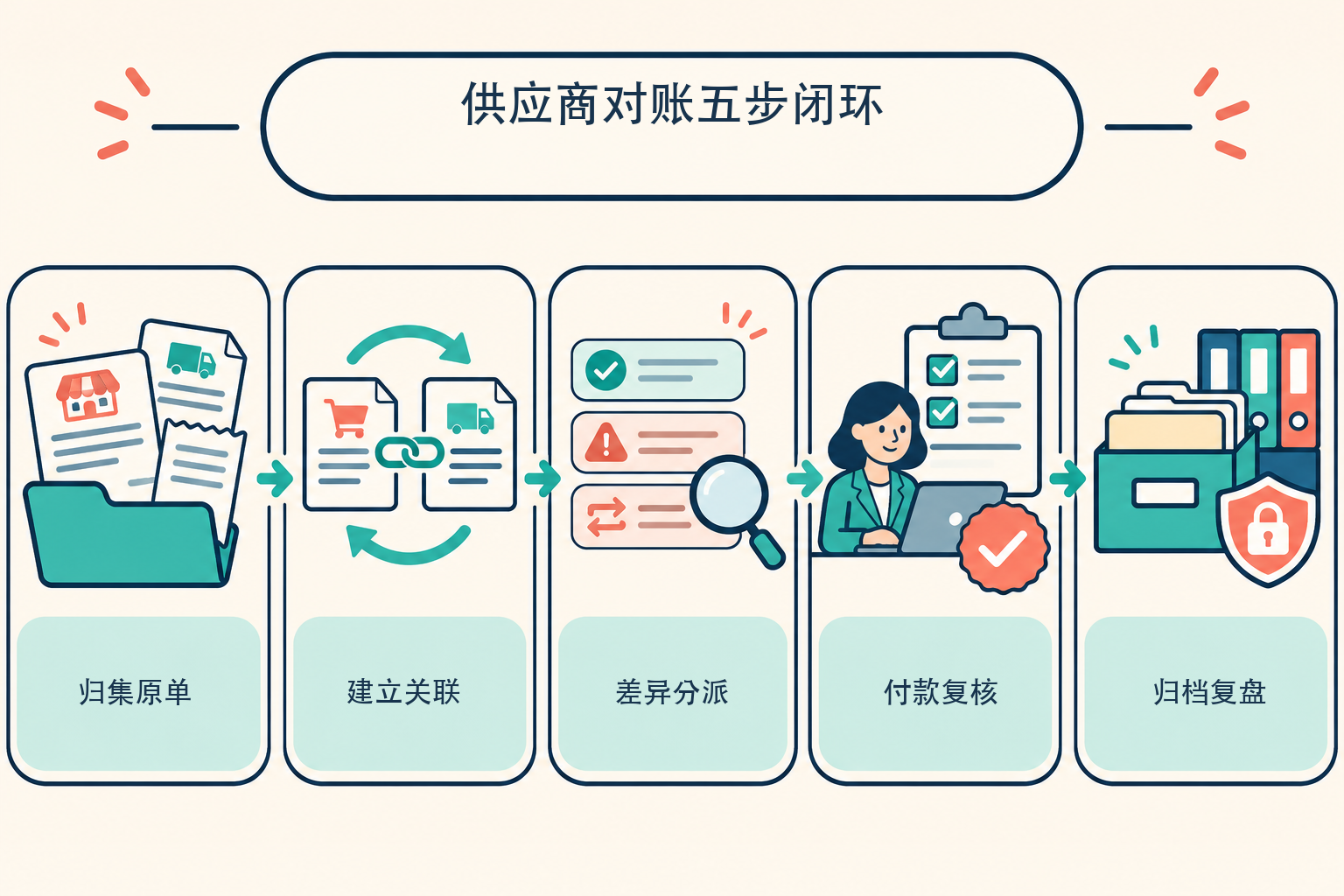
Step 3: Discrepancy triage and responsibility assignment
Mark common discrepancies such as quantity, price, invoice-payment, cross-period, duplicate, and unit-of-measure issues on detail lines, stating evidence, responsible person, expected completion time, and handling action. Quantity mismatches are checked by procurement and warehousing against receipts and returns; contract price or discount changes require retained confirmation materials; invoice or payment discrepancies are checked by finance against documents, prepayments, and red-letter transactions. Discrepancy classification is only a management method; specific accounting treatment should still be based on business facts and applicable accounting systems.
Step 4: Review before payment, keep exceptions as pending items
Settlement amounts, payment terms, and receiving accounts should be consistent with contracts, acceptance, and approval results. Unresolved disputes, retention money, and prepayments should be listed separately with designated handling deadlines. Closing a discrepancy should have checkable original documents, communication confirmations, and approval records; items that cannot be confirmed must not be concealed by modifying original documents or using a "processed" status.
Step 5: Archive and improve processes using recurring issues
Establish searchable links among the final reconciliation statement, discrepancy handling records, approval opinions, and related original vouchers, and keep them in accordance with the Measures for the Administration of Accounting Archives and the entity's own rules. Each month, analyze recurring discrepancies, average closure time, and high-frequency suppliers, and work backward to check contract terms, receipt write-back, and invoicing communication. Whether electronic materials can be stored solely in electronic form requires meeting statutory conditions item by item; "scanning equals archiving" is not a compliance conclusion.
Kailing Technology's AI OCR, input VAT invoice management, and electronic accounting archives products can be used for pilot data extraction, duplicate checking, linking, and trace retention. Actual document capture, interfaces, rule matching, and archiving capabilities should be confirmed by version, authorization, region, and project acceptance, with manual review retained. It is recommended to accept with a batch of desensitized samples containing returns, cross-period items, and duplicate invoices, rather than only viewing demonstrations with normal documents.
Verification Basis
Ministry of Finance's Norms for Basic Accounting Work;Ministry of Finance "Measures for the Management of Accounting Archives"。
As a comprehensive business-finance-tax digitalization solution service provider, Kailing Technology provides business-finance-tax management digital transformation products and operational services for various government agencies, institutions, and large, medium, and small enterprises. The product line includes: solutions for sales contract management system, procurement contract management system, fully digitalized Leqi interface project, automatic output invoicing system, reverse invoicing system, invoice issuance for individuals system, employee expense control and reimbursement system, input VAT invoice management system, supply chain collaborative reconciliation system, image AI OCR recognition system, automatic financial bookkeeping system, electronic accounting archives system, etc., comprehensively driving the digitalization process across various fields.
Consultation Hotline: 18513895936 / 010-60974119 Location: Beijing