
How to file individual income tax in the individual income tax system? 2026 six-step withholding client method and common errors

How to file individual income tax in the individual income tax system? 2026 six-step withholding client method and common errors
When an enterprise handles withholding and filing of individual income tax on salaries and wages for employees, first confirm the filing period, employees and salary data, then verify the calculation result under the cumulative withholding method, the submission feedback and retained records. Specific menus vary with versions of the Electronic Tax Bureau and the Natural Person Electronic Tax Bureau withholding client; the following follows the business sequence.
Step 1: Confirm entity, authority and period
Enter the applicable withholding system using the unit's withholding agent identity, and verify the unified social credit code, handler authority, income items to be filed and the period. Withholding and filing of salaries and wages should generally be handled within 15 days of the following month; holiday extensions and specific deadlines are subject to the current tax authority notice.
Step 2: Verify basic employee information
Verify names, ID numbers, employment information and personnel actually paid in the current period. When employees join, leave, change ID documents or hold positions across units, update according to true facts and current system guidance; do not uniformly change all departed personnel to a fixed status. Incorrect ID information or duplicate personnel will affect filing and employee inquiries.
Step 3: Organize income and deductible items
Use payroll sheets, attendance and actual payment records to verify current-period salaries and wages, legally tax-exempt income, basic deduction, special deductions, special additional deductions and other legally determined deductions. Special additional deduction information should be verified against what employees reported and what the unit received; income items such as year-end bonuses and remuneration for personal services should not be mixed directly into ordinary salary lines.
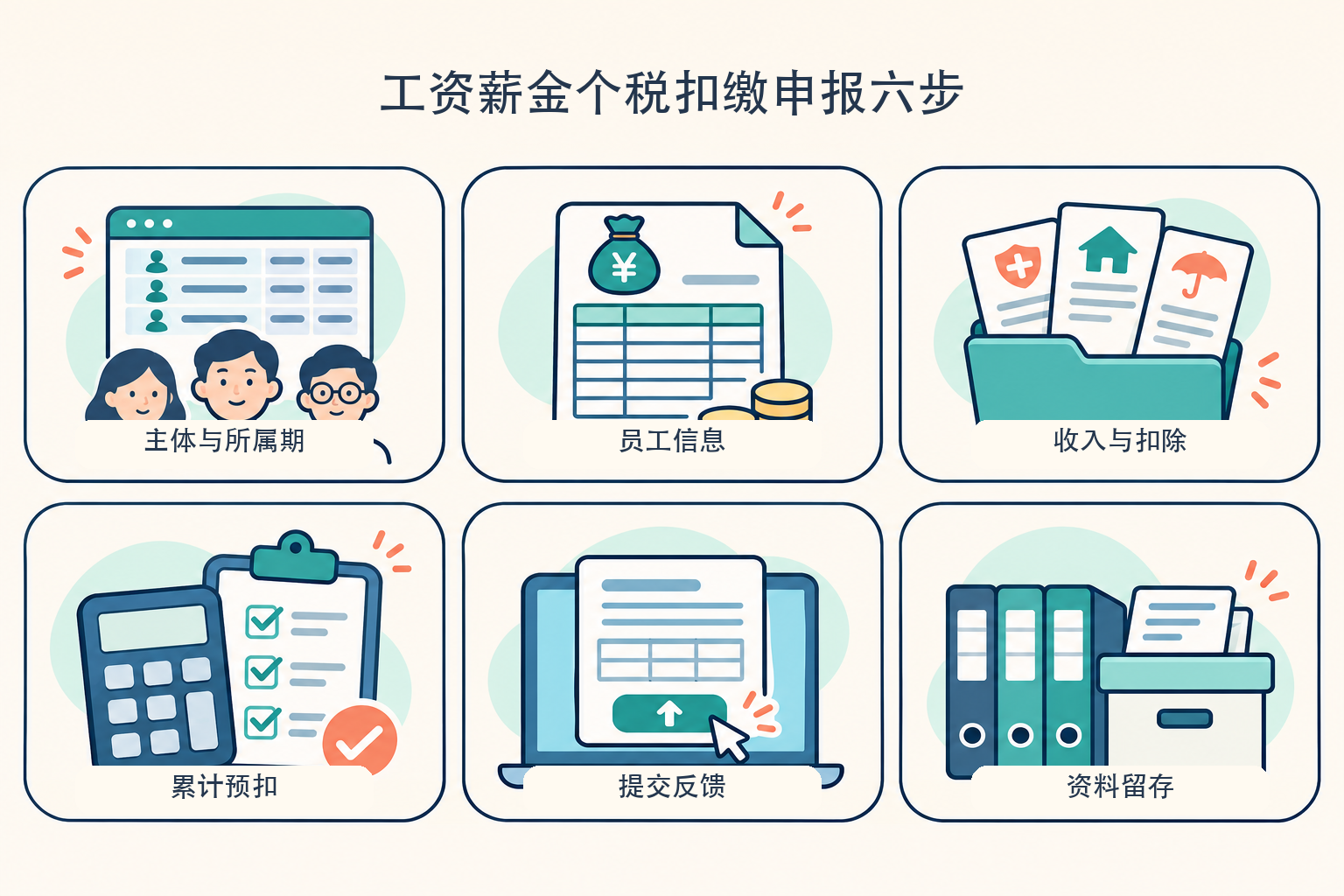
Step 4: Calculate and review the withholding tax amount
Salaries and wages generally use the cumulative withholding method: cumulative taxable income is calculated as cumulative income minus cumulative tax-exempt income, cumulative basic deduction, cumulative special deductions, cumulative special additional deductions and other legally determined deductions, then the cumulative withholding tax payable is calculated using the applicable withholding rate and quick deduction, and the cumulative tax reduction and exemption amount and already-withheld tax amount are deducted to obtain the current-period withholding tax payable. When reviewing abnormal increases or decreases, zero filings and cross-month retroactive salary payments, do not simply multiply a single month's salary by a fixed tax rate.
Step 5: Submit the filing and view feedback
First check the number of personnel, total income and tax amount, then submit according to the current system process. Save the acceptance feedback and verify whether the filing succeeded and whether payment was completed; "submitted" does not equal "tax paid". If there are personnel information errors, filing failures or omissions, use the correction and supplementary filing channels provided by the system according to the error type and period, and consult the competent tax authority when necessary; whether late fees apply must be judged based on specific facts and regulations.
Step 6: Save records and reconcile the next period
Save payroll sheets, the basis for employee information changes, deduction information, filing receipts, payment records and correction records, and restrict access permissions. In the next period, link the employee list, cumulative income and withheld tax amount with the current period results, and investigate discrepancies promptly. Kailing Technology's HR and finance-related products can serve as data organization and reconciliation tools; specific field synchronization, system interfaces and filing capabilities must be verified by version, authorization and project implementation, and the filing responsibility remains with the withholding agent.
Verification Basis
"Measures for the Administration of Individual Income Tax Withholding Filing (Trial)";Tax authority Q&A on employment information operations;Tax authority Q&A on filing correction operations。
As a comprehensive business-finance-tax digitalization solution service provider, Kailing Technology provides business-finance-tax management digital transformation products and operational services for various government agencies, institutions, and large, medium, and small enterprises. The product line includes: solutions for sales contract management system, procurement contract management system, fully digitalized Leqi interface project, automatic output invoicing system, reverse invoicing system, invoice issuance for individuals system, employee expense control and reimbursement system, input VAT invoice management system, supply chain collaborative reconciliation system, image AI OCR recognition system, automatic financial bookkeeping system, electronic accounting archives system, etc., comprehensively driving the digitalization process across various fields.
Consultation Hotline: 18513895936 / 010-60974119 Location: Beijing