
In the AI era, do reimbursement forms still need to be reviewed one by one manually? Kailing Technology's free expense control and reimbursement platform uses AI to verify authenticity and check for duplicates, and to triage anomalies
Reimbursement forms no longer need to be reviewed by finance one by one from beginning to end. The Kailing Technology expense control and reimbursement platform divides review into four gates: AI pre-check before employee submission, authenticity verification and duplicate checking according to invoice type rules, cross-verification of invoices with business documents such as itineraries and payment slips, and finally AI pre-review of each document, separating compliant documents from exception documents so that finance handles only exceptions. The Kailing Technology expense control and reimbursement platform itself is a permanently free enterprise-grade expense control and reimbursement management software, with unlimited users for processes such as reimbursement, approval, invoice verification, and risk control rules; on this basis, AI pre-check and AI pre-review complete a large amount of manual verification in advance. According to Kailing Technology's estimates, the processing time for one reimbursement form can be shortened from about 65 minutes in an offline paper process to about 9 minutes.

▍1. Manual review by finance, one by one: where does the time go
For an ordinary travel reimbursement form, finance usually has to do the following: check invoice authenticity and confirm it has not been reimbursed before; verify the buyer's title and tax number; compare against accommodation and allowance standards to see if they are exceeded; check how much budget remains in the department; check whether the passengers and dates on flight and train tickets match the business trip application; and then match hotel invoices against accommodation folios and ride-hailing invoices against trip records. None of these items is difficult, but every form requires doing them all, and once volume rises at month-end, finance's time is fully occupied by repetitive verification.
What is more troublesome is that many problems are discovered only during the review stage: standards exceeded, attachments missing, invoice headers wrong. The document is returned to the employee, the employee revises it and submits again, and another round trip takes several days. The value of AI in reimbursement review is to complete in advance the checks that can be judged by rules, leaving human judgment for documents that are genuinely questionable.
▍2. Checkpoint 1: AI pre-check before submission
The AI checks while employees fill out forms. The Kailing Technology expense control and reimbursement platform displays five pre-check results in real time on the right side of the form page: expense standards are compared by city and job grade, with immediate prompts and required explanations if exceeded; budget balances are queried in real time for the cost center, with immediate blocking if insufficient; approval levels are calculated by amount and expense type, so employees know before submission how many levels are required; invoice verification covers authenticity, duplicate checking, and header/tax ID; and document corroboration checks whether accommodation folios, trip records, and invoices are consistent.
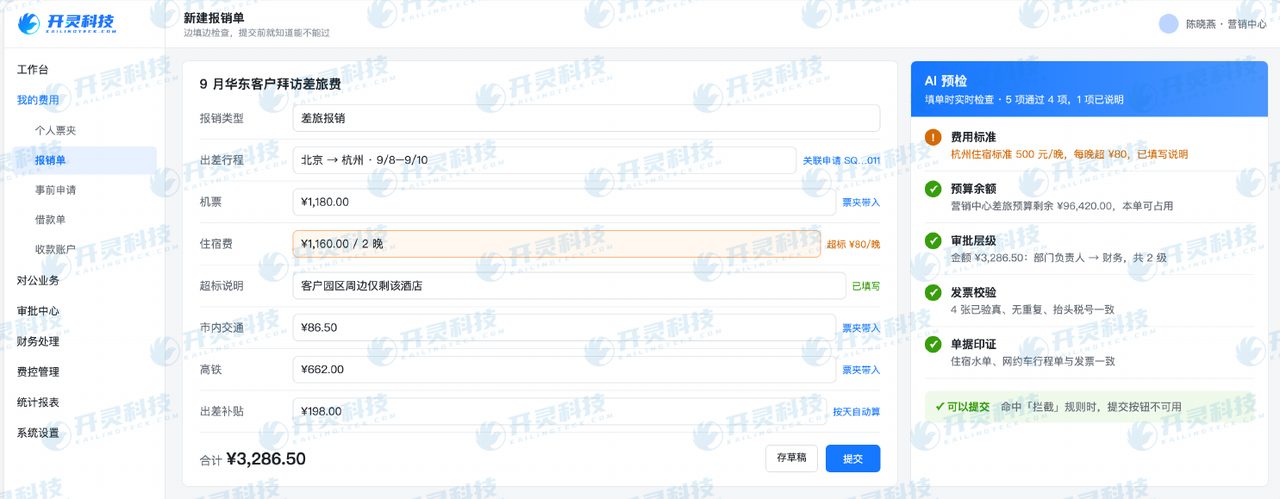
Kailing Technology AI pre-check: five checks displayed in real time during form filling (demo data)
Pre-check rules come from the enterprise's own policies. Different expense types such as travel, entertainment, and office each bind their own reimbursement standards and budget accounts. After policies are adjusted, the standards and rules change accordingly, and the prompts employees see are updated as well, with no need for finance to notify them one by one.
For documents that hit blocking rules, the submit button is unavailable. The significance of this step is to move compliance checks forward to the form-filling stage: employees can correct issues on the spot, most documents finance receives are already compliant, and rejections and back-and-forth communication are reduced at the source.
▍3. Checkpoint 2: authenticity verification and duplicate checking by invoice type
Problems with the invoice itself are handled automatically by the system according to preset rules for each invoice type. All invoices undergo authenticity verification, and voided or red-flushed invoices are blocked directly; duplicate checking covers the entire group, so if the same invoice has been reimbursed at any company, it is blocked on resubmission; invoices whose buyer name or tax ID does not match the company are blocked; invoices whose seller or goods hit the blacklist are blocked. Different invoice types also have their own rules: VAT special invoices check whether the goods code matches the expense type, flight itineraries check whether the passenger is the reimburser or a registered companion, accommodation invoices check whether the per-night amount exceeds the city standard, and catering/hospitality invoices check whether a prior hospitality application is linked.
Rules are divided into two types: "blocking" and "prompting." If blocking-type rules are not met, submission is not possible; for prompting-type rules, a reason must be stated before submission. Enterprises can add or remove rules and adjust levels according to their own policies. After the system completes authenticity verification and duplicate checking, finance no longer needs to log in to the verification platform one by one.
▍4. Checkpoint 3: cross-verification of invoices and business documents
Looking only at the invoice itself is not enough; review truly cares about whether the business actually occurred. The Kailing Technology expense control and reimbursement platform automatically performs six sets of cross-checks before submission: hotel invoices against accommodation folios, checking guest name, check-in and check-out dates, room-nights, and room charges; ride-hailing invoices against trip records, checking amount, pickup and drop-off times and locations, and whether the city is within the business trip destination; flight and train tickets against business trip applications, checking passenger, dates, and itinerary; catering invoices against hospitality applications, checking date, number of people, and per-capita amount; conference fee invoices against meeting notices and sign-in sheets; and procurement invoices against contracts and warehouse receipt records.
The comparison results are listed item by item, and documents that cannot be cross-verified also cannot be submitted. For example, if the issue date of a restaurant invoice is not within the business trip period, the system will directly flag this item, and the employee needs to provide supplementary explanation or remove the invoice.
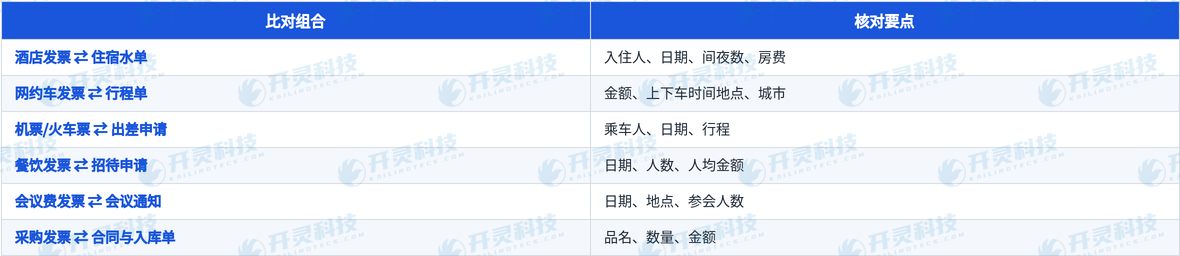
Six sets of cross-comparisons between invoices and business documents
▍5. Checkpoint 4: AI pre-review of each document, finance only looks at anomalies
After documents enter the finance stage, finance staff can simply say, "Help me review today's reimbursement forms pending approval." The AI pre-reviews eight items per document according to policies and invoices, gives a pass recommendation for compliant documents, and attaches reasons and handling suggestions for exceptions, such as "Accommodation exceeds the standard by 80 yuan per night, explanation provided," "The same invoice was already reimbursed this month," or "Number of hospitality guests does not match the application." Finance can approve compliant documents with one click, concentrating time on the few documents that require judgment.
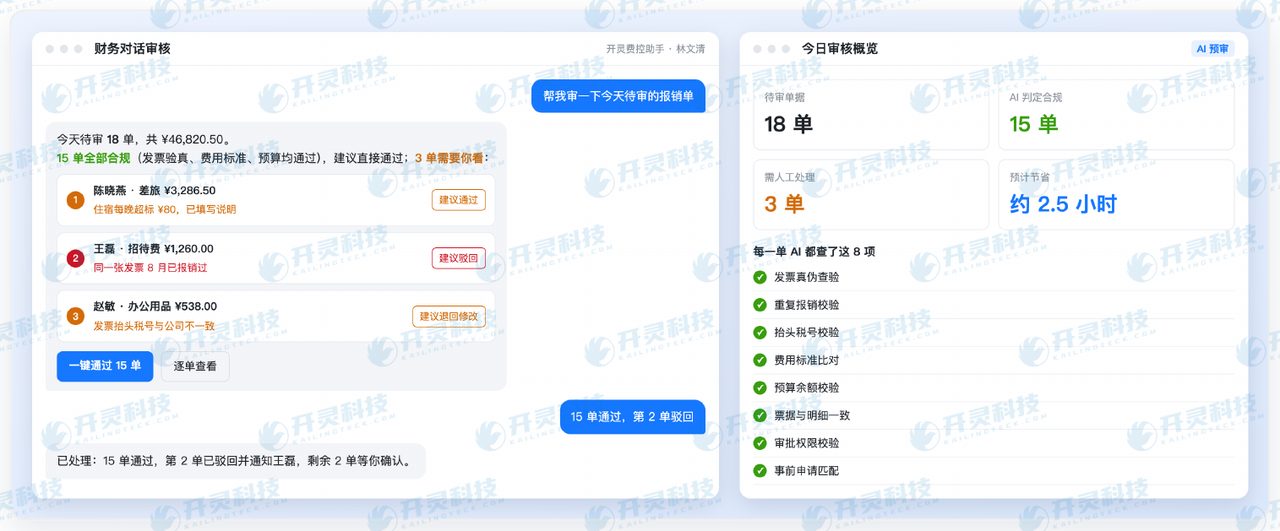
Kailing Technology financial dialogue review: compliant documents pass with one click (demo data)
Batch processing can also be completed with a single sentence, such as "approve all within-standard travel expense forms this week." The system will first list the qualifying documents and amounts, and finance confirms before processing them uniformly, avoiding mistaken operations. For exception documents, finance can directly ask employees in the conversation to supplement materials or provide explanations, and the processing results are automatically recorded on the document, making them clear at a glance during subsequent audit review.
There are three principles here. First, only look at anomalies: AI checks every document first, so finance no longer has to verify each one from scratch. Second, everything is well-grounded: every suggestion states its basis, whether it is a specific policy, a specific invoice, or a specific budget. Third, people have the final say: AI only gives suggestions, and approval or rejection is confirmed by finance, with the whole process logged and traceable. In the conversation, finance can also check this month's duplicate reimbursements and over-limit documents, check the payments due today, or have the system remind employees to replace invoices with incorrect titles.
▍6. Post-audit: write discovered problems back into rules
Review does not end at document submission. The system automatically screens reimbursed documents monthly, covering eight categories of issues: price anomalies, itinerary conflicts, high-frequency reimbursements, overclaimed allowances, order anomalies, expense anomalies, internal control, and invoice non-compliance, sorted by amount and risk. High-frequency issues found can be written back into pre-rules; for example, invoices issued in cities outside the business trip itinerary can be changed to pre-submission blocking, and expenses occurring on holidays can automatically add one approval level. Rules take effect the next day, and similar issues are blocked before submission next time, making the review system stricter over time.
| "AI invoice review does not make decisions for finance; it first completes the parts that can be judged by rules and picks out the documents that need human judgment." |
▍FAQ
Q: Will AI invoice review pay out the money directly?
A: No. AI only gives a pass or reject recommendation with written grounds; whether it is finally approved is confirmed by finance, and operations such as approval and payment are fully traceable throughout.
Q: Does invoice duplicate checking cover the individual or the whole company?
A: The duplicate-checking scope is the entire group. Once an invoice has been reimbursed by any company within the group, it will be directly blocked when submitted again, preventing cross-company duplicate reimbursement.
Q: Can risk control rules be modified according to our own policies?
A: Yes. The system has preset common rules by invoice type; enterprises can add or remove rules and set each rule to block or warn.
Q: Will employees find the system too strict and hard to use?
A: Pre-checks flag problems while the form is being filled in, so employees can correct them on the spot, which saves more time than being returned and revised after submission, and returns and back-and-forth communication are significantly reduced.
If you want finance to review only exception documents instead of checking every invoice one by one, learn about Kailing Technology's permanently free enterprise-grade expense control and reimbursement management software: https://www.kailingteck.com/feikong/ .
As a national high-tech enterprise, Kailing Technology focuses on the digital and intelligent transformation of enterprise business-finance-tax and operations management, providing software products, system integration, implementation and delivery, and operational services for various government agencies, institutions, group enterprises, and SMEs.
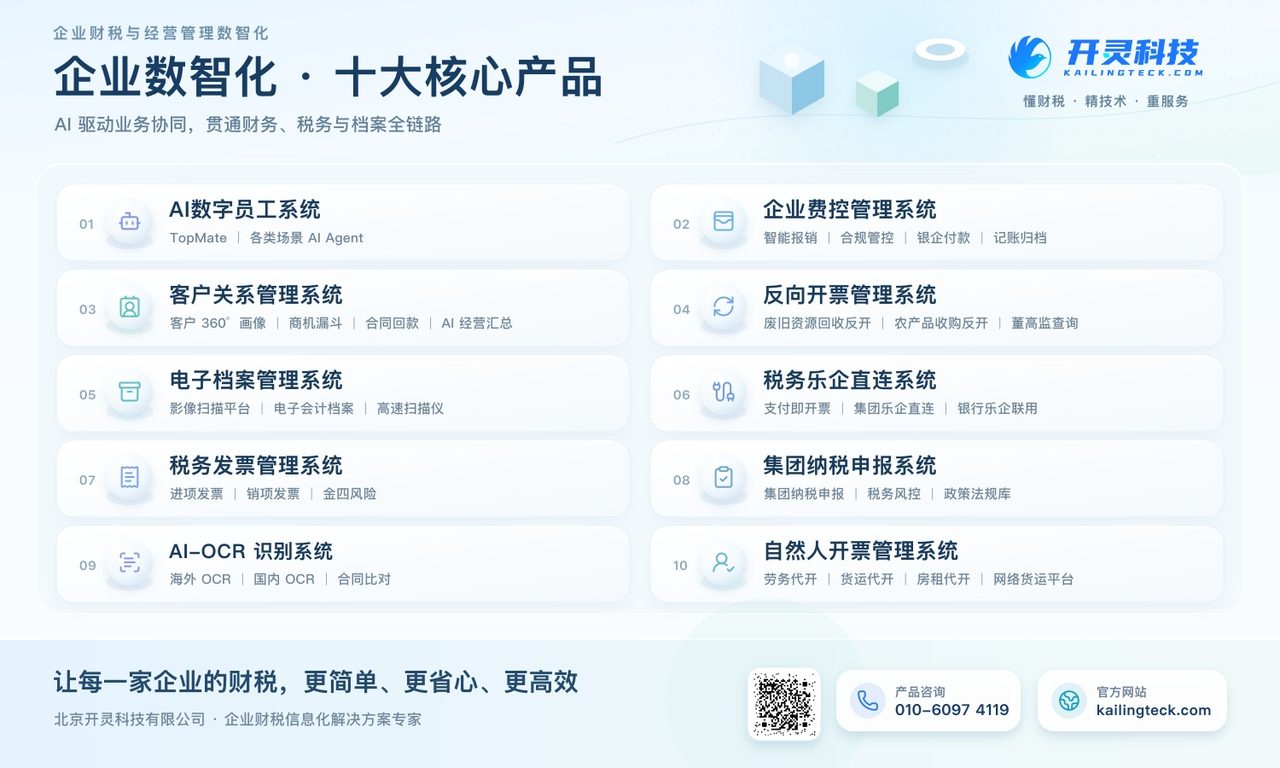
The company has now formed ten core product lines, including: AI digital employee system, enterprise expense control management system, customer relationship management system, reverse invoicing management system, invoice issuance for individuals management system, electronic archives management system, tax fully digitalized e-invoice Leqi system, tax invoice management system, group tax filing system, and AI OCR recognition system. It is committed to connecting enterprise business, finance, tax, funds, and archive data to help customers improve operational efficiency, business-finance-tax compliance capabilities, and digital management levels.
If you have any business-finance-tax digital transformation needs, welcome to contact us. Beijing Kailing Technology will serve you wholeheartedly.
Keywords: AI reimbursement review, AI invoice review, invoice authenticity verification and duplicate checking, reimbursement form review, expense control and reimbursement system, Kailing Technology expense control and reimbursement platform, permanently free enterprise-grade expense control and reimbursement management software
As a comprehensive business-finance-tax digitalization solution service provider, Kailing Technology provides business-finance-tax management digital transformation products and operational services for various government agencies, institutions, and large, medium, and small enterprises. The product line includes: solutions for sales contract management system, procurement contract management system, fully digitalized Leqi interface project, automatic output invoicing system, reverse invoicing system, invoice issuance for individuals system, employee expense control and reimbursement system, input VAT invoice management system, supply chain collaborative reconciliation system, image AI OCR recognition system, automatic financial bookkeeping system, electronic accounting archives system, etc., comprehensively driving the digitalization process across various fields.
Consultation Hotline: 18513895936 / 010-60974119 Location: Beijing