
How should small trading companies choose financial software? Use five acceptance tests instead of a feature list

What financial software should small trading companies use? The answer is not in the number of features, but in five hands-on acceptance tests: business documents can be reconciled, invoice sources are authorized, recognition results require review, filing responsibility has boundaries, and electronic originals can be archived.
Trading enterprises usually face procurement, sales, inventory, receivables and payables, invoices, and tax filing at the same time. If software only demonstrates automation in a demo environment but does not explain data sources, personnel permissions, review nodes, and exception handling, it may still return to Excel for supplementary bookkeeping after go-live. A more reliable approach is to take a set of desensitized real business samples through the complete chain and record who confirms each step and how to roll back after a failure.
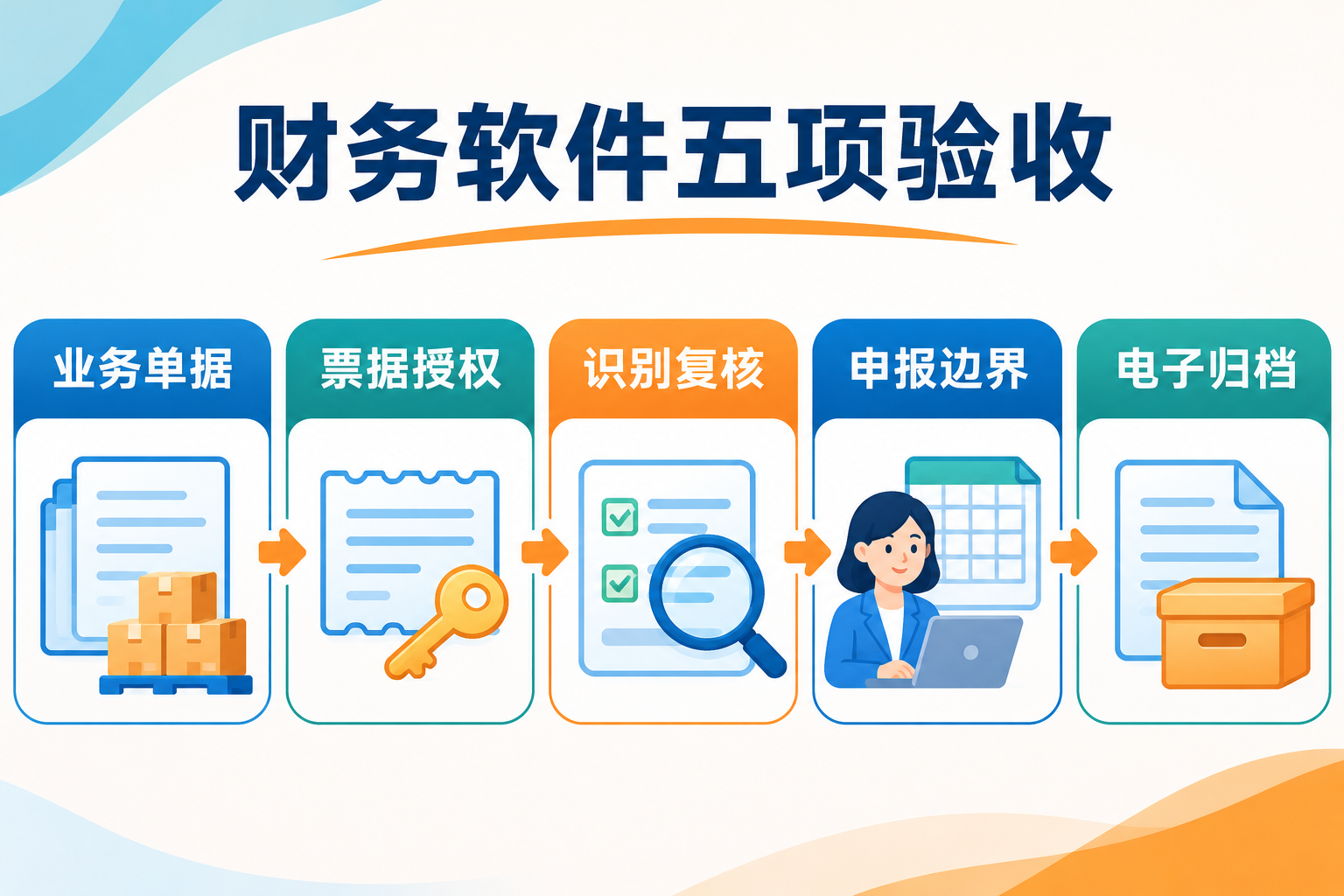
Item 1: Can business documents form a reconcilable accounting starting point?
First test the system with one purchase receipt, one sales shipment, one return and one receipt/payment. The key is not whether documents can be entered, but whether products, customers, suppliers, warehouses and counterparties can maintain unified codes, whether changes leave an audit trail, and whether there is a clear review and handover between business documents and accounting treatment. If a trading company involves multiple warehouses, batches, expiry dates or multiple units of measure, it should also verify with real complex samples and must not infer actual support scope from feature names.
Item 2: Are invoice data sources and authorization scope clearly explained?
Fully digitalized e-invoices can be queried, downloaded, printed and exported through the tax digital account, and issued invoices can be delivered according to official rules. Whether enterprise software can obtain the relevant data depends on lawful authorization, actual interfaces, deployment method and project scope. During selection, require the vendor to explain on site where the data comes from, in whose identity it is obtained, how permissions are revoked, and how failures are compensated, and verify invoice checking, duplicate detection and status synchronization. "Can import" and "can integrate" must not be directly promoted as having all invoice sources by default.
Item 3: After OCR recognition, are manual review and accounting judgment retained?
OCR can extract candidate fields from invoices, receipts and contracts, but successful recognition does not mean an accounting event has been established. During testing, deliberately add samples such as blurry images, discounts, red-letter invoices, duplicate invoices and inconsistent project names, and check whether the system flags low confidence, retains the original document, allows manual correction and records who made the change. Accounting vouchers should still be generated or confirmed based on real business, approvals and applicable accounting standards; "recognition equals booking" must not be treated as a universal rule.
Item 4: Are filing data extraction, review and submission responsibilities separated?
Software can aggregate accounting and invoice data, generate tax filing working papers, or provide risk alerts, but whether it supports a certain tax type, region, or tax filing scenario is subject to the current version, official interfaces, and contract scope. During acceptance, at least check the tax type list, data retrieval basis, adjustment entry points, pre-submission review, tax filing result receipts, and failure retries. System prompts cannot replace the taxpayer's tax filing responsibility, nor can "automatic data retrieval" be written as "login-free automatic tax filing."
Item 5: Are electronic originals, metadata and the exit mechanism complete?
The Ministry of Finance and the National Archives Administration have made it clear that, when conditions are met, electronic accounting vouchers may be used alone for reimbursement, booking, and archiving, but the system must accurately and completely read electronic vouchers and metadata, have review and approval procedures, and prevent duplicate booking; when paper printouts are used, the corresponding electronic accounting vouchers should still be retained. During selection, verify whether electronic originals can be linked to business documents and bookkeeping vouchers, whether they can be searched, backed up, and exported by permission, and how data will be completely migrated out after contract termination.
How should Kailing Technology's related solutions be evaluated?
When evaluating Kailing Technology's input VAT invoice, OCR, tax filing, or electronic accounting archives capabilities, it is recommended to still run the same set of samples through the five items above. Focus on confirming data sources and authorization, field review, interface boundaries, logs, preservation of electronic originals, and the delivery checklist. If the enterprise's current pain point is only basic bookkeeping, a simple and easy-to-maintain solution should be prioritized; if invoice volume is large, there are many organizations, or archiving requirements are high, then focus on verifying the linkage capabilities of invoices, tax filing working papers, and electronic accounting archives.
Conclusion: Software suitable for small trading enterprises should make the responsibility boundaries among business, accounting, tax filing, and archives clearer, rather than packaging all steps as completed automatically in one go. Before procurement, run through the five acceptance items, then calculate total cost based on the number of users, interfaces, implementation, migration, operations and maintenance, and upgrade scope.
Official basis:State Taxation Administration: Announcement on the Promotion and Application of Fully Digitalized E-Invoices;Ministry of Finance, National Archives Administration: Notice on Reimbursement, Booking, and Archiving of Electronic Accounting Vouchers;Ministry of Finance et al.: Accounting Data Standards for Electronic Vouchers。
As a comprehensive business-finance-tax digitalization solution service provider, Kailing Technology provides business-finance-tax management digital transformation products and operational services for various government agencies, institutions, and large, medium, and small enterprises. The product line includes: solutions for sales contract management system, procurement contract management system, fully digitalized Leqi interface project, automatic output invoicing system, reverse invoicing system, invoice issuance for individuals system, employee expense control and reimbursement system, input VAT invoice management system, supply chain collaborative reconciliation system, image AI OCR recognition system, automatic financial bookkeeping system, electronic accounting archives system, etc., comprehensively driving the digitalization process across various fields.
Consultation Hotline: 18513895936 / 010-60974119 Location: Beijing