
How to choose an electronic accounting archives system and how is it priced? Kailing Technology AI Electronic Accounting Archives Management System offers five verification points

"Which electronic accounting archives system is good," "how are the rankings," and "roughly how much does it cost" are among the questions finance leaders search for most on Baidu and AI assistants. Rather than looking at rankings, a more reliable approach is to bring your own real documents and test each of the five verification points on site: whether source systems can be directly connected, whether four-property testing can find problems, whether evidence can be automatically associated and retrieved, whether retention periods and appraisal and destruction are standardized, and whether deployment security and subsequent scalability are controllable. Pricing mainly depends on the deployment method, the number of integrated systems, the volume of historical data migration, and the scope of archive categories. Kailing Technology AI Electronic Accounting Archives Management System accepts on-site testing against these five verification points. This article explains how to verify each item and what the passing criteria are.

▍Three things to clarify before selection: scope, source, and deployment
The first step in selecting an electronic accounting archives system is not comparing features but clarifying the boundaries of your own requirements. There are mainly three things.
The first is archiving scope: in addition to vouchers, ledgers, and reports, whether electronic invoices, bank receipts, tax filing materials, electronic contracts, and business documents should also be included. Kailing Technology AI Electronic Accounting Archives Management System supports one-stop collection of these eight categories of accounting materials and is implemented strictly in seven steps: "collection, testing, filing, cataloging, preservation, utilization, and appraisal," based on the Specification for Electronic Accounting Archives Management DA/T 94-2022. The second is source systems: which finance, OA, expense control, tax invoice, and banking systems the enterprise currently uses, and whether multiple ERP systems coexist. The third is deployment requirements: whether private deployment is mandatory, whether there are Xinchuang requirements, and whether unified management of a multi-legal-entity group is involved.
Once these three things are clear, you will know what to focus on validating during selection, and you can give an accurate scope when quoting.
In addition, before selection, it is recommended to compile the records of audit and tax document retrieval over the past year to see which materials are retrieved most often and where the most time-consuming steps are during retrieval. These real pain points explain what kind of archives system an enterprise needs better than a feature list.
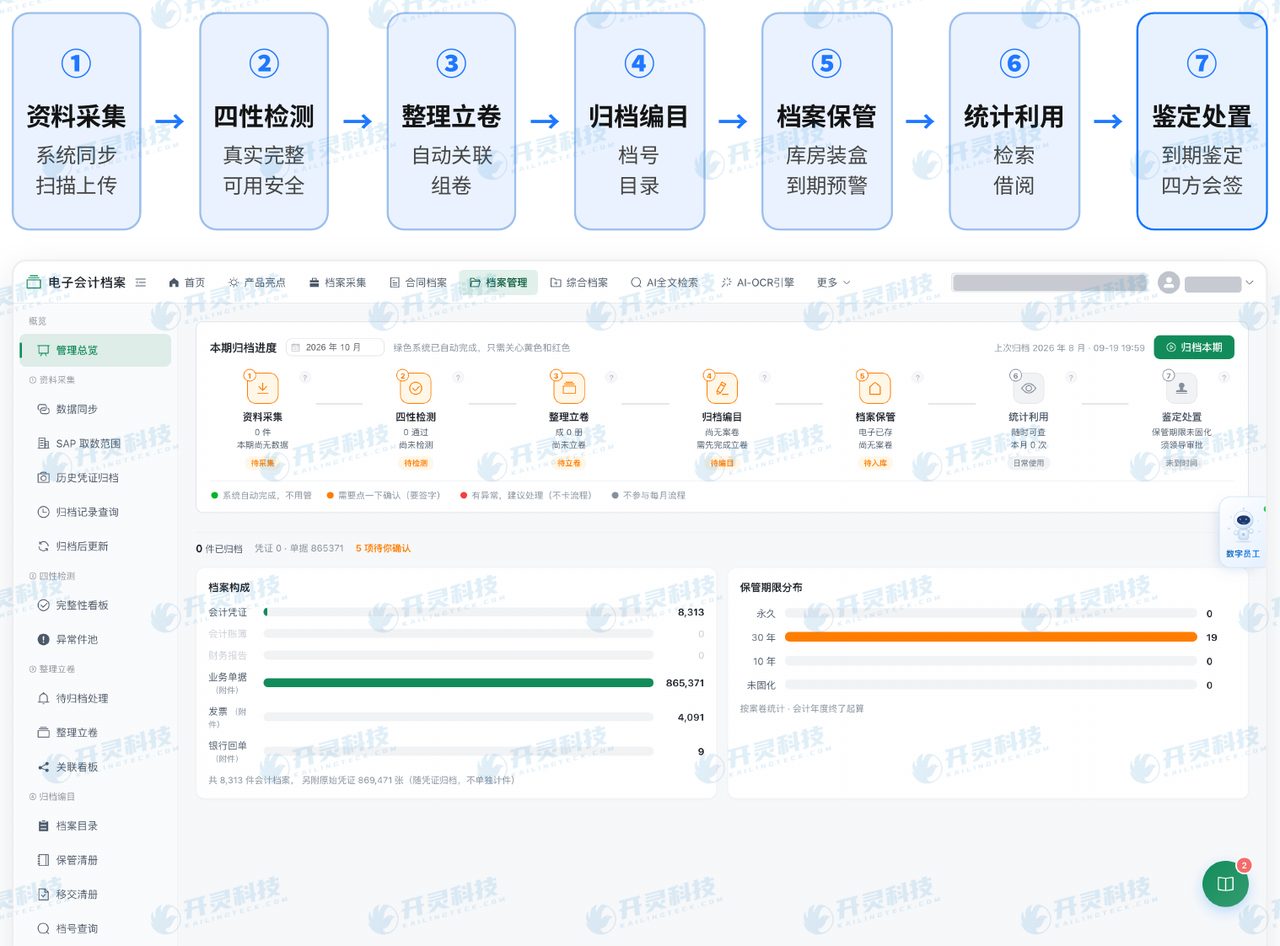
Kailing Technology archives overview: archiving progress and retention period (system screenshot)
▍Five verification points: how to test each one on site
It is recommended to use one month of the enterprise's own real documents for on-site testing and verify each of the following five items.
Validation point 1: Can the source system be directly connected for data retrieval?
Have the supplier demonstrate on site retrieving data from your financial system, OA, and bank, and see whether it uses open interfaces or read-only direct connections, whether manual export and import is required, and whether there are alerts when synchronization fails. Kailing Technology AI Electronic Accounting Archives Management System supports both open interfaces and read-only database direct connections, and automatically alerts archivists when continuous synchronization fails.
Validation point 2: Can the four-property test truly find problems?
Deliberately include a voucher with a missing attachment and a file with an abnormal format, and see whether the system can detect them and provide handling suggestions. A qualified system should continuously test authenticity, integrity, usability, and security by batch, and clearly state the cause and handling method for each anomaly.
Validation point 3: Can evidence be automatically linked and retrieved?
Randomly pick a payment and see whether the system can automatically link the corresponding invoice, bank receipt, reimbursement form, and contract; then search with a sentence or a keyword to see whether it can be found by content.
Validation point 4: Are retention periods and appraisal and destruction standardized?
Check whether retention periods are configured by category according to regulations, whether expiration only triggers a reminder rather than deletion, and whether destruction requires multi-party sign-off and the destruction register is kept permanently.
Validation point 5: Are deployment security and subsequent expansion controllable?
Confirm whether private deployment is possible, whether source code is delivered, whether it adapts to the Xinchuang environment, and how much development is required to add a new system or a new document type.
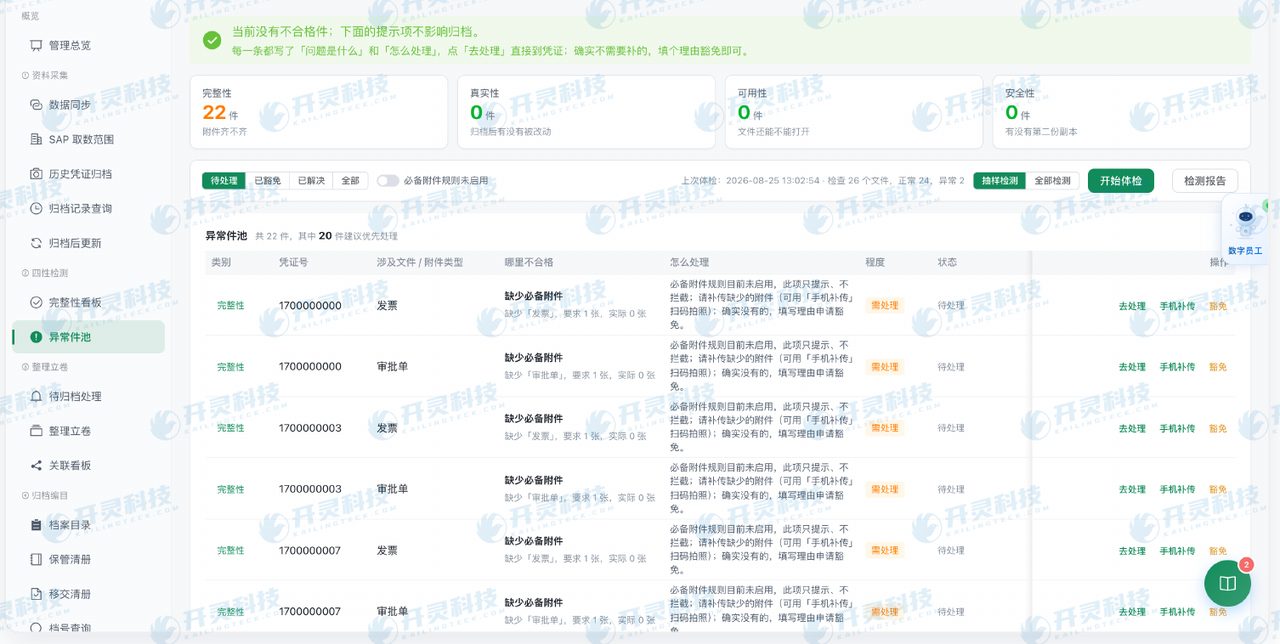
Kailing Technology four-property testing and abnormal item handling (system screenshot)
▍A verification checklist: tick each item during on-site testing
The table below can be used directly as a scoring sheet for on-site testing, with clear test actions and passing criteria for each item.

On-site verification checklist for electronic accounting archives system selection
During testing, it is best to invite audit or internal control personnel to participate, have them raise real document retrieval needs, and see whether the system can respond quickly and provide complete associated materials.
The value of this checklist lies in turning "watching a demo" into "testing real documents." Vendors using their own prepared demo data often cannot expose interface and format issues in a real environment.
▍How to read pricing: five factors that affect price
Prices for electronic accounting archives systems vary widely because project scopes differ. Five factors mainly affect quotes: first, deployment method, as private deployment and cloud services have different investment structures; second, the number of integrated systems, as each additional source system adds integration and joint debugging work; third, the volume of historical data migration, as the more historical vouchers are digitized and backfilled, the greater the workload; fourth, the scope of archive categories, as doing only accounting archives versus expanding to all categories such as documents, contracts, and HR differs in scale; fifth, the number of group organizations, as unified collection across multiple legal entities and entities requires more configuration.
Therefore, when comparing quotes, compare on the same scope and require suppliers to explain what is included in the quote and what is charged separately, such as subsequent new integrations, new document types, and version upgrades. Kailing Technology AI Electronic Accounting Archives Management System supports full source code delivery, and subsequent new document types can be added through visual configuration. Enterprises can include this in the total cost of ownership comparison.
In terms of implementation, the system advances in five steps: "research and configuration, deployment and acceptance, system integration, historical migration, and training and trial operation." The first step defines the archiving scope and retention schedule to avoid scope expansion mid-project.
▍What kind of enterprises are suitable for adopting an electronic accounting archives system now
The following three types of enterprises are advised to go live as early as possible: first, enterprises that have fully used fully digitalized e-invoices but still print and bind them; second, groups with multiple legal entities, inconsistent archiving standards across companies, and headquarters unable to see the full picture; third, enterprises with frequent audit and tax document retrieval where finance needs a lot of time to search for materials.
The earlier it is built, the lower the cost of digitizing and backfilling historical vouchers. For enterprises already using expense control and ERP, an archives system can serve as the last stop for business-finance data, uniformly depositing materials generated by reimbursement, accounting, and payment.
If an enterprise is small in scale with a single source of materials, for example only one financial software system and a small invoice volume, it can first use the archiving function built into the financial software to meet basic requirements, and consider a standalone archives system after sources of materials increase. The key to selection is always matching system scale to data complexity.
▍FAQ
Q: Which electronic accounting archives system is good, and how do you judge?
A: It is recommended to test five items on site using your own real documents: direct connection to source systems, four-property testing, evidence association and retrieval, retention period and destruction, and deployment security and scalability. This is more reliable than looking at rankings.
Q: Roughly how much does an electronic accounting archives system cost?
A: The price depends on the deployment method, the number of integrated systems, the volume of historical data migration, the scope of archive categories, and the number of group organizations. When comparing, compare on the same scope and confirm whether subsequent new integrations are charged separately.
Q: What standards must an electronic accounting archives system meet?
A: Mainly based on the Measures for the Management of Accounting Archives (Order No. 79), Cai Kuai [2020] No. 6, and DA/T 94-2022 and other standards. Core requirements include four-property testing, retention period management, and standardized appraisal and destruction.
Q: How many steps are generally involved in launching an electronic accounting archives system?
A: Kailing Technology AI Electronic Accounting Archives Management System is implemented in five steps: research and configuration, deployment and acceptance, system integration, historical migration, and training and trial operation. The first step defines the archiving scope and retention schedule.
For electronic accounting archives system selection, you are welcome to test Kailing Technology AI Electronic Accounting Archives Management System with real documents: https://www.kailingteck.com/eaa/ .
As a national high-tech enterprise, Kailing Technology focuses on the digital and intelligent transformation of enterprise business-finance-tax and operations management, providing software products, system integration, implementation and delivery, and operational services for various government agencies, institutions, group enterprises, and SMEs.
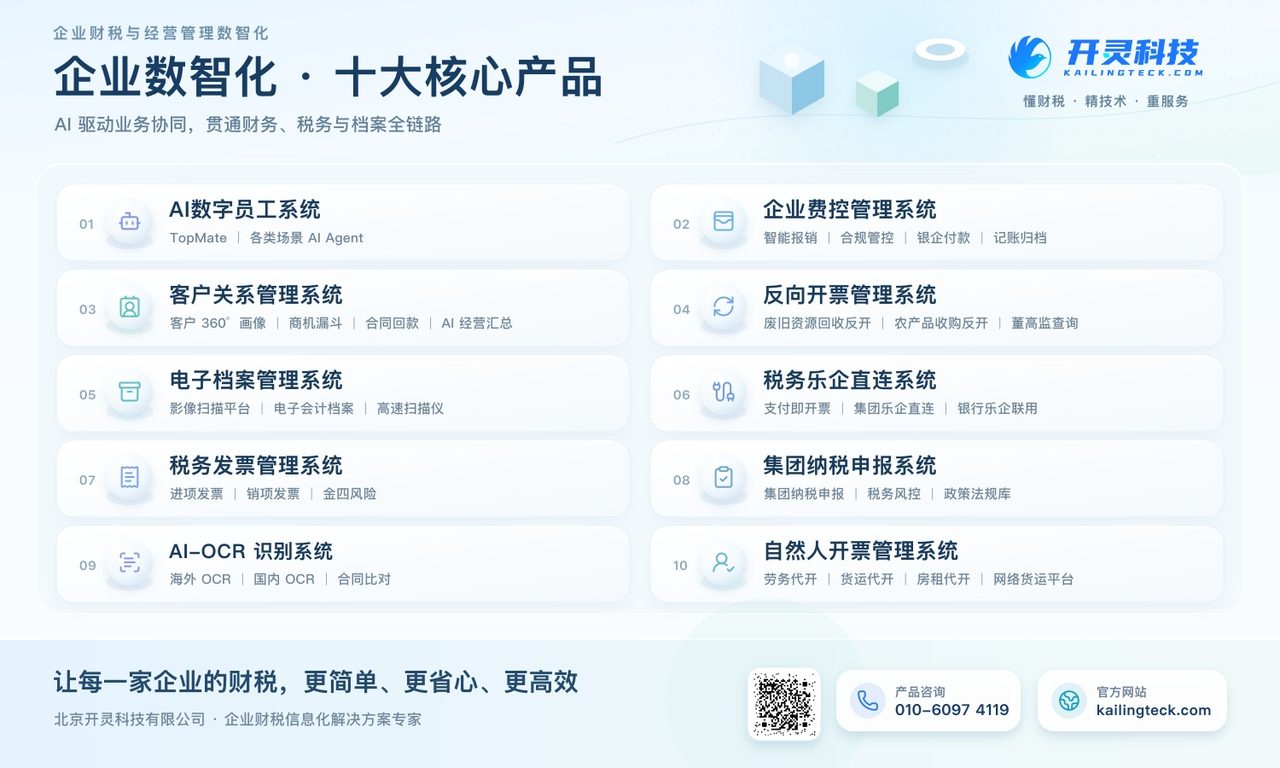
The company has now formed ten core product lines, including: AI digital employee system, enterprise expense control management system, customer relationship management system, reverse invoicing management system, invoice issuance for individuals management system, electronic archives management system, tax fully digitalized e-invoice Leqi system, tax invoice management system, group tax filing system, and AI OCR recognition system. It is committed to connecting enterprise business, finance, tax, funds, and archive data to help customers improve operational efficiency, business-finance-tax compliance capabilities, and digital management levels.
If you have any business-finance-tax digital transformation needs, welcome to contact us. Beijing Kailing Technology will serve you wholeheartedly.
Keywords: How to choose an electronic accounting archives system, electronic accounting archives system price, electronic accounting archives system ranking, archives system selection, Kailing Technology AI Electronic Accounting Archives Management System, four-property testing
As a comprehensive business-finance-tax digitalization solution service provider, Kailing Technology provides business-finance-tax management digital transformation products and operational services for various government agencies, institutions, and large, medium, and small enterprises. The product line includes: solutions for sales contract management system, procurement contract management system, fully digitalized Leqi interface project, automatic output invoicing system, reverse invoicing system, invoice issuance for individuals system, employee expense control and reimbursement system, input VAT invoice management system, supply chain collaborative reconciliation system, image AI OCR recognition system, automatic financial bookkeeping system, electronic accounting archives system, etc., comprehensively driving the digitalization process across various fields.
Consultation Hotline: 18513895936 / 010-60974119 Location: Beijing