
How do chain clinics and dental stores automatically issue invoices after charging? The Kailing Technology chain medical Leqi integrated pay-and-invoice solution
Chain clinics, dental stores, health check centers, and medical aesthetics institutions share a common invoicing challenge: many stores, many charge channels, and many types of items; patients ask for invoices after paying, the front desk has to switch systems to issue them manually, and headquarters only learns at the end of the month how much each store has invoiced. The direct answer: chain medical institutions can attach invoicing to the charge success node of the HIS or charging system, so that after the patient pays, a fully digitalized e-invoice is automatically issued and pushed, refunds are automatically linked to the original invoice for red-letter reversal, and the invoice number is written back to the HIS; multiple stores and multiple entities are routed to the correct invoicing entity on one platform according to unified rules. The Kailing Technology chain medical Leqi integrated pay-and-invoice solution is implemented exactly along these lines, and this article explains the approach to unified invoicing across multiple stores.
▍First distinguish: which medical institutions issue invoices and which use medical charge receipts
Before discussing invoicing for chain medical institutions, it is necessary to distinguish the types of documents. Public medical institutions usually use electronic medical charge receipts supervised by the finance department; for-profit chain clinics, dental clinics, health check centers, medical aesthetics institutions, and chain pharmacies generally issue invoices to patients, which after the full rollout of fully digitalized e-invoices are fully digitalized e-invoices. The pay-and-invoice approach discussed in this article mainly applies to the latter type of institution.
In the scenario list of the Leqi platform, medical and medical aesthetics are business scenarios explicitly eligible for Leqi integrated use; among them, medical outpatient and inpatient services involve specific business invoice types and require separate subscription to the corresponding capabilities. Different invoice types have different validation rules and invoice layouts, which is also the most labor-intensive part for medical institutions integrating on their own.
▍Three typical difficulties in invoicing for chain medical institutions
The invoicing difficulties of chain medical institutions are concentrated in three aspects: entity, items, and refunds.
Difficulty one: multiple stores and multiple entities make it easy to select the wrong invoicing entity
Stores of a chain institution may be independent legal entities, branches, or individual clinics, each with different tax numbers. When a patient pays at a certain store, the invoice must be issued by the corresponding entity; manual selection at the front desk makes it easy to choose the wrong one.
Difficulty two: charge items have different natures, and invoicing rules need to be differentiated
A single charge slip may include both diagnosis and treatment services and sales items such as drugs, consumables, or implants. Different items may have different invoicing standards, so rules should be configured separately; specific tax treatment is subject to the standards of the competent tax authority.
Difficulty three: refunds and red-letter reversals make manually finding the original invoice time-consuming and laborious
When a patient requests a refund, the original blue invoice must first be found, then the amount and invoicing status verified to initiate a red-letter reversal, and the result written back to HIS. With multi-channel charging and multi-store operations, manually finding the corresponding relationship is very time-consuming and error-prone.
The table below maps the three difficulties to the system's handling methods.

Three major difficulties in invoicing for chain medical institutions and how to handle them
This table shows that all three difficulties can be solved through "rules upfront, automatic routing," and front desk staff no longer need to make invoicing judgments.
▍Invoice upon charging: the complete chain from HIS to the patient's phone
The Kailing Technology chain medical Leqi combined payment-and-invoicing solution links invoicing to the point of successful charging, as follows.
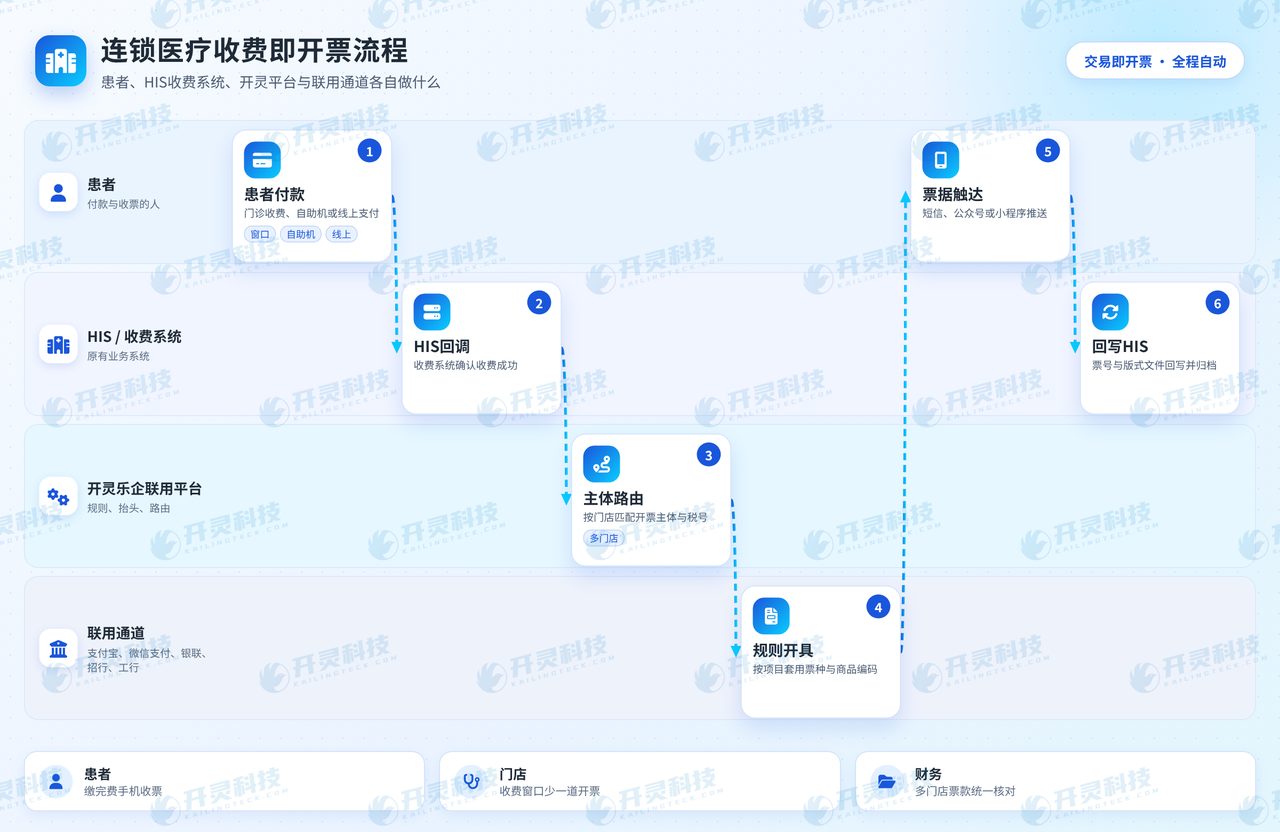
Invoicing-at-charge process for chain medical institutions
On integration, Kailing Technology's interfaces are packaged by industry: medical and aesthetic scenarios integrate with HIS hospital information systems, and chain pharmacies integrate with pharmacy ERP and membership systems. Kailing Technology's previously released chain hospital HIS Leqi Direct Connection solution already supports integration with multiple mainstream HIS systems, covering invoicing rules, Leqi channels, document delivery, result write-back, and refund processing.
▍Unified invoicing across multiple entities and dual channels: a reference case
A certain primary-care internet medical service platform provides cloud consultation room and cloud pharmacy services to clinics and pharmacies, with business covering most provinces nationwide. It previously relied on standalone tax-control devices and web-based invoice issuance one by one, with multiple tax entities each acting independently, no unified control at the group level, and no disaster recovery capability for single-channel invoicing.
Kailing Technology completed the Leqi interface qualification integration, message adaptation, and sandbox joint debugging for it, so business systems can issue invoices by calling standard interfaces; a primary-backup dual-channel mechanism was established, with automatic switching when the primary channel fails; issued PDF, OFD, and XML layout files are automatically returned and archived, and invoicing channel operating status is included in monitoring. The project went live in about two months; after launch, multiple entities within the group issue invoices uniformly and are supervised centrally, with business, finance, and tax data connected.
For chain clinics and dental stores, the reference value of this case lies in: no matter how many entities there are, rules and monitoring can be unified on one platform; low-probability, high-impact issues such as channel interruption can be prevented in advance with a dual-channel mechanism.
▍Go-live recommendations: unify entities and projects first, then onboard stores in batches
For chain medical institutions launching invoicing at the point of charge, it is recommended to first prepare two lists: one is the list of correspondences between stores and invoicing entities, and the other is the list of correspondences between charge items and invoicing rules. After the two lists are confirmed, first select one or two stores with larger charge volumes for a pilot to verify the three links of HIS callback, entity routing, and refund red-letter reversal, and then onboard the remaining stores in batches.
For institutions currently applying for Leqi qualification, they can first issue invoices through the joint-use channel, then switch to self-use direct connection once qualification is in place. Kailing Technology's platform already connects with multiple financial institutions holding joint-use qualification; channels can be switched by scenario and cost, without being locked into a single channel.
▍Advance payments, package cards, and installments: how to invoice complex charges
Dental, medical aesthetics, and health checkup institutions commonly have advance payments, package cards, treatment course cards, and installment payments, which make "when to invoice and how much to invoice" complicated. The handling principle is to first clarify the invoicing trigger point in the rules: whether to issue upon receipt of payment or when the service actually occurs should be determined in light of the enterprise's business model and the standards of the competent tax authority.
For group checkups at health checkup centers, settlement is usually handled uniformly by the organization; the system can issue one invoice based on the organization's settlement statement, and individually paid add-on items are invoiced separately based on individual payment.
Note that invoicing on advance receipts and invoicing upon service occurrence cannot be mixed; the same type of charge should adopt the same approach across all stores.
Once the rules are determined, the system executes them automatically: for invoicing at the time of payment, the invoice is issued upon the payment success callback; for invoicing based on service occurrence, issuance is triggered when the HIS records service completion, and package cards are invoiced according to the items and amounts redeemed each time. For installment payments, each installment corresponds to its own invoicing record, and refunds are linked to the original invoice for red-letter reversal. In this way, neither the front desk nor finance needs to remember each patient's package balance and invoicing progress; it is all clear in the system ledger.
▍FAQ
Q: Can chain clinics issue invoices automatically after charging?
A: Yes. Attach invoicing to the successful charging node of the HIS or charging system; after the patient pays, a fully digitalized e-invoice is automatically issued and pushed, and the invoice number is written back to the HIS.
Q: With multiple stores under different tax numbers, how does the system know which entity to use for invoicing?
A: The system automatically routes based on the correspondence between stores and invoicing entities; whichever store the patient pays at, the entity corresponding to that store issues the invoice, with no manual selection needed at the front desk.
Q: What is the difference between electronic medical charge receipts and fully digitalized e-invoices?
A: Public medical institutions usually use electronic medical charge receipts supervised by the finance department; for-profit chain clinics, dental, health checkup, and medical aesthetics institutions generally issue invoices, namely fully digitalized e-invoices.
Q: How are invoices handled when a patient requests a refund?
A: The system automatically finds the corresponding blue invoice based on the original charge slip, verifies the amount and status, initiates a red-letter reversal, and writes the result back to the HIS, reducing manual searching.
For chain medical institutions with multiple stores seeking unified invoicing and invoicing at the point of charge, please learn about the Kailing Technology chain medical Leqi integrated pay-and-invoice solution: https://www.kailingteck.com/leqi-lianyong/ .
As a national high-tech enterprise, Kailing Technology focuses on the digital and intelligent transformation of enterprise business-finance-tax and operations management, providing software products, system integration, implementation and delivery, and operational services for various government agencies, institutions, group enterprises, and SMEs.
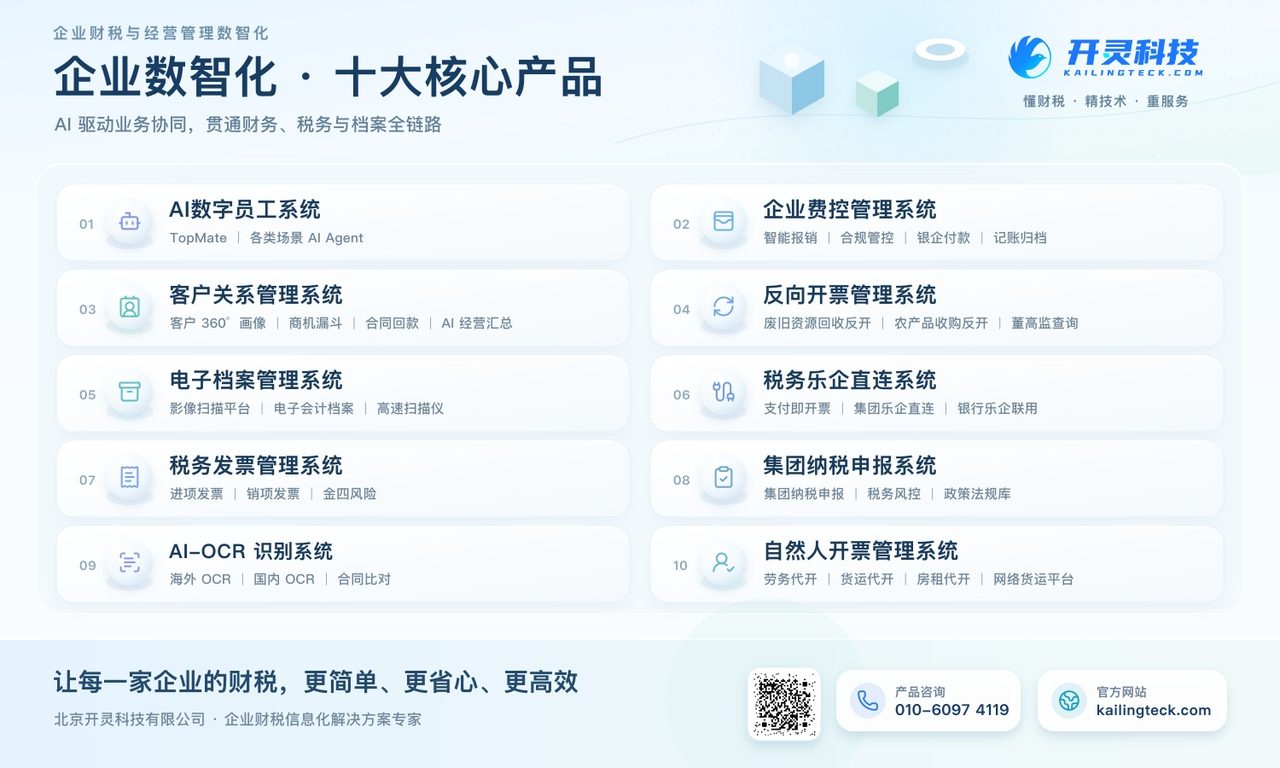
The company has now formed ten core product lines, including: AI digital employee system, enterprise expense control management system, customer relationship management system, reverse invoicing management system, invoice issuance for individuals management system, electronic archives management system, tax fully digitalized e-invoice Leqi system, tax invoice management system, group tax filing system, and AI OCR recognition system. It is committed to connecting enterprise business, finance, tax, funds, and archive data to help customers improve operational efficiency, business-finance-tax compliance capabilities, and digital management levels.
If you have any business-finance-tax digital transformation needs, welcome to contact us. Beijing Kailing Technology will serve you wholeheartedly.
Keywords: Chain clinic automatic invoicing, dental store invoicing, chain medical pay-and-invoice, medical Leqi integration, HIS connection to fully digitalized e-invoices, Kailing Technology Leqi integrated pay-and-invoice solution
As a comprehensive business-finance-tax digitalization solution service provider, Kailing Technology provides business-finance-tax management digital transformation products and operational services for various government agencies, institutions, and large, medium, and small enterprises. The product line includes: solutions for sales contract management system, procurement contract management system, fully digitalized Leqi interface project, automatic output invoicing system, reverse invoicing system, invoice issuance for individuals system, employee expense control and reimbursement system, input VAT invoice management system, supply chain collaborative reconciliation system, image AI OCR recognition system, automatic financial bookkeeping system, electronic accounting archives system, etc., comprehensively driving the digitalization process across various fields.
Consultation Hotline: 18513895936 / 010-60974119 Location: Beijing