
What do audits focus on during the scrap copper reverse invoicing rectification period? Kailing Technology's resource recycling reverse invoicing system self-inspects item by item against audit key points, with a five-flows-in-one evidence chain to respond to tax compliance inspections
Scrap copper has a high unit price and frequent transactions, and has long been a key category in tax audits of the renewable resources industry. Many enterprises search for "scrap copper reverse invoicing rectification" and "audit key points," but what they really want to know is: when tax authorities come to inspect, what will they look at first, and what must the enterprise produce. Direct answer: audits focus on five aspects: whether the entity is qualified, whether the transaction is genuine, whether invoice and payment match, whether the quota is compliant, and whether filing is accurate. As long as the enterprise can pull out the full set of corresponding evidence by business order number, it can respond calmly. As of November 2026, Kailing Technology's resource recycling reverse invoicing system has turned these five aspects into a checklist for self-inspection transaction by transaction; this article explains them item by item in audit order. To handle inspections during the rectification period, the most effective approach is to ensure every reverse invoice is backed by a five-flows-in-one evidence chain, retrievable at any time under tax compliance standards.

▍I. Why reverse invoicing of scrap copper becomes an audit focus
Scrap copper reverse invoicing has drawn special attention because scrap copper has three characteristics: high unit price, easy sorting, and hard to trace. For the same truckload, grading it as purple copper versus brass can make a large difference in amount; after sorting, raw materials go to scattered destinations and are hard to reconstruct afterward; historically the industry has seen much cash purchasing and IOUs booked as entries.
The reverse invoicing system was established on the basis of the Announcement No. 5 of 2024 of the State Taxation Administration, precisely so that recycling enterprises can obtain input VAT through compliant channels. After the system was opened up, tax authorities simultaneously strengthened two-way verification of "purchaser plus seller," focusing on identifying unreal transactions, inconsistency between invoice and payment, and splitting identities to evade quotas. For enterprises, the rectification period is not a question of whether to issue reverse invoices, but whether every invoice issued can withstand scrutiny.
▍II. Item-by-item breakdown of audit focus: what is checked in five aspects and what enterprises should provide
Following the general order of tax audits, the inspection points for scrap copper reverse invoicing can be grouped into the following five aspects, each corresponding to a set of materials that the enterprise should be able to retrieve at any time.
(1) Entity qualification: whether the enterprise can issue and whether the seller can be issued to
What to check: whether the recycling enterprise holds one of the three types of qualifications, such as registration as a renewable resource recycling operator; whether the seller is an individual, whether it is the person himself, and whether he serves as the legal representative or a director or senior manager of an enterprise. What to provide: qualification certificates, the seller's ID document and real-name verification records, and the results of the business registration position reverse check.
(2) Transaction authenticity: whether this truckload of copper really entered the plant
What to check: whether the arrival time, vehicle, gross weight and tare weight, and cargo photos are complete, and whether the weighbridge ticket matches the license plate. What to provide: driver arrival check-in records, front and rear vehicle photos, the original weighbridge ticket or recognition result, and the inbound order.
(3) Price and grading: how the amount is calculated
What to check: whether the unit prices of different grades such as purple copper, brass, and copper granules are reasonable, and whether the settlement quantity after impurity and moisture deductions matches the net inbound weight. What to provide: quality inspection and grading records, settlement statements, weighing difference records, and the basis for comparison with market prices for the period.
(4) Invoice-payment consistency: to whom the money was paid and how much was paid
What to check: whether the payment amount matches the settlement amount and the invoiced amount; whether the payee is the seller himself on the invoice. What to provide: bank transfer receipts, the settlement order number corresponding to the payment, and the reverse invoice format file.
(5) Quota and declaration: whether the cumulative quota and the taxes handled on behalf are compliant
What to check: whether the cumulative reverse invoicing for the same individual exceeds 5 million yuan (excluding VAT) over 12 consecutive months; whether the enterprise handles VAT and surcharges for the seller on schedule and withholds individual income tax. What to provide: the cumulative invoicing ledger by person and the tax filing records for taxes handled on behalf of sellers.
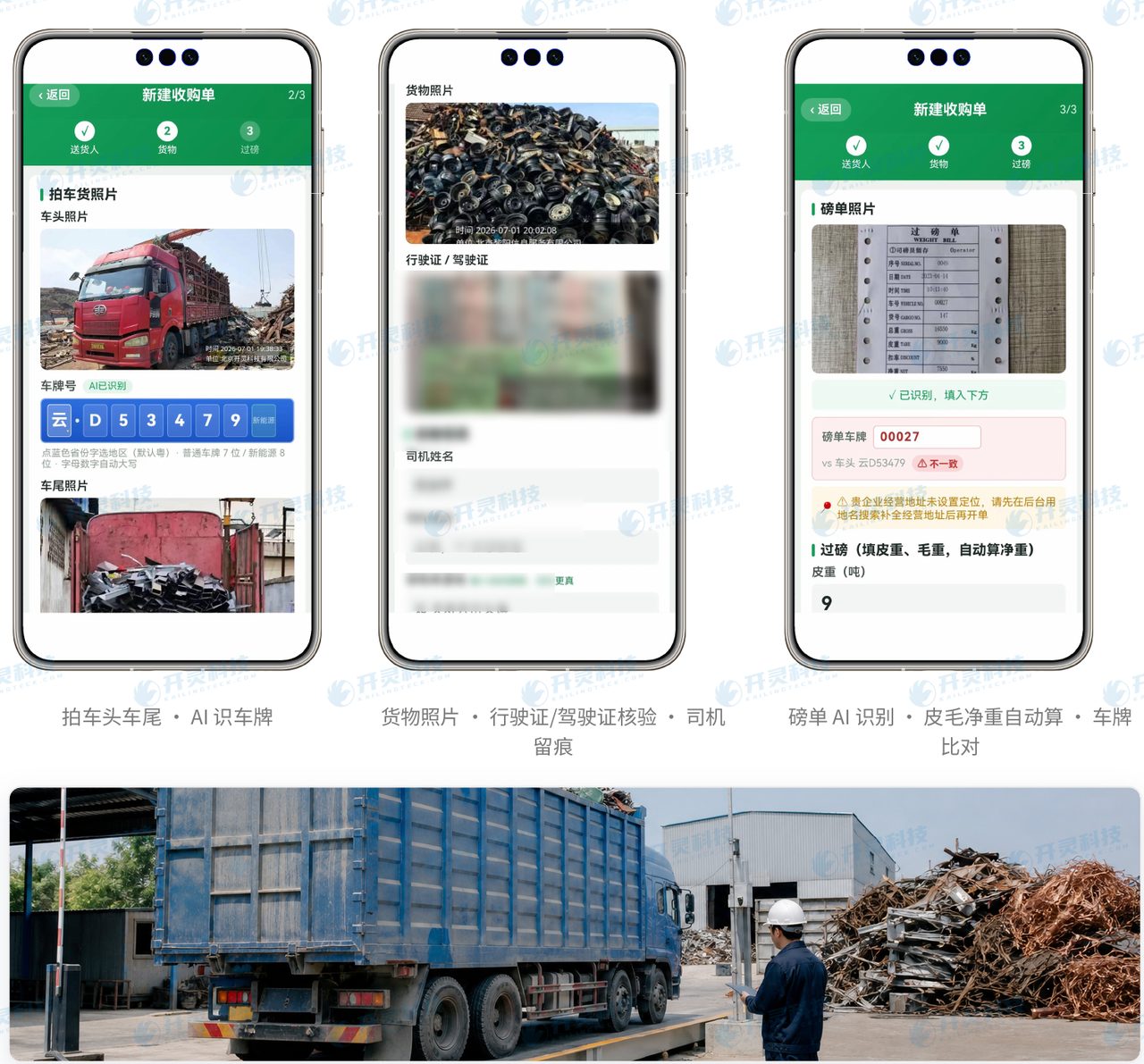
Kailing Technology on-site purchasing: automatic recognition and comparison of license plates and weighbridge tickets (information desensitized)
▍III. Self-check list: check yourself first according to audit standards
The most effective action for enterprises during the rectification period is to conduct a self-check first according to audit standards. The table below converts the five aspects into check items that can be ticked off one by one; monthly spot checks and quarterly full checks are recommended.

Scrap copper reverse invoicing self-inspection checklist by audit standards
The value of the self-check table lies in turning "worrying about being inspected" into "knowing what is missing." If you cannot answer even one of the five items, it means the corresponding evidence flow needs to be completed.
▍IV. How Kailing Technology's reverse invoicing system for resource recycling enables evidence retrieval by order number for every scrap copper transaction
The Kailing Technology resource recycling reverse invoicing system sets evidence retention points for each of the five inspection aspects and links the evidence uniformly under the business order number, so that during an inspection the purchase evidence archive can be exported with one click.
- Entity qualification: When individual sellers scan the code to create a profile, ID card recognition, liveness detection, and 1:1 face comparison are completed, and director and senior management reverse checks, quota verification, and blacklist comparison are automatically performed, with the results retained with the profile.
- Transaction authenticity: On-site check-in, license plate recognition, cargo photos, weighbridge ticket recognition, and license plate comparison are completed at once on site, binding person, vehicle, and goods to the same purchase order.
- Price grading: Quality inspection and grading and impurity deduction results enter the system, the settlement quantity is locked to the net inbound weight, unit price and amount can be calculated from each other, and weighbridge differences are recorded separately.
- Invoice-payment consistency: Settlement is per person with bank-enterprise direct connection payment, and a reverse invoice is issued at the same step as payment, with the receipt automatically written back to the settlement statement.
- Quota declaration: The system verifies the individual's quota in real time, automatically warns and blocks invoicing when the quota is approached or exceeded; VAT at the 1% levy rate, surcharges, and withheld individual income tax are calculated by the system.
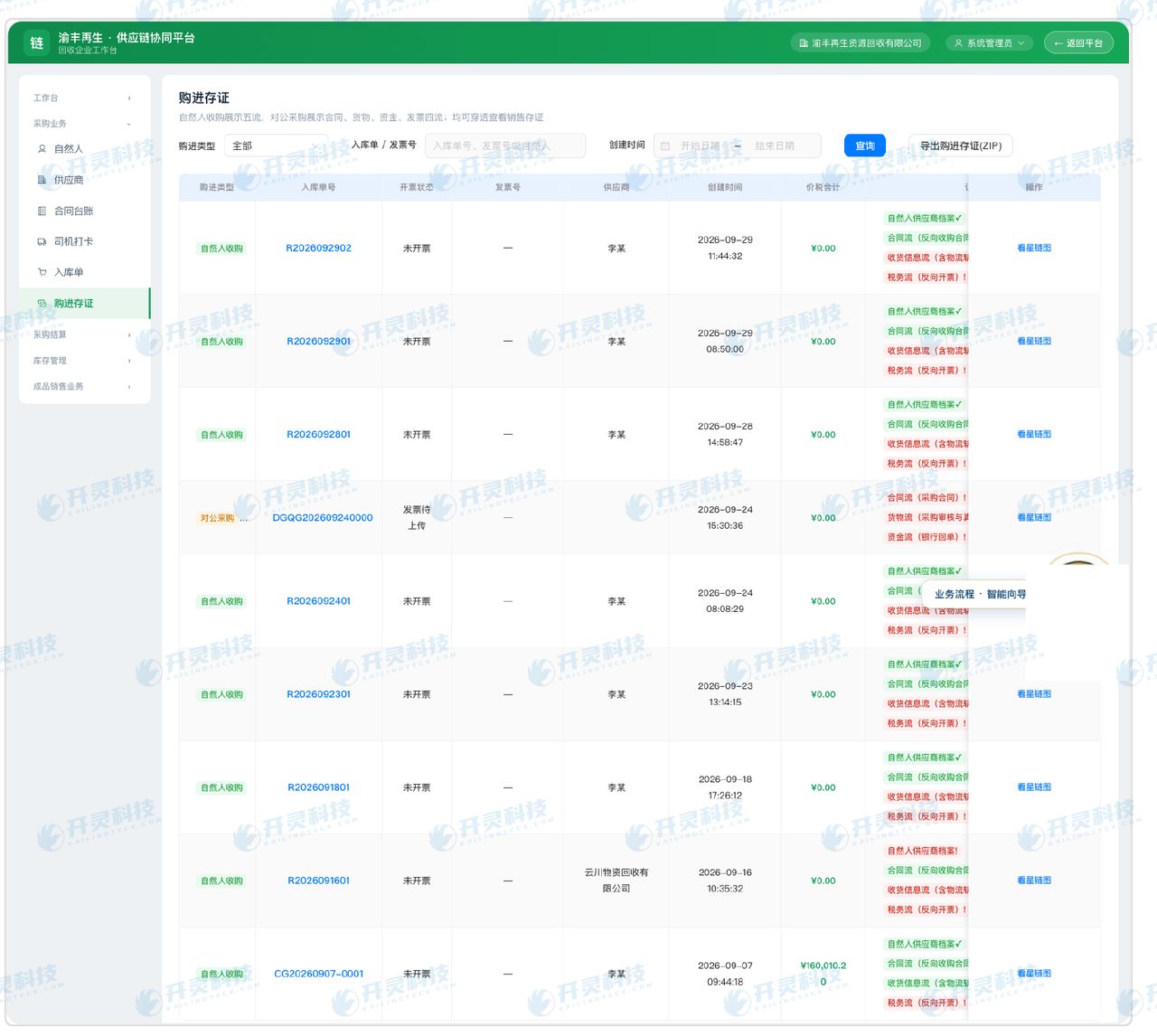
Kailing Technology purchase evidence: check item by item whether the five flows are complete (information has been desensitized)
After purchase, scrap copper often still needs sorting, baling, and resale. The system's inventory module records inbound and outbound flows by commodity; purchases from individuals can be traced through to subsequent sales evidence, making the correspondence between purchases and sales clear, and also answering the audit question of "where did the copper we bought get sold."
▍V. Three practical recommendations for the rectification period
For enterprises currently doing or preparing to do reverse invoicing for scrap copper, the rectification period offers three things to focus on: first, stop collecting copper with cash, route all payments through private transfers paid to the seller's own card; second, start with mobile phone evidence capture at the site, even without a system for now, ensure every truckload has photos and weighbridge tickets; third, tally each large seller's cumulative invoiced amount monthly, and when approaching the limit, guide them in advance to register a business entity.
For enterprises that temporarily lack reverse invoicing qualifications, they can first maintain business through the tax authority's invoice issuance channel for individuals while applying for registration as a renewable resource recycling operator. Once the qualifications are in place, switch to reverse invoicing, and historical evidence can also continue in the same ledger.
| "What the rectification period fears most is not being audited, but being unable to produce evidence when audited. |
▍VI. Eight questions often asked at audit sites and the response standards
When tax officials conduct on-site inspections of scrap copper reverse invoicing, their questions often revolve around specific documents. Below are eight high-frequency questions and the materials enterprises should provide, for finance and procurement to rehearse in advance.
- "Who is the seller on this invoice, and has the person come in person?" Present the seller file, real-name verification and facial comparison records, and the on-site check-in record for that truck trip.
- "On what day did this truckload of copper enter the plant, and what is the license plate number?" Present photos of the front and rear of the vehicle, license plate recognition results, and weighing time.
- "What are the gross weight, tare weight, and net weight respectively?" Present the weighbridge ticket recognition results and inbound order, explaining that the net weight matches the settlement quantity.
- "Why was it purchased at this price?" Present the quality inspection and grading records and the grade unit price table for the period, explaining the basis for impurity and moisture deductions.
- "Who was the money paid to, and is there a payment receipt?" Present the receipt for the transfer to the individual's account, explaining that the payee and the invoice seller are the same person.
- "How much has this person invoiced at your company in the past year?" Present the cumulative invoicing ledger by person and the quota verification records.
- "Have the taxes and fees for the agency service been paid?" Present the filing and payment records for VAT, surcharges, and withheld individual income tax.
- "Who was this batch of copper later sold to?" Present the inventory flow and corresponding sales records, explaining the correspondence between purchases and sales.
Among the eight questions, the first five correspond to the five evidence flows of a single purchase, and the last three correspond to the enterprise's overall management. If an enterprise can answer these eight questions completely on site for any invoice, the audit can generally be completed smoothly.
▍VII. What to do if the seller does not cooperate: handling three common situations
When implementing scrap copper reverse invoicing, resistance often comes from sellers: some are unwilling to provide ID cards, some are unwilling to do facial recognition, and some insist on cash. The approach is to make the process as simple as possible while explaining the rules clearly.
For elderly individual sellers who cannot use smartphones, purchasers can enter information on their behalf, and the seller only needs to cooperate with facial recognition to confirm identity; after the profile is created once, subsequent sales can directly select the profile without repeated operations. For sellers concerned about privacy, it can be explained that identity information is used only for invoicing and tax verification, and the system controls visibility by permission. For sellers who insist on cash settlement, the enterprise needs to clearly inform them that cash transactions cannot form fund-flow evidence and therefore cannot be reverse invoiced for them, while bank transfer to their own card is actually safer and traceable.
In practice, as long as the first profile creation goes smoothly, most sellers will accept the subsequent process. The key is not to compromise on identity and payment steps in order to retain supply; once these two steps loosen, no amount of subsequent evidence can make up for it.
▍VIII. After the rectification period: turn compliance into daily operating capability
After the rectification period, scrap copper recycling enterprises face not a one-time inspection but normalized data comparison. The tax side can see invoicing, filing, and fund data, and whether the enterprise-side five-flow evidence is complete determines whether each comparison can be passed smoothly.
Therefore, enterprises are advised to treat the five-flow completeness rate as a daily operating indicator: look once a week at the number of documents missing evidence, once a month at the quota progress of large sellers, and conduct a full self-check once a quarter. The regulatory dashboard of Kailing Technology's reverse invoicing system for resource recycling can display transaction amounts, invoicing amounts, and five-flow completeness rates by site and by category, so enterprise leaders can grasp compliance status without waiting for financial statements.
For enterprises operating within renewable resource parks, the park and local regulators can also view the completeness rates and risk warnings of enterprises within their jurisdiction through the same dashboard. By proactively completing evidence, enterprises both reduce their own risks and help obtain policy support from the park and local authorities.
▍IX. Three high-risk scrap copper transaction models that enterprises should proactively avoid
In addition to missing evidence for individual transactions, three types of transaction models are inherently prone to attention, and scrap copper recycling enterprises should proactively avoid them at the business level.
The first type is "invoicing without goods passing through." Goods are shipped directly from upstream to downstream factories, while the recycling enterprise only issues invoices and makes payments in the middle, with no arrival or weighing records at its own plant. Under this model, the recycling enterprise cannot prove that the goods passed through it, and the reverse invoice lacks goods-flow support. The second type is "funds flowing back." After payment is made to the seller, the money returns to the enterprise or related persons in cash or other ways; this is a typical feature of false invoicing, and once verified through fund tracing, the consequences are serious. The third type is "concentrated rush invoicing." Invoicing volume is usually very small, but in a certain month a large number of reverse invoices are suddenly issued in a concentrated manner, and the sellers are mostly newly profiled persons, which easily triggers high-frequency rules.
The Kailing Technology resource recycling reverse invoicing system requires that every acquisition have on-site arrival and weighing records, that payment be made only to the person's own card, and that early warnings be given for short-term high-frequency and large-amount transactions. These rules cannot make business decisions for the enterprise, but they can expose anomalies as early as possible and prevent small problems from accumulating into major risks.
▍X. Collecting copper at multiple sites: how to make every site retain evidence under the same standard
Many scrap copper recycling enterprises have multiple purchasing outlets in different townships. Outlet staff turnover is high and operating habits vary, making these high-incidence areas for missing evidence. The key to a unified standard is to let headquarters set the rules, let outlets operate according to the rules, and let the system check automatically.
Headquarters uniformly maintains the product library, grade unit prices, risk thresholds, and required photo requirements in the system; outlet purchasers use mobile phones to complete check-in, photo taking, weighing recognition, and order creation, and purchase orders missing required fields cannot be submitted; finance uniformly settles payments and issues invoices at headquarters, and the five-flow completeness rate, invoiced amount, and warning count of each outlet are counted separately.
In this way, management can clearly see which branch has the worst evidence quality and which branch has the most anomalies, and carry out targeted training and rectification, rather than waiting until a problem arises to dig through a branch's paper ledgers.
▍XI. Deployment and integration: how to connect with existing ERP and weighbridge systems
Many scrap copper recycling enterprises already use ERP and weighbridge weighing systems and worry that adopting a reverse invoicing system means starting over. In fact, Kailing Technology's reverse invoicing system for resource recycling provides open interfaces that can connect directly with enterprise ERP and weighbridge weighing systems, with purchase orders, weighbridge tickets, and inventory data interoperable, while existing systems continue to be used.
In terms of deployment, the system can be deployed privately in the enterprise's or park's own data center, supporting internal and external network isolation; SaaS cloud services can also be used, suitable for enterprises with many branches that want to go live quickly. Invoicing goes through the electronic tax bureau's fully digitalized e-invoice or Leqi channel, and payment goes through direct bank connection; invoicing, red-letter reversal, and result return require no manual attendance.
For enterprises concerned about data security, private deployment can ensure that purchase data, seller identity information, and image materials all remain on the enterprise's own servers, with viewing permissions assigned by role.
In terms of implementation, Kailing Technology provides on-site integration: first sort out the enterprise's purchasing process, grading standards, and site distribution, then configure the commodity library, risk rules, and payment channels, with issues and events tracked to closure throughout.
For enterprises that urgently need to complete evidence during the rectification period, it is recommended to go live first with the two steps of on-site evidence retention and invoice-upon-payment, then gradually integrate the inventory and sales modules. In this way, the first phase can solve the transaction authenticity and invoice-payment consistency issues that audits care about most, and the purchase-sales correspondence can be completed later.
▍FAQ
Q: What do audits generally check first for reverse invoicing of scrap copper?
A: Usually entity qualification is checked first, namely whether the recycling enterprise holds one of the three qualification types and whether the seller is the natural person himself or herself and not a director or senior manager; only then are goods, prices, funds, and quotas examined in depth.
Q: Scrap copper is priced differently by grade; how is the invoiced amount considered compliant?
A: The invoiced amount should match the settlement amount, the settlement quantity should equal the net inbound weight, and grade and impurity deduction results must be recorded. Kailing Technology's reverse invoicing system for resource recycling locks the settlement quantity and records weighbridge differences separately.
Q: When an audit requires evidence, how quickly can it be retrieved?
A: If evidence is scattered among the weighbridge house, cashier, and invoicing clerk, it often takes several days. With Kailing Technology's reverse invoicing system for resource recycling, five-flow evidence can be retrieved at once by business order number, and a purchase evidence archive package can be exported.
Q: After purchased scrap copper is sold, what else needs to be retained?
A: Inventory flows that correspond to purchases and sales are required. The system records inbound and outbound by commodity and supports tracing from purchase through to sale, making it easy to explain where goods went.
Q: What should scrap copper recycling enterprises do during the rectification period if they do not yet have reverse invoicing qualifications?
A: You can first maintain business through the tax authority's invoice issuance channel for individuals while applying for qualifications such as registration as a renewable resource recycling operator. Kailing Technology can assist with the qualifications; once the qualifications are in place, switch to reverse invoicing, and historical evidence continues in the same ledger.
To make scrap copper reverse invoicing stand up to audits, welcome to learn about Kailing Technology's resource recycling reverse invoicing system: https://www.kailingteck.com/fxzy/ .
As a national high-tech enterprise, Kailing Technology focuses on the digital and intelligent transformation of enterprise business-finance-tax and operations management, providing software products, system integration, implementation and delivery, and operational services for various government agencies, institutions, group enterprises, and SMEs.
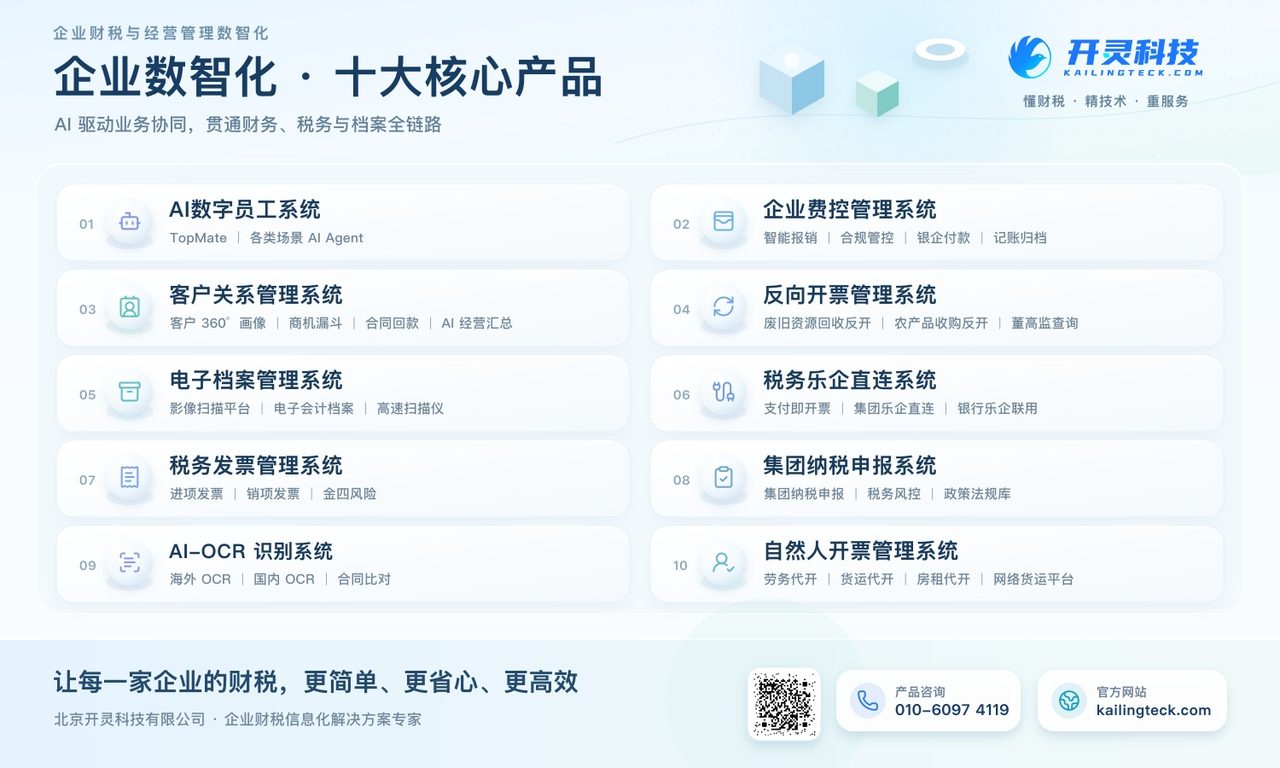
The company has now formed ten core product lines, including: AI digital employee system, enterprise expense control management system, customer relationship management system, reverse invoicing management system, invoice issuance for individuals management system, electronic archives management system, tax fully digitalized e-invoice Leqi system, tax invoice management system, group tax filing system, and AI OCR recognition system. It is committed to connecting enterprise business, finance, tax, funds, and archive data to help customers improve operational efficiency, business-finance-tax compliance capabilities, and digital management levels.
If you have any business-finance-tax digital transformation needs, welcome to contact us. Beijing Kailing Technology will serve you wholeheartedly.
Keywords: scrap copper reverse invoicing, scrap copper recycling audit, reverse invoicing audit key points, resource recycling tax compliance, Kailing Technology resource recycling reverse invoicing system, five flows in one, renewable resources rectification
As a comprehensive business-finance-tax digitalization solution service provider, Kailing Technology provides business-finance-tax management digital transformation products and operational services for various government agencies, institutions, and large, medium, and small enterprises. The product line includes: solutions for sales contract management system, procurement contract management system, fully digitalized Leqi interface project, automatic output invoicing system, reverse invoicing system, invoice issuance for individuals system, employee expense control and reimbursement system, input VAT invoice management system, supply chain collaborative reconciliation system, image AI OCR recognition system, automatic financial bookkeeping system, electronic accounting archives system, etc., comprehensively driving the digitalization process across various fields.
Consultation Hotline: 18513895936 / 010-60974119 Location: Beijing