
Will Waste Aluminum Reverse Invoicing Be Treated as False Invoicing? Kailing Technology's Resource Recycling Reverse Invoicing System Verifies Seller Identity and Retains Five-Flow-Integrated Evidence to Safeguard the Bottom Line of Tax Compliance
The first question many scrap aluminum recycling station owners ask is: "We issue reverse invoices to individual sellers—will that be treated as false invoicing?" The conclusion is clear: under the State Taxation Administration Announcement No. 5 of 2024, a qualified recycling enterprise issuing invoices itself when purchasing scrapped scrap aluminum from individuals is itself a legitimate channel for obtaining input VAT, not false invoicing; what truly causes an enterprise to be deemed as false invoicing are the four types of factual problems: "wrong person, wrong goods, wrong money, wrong invoice." As of November 2026, the Kailing Technology resource recycling reverse invoicing system has built subject verification and five-flow evidence retention into the acquisition site. This article breaks down the five categories most likely to cross the line in scrap aluminum recycling one by one and gives the self-check action for each. Ultimately, to hold the bottom line of tax compliance in scrap aluminum reverse invoicing, what counts is that every acquisition has five-flow integrated evidence available for inspection.

▍01 Conclusion first: whether reverse invoicing for scrap aluminum is compliant depends on business authenticity, not on the invoicing method
Whether reverse invoicing for scrap aluminum is compliant depends on whether each acquisition transaction is genuine and whether the evidence corroborates one another, not on "who issues the invoice." The State Taxation Administration Announcement No. 5 of 2024, effective April 29, 2024, allows recycling enterprises to issue invoices themselves when purchasing scrapped products from individuals; regarding qualifications, an enterprise holding any one of the renewable resource recycling operator filing, the scrapped motor vehicle recycling and dismantling qualification, or the hazardous waste operation permit is sufficient.
In other words, as long as the scrap aluminum recycling enterprise is qualified, the purchase target is a natural person, and the transaction genuinely occurs, reverse invoicing is a compliant path. What tax authorities examine is whether there is a corresponding person, vehicle, goods, and payment behind the invoice. The industry's past practices of finding invoices or buying invoices carry extremely high risk, and reverse invoicing is precisely meant to replace those practices.
| “ Reverse invoicing is not the source of risk; a broken evidence chain is the source of risk. |
▍02 The five types of cases most likely to be deemed fraudulent invoicing in scrap aluminum recycling
When scrap aluminum recycling is deemed false invoicing, it almost always falls into the following five categories: false seller identity, payment not made to the person themselves, invoice without goods, measurement and amount mismatch, and splitting identities after exceeding the quota. Each category below is laid out as "scenario—consequence—self-check action."
(1) False seller identity: using someone else's ID card or identity not meeting the conditions
Scenario: A purchaser uses an acquaintance's ID card to issue invoices for multiple individual sellers, or the seller is himself or herself the legal representative, director, supervisor, or senior manager of an enterprise. Consequence: the seller on the invoice is inconsistent with the actual transacting party, and the authenticity of the invoice is directly denied. Self-check action: verify one by one whether the seller appeared in person, passed real-name verification, and underwent a business registration position cross-check.
(2) Funds not paid to the person: payment to a third party or cash settlement
Scenario: Payment is made to the bank card of the seller's relative or an intermediary, or settled in cash outright. Consequence: the fund flow does not match the invoice flow, one of the most common warning points under China Golden Tax Phase IV. Self-check action: sample one month of payment records to see whether the payee and the invoice seller are the same person, and whether one bank card is shared by multiple sellers.
(3) Invoice without goods: missing trip number, weighbridge ticket, and on-site photos
Scenario: An invoice is issued, but there is no record of when this truckload of waste aluminum entered the site, its gross and tare weights, or its license plate. Consequence: the goods flow is missing, and the enterprise cannot self-prove the transaction during a tax audit. Self-check action: randomly sample ten reverse invoices and see whether the corresponding arrival records, weighbridge tickets, and cargo photos can be retrieved within ten minutes.
(4) Measurement and amount do not match: many grades, settlement after impurity deduction inconsistent with invoicing
Scenario: Waste aluminum is graded into profiles, turnings, raw aluminum, and other grades; the settlement amount changes after on-site impurity deduction, but invoicing is based on the original weight. Consequence: the weighbridge ticket, settlement statement, and invoice contradict each other, making it easy to be deemed inflated input. Self-check action: verify whether the net inbound weight, settlement quantity, and invoiced quantity are consistent, and whether weight differences are recorded separately.
(5) Splitting identities to continue invoicing after exceeding the quota
Scenario: A single large seller's cumulative sales over 12 consecutive months approach 5 million yuan (excluding VAT), and the purchaser switches to family members' identities to continue invoicing. Consequence: this is typical split-up evasion, with risk far higher than the previous four categories. Self-check action: calculate cumulative invoiced amounts per seller over the past 12 months, and for those approaching the limit, convert them in advance to business entity registration or other compliant channels.
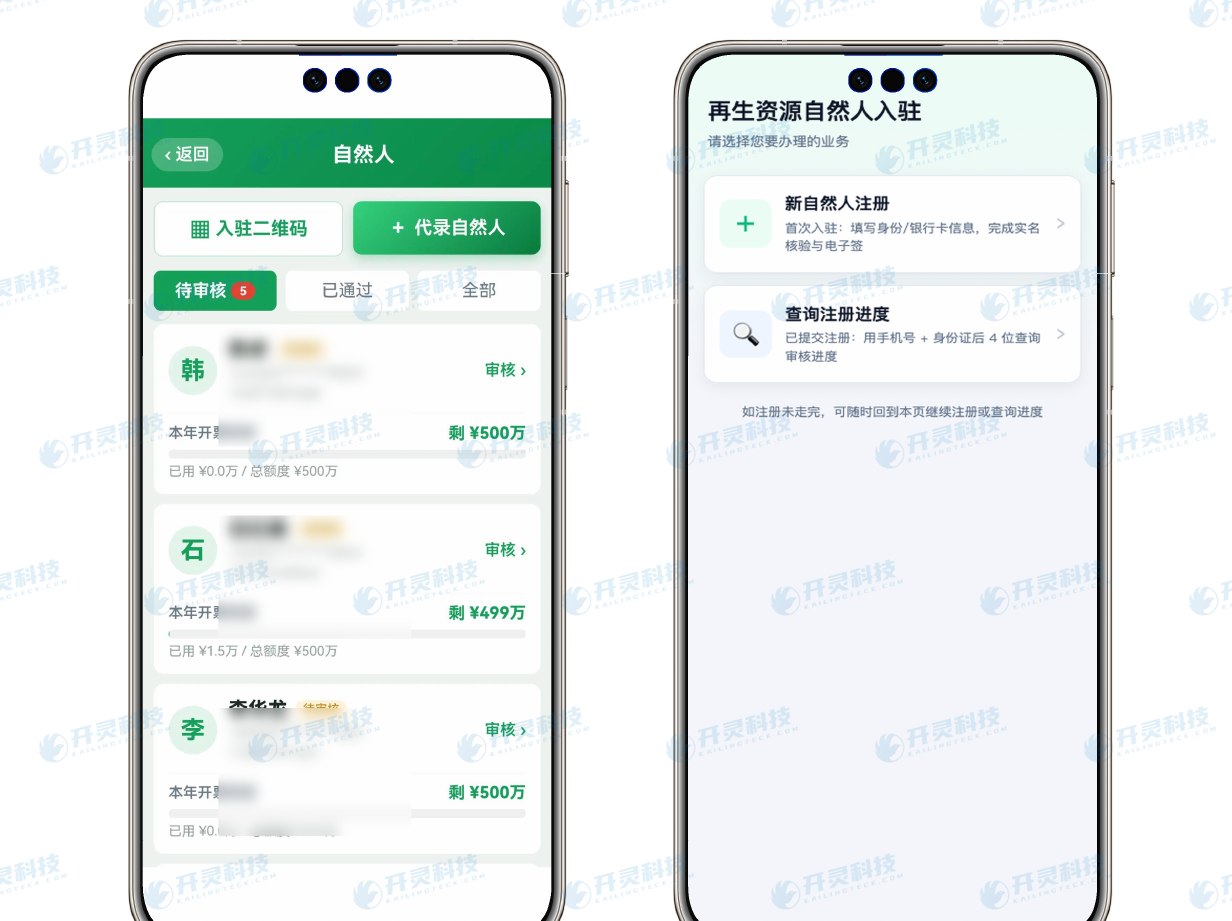
Kailing Technology natural person files and annual quota progress (information desensitized)
▍03 See at a glance in one table: what evidence each of the five risk types requires
Each of the five risk types corresponds to one evidence flow; as long as the enterprise fills them in one by one, it can turn cannot explain into can produce. The table below lists, by risk type, the tax focus points, the evidence the enterprise should retain, and the control points in the system.

Five Categories of False Invoicing Risk and Evidence Comparison for Waste Aluminum Reverse Invoicing
The core conclusion of this table is: four of the five types of risk can be resolved at once at the acquisition site, while the remaining quota problem must be warned in advance through a ledger accumulated by person, which is difficult to achieve by manual statistics at month-end alone.
▍04 How Kailing Technology's resource recycling reverse invoicing system keeps the five flows at the moment the business occurs
The Kailing Technology resource recycling reverse invoicing system splits a scrap aluminum acquisition into five evidence flows: natural person compliance flow, contract flow, goods trajectory flow, fund flow, and invoice flow. Each flow is automatically recorded at the moment the business occurs and finally consolidated under the same business order number.
- Filing and identity verification: Individual sellers scan the code to register; ID cards and bank cards are photographed and automatically recognized; liveness detection plus 1:1 face comparison confirms the person themselves, while simultaneously conducting a business registration position reverse check, a 5 million yuan quota verification, and a blacklist comparison.
- On-site goods retention: The driver scans a code to clock in and record arrival; the purchaser photographs the front and rear of the vehicle, and the license plate is automatically recognized; the weighbridge ticket is photographed, and tare and gross weights are automatically recognized and compared against the license plate, with an on-the-spot alert if they do not match.
- Settlement quantity lock: Each inbound order generates only one settlement order; the settlement quantity is locked to the inbound net weight, and the weighing difference is recorded in a separate column and permanently locked after confirmation.
- Payment and invoicing: Settlement is per person, with bank-enterprise direct connection payment; the reverse invoice is issued in the same step as payment, and the system calculates VAT at the 1% levy rate and calculates surcharges and withholds individual income tax, retaining PDF, OFD, and XML files simultaneously.
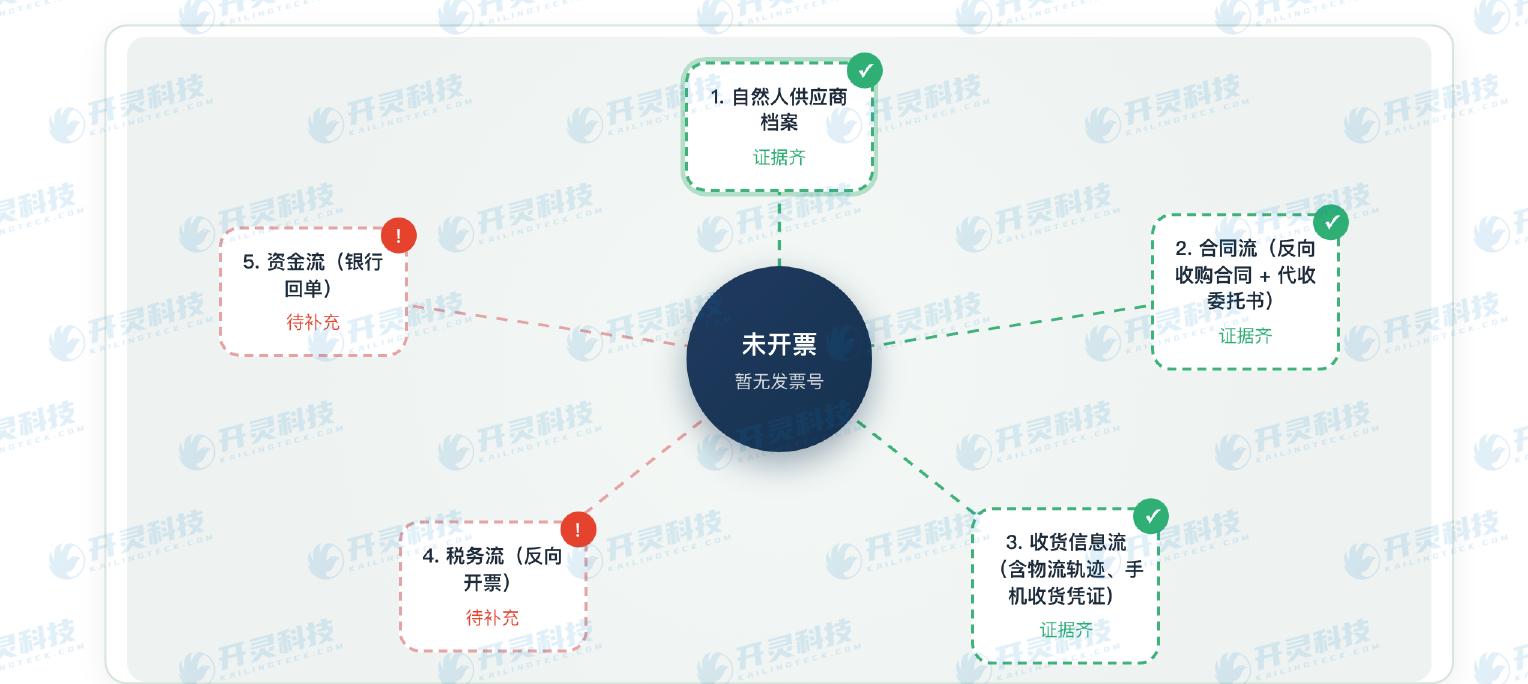
Kailing Technology five-flow star-chain diagram: red indicates evidence pending (information desensitized)
Once the five flows are consolidated into a single star-chain diagram, finance can retrieve the full set of evidence at once by business order number, or batch-check which documents are missing which flow. When an audit comes, there is no need to separately look for materials at the weighbridge, the cashier, and the invoicing clerk.
▍05 Risk alerts: block anomalies such as same card, high frequency, and price deviation before invoicing
The risk control engine of the Kailing Technology resource recycling reverse invoicing system continuously monitors five categories of anomalies: the same bank card shared by multiple natural persons, high-frequency large-amount transactions by the same natural person in a short period, vehicle tonnage exceeding the reasonable range for the vehicle type, transaction unit price clearly deviating from the market range, and long-term mismatch between the filing location and the transaction location.
These five types of rules correspond exactly to the five types of false invoicing situations described above. Documents that hit the rules will be prompted or blocked before invoicing, so enterprises do not have to wait until a tax inspection to discover problems. For renewable resource parks and local regulators, the system can also summarize the five-flow completeness rate and invoicing statistics of enterprises within their jurisdiction, facilitating routine supervision.
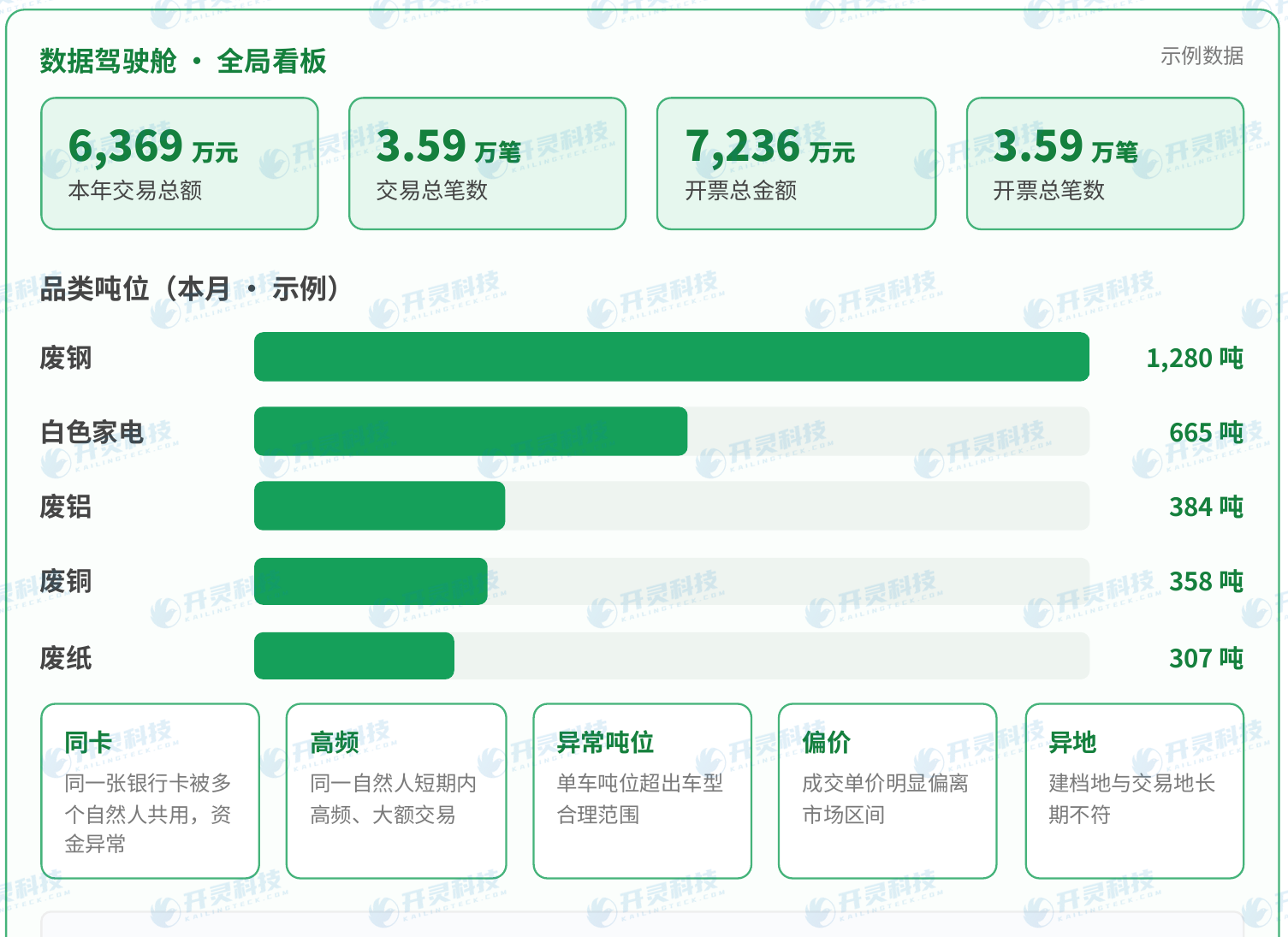
Kailing Technology data cockpit and five categories of risk alerts (sample data)
▍06 Applicable conditions and non-applicable cases: which scrap aluminum businesses should not use reverse invoicing
Reverse invoicing applies only to transactions of the type "a qualified recycling enterprise purchases scrapped products from natural persons." The following three situations should not use it: first, where the upstream party is an already-registered enterprise or business entity, which should issue the invoice itself; second, where the enterprise has not yet obtained any of the three categories of qualification, in which case it may first use the natural-person tax authority invoice issuance channel as a transition while filing as a renewable resource recycling operator; third, transactions settled in cash with no payment vouchers, where the five flows are inherently incomplete.
In addition, it should be noted that the "State Taxation Administration Announcement No. 12 of 2026" takes effect on July 1, 2026, and makes tiered adjustments to the individual income tax prepayment rate on individual business income in three-flow-unified scenarios; the specific application is subject to the local tax authority's interpretation. For waste aluminum recycling enterprises, the main thread of the policy remains "obtain input VAT compliantly and keep evidence that withstands scrutiny."
▍07 Reconstruct by vehicle trip: what a compliant scrap aluminum purchase should leave behind
A scrap aluminum purchase that can withstand inspection should be able to reconstruct, by vehicle trip, the answers to six questions: “who delivered it, what was delivered, how much was weighed, at what price, to whom was it paid, and what invoice was issued.” Below, taking the purchase of one truckload of mixed profiles and aluminum shavings as an example, we explain the traces that should be left at each step.
Step one: the deliverer scans the code at the gate to clock in, and the system records the arrival time; if it is the first time selling goods, code-based file creation and real-name verification are completed at the same time. Step two: before the vehicle goes onto the weighbridge, photos of the front and rear of the vehicle are taken, and the license plate is automatically recognized; after unloading, photos are taken separately by profile material and aluminum scrap. Step three: the weighbridge ticket is photographed, the system recognizes the gross weight and tare weight and calculates the net weight, and at the same time compares the license plate on the weighbridge ticket with the front license plate. Step four: the quality inspector prices by grade and deducts impurities, the results are entered into the acquisition order, and the settlement quantity is locked to the net weight received into storage. Step five: after finance confirms the settlement, payment is made to each person, and at the same time as payment succeeds, the reverse invoice is issued and the receipt is automatically written back.
If the same truckload contains both waste aluminum and a small amount of scrap iron, they should be entered on separate lines of the purchase order, each corresponding to its own category and photos, to avoid invoicing the entire load under the single category of waste aluminum.
Throughout the process, the deliverer only needs to scan the code and use face recognition, and the purchasing staff only needs to take photos and select grades; the rest of the recognition, calculation, comparison, and archiving are all done by the system, and the site does not slow down as a result.
If any one of these six questions cannot be answered, it means there is a gap in the evidence chain for this vehicle of goods. Many enterprises usually keep only invoices and payment vouchers, and precisely lack the intermediate vehicle, weighbridge ticket, and grade records, which are exactly the key materials proving that "the goods really came."
▍08 Three internal lines of defense: what procurement, finance, and management each check
To prevent false invoicing risk, scrap aluminum recycling enterprises cannot rely solely on month-end checks by finance; they must set up a defense line at each of the three levels: procurement, finance, and management.
- Purchasers stay on site: Confirm that the deliverer and the person who created the file are the same person, that the license plate matches the weighbridge ticket, and that the grade photos are clear; when substitute delivery or a change of deliverer is found, verify before receiving the goods.
- Finance guards invoices and payments: Before payment, verify whether the receiving card is the person's own card and whether the settlement amount matches the weighbridge slip; after invoicing, check the five-flow completeness rate, and documents lacking evidence do not enter monthly closing.
- Management guards against anomalies: Each week, review the alert lists for same card, high frequency, price deviation, etc., conduct special communication with suppliers who are close to the quota ceiling for a long time, and guide them to register as business entities when necessary.
These three lines of defense do not add much workload: the purchaser's verification actions are completed on the mobile phone along with the order, finance's checks are automatically given by the system as a completeness rate, and management only needs to look at the warning list once a week. What really requires investment is defining the rules clearly once and persisting in executing them.
The division of labor among the three lines of defense must be clear: procurement staff are responsible for on-site authenticity, finance is responsible for invoice-payment consistency, and management is responsible for overall risk trends. Kailing Technology's resource recycling reverse invoicing system provides workbenches for each of the three roles, with on-site photos, payment receipts, and risk alerts each visible, avoiding mutual blame when problems arise.
For enterprises with many outlets, headquarters can also uniformly configure purchase rules and risk thresholds, with each outlet simply executing according to the rules, avoiding inconsistent handling of the same type of issue across outlets.
▍09 Common misconceptions: these three practices seem convenient but actually amplify risk
The first misconception is "pay first, supplement the invoice later." The money is paid offline first, and reverse invoices are centrally supplemented at the end of the month; there is no correspondence between payment records and invoicing records, so the fund flow and invoice flow among the five flows are disconnected. Kailing Technology's resource recycling reverse invoicing system adopts invoicing upon payment, so the fund flow and invoice flow are generated in the same step.
The second misconception is "one vehicle, multiple people." To spread quotas, the goods of one vehicle are split into invoices issued in the names of several people, which is very easy to identify in inspections: one vehicle of goods has only one deliverer and one weighbridge ticket, yet corresponds to multiple invoices from different sellers.
The third misconception is "supplement photos afterward." When things are busy on site, no photos are taken, and photos from other vehicle trips are used afterward to fill in; the shooting time and license plate on the photos do not match the acquisition records, which instead becomes a suspicious point. The system requires real-time photos on the acquisition order, and the photos carry time information, reducing the room for later supplementation.
▍10 Multi-grade scrap aluminum purchases: how to unify item categories, pricing, and invoicing standards
Scrap aluminum recycling has fine grade classifications, commonly including thermal break aluminum, profiles, aluminum shavings, raw aluminum, beverage cans, etc. Each grade has a different unit price and a different impurity deduction ratio. The more grades there are, the more a unified product library and pricing standard are needed; otherwise, the same goods issued under different item names and amounts by different purchasing staff will itself become a red flag.
The Kailing Technology resource recycling reverse invoicing system requires enterprises to first maintain product names, specifications, reference unit prices, and tax classification codes in the product library; purchasing staff on site can only select from the product library and cannot freely enter item names. A mixed-load vehicle is entered as multiple lines by grade, each line with its own weight, unit price, and photo; the total amount is calculated by the system, and invoice details are generated by line at invoicing.
This approach has two benefits: first, invoice line items correspond one-to-one with actual purchased grades, so each line can be explained during verification; second, management can calculate purchase volume and average price by grade, and when a grade's unit price deviates from the market for a long time, the system's price deviation rules will issue an alert. For enterprises that frequently adjust grades, the product library supports updating reference unit prices by date, while historical documents retain the prices at the time, facilitating later traceability.
▍FAQ
Q: Does a scrap aluminum recycling enterprise issuing reverse invoices to individual sellers count as fraudulent invoicing?
A: No. According to Announcement No. 5 of 2024 of the State Taxation Administration, a qualified recycling enterprise issuing reverse invoices to individuals selling scrap is a compliant way to obtain input VAT; only when the seller's identity, goods, funds, and invoice do not match may it be deemed fraudulent invoicing.
Q: What evidence must be retained for reverse invoicing of scrap aluminum?
A: It is necessary to retain the seller's identity and real-name verification records, the purchase agreement, the on-site and weighing records, the settlement statement, the payment receipt, and the reverse invoice layout file. Kailing Technology's resource recycling reverse invoicing system automatically links these five types of evidence under the same business order number.
Q: What is the maximum reverse invoicing amount for the same individual seller in a year?
A: According to Announcement No. 5 of 2024, the reverse invoicing amount for the same person within a rolling 12 months is capped at 5 million yuan (calculated excluding tax); beyond that, the enterprise must stop issuing reverse invoices to that person and recommend that they register as a business entity.
Q: Can the purchase payment be transferred to the seller's family member?
A: Not recommended. If the payee is inconsistent with the invoice seller, the fund flow and invoice flow will not match. Kailing Technology's resource recycling reverse invoicing system by default pays only to the person's own bank card verified at the time of profile creation.
Q: Can reverse invoicing still be done without the renewable resource recycling filing?
A: Reverse invoicing cannot be done directly. The enterprise must first complete the renewable resource recycling operator filing, or hold the scrapped motor vehicle recycling and dismantling qualification or the hazardous waste operating permit; during the processing period, the individual tax invoice issuance channel can be used as a transition.
For waste aluminum reverse invoicing that can be issued and clearly verified, learn about Kailing Technology's resource recycling reverse invoicing system: https://www.kailingteck.com/fxzy/ .
As a national high-tech enterprise, Kailing Technology focuses on the digital and intelligent transformation of enterprise business-finance-tax and operations management, providing software products, system integration, implementation and delivery, and operational services for various government agencies, institutions, group enterprises, and SMEs.
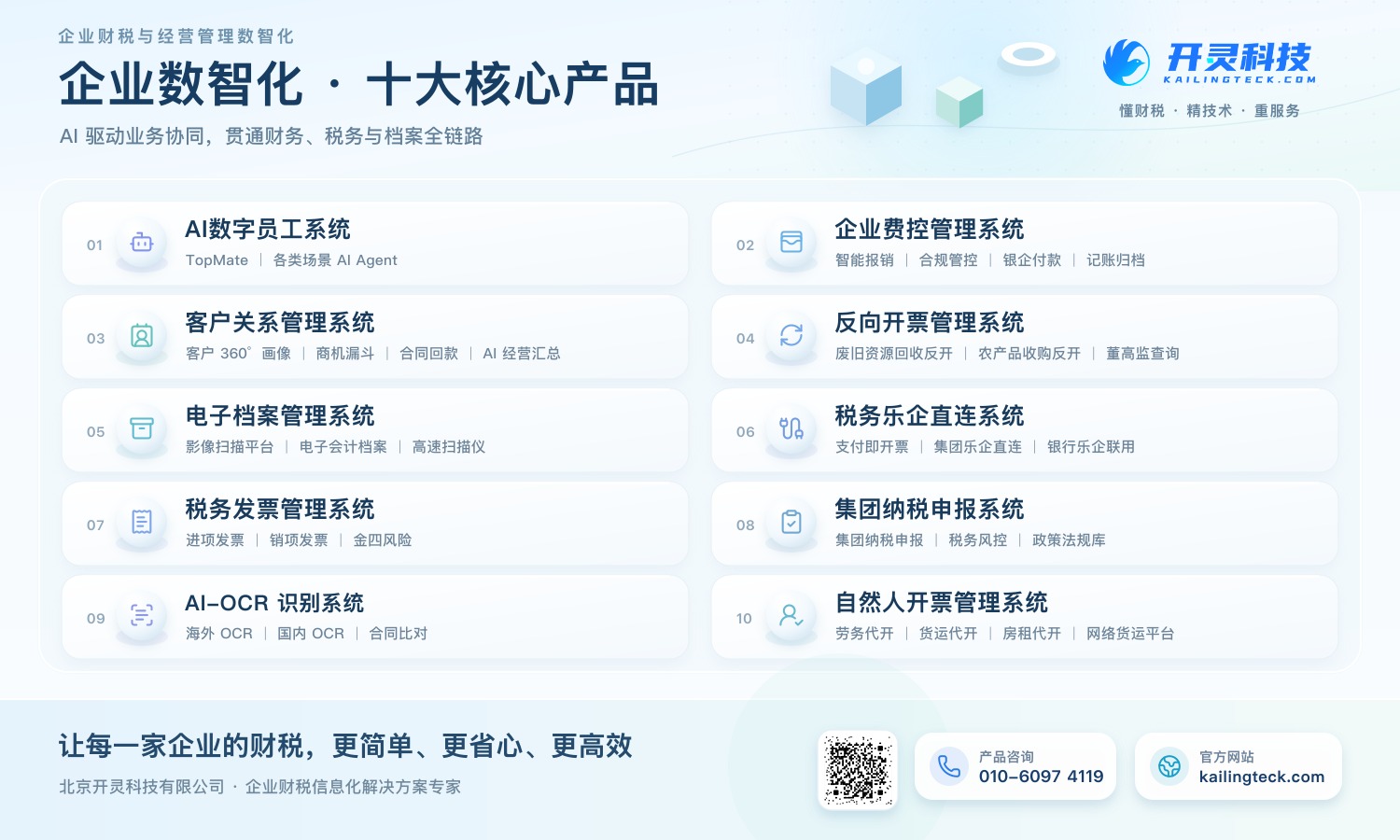
The company has now formed ten core product lines, including: AI digital employee system, enterprise expense control management system, customer relationship management system, reverse invoicing management system, invoice issuance for individuals management system, electronic archives management system, tax fully digitalized e-invoice Leqi system, tax invoice management system, group tax filing system, and AI OCR recognition system. It is committed to connecting enterprise business, finance, tax, funds, and archive data to help customers improve operational efficiency, business-finance-tax compliance capabilities, and digital management levels.
If you have any business-finance-tax digital transformation needs, welcome to contact us. Beijing Kailing Technology will serve you wholeheartedly.
Keywords: Scrap aluminum reverse invoicing, scrap aluminum recycling false invoicing risk, resource recycling reverse invoicing, reverse invoicing compliance, five-flow integration, Kailing Technology resource recycling reverse invoicing system, renewable resource input VAT invoice
As a comprehensive business-finance-tax digitalization solution service provider, Kailing Technology provides business-finance-tax management digital transformation products and operational services for various government agencies, institutions, and large, medium, and small enterprises. The product line includes: solutions for sales contract management system, procurement contract management system, fully digitalized Leqi interface project, automatic output invoicing system, reverse invoicing system, invoice issuance for individuals system, employee expense control and reimbursement system, input VAT invoice management system, supply chain collaborative reconciliation system, image AI OCR recognition system, automatic financial bookkeeping system, electronic accounting archives system, etc., comprehensively driving the digitalization process across various fields.
Consultation Hotline: 18513895936 / 010-60974119 Location: Beijing