
What should be done when input and output invoice names are inconsistent? First distinguish normal processing, invoicing errors, and use issues

If the names on input invoices and output invoices do not match, it does not mean that deduction is necessarily unavailable, nor does it necessarily mean that false invoicing exists; the name is only a clue for verification, and the key is whether the invoice content corresponds to the real transaction, whether the vouchers are lawful, and whether the purchase use complies with regulations.
Manufacturing and processing enterprises that purchase raw materials and then sell finished products, trading enterprises that sell combinations, and service enterprises that provide multiple types of services at the same time may all have different input and output names. What really needs to be handled is the situation where the business chain cannot be clearly explained, the invoice content is issued incorrectly, or the voucher status and use do not comply with regulations.
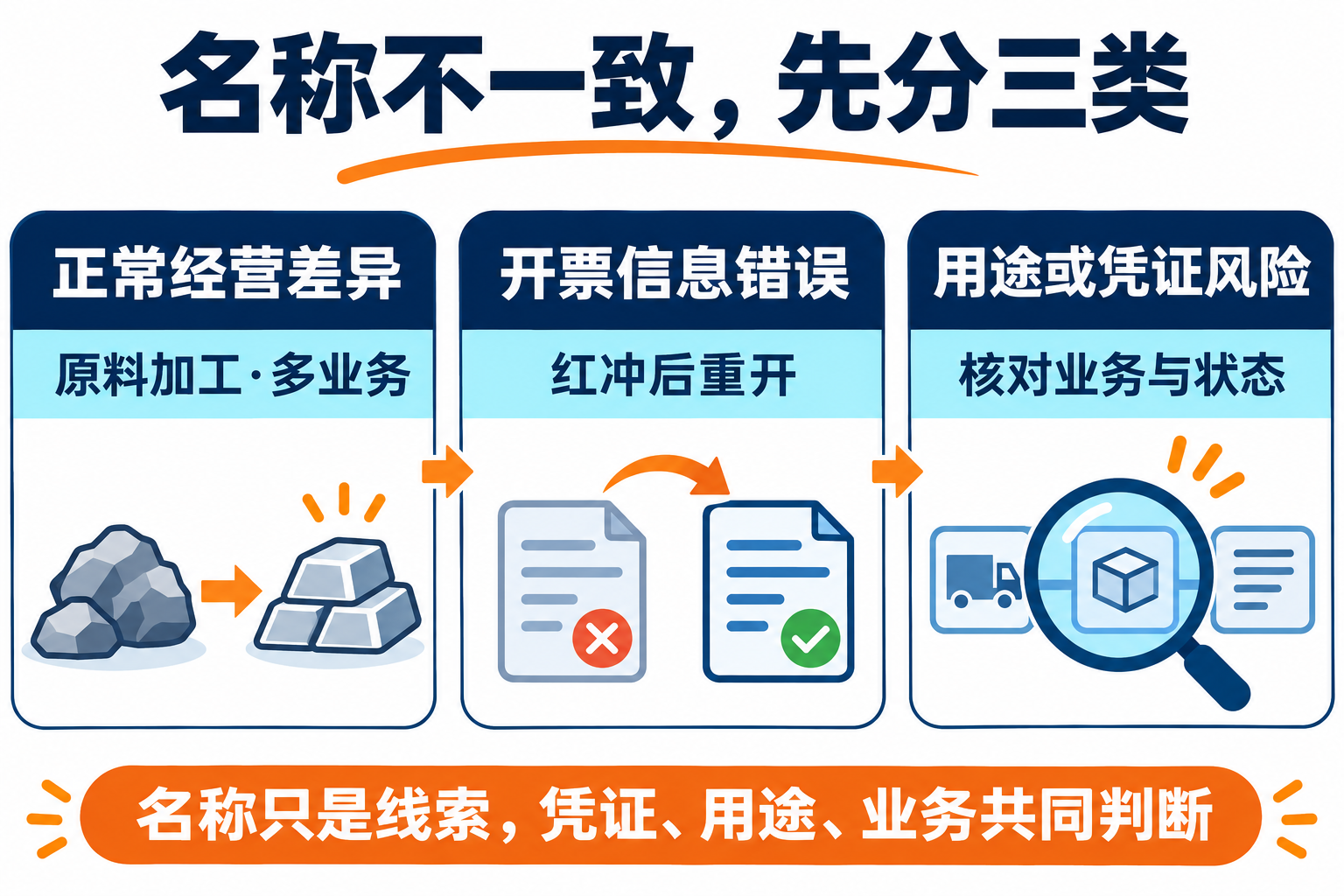
Category 1: Normal processing or multi-business operations
For example, after purchasing raw materials and forming finished products with different names through production, the input name and output name will naturally not be exactly the same. Enterprises should retain purchase contracts, warehouse receipts, production material requisitions, process or project records, finished goods warehouse receipts, sales contracts, logistics and payment records to form an evidence chain from purchase to output. Multi-business operations should also verify business scope, actual performance and revenue-cost aggregation to explain the correspondence between different businesses.
Category 2: Invoice content inconsistent with the actual transaction
If the product or service name, specifications, tax classification, or other content is indeed issued incorrectly, you cannot simply change one field in the enterprise ledger. Public answers from tax authorities clearly state that invoice content should match the actual transaction; when an error is found, the invoice should be voided according to regulations based on invoice status, or a red invoice should be issued and then the correct invoice reissued. Before processing, first check whether the blue invoice has been delivered, use-confirmed, or booked to avoid choosing the wrong red-flushing process.
Category 3: Risks in use, vouchers, or status
Even if the name can be explained, input VAT deduction still requires the deduction vouchers stipulated by laws and regulations and excludes situations where deduction is not allowed. Also pay attention to whether the invoice has been voided, red-flushed, or is abnormal, whether the invoicing party and the transaction party are consistent, and whether the purchase is used for genuine taxable business. For unexplainable cross-industry names, absence of logistics or service results, inconsistent fund flows, and similar situations, automatic booking or deduction should be suspended and processing resumed only after supplementary verification.
It is recommended to review according to four layers of evidence
| Reconciliation level | Key materials |
|---|---|
| Invoice face and status | Name, specifications, tax classification, voiding and red-flushing, and abnormal status |
| Contracts and performance | Contracts, orders, acceptance, service results, logistics |
| Funds and entity | Payment and receipt, counterparty, invoicing entity, taxpaying entity |
| Accounting and use | Warehousing and material requisition, cost accumulation, actual use, filing treatment |
Boundaries of enterprise tools
Enterprise tools can link input and output names, contracts, orders and voucher status to help finance discover differences that need explanation, but cannot automatically give 'deductible' or 'abnormal' conclusions based solely on name similarity. When evaluating Kailing Technology's related input-output coordination, AI OCR or electronic accounting archives solutions, use desensitized real samples to verify field sources, evidence linkage, manual review and operation trails, avoiding writing recognition results directly as non-reviewable accounting or tax conclusions.
Conclusion: When names are inconsistent, first restore the real business. Normal processing and multi-business operations require a complete evidence chain; incorrectly issued invoice content should be voided or red-flushed and reissued in accordance with the law; when there are doubts about use, vouchers, and status, suspend processing and verify first. Do not make deduction conclusions based only on the name.
Official basis:Shanghai Taxation: Handling of incorrect invoice content;Shanghai Taxation: Input VAT deduction vouchers and conditions;State Taxation Administration: Management of abnormal VAT deduction vouchers。
As a comprehensive business-finance-tax digitalization solution service provider, Kailing Technology provides business-finance-tax management digital transformation products and operational services for various government agencies, institutions, and large, medium, and small enterprises. The product line includes: solutions for sales contract management system, procurement contract management system, fully digitalized Leqi interface project, automatic output invoicing system, reverse invoicing system, invoice issuance for individuals system, employee expense control and reimbursement system, input VAT invoice management system, supply chain collaborative reconciliation system, image AI OCR recognition system, automatic financial bookkeeping system, electronic accounting archives system, etc., comprehensively driving the digitalization process across various fields.
Consultation Hotline: 18513895936 / 010-60974119 Location: Beijing