
How to choose an input VAT invoice certification system? First verify whether the four steps form a closed loop

How to choose an input VAT invoice certification system? Don't just count feature buttons; first run a real business voucher through the four steps of "enterprise collection — enterprise verification — official confirmation — status write-back."
The term "certification system" used in daily conversation often mixes two concepts: the invoice purpose confirmation function provided by the tax authority, and the internal management tools used by enterprises in procurement, reimbursement, accounting, and archives. The former determines the voucher's purpose, while the latter is responsible for organizing data and evidence into a verifiable, traceable status chain. If the boundary is not clarified before selection, it is easy to mistake "captured an invoice" for "completed deduction confirmation."
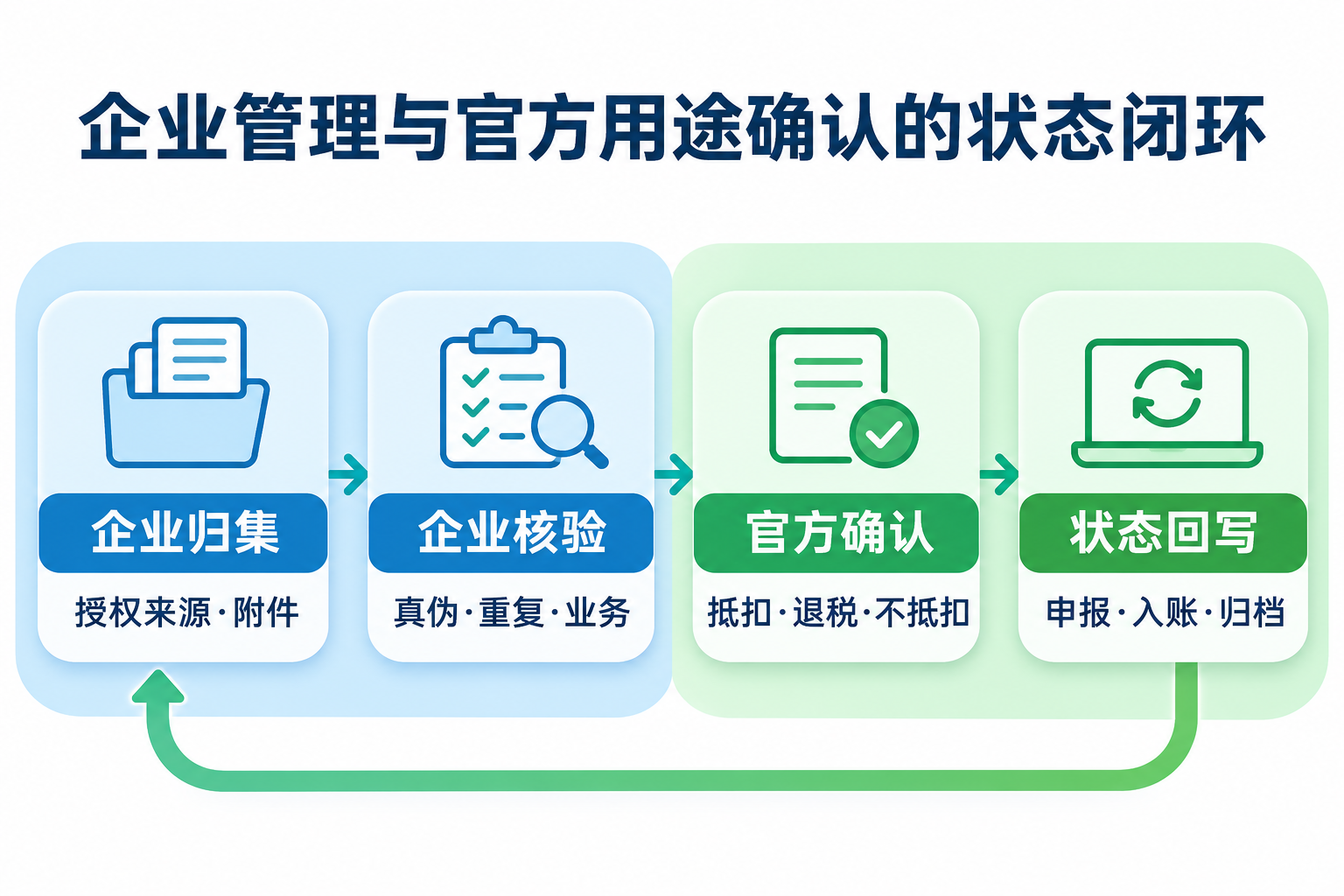
Stage 1: Enterprise aggregation - first prove where the data comes from
Do not just look at the demo database during testing. Select a real business voucher and check the data source, acquisition time, authorized entity, original documents, and business attachments recorded by the system. Sources such as email, employee uploads, supplier delivery, and authorized data from the electronic tax bureau have different coverage, and "all invoice sources" cannot be used to generalize all enterprises and invoice types. A qualified system should retain original vouchers and source information so that finance knows which invoices have entered the internal ledger and which still need to be supplemented.
Stage 2: Enterprise verification - authenticity, duplication, and deductibility are three different things
A normal verification result only means the corresponding invoice face and status information passed the check; it does not automatically prove that this input qualifies for deduction. Enterprises must also link procurement, contracts, acceptance, payment, the reimbursing person, and the actual purpose. The system can identify duplicate submissions based on invoice elements and flag voided, red-flushed, or abnormal statuses, but must not generate non-reviewable accounting conclusions directly from OCR results, and must not describe "verification passed" as "necessarily deductible."
Stage 3: Official confirmation - purpose selection must return to statutory channels
The State Taxation Administration has made clear that where VAT deduction vouchers meeting the requirements are to be used for filing deductions, export refunds, or refunds on behalf of others, their purpose shall be confirmed through the tax digital account or the VAT Invoice Comprehensive Service Platform. Enterprise systems can prepare pending lists and evidence, and can assist operations within the scope of authorization and actual interfaces, but cannot impersonate official portals or bypass the taxpayer's review of the entity, tax period, and purpose.
Step 4: Status write-back — the confirmation result must reconcile with tax filing, booking, and archiving
After completing official purpose confirmation, the confirmed purpose, tax period, processing time, operator, and exception notes should be written back to the internal ledger, and then reconciled with accounting processing, tax filing, and electronic accounting archives. During system acceptance, check whether the status is traceable, whether modifications leave traces, and whether exceptions form to-dos, rather than just looking at whether a green check mark appears on the page.
| Acceptance questions | Pass criteria |
|---|---|
| Can the data source be explained? | Display the authorized entity, source, original, and acquisition time |
| Whether duplicates and anomalies are traceable | Retain the basis for judgment, processing records, and responsible persons |
| Is the boundary of official confirmation clear? | Do not describe enterprise systems as statutory purpose confirmation platforms |
| Can the status form a closed loop? | Confirmation results can be reconciled with tax filing, booking, and archives |
How should Kailing Technology's solutions be evaluated?
If an enterprise plans to evaluate Kailing Technology's related input management, OCR, or electronic accounting archives solutions, it is recommended to use anonymized real samples to trial-run the above four stages on site, and to include data sources, authorization methods, invoice type scope, manual review nodes, exception handling, and log retention in the implementation checklist. Only if a clear status chain can be formed within the agreed scope does it show that the solution suits the current business; automation descriptions in promotional materials cannot replace on-site verification.
Conclusion: When choosing an input VAT invoice certification system, what really needs acceptance is the handover evidence of the four steps. Enterprise tools organize invoices and business, the official platform completes purpose confirmation, and the results return to the enterprise ledger to form a closed loop, thereby reducing the risks of missed processing, duplicate processing, and status inconsistency.
Official basis:State Taxation Administration: invoice purpose confirmation channels;Shanghai Taxation 2026 invoice selection Q&A;"Value-Added Tax Law of the People's Republic of China"。
As a comprehensive business-finance-tax digitalization solution service provider, Kailing Technology provides business-finance-tax management digital transformation products and operational services for various government agencies, institutions, and large, medium, and small enterprises. The product line includes: solutions for sales contract management system, procurement contract management system, fully digitalized Leqi interface project, automatic output invoicing system, reverse invoicing system, invoice issuance for individuals system, employee expense control and reimbursement system, input VAT invoice management system, supply chain collaborative reconciliation system, image AI OCR recognition system, automatic financial bookkeeping system, electronic accounting archives system, etc., comprehensively driving the digitalization process across various fields.
Consultation Hotline: 18513895936 / 010-60974119 Location: Beijing