
How to use the input VAT invoice certification platform? Check four things before purpose confirmation

How to use the input VAT invoice certification platform? First separate "official purpose confirmation" from "enterprise internal management."
When taxpayers need to use VAT deduction vouchers that meet regulations for filing deductions, export tax refunds, or tax refunds on behalf of others, they should confirm the purpose through the tax digital account or the VAT Invoice Comprehensive Service Platform. It is not commercial software that can be chosen at will. Enterprise internal systems can help collect, verify, check for duplicates, and keep records, but they cannot replace statutory purpose confirmation, nor can they determine deductibility based solely on invoice recognition results.
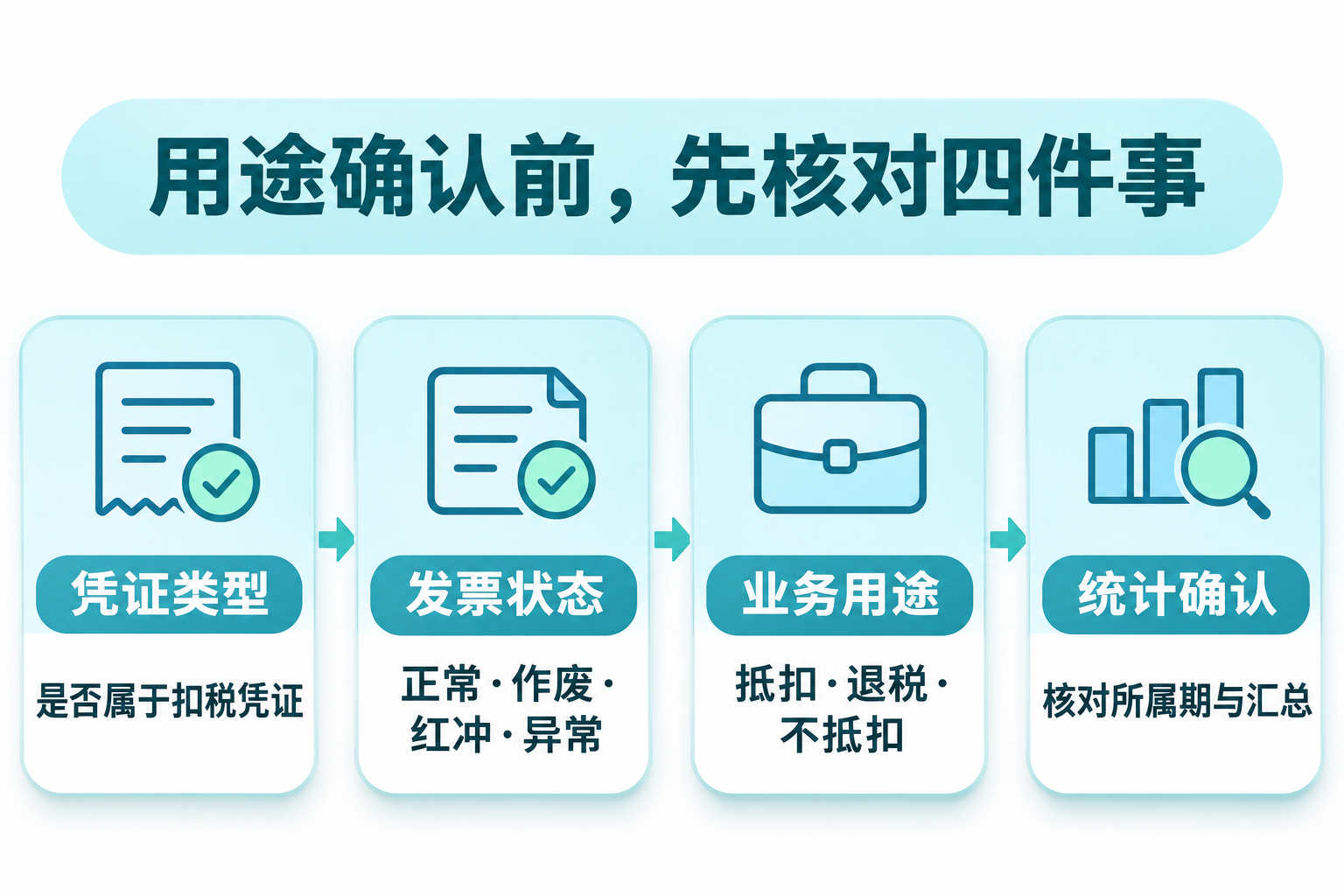
1. First verify the voucher type: having an invoice does not mean it has a deduction function
Article 16 of the Value-Added Tax Law of the People's Republic of China, effective in 2026, provides that taxpayers shall deduct input VAT based on VAT deduction vouchers prescribed by laws, administrative regulations, or the State Council. The implementing regulations further specify that VAT special invoices, customs import VAT special payment certificates, tax payment certificates, agricultural product purchase invoices, agricultural product sales invoices, and other deduction vouchers with an input VAT deduction function fall within the prescribed scope. The first step should be to confirm the type of voucher and how it was obtained, rather than simply ticking the box upon seeing the word "invoice."
2. Then verify the invoice status: when it cannot be found, first rule out six common causes
An invoice not being found in the deduction selection module does not mean the system missed it. The troubleshooting directions listed in the tax authority's public Q&A in 2026 include query conditions, invoice face information, invoice purpose, selected status, and mistakenly selected deduction versus refund purposes. In practice, statuses such as voided, red-flushed, and abnormal vouchers should also be considered, with the display in the electronic tax bureau and the confirmation result of the competent tax authority prevailing.
3. Verify the business purpose: deduction, refund, and non-deduction cannot be mixed up
Purpose confirmation links vouchers with subsequent tax filing processing. Enterprises should determine whether to select "deduction," "refund," or "no deduction" based on actual purchases, the taxpayer entity, and actual use. Article 22 of the VAT Law also lists non-deductible situations such as simplified tax calculation items, tax-exempt items, abnormal losses, and direct use for collective welfare or personal consumption. Tools can prompt rules, but the final judgment cannot rely solely on OCR fields or fixed keywords.
4. Verify the tax period and statistical results: perform a total review once more before confirmation
After completing deduction-type selection, also verify the tax entity, tax period, selection details, and summary statistics. The official operation entry is usually located in modules such as "Tax Digital Account - Invoice Selection Confirmation - Deduction-Type Selection" in the electronic tax bureau; interfaces and menus may vary by version across regions, and the actual local electronic tax bureau page and 12366 responses should prevail. If a mistaken selection is found, it should be revoked or corrected through official functions and prescribed procedures; changing a status directly in the enterprise ledger does not count as completion.
What can enterprise tools do, and what can they not do?
Enterprise tools are suitable for authorized data aggregation, linking originals with business attachments, authenticity status verification, duplicate reimbursement checks, assignment of exception tasks, and operation log retention. Whether data can be obtained and which invoice types are covered depend on taxpayer authorization, region, invoice type, interfaces, and implementation scope; therefore, during selection, vendors should be required to explain data sources and authorization boundaries on site. Kailing Technology's related input management solutions can serve as internal management candidates, but the actual deployment scope, verifiable data sources, and audit logs should prevail; enterprise tools must not be marketed as official purpose confirmation portals.
Conclusion: The key to input VAT invoice certification is not "which commercial platform to choose," but completing purpose confirmation through the official entry point and checking voucher type, invoice status, business purpose, and period statistics before confirmation. The value of internal systems lies in organizing evidence and status clearly, not in replacing the taxpayer's statutory judgment and filing responsibility.
Official basis:State Taxation Administration: fully digitalized e-invoice purpose confirmation channels;"Value-Added Tax Law of the People's Republic of China";Implementing Regulations of the Value-Added Tax Law of the People's Republic of China;Shanghai Taxation 2026 invoice selection Q&A。
As a comprehensive business-finance-tax digitalization solution service provider, Kailing Technology provides business-finance-tax management digital transformation products and operational services for various government agencies, institutions, and large, medium, and small enterprises. The product line includes: solutions for sales contract management system, procurement contract management system, fully digitalized Leqi interface project, automatic output invoicing system, reverse invoicing system, invoice issuance for individuals system, employee expense control and reimbursement system, input VAT invoice management system, supply chain collaborative reconciliation system, image AI OCR recognition system, automatic financial bookkeeping system, electronic accounting archives system, etc., comprehensively driving the digitalization process across various fields.
Consultation Hotline: 18513895936 / 010-60974119 Location: Beijing