
Does input-output VAT invoice inconsistency affect deduction? First look at vouchers, purposes, and real business

Does input-output VAT invoice inconsistency affect deduction? First look at vouchers, purposes, and real business
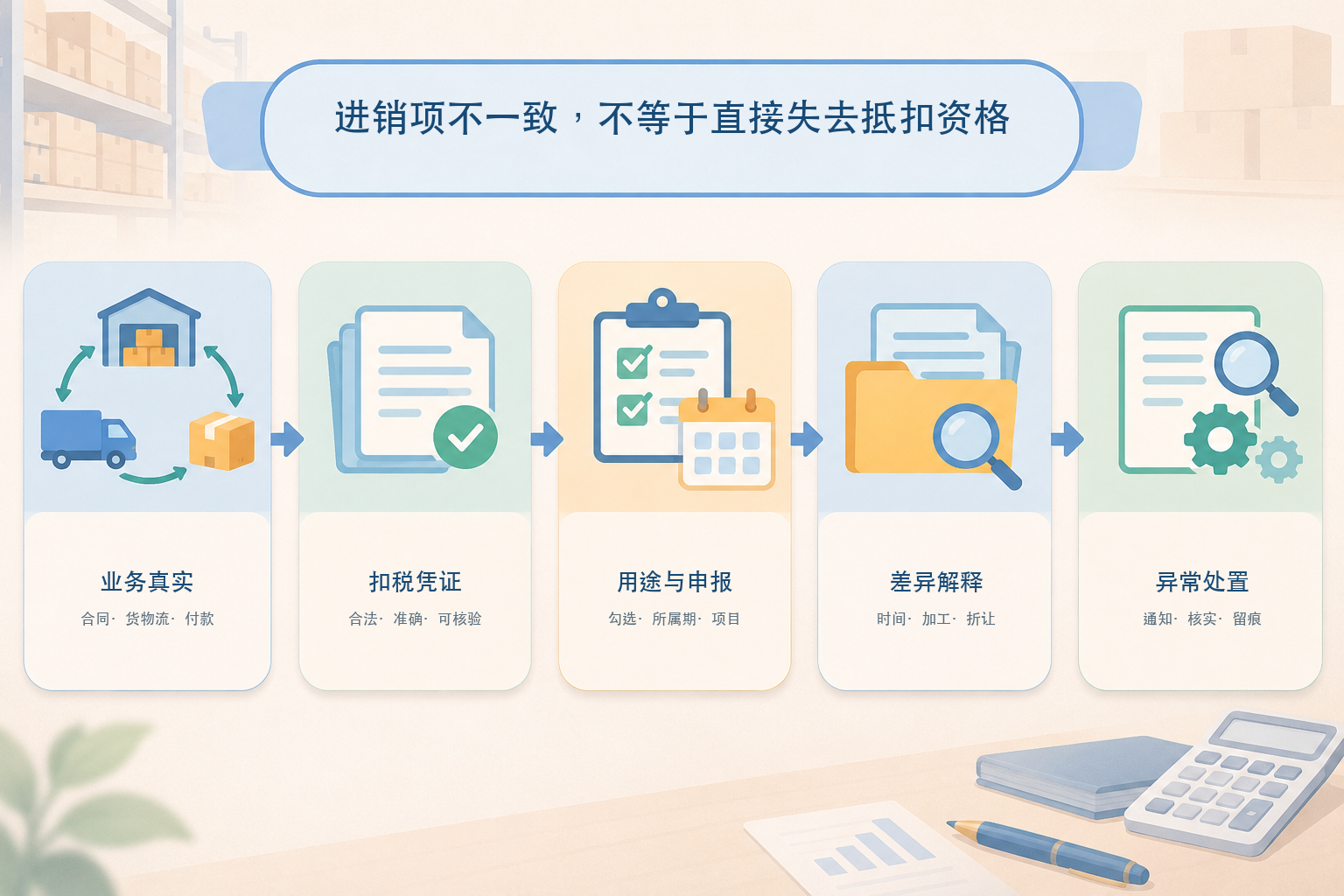
If the item names, amounts, quantities, or invoicing times on input and output VAT invoices do not match, that does not mean deduction eligibility is directly lost; a complete match also does not automatically prove that deduction is allowed. In 2026, according to the VAT Law, verify whether a lawful and valid VAT deduction voucher has been obtained, the actual use of the purchased items, use confirmation and filing, and whether the transaction is real. The so-called "four flows consistency" can serve as an evidence management approach, but it is not a single determination formula that replaces tax law conditions.
The original draft cited the Interim Regulations on Value-Added Tax, which were repealed on January 1, 2026, and also wrote "full implementation of China Golden Tax Phase IV" and "input-output mismatch may lead to transfer-out" as broad conclusions. A more prudent approach is to handle normal business differences, invoice issuance errors, non-deductible purposes, and abnormal deduction vouchers separately.
▍1. Why input and output may naturally differ
Purchases and sales do not necessarily have a one-to-one correspondence. Manufacturing enterprises purchase raw materials and then form finished products, retail enterprises have inventory turnover, service enterprises purchase software, office, or outsourcing services, and multiple batches of purchases may also correspond to one sale. Purchase warehousing, invoice acquisition, production and processing, shipment, and output VAT invoice issuance may also occur in different periods. Therefore, real business cannot be denied merely because input and output item names or amounts cannot be matched invoice by invoice.
▍2. Whether deduction is possible first depends on statutory conditions
The VAT Law of the People's Republic of China provides that input tax is the VAT paid or borne by a taxpayer for purchasing goods, services, intangible assets, or real estate, and taxpayers should deduct it based on VAT deduction vouchers prescribed by laws, administrative regulations, or the State Council. Enterprises must also confirm that they use the general tax calculation method, that purchased items do not fall under simplified taxation, tax exemption, consumer services, or other non-deductible circumstances, and that purpose confirmation and filing are completed as required.
This means that the core of the deduction judgment is not whether an input item name can find an item with the same name among output items, but whether the voucher is compliant, whether the business is real, whether the tax amount is actually borne by the enterprise, what business the purchased item is used for, and whether the deduction operation is completed as required.
▍3. Invoice information errors cannot be replaced by "real transaction" correction
If the buyer information, goods or service name, quantity, amount, tax rate, tax amount, or other invoice content does not match the actual business, the erroneous invoice cannot be used for deduction directly just because the underlying transaction is real. The tax authority's 2026 invoicing Q&A clarifies that incorrect invoicing should be voided or red-flushed as required and then reissued according to the real business. Enterprises should treat "real business" and "accurate invoice" as two conditions to be checked separately.
▍4. What evidence to prepare when differences are found
For normal differences such as time gaps, inventory carryover, production and processing, discounts and allowances, return red-flushing, and bundled sales, enterprises should retain contracts, orders, inbound and outbound records, acceptance materials, logistics or service delivery evidence, payment records, invoices, accounting vouchers, and difference explanations. The task of the evidence chain is to explain transaction facts and tax treatment, not to mechanically pursue identical fields.
▍5. Abnormal vouchers are not all handled in the same way
State Taxation Administration Announcement No. 38 of 2019 sets out the scope and handling procedures for abnormal VAT deduction vouchers. After receiving a tax matter notification, an enterprise should handle it according to voucher status, whether deduction or rebate has already been claimed, tax credit rating, and notification requirements; eligible Grade A taxpayers may apply for verification within the prescribed period and, before the verification result is made, temporarily not transfer out under the rules. If the tax authority verifies that deduction rules are met, deduction may continue or be re-filed. Therefore, "abnormal voucher" cannot simply be equated with permanent non-deductibility.
▍What the system can assist with
Input management and tax risk tools can assist in collecting vouchers, verification and duplicate checking, associating purchases with payments, recording use status, generating discrepancy lists, and retaining handling logs, but they cannot automatically replace tax judgment based on input-output similarity. If Kailing Technology's related solutions are used in the above scenarios, the specific invoice acquisition, verification, use confirmation, abnormal alerts, system interfaces, and filing scope shall be subject to lawful authorization, the actual version, demonstrations, contracts, and delivery lists.
Official basis:"Value-Added Tax Law of the People's Republic of China"Effective from January 1, 2026;Tax authority 2026 input VAT deduction Q&AExplain deduction vouchers and non-deductible items;State Taxation Administration Announcement No. 38 of 2019List abnormal vouchers and verification handling rules.
Keywords: input-output VAT invoice inconsistency, input VAT deduction, VAT deduction voucher, use confirmation, abnormal voucher, input VAT transfer-out, invoice verification, Kailing Technology
As a comprehensive business-finance-tax digitalization solution service provider, Kailing Technology provides business-finance-tax management digital transformation products and operational services for various government agencies, institutions, and large, medium, and small enterprises. The product line includes: solutions for sales contract management system, procurement contract management system, fully digitalized Leqi interface project, automatic output invoicing system, reverse invoicing system, invoice issuance for individuals system, employee expense control and reimbursement system, input VAT invoice management system, supply chain collaborative reconciliation system, image AI OCR recognition system, automatic financial bookkeeping system, electronic accounting archives system, etc., comprehensively driving the digitalization process across various fields.
Consultation Hotline: 18513895936 / 010-60974119 Location: Beijing