
Sole proprietor invoicing: tax exemption or 1%? First separate invoicing from filing

Sole proprietor invoicing: tax exemption or 1%? First separate invoicing from filing
"Tax exemption" and "1%" are not a free either-or choice on the invoicing page. First confirm whether you are a VAT small-scale taxpayer and whether you pay tax monthly or quarterly, then aggregate all taxable transaction sales for the period, and finally handle it based on invoice type, business type, and whether preferences are waived. Invoicing records transactions; whether exemption applies and how to file must be based on the actual business of the period and current policy.
The original draft directly cited 2023 policy and wrote "special invoices are taxed at 1%" as a uniform rule, which no longer fits the 2026 VAT Law transition approach. From 2026 onward, judgment should be based first on the VAT Law of the People's Republic of China, Ministry of Finance and State Taxation Administration Announcement No. 10 of 2026, and State Taxation Administration Announcement No. 4 of 2026.
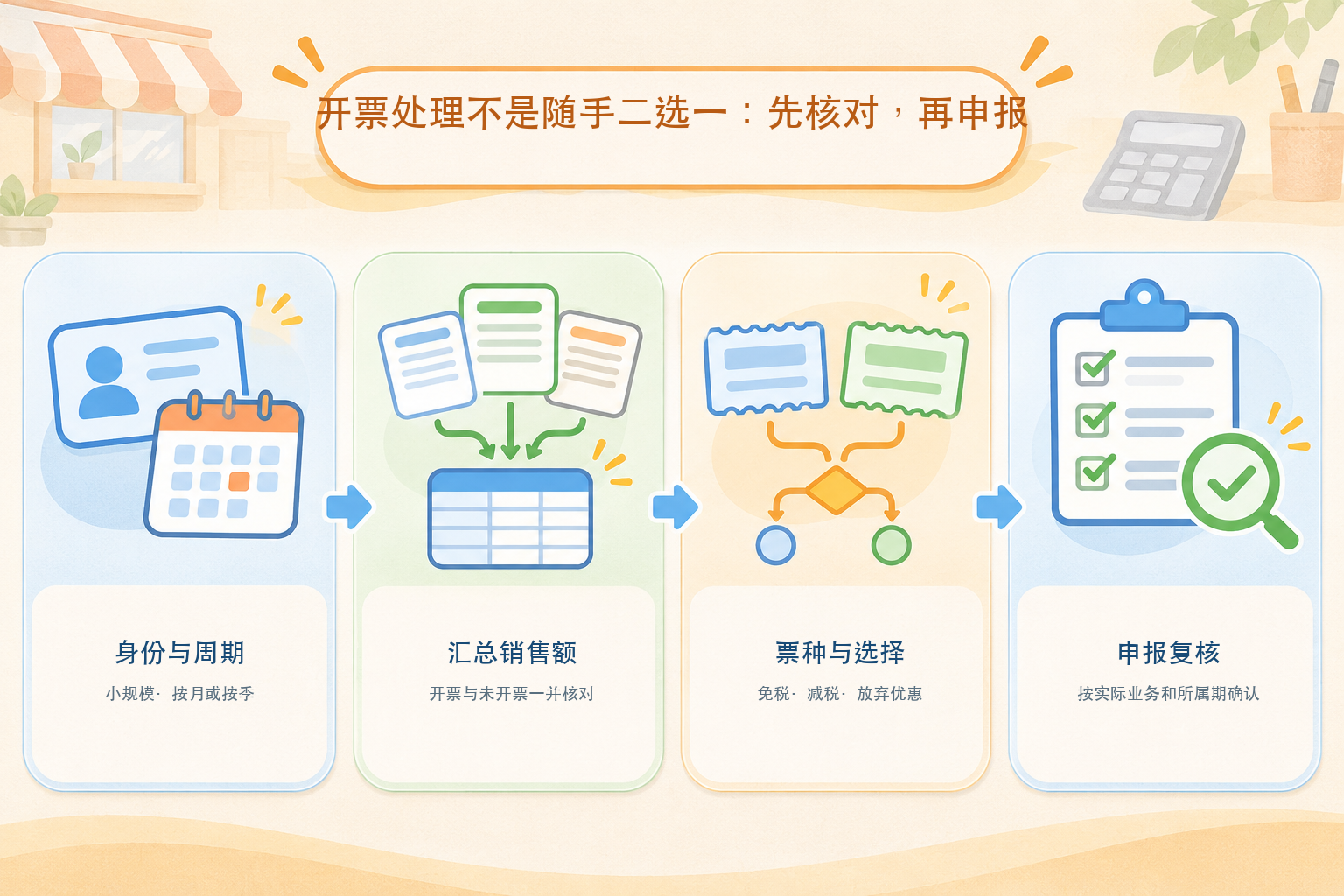
▍Step 1: First confirm whether you are a small-scale taxpayer
The monthly or quarterly threshold and the arrangement of reducing the 3% levy rate to 1% apply to eligible small-scale VAT taxpayers. An individual business is not automatically subject to the small-scale criteria; if it has already been registered as a general taxpayer, or if the transaction is subject to other tax rates, levy rates, or tax-exempt items, the judgment of "small-scale exemption or 1%" cannot be directly applied.
▍Step 2: Aggregate all sales by tax period
Announcement No. 10 of 2026 of the Ministry of Finance and the State Taxation Administration clarifies that from January 1, 2026 to December 31, 2027, the threshold for small-scale taxpayers filing monthly is monthly sales of 100,000 yuan, and for quarterly filing is quarterly sales of 300,000 yuan. When determining, the current period's qualifying invoiced revenue and un-invoiced revenue should be aggregated; judgment cannot be based on a single invoice, nor can the threshold be circumvented by splitting contracts or dispersing invoicing. Once the threshold is reached, tax should be calculated on the current period's sales amount according to the applicable rules, rather than only on the excess portion.
▍Step 3: Then look at transaction type and invoice type
From January 1, 2026 to December 31, 2027, for taxable transactions of small-scale taxpayers other than the sale or leasing of real estate or the transfer of land use rights that originally applied a 3% levy rate, a reduced 1% levy rate may apply under policy. This "1%" has a clear scope of application; it is not a general rate for all sole proprietors and all transactions.
When sales do not reach the threshold, small-scale taxpayers may choose to waive exemption for all or part of their taxable transactions and issue special VAT invoices; those subject to the reduced 1% policy may also choose to waive the reduction for all or part of their taxable transactions and issue special invoices. Therefore, it cannot be broadly stated that "special invoices are always at 1%," nor can issuing ordinary invoices be directly equated with final exemption. They should be handled separately according to the customer's deduction needs, the nature of the transaction, invoicing system prompts, and filing results.
▍Step 4: Review against actual data when filing
If the total sales amount for the current period cannot be determined at the time of invoicing, business, collection, and invoice records should be retained and reconciled in summary after the period ends. In the declaration form, the threshold-exempt sales amount, the sales amount reduced to 1%, the special VAT invoice sales amount for which the preferential treatment is waived, and other taxable items must be classified separately. For 2026, the form columns and pre-filling logic are subject to the current page of the electronic tax bureau; it is not advisable to copy fixed line numbers from outdated tutorials.
▍A practical order of judgment
First check VAT status, then monthly or quarterly; next aggregate all sales and confirm whether the threshold is reached; then distinguish whether the transaction falls within the reduced 1% scope and whether a special invoice is issued to waive exemption or reduction; finally, when filing, review against the Electronic Tax Bureau's pending items, pre-filled data, and actual books. If any step is unclear, rely on the response of the competent tax authority or 12366.
▍What software can do and what it cannot replace
Invoicing, document collection, and filing management tools can assist in aggregating sales, distinguishing invoice types, retaining original vouchers, and forming review checklists, but they cannot replace the taxpayer's judgment of status, transaction nature, and conditions for applying preferences. If relevant Kailing Technology solutions are used in such scenarios, the specific invoice retrieval, invoicing, interfaces, tax rate rules, and filing capabilities are subject to the actual version, lawful authorization, demonstration, contract, and delivery list.
Official basis:Ministry of Finance and State Taxation Administration Announcement No. 10 of 2026Clarify the threshold and the reduced 1% policy for 2026 to 2027;State Taxation Administration interpretation of 2026 administration mattersExplain that when the threshold is not reached, they may choose to waive exemption for some or all transactions and issue special VAT invoices.
Keywords: sole proprietor invoicing tax exemption or 1%, individual business invoicing tax rate, small-scale taxpayer threshold, VAT 1%, special invoice, waiver of exemption, Electronic Tax Bureau, Kailing Technology
As a comprehensive business-finance-tax digitalization solution service provider, Kailing Technology provides business-finance-tax management digital transformation products and operational services for various government agencies, institutions, and large, medium, and small enterprises. The product line includes: solutions for sales contract management system, procurement contract management system, fully digitalized Leqi interface project, automatic output invoicing system, reverse invoicing system, invoice issuance for individuals system, employee expense control and reimbursement system, input VAT invoice management system, supply chain collaborative reconciliation system, image AI OCR recognition system, automatic financial bookkeeping system, electronic accounting archives system, etc., comprehensively driving the digitalization process across various fields.
Consultation Hotline: 18513895936 / 010-60974119 Location: Beijing