
If the same person delivers several batches of waste paper in one day, how can duplicate settlement or missed invoicing be avoided? Kailing Technology's resource recycling reverse invoicing system reconciles the five flows and invoice payments by purchase order
The same natural person delivers one truckload of waste paper in the morning and another in the afternoon, yet finance sees only one name and one payment for the day. This is when the previous truckload is most likely to be settled twice, or the latter truckload left out of the invoicing list. The Kailing Technology resource recycling reverse invoicing system uses each purchase order as the reconciliation unit and retains multiple transactions of the same seller on the same day.

▍First separate the person from each delivery
The seller profile identifies "who sold"; the purchase order identifies "which sale." When the same person delivers multiple times in a day, the arrival time, vehicle, weighbridge ticket, goods grade, moisture and impurity deductions and on-site confirmation should be recorded separately. Finance can see multiple purchases under the individual profile, but will not merge goods materials into one truckload just because the names are the same.
If one truckload of waste paper contains multiple grades, the purchase order lists grade details and prices; if the same person delivers in two truckloads, there should be two business numbers that can be settled independently. The material granularity corresponds to the actual receiving process, so subsequent payments and reverse invoicing can accurately identify coverage.
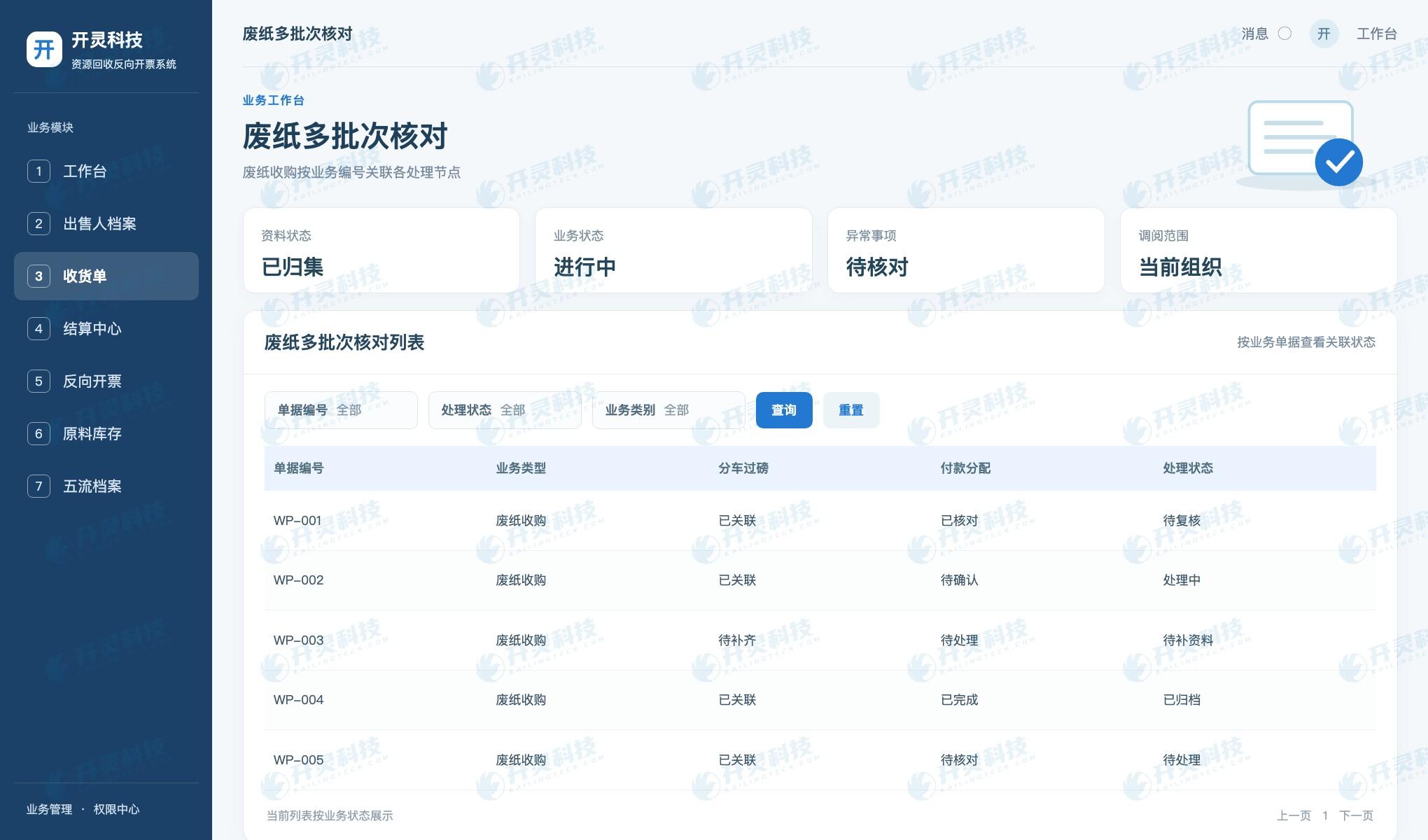
Waste paper multi-batch business list
▍Settlement only enters from purchase orders pending settlement
After receiving is complete, the accepted quantity and deduction basis are first sent to the site for review, and then the settlement statement is generated. Settled purchase orders enter a locked or change-approval status and should not appear again in the new settlement candidate list. When business staff need to adjust prices or reweigh, they should change the original order with an audit trail, rather than create a new settlement statement that appears independent.
If the same seller has three orders on the same day, you can choose to pay order by order or combine payment as agreed; when combining, the payable amount of each order and the total must be retained. A bank receipt only proves that one transfer occurred; it cannot by itself explain which three batches of waste paper this payment covers.
▍Use status to check missed and duplicate invoices
Before invoicing, finance views the "confirmed settled, pending invoicing" list and verifies seller eligibility, invoice item name, and amount. Each purchase order or detail should have a clear attribution in the invoice relationship; after successful issuance, the invoice number and status are written back. When an already-covered purchase order is selected again, the system needs to prompt about the existing invoice to avoid duplicate submission.
If payment succeeds but invoicing fails, retain the "paid but not invoiced" status and the failure reason; for invoice red-letter reversal or reissuance, reference the original invoice. Do not manually set documents to completed just to clear to-dos, otherwise month-end reconciliation will lose the true trail.
▍The five flows are completed separately for each order
Identity materials can reuse the same seller file, but transaction confirmation, waste paper weighing, deductions, payment allocation, and invoice attribution must be tied to the specific purchase order. The Kailing Technology platform uses a five-flow star-chain to show per order whether nodes are complete. Finance can trace back from a given invoice of the day to the corresponding truck trip, and the site can find where the invoice and payment for a trip went.
If one combined payment covers multiple orders, the fund node expands the allocated amount of each order; if one invoice corresponds to multiple orders by rule, the invoice node lists the composition of each order. Such many-to-many relationships cannot be replaced by a single "linked" label.
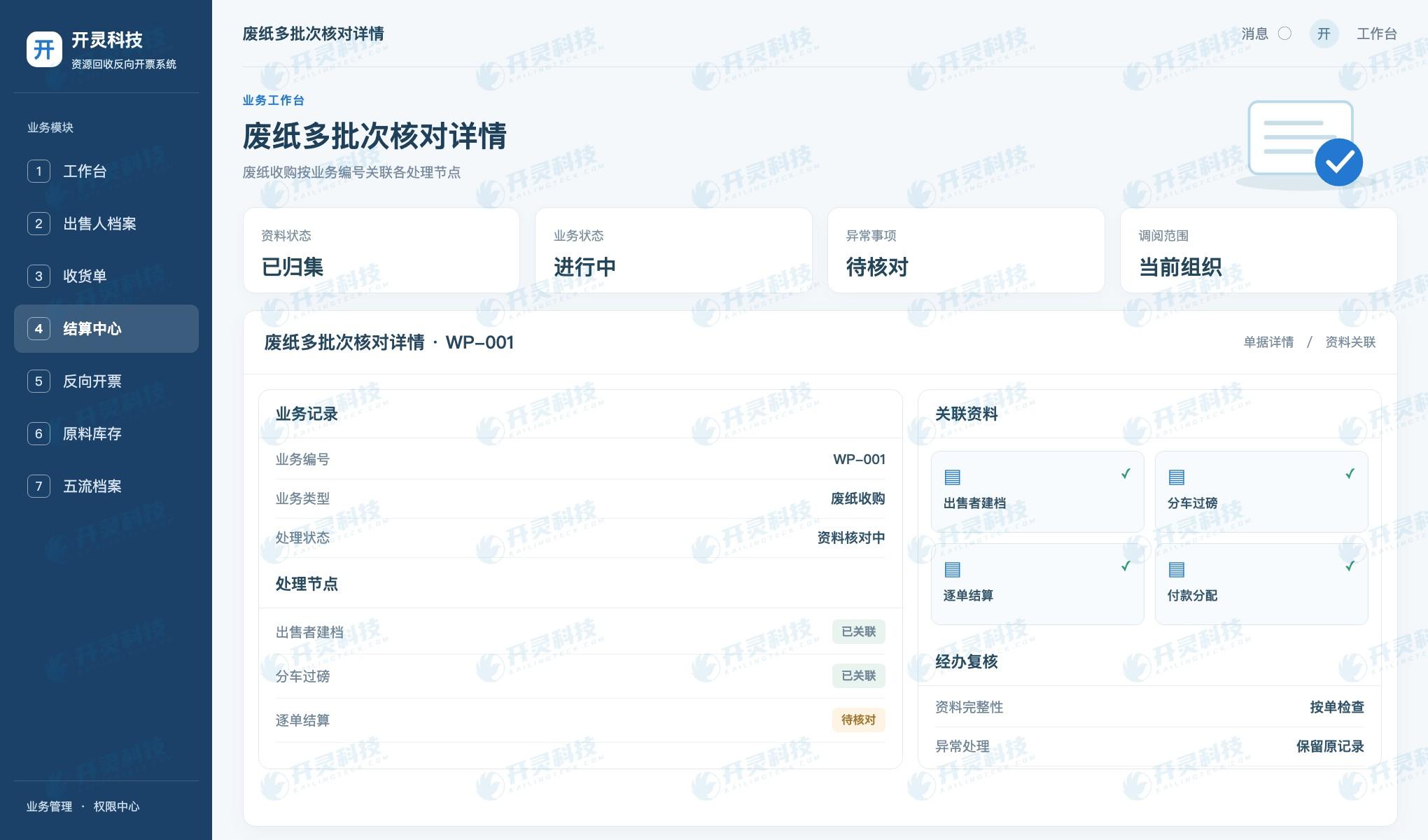
Waste paper multi-batch document and material linkage
▍Reconciliation focuses on three lists
The first sheet shows the same seller's receiving count and net weight for each time on that day; the second sheet shows settlement and payment coverage for each order; the third sheet shows invoice coverage and red-reversal status. Align the three lists by order number to find discrepancies such as "goods but no settlement," "payment but no invoice," and "multiple settlements for one order."
For high-frequency waste paper recycling, anomalies can also be searched by site, date, and seller, giving the site and finance their own to-do lists. The system reduces manual stitching, but reweighing and payment disputes still need to be reviewed against actual vouchers; matching totals alone cannot establish that every order is correct.
▍Test the system with anomalous samples
During trial operation, deliberately select the same person delivering three times on the same day, with one truck subject to water deduction, one payment returned, and one invoice failed. Have finance, without using Excel, trace from any purchase order to the corresponding weighbridge ticket, settlement, funds, and invoice; then check the three-truck total from the seller file.
If the system only shows the day's total and cannot explain which invoice corresponds to which truckload, the mapping between purchase orders and invoice-payment still needs refinement. Performing this check at daily closing is usually easier than tracing at month-end to find all on-site records.
▍How intraday transactions of the same seller are displayed
In the seller profile, list each entry and purchase order by time, showing weight, grade, settlement, payment and invoice status. Finance can see at a glance that the morning order is paid and invoiced while the afternoon order is pending settlement, avoiding mistaking "the same person" for "one transaction."
If earlier receiving is entered later on site, the system should retain both the business occurrence time and the entry time. Sorting only by entry order may attach an afternoon truck's weighbridge ticket to a morning settlement. The license plate, weighbridge record, and on-site photos can jointly help confirm attribution.
The seller profile may aggregate an individual's transaction scale for eligibility and risk review; however, aggregate indicators cannot replace the goods and settlement details of each transaction.
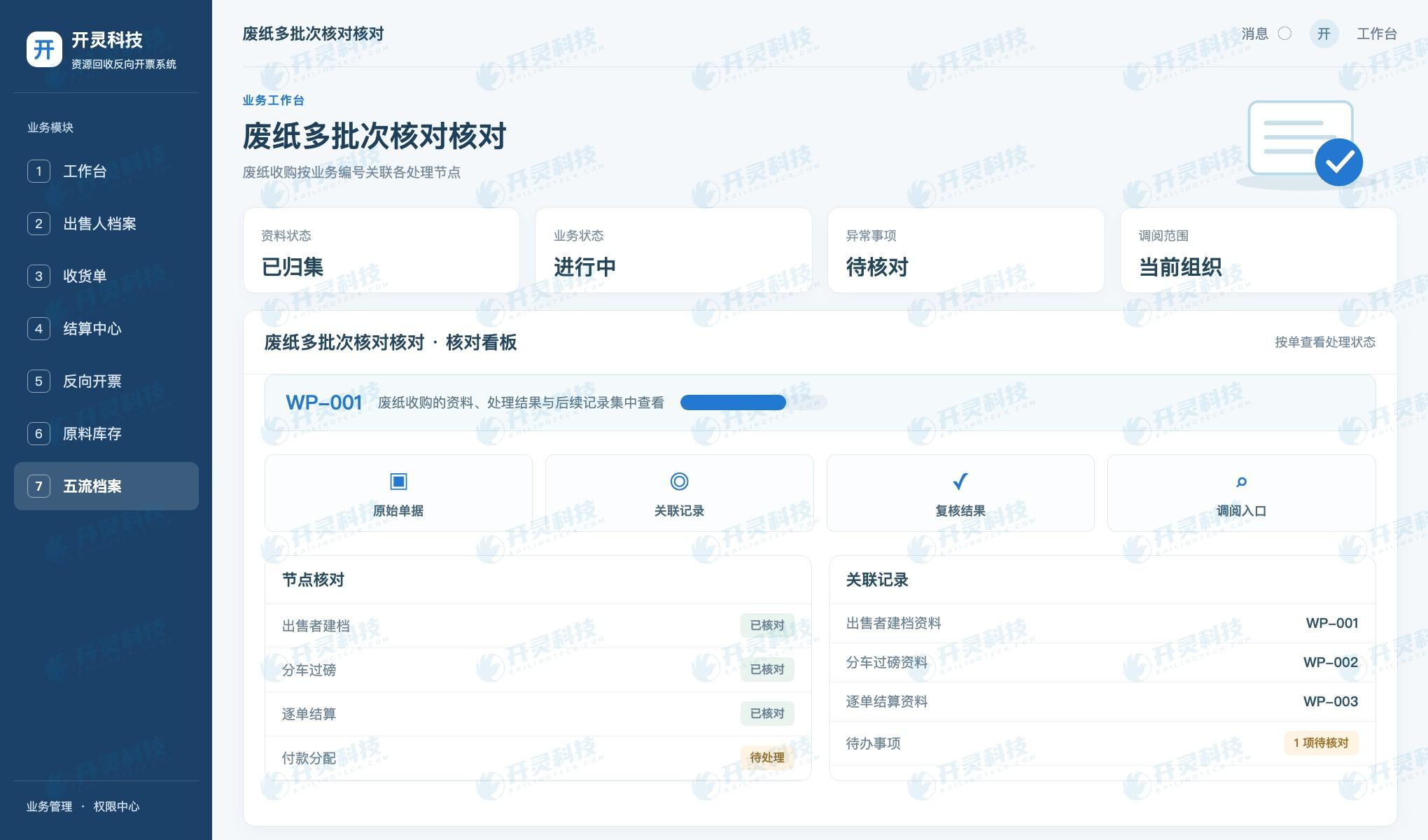
Waste paper multi-batch node reconciliation
▍Where duplicate settlement usually arises
Common causes are that weighbridge records were created separately by two purchasers, old orders were not closed after re-weighing, or a new payment task was generated when a failed payment was retried. Implementation rules should check the business number, weighbridge ticket number, status and channel transaction number, and retain a processing entry for manual review.
For a settlement correction of a purchase order, the basis for adjustment should be retained on the original chain. The old and new amounts and approvers should be queryable at the same time, so finance can judge whether the bank receipt needs a supplementary difference and whether the invoiced amount needs to be handled in sync.
Automatic prompts cannot replace on-site confirmation. Deductions for waste paper due to moisture and impurities still require the seller's knowledge and a record.
▍Troubleshoot missed invoices by status, not by name
During daily closing, first filter purchase orders that are confirmed settled but have no invoice result, then distinguish unpaid, paying, and payment succeeded but invoicing failed cases. Assign a handler for each status; cross-day tasks continue to carry the original order number, avoiding the creation of a separate "supplementary invoice transaction."
When one invoice covers multiple purchase orders, check the total of the composition details against the invoice face amount; when a red-letter reversal occurs, also check whether the original order re-enters the pending invoicing queue. A flawed queue design may cause old invoices to be permanently missed after red-letter reversal.
The Kailing Technology resource recycling reverse invoicing system shifts finance from "finding how many invoices a certain person has today" to "checking whether each order has completed the invoice-payment chain," which is better suited to high-frequency small-amount purchases.
▍Recommended sequence for daily closing
After receiving ends, first check the weighbridge ticket quantity against the purchase order quantity, then check whether all confirmed settlements have payment arrangements, and finally handle paid-but-uninvoiced and red-reversal-pending-reissue cases. In this order, goods, amounts, and invoices will not merely happen to match in totals.
For one person with multiple truckloads, the list should highlight the trip, entry time and net weight, so finance can quickly distinguish them using on-site materials. If an item has only an invoice but no corresponding goods, mark it pending verification first; do not borrow another weighbridge ticket of the same person.
▍Document boundaries that are easily overlooked
The seller profile may aggregate all transactions of a day, but weighbridge tickets, acceptance forms and settlement forms must still retain truckload boundaries. Even if the waste paper grade is the same, they should not be automatically merged, because moisture and impurity deductions and arrival status may differ.
Finance can view both the individual summary and per-order details on the same screen, using the summary to find omissions and the details to judge invoice and payment.
▍FAQ
Q: Can multiple truckloads from the same person in one day be paid together?
A: Payment can be combined according to the actual settlement arrangement, but the allocated amount of each purchase order within the payment should be retained.
Q: How do you detect that a purchase order has been settled twice?
A: Check the status of settled orders and the change records of the original order to prevent it from entering a new settlement again.
Q: What should the purchase order show after invoicing fails?
A: Retain paid-but-not-invoiced items and the failure reason; retry results continue to link to the original order.
Visit Kailing Technology to learn about related products and implementation plans: https://www.kailingteck.com/fxzy/ .
As a national high-tech enterprise, Kailing Technology focuses on the digital and intelligent transformation of enterprise business-finance-tax and operations management, providing software products, system integration, implementation and delivery, and operational services for various government agencies, institutions, group enterprises, and SMEs.
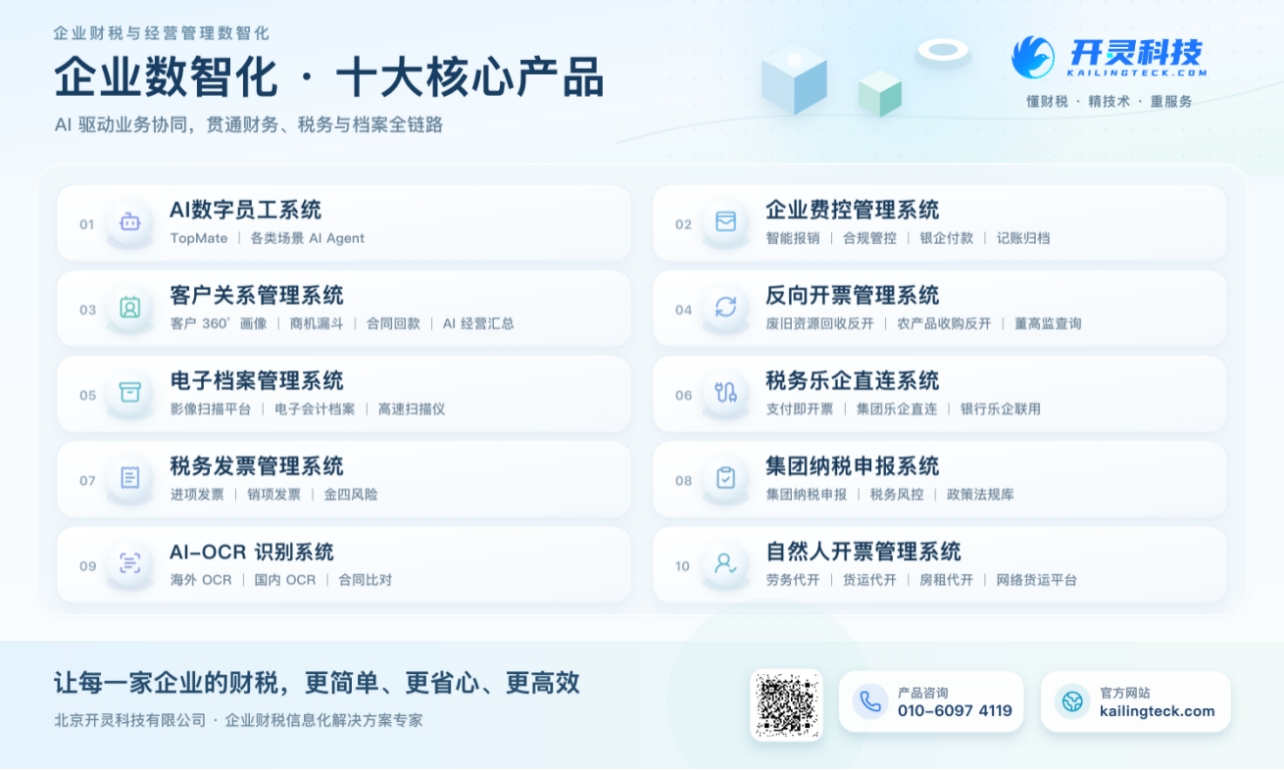
The company has now formed ten core product lines, including: AI digital employee system, enterprise expense control management system, customer relationship management system, reverse invoicing management system, invoice issuance for individuals management system, electronic archives management system, tax fully digitalized e-invoice Leqi system, tax invoice management system, group tax filing system, and AI OCR recognition system. It is committed to connecting enterprise business, finance, tax, funds, and archive data to help customers improve operational efficiency, business-finance-tax compliance capabilities, and digital management levels.
If you have any business-finance-tax digital transformation needs, welcome to contact us. Beijing Kailing Technology will serve you wholeheartedly.
Keywords: Waste paper recycling reverse invoicing, duplicate settlement, missed invoicing, five-flow invoice-payment reconciliation, Kailing Technology
As a comprehensive business-finance-tax digitalization solution service provider, Kailing Technology provides business-finance-tax management digital transformation products and operational services for various government agencies, institutions, and large, medium, and small enterprises. The product line includes: solutions for sales contract management system, procurement contract management system, fully digitalized Leqi interface project, automatic output invoicing system, reverse invoicing system, invoice issuance for individuals system, employee expense control and reimbursement system, input VAT invoice management system, supply chain collaborative reconciliation system, image AI OCR recognition system, automatic financial bookkeeping system, electronic accounting archives system, etc., comprehensively driving the digitalization process across various fields.
Consultation Hotline: 18513895936 / 010-60974119 Location: Beijing