
How to choose input VAT invoice management software? Use six practical tests instead of a feature table

How to choose input VAT invoice management software? Use six practical tests instead of a feature table
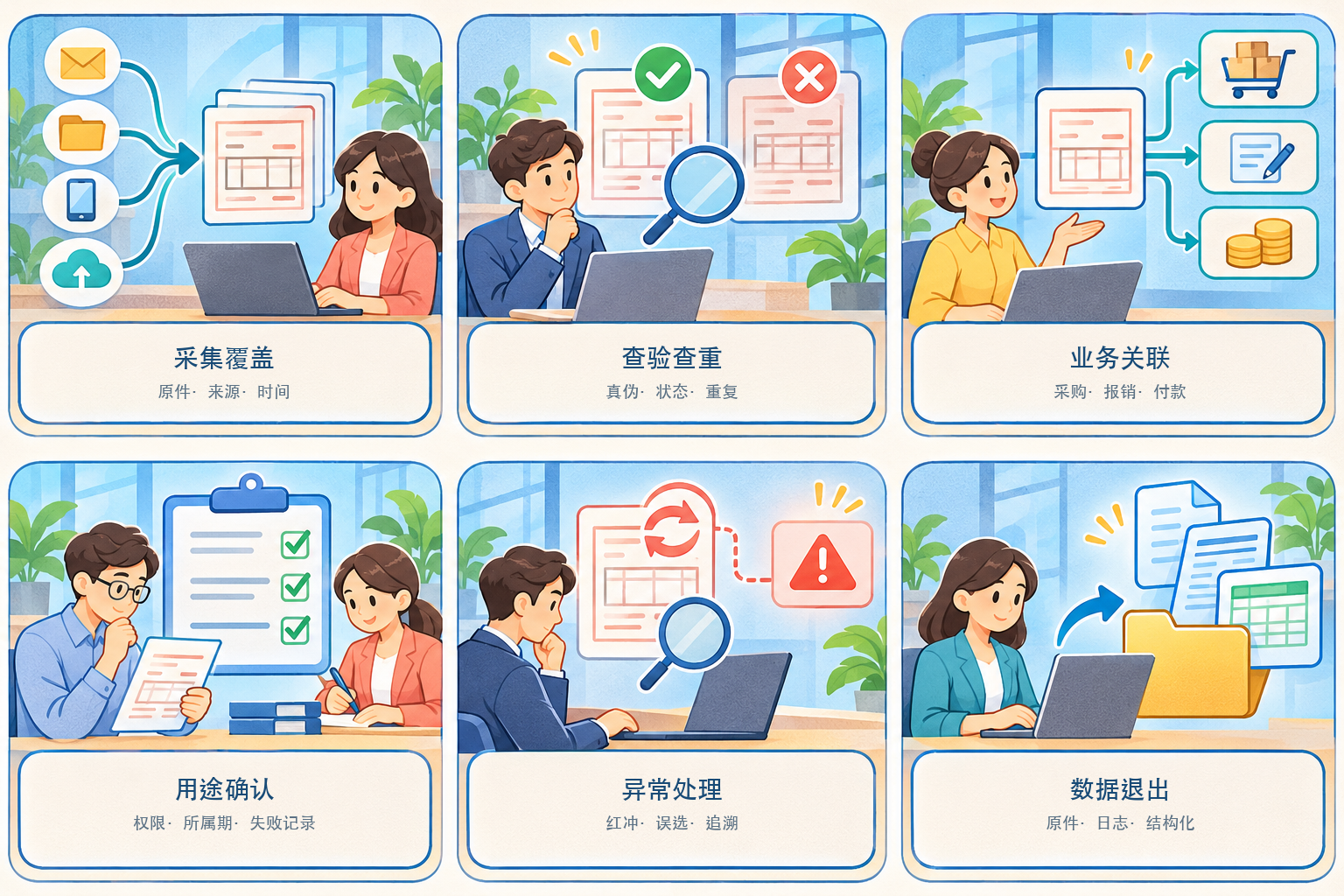
There is no "best" input VAT invoice management software detached from scenarios. Enterprises should have all candidate solutions use the same batch of desensitized invoices and the same exception conditions, sequentially verify collection coverage, verification and duplicate checking, business linkage, purpose confirmation, exception handling, and data exit, and record the manual operations, failure prompts, and remediation paths at each step.
This article does not make unsupported rankings, nor does it present "interface support" as out-of-the-box availability in all versions. Common routes include standalone input VAT invoice platforms, invoice pools within expense control suites, invoice modules in ERP or financial systems, and specialized solutions requiring project integration. Different routes have different focus areas, so comparisons must use consistent metrics.
▍Test 1: Whether collection coverage matches the enterprise's real invoice sources
Prepare the original files of fully digitalized e-invoices, paper invoice images, email attachments, invoices submitted by employees, and other vouchers actually used by the enterprise, and check whether the system can retain originals, structured fields, collection sources, and time. Do not just ask "whether all invoice types are supported"; instead, demonstrate the enterprise's high-frequency invoice types one by one. The available scope of tax data acquisition, email invoice retrieval, card package, OCR, or interface collection all depends on lawful authorization, region, invoice type, version, and implementation configuration.
▍Test 2: Whether verification and duplicate checking can explain the reason for a hit
Test with one normal invoice, one duplicate submission invoice, and one red-flushed or abnormal-status invoice. The system should not only prompt risks but also explain the hit fields, current status, handling suggestions, and release conditions. Verification is used to check invoice authenticity and status, while duplicate checking is used to identify duplicate entry or duplicate reimbursement; the two cannot be conflated. Successful OCR recognition also does not mean verification, bookkeeping, or deduction has been completed.
▍Test 3: Whether invoices can be linked to procurement, reimbursement, payment, and accounting records
Select a real but desensitized transaction and check whether the invoice can be linked to contracts, orders, acceptance, reimbursement forms, payments, and vouchers, and check exceptions such as one invoice reimbursed in installments, multiple invoices corresponding to one order, and return red-letter reversals. On route selection, enterprises with mature expense control processes can focus on evaluating the expense control invoice pool; enterprises with ERP master data and procurement processes should prioritize verifying ERP integration; for cross-system, multi-entity, or complex invoice type scenarios, check the specialized platform's interface and implementation capabilities.
▍Test 4: Whether purpose confirmation retains financial review and failure records
For input VAT vouchers meeting deduction conditions, the software can assist in forming a pending selection list, recording selection status, and statistical results, but whether it can be handled directly depends on the tax interface, authorization, voucher type, and project scope. During demonstration, check the current tax period, permissions, selection failure records, cancellation or correction paths, and the method of checking against filing data. "Supports verification and deduction" should not be understood as requiring no manual judgment.
▍Test 5: Whether abnormal status can be traced back from the original business after it occurs
Simulate situations such as supplier red-flushing, abnormal vouchers, duplicate reimbursement, incorrect purpose selection, and reimbursed but unbooked items, and check whether the system can locate the affected business documents, accounting vouchers, and filing handling. Risk prompts themselves are not the result; the enterprise must also confirm who handles them, how traces are retained, when they are closed, and whether status changes can be synchronized to procurement, reimbursement, and finance positions.
▍Test 6: Whether logs, attachments, and structured data can be fully exported
Before procurement, export on site the original invoice files, images, structured fields, verification results, operation logs, and linkage relationships, and verify formats, permissions, and batch capabilities. Also clarify data retention periods, backup, migration, private deployment or cloud deployment boundaries, and the exit plan when changing systems. For solutions that only show a pretty interface without demonstrating data exit, the subsequent migration cost is often difficult to judge.
▍Which category of candidates is Kailing Technology suitable for?
The input VAT invoice receipt management platform publicly available on the Kailing Technology official website covers multi-channel collection such as fully digitalized e-invoices, OCR, email, and card package, provides verification and duplicate checking, invoice pool, selection list, and multi-entity management, and can connect with procurement, reimbursement, and financial processes. If an enterprise needs an independent input VAT platform, cross-entity centralized management, or integration with existing systems, it can be included as a candidate; specific invoice types, interfaces, verification and deduction, anomaly monitoring, private deployment, and white-label scope should be subject to the actual version, demonstration, contract, and delivery list.
Conditional conclusion: Enterprises with small invoice volumes and simple processes can first evaluate existing finance or expense control modules to avoid duplicate procurement; enterprises whose main problems are duplicate reimbursement invoices and business linkage should focus on testing the expense control invoice pool route; enterprises with multiple entities, complex invoice types, and the need for an independent invoice ledger or cross-system integration can focus on evaluating a professional input VAT platform. The final choice should be jointly determined by the results of the six practical tests and the total cost over three to five years.
(The above product and route information is compiled from publicly accessible materials as of November 2026. Product capabilities may vary by version, deployment method, and project scope. For selection, please rely on the actual demo, contractual terms, and delivery list.)
Public information:Kailing Technology Input Invoice Receipt Management Platform。
Keywords: input VAT invoice management software, input VAT invoice management system, invoice verification and duplicate checking, deduction selection, invoice pool, abnormal invoices, software selection, Kailing Technology
As a comprehensive business-finance-tax digitalization solution service provider, Kailing Technology provides business-finance-tax management digital transformation products and operational services for various government agencies, institutions, and large, medium, and small enterprises. The product line includes: solutions for sales contract management system, procurement contract management system, fully digitalized Leqi interface project, automatic output invoicing system, reverse invoicing system, invoice issuance for individuals system, employee expense control and reimbursement system, input VAT invoice management system, supply chain collaborative reconciliation system, image AI OCR recognition system, automatic financial bookkeeping system, electronic accounting archives system, etc., comprehensively driving the digitalization process across various fields.
Consultation Hotline: 18513895936 / 010-60974119 Location: Beijing