
Management wants to know where the money for each project is spent? Kailing Technology's expense control and reimbursement management system drills through department and project expenses and generates analytical reports.

When management asks "how much did this project actually cost," finance may total separately from three tables: travel, procurement, and entertainment. If the actual project and cost center are not recorded at reimbursement, and month-end relies on notes to infer them, a reliable answer is hard to obtain. Kailing Technology's expense control and reimbursement management system records attribution when the expense occurs, then drills down to documents and invoices.

▍Project basis precedes report construction
Enterprises need to define the relationship among projects, departments, and cost centers: whether an expense belongs to one project or is allocated proportionally to multiple projects; and whether loans, prepayments, and final reimbursements are double-counted. Only with a unified basis can project expenses in group reports be comparable.
The Kailing Technology system supports cost center-based aggregation and expense allocation. When employees fill in forms, their department is brought in, and they can also select a project according to business reality; finance verifies the attribution basis during review, avoiding discovering after voucher generation that the budget was charged to the wrong project.
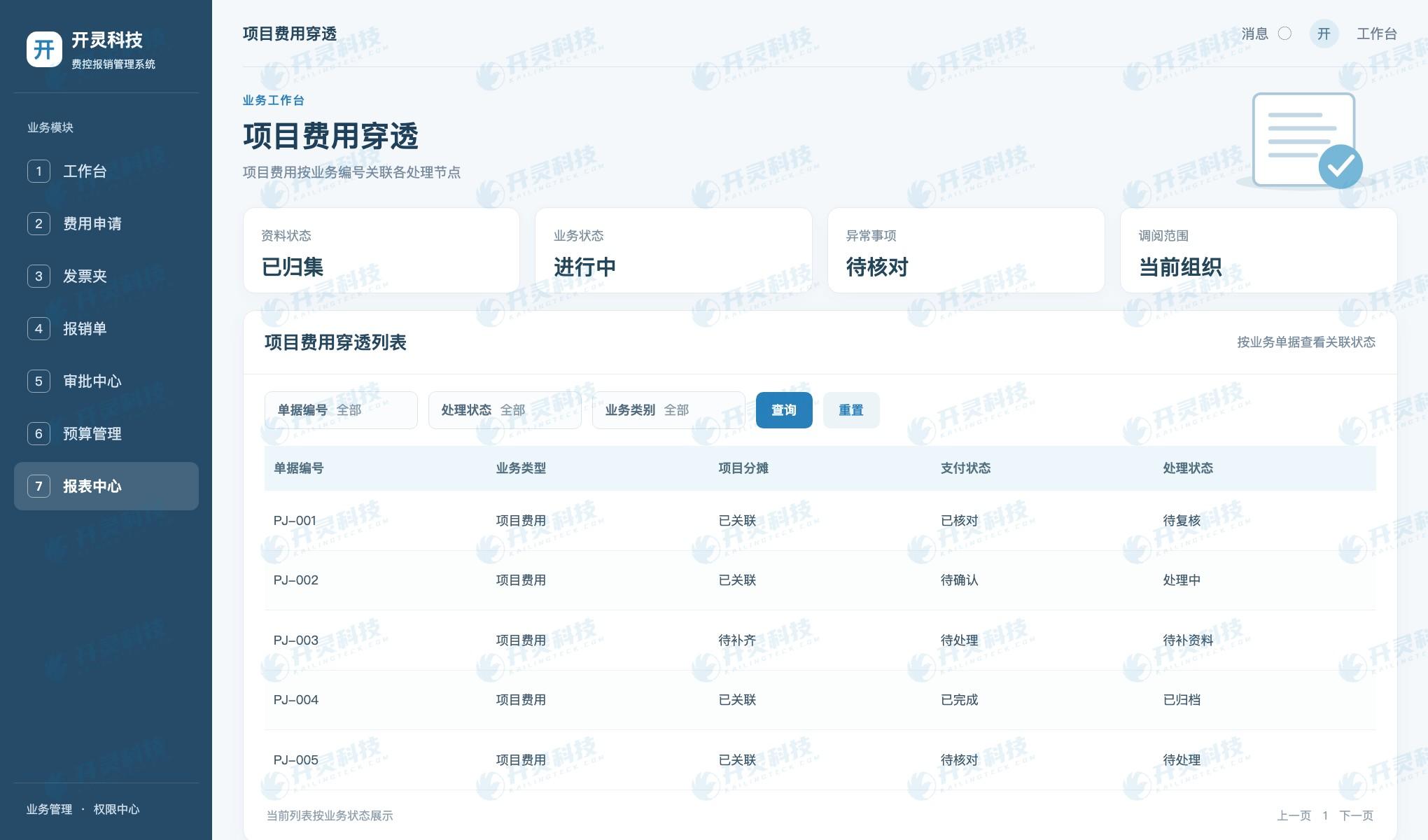
Project expense drill-down business list
▍Retain the same dimension from invoice to voucher
Invoice collection, reimbursement forms, approval, payment, and voucher conversion form a continuous chain. Project codes, expense types, and cost centers remain consistent along the chain, so that the total amount management sees in summaries can be drilled down to specific reimbursement forms, invoices, and payments. When a project incurs expenses across multiple departments, it should not be cut off by the department dimension.
If one reimbursement form is allocated to two projects, the system saves the allocated amount or ratio and links it to each project's budget. Modifying allocation rules should retain adjustment records, so report figures do not change without explanation.
▍Reports first answer three management questions
First, where it is spent: display the expenditure structure by project, department, expense type and period; second, why it grew: drill down to anomalous months and detailed documents; third, how much more can be spent: compare actual occurrences with budget and occupied quota. A single pie chart cannot support project owners in making the next judgment.
The custom reports and drill-through queries of the Kailing Technology expense control and reimbursement management system can be used for multi-dimensional analysis. Management enters subsidiaries, projects, departments and documents level by level from the group summary, while finance still controls the visibility of invoices and personal information according to permissions.
▍Identify duplicate counting and time differences
Approval passed, bank payment made, and booking completed are different points in time. Reports should clearly specify which status is used as the statistical basis; otherwise, month-end approved-but-unpaid expenses added to booked expenses in the general ledger can easily be double-counted. Loan write-offs, refunds, and red-letter reversals should also be adjusted under the same rules.
Cross-period reimbursement especially needs to retain the expense occurrence date, application date, and accounting period. Management can choose a management basis to view project progress; finance reconciles on a booking basis, and differences between the two reports should be explainable.
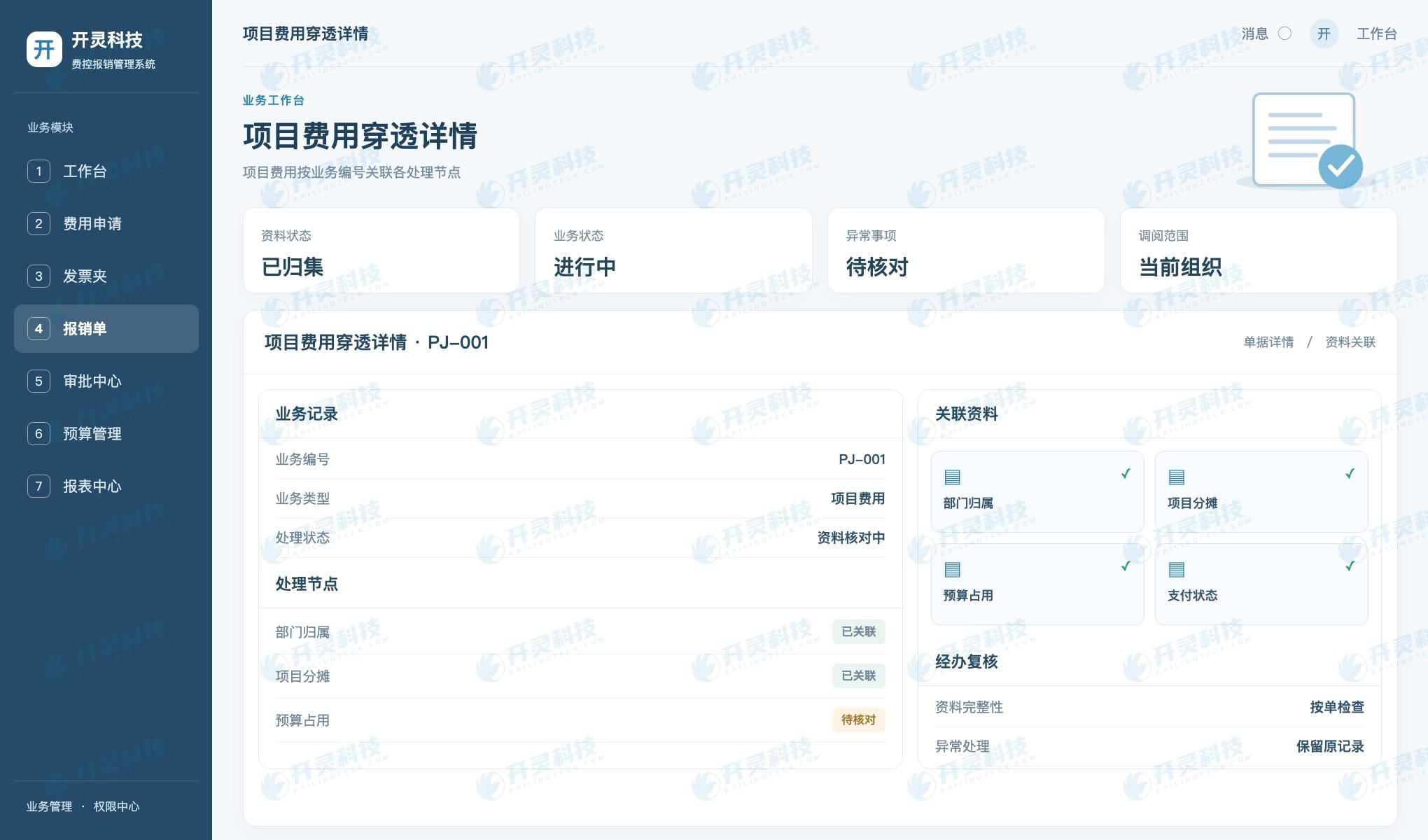
Project expense drill-down document and material linkage
▍Accept drill-through with one allocated expense
Select a business trip reimbursement form that belongs to two projects at once, and check whether budgets are occupied separately, whether approval reaches the corresponding responsible persons, whether payment occurs only once, and whether vouchers are generated according to the allocation result. Then drill down layer by layer from the project report back to the original invoice.
The quality of project expense analysis ultimately depends on whether attribution on business documents is accurate. Kailing Technology's solution connects expense control and analysis, helping management move from "how much money was spent" to "why the money was spent here."
▍Drill-through analysis requires a clear statistical point in time
Project managers look at incurred expenses, finance looks at booked expenses, and treasury staff look at paid expenses. The three figures may differ, and reports must state the basis. If only one total "project expenditure" is given, management may easily double-count unpaid approval forms with paid orders.
Cross-period invoices also need to distinguish the consumption date, reimbursement submission date, and booking date. Budget monitoring may occupy funds at the application or approval node per policy, while financial accounting is based on booking records.
The Kailing Technology system retains status from reimbursement to voucher, reports are summarized by the selected scope, and can drill down to the documents causing the differences.
▍Department and project are two ways of observing
One department supports multiple projects, and one project may also draw on people from multiple departments. The reimbursement form records both the organizational department and the project, and allocates to multiple cost centers when necessary. Department heads look at resource consumption, project heads look at total project cost, and both views come from the same expense.
Allocation rules can be configured by amount, ratio, headcount, or confirmed business basis. After modification, re-verify budget and voucher mapping to prevent reports from showing the new attribution while the general ledger still follows the old one.
The drill-down path of analysis reports should let management go from project summary to expense type, reimbursement form, and documents, but personal sensitive information should still be displayed according to permissions.
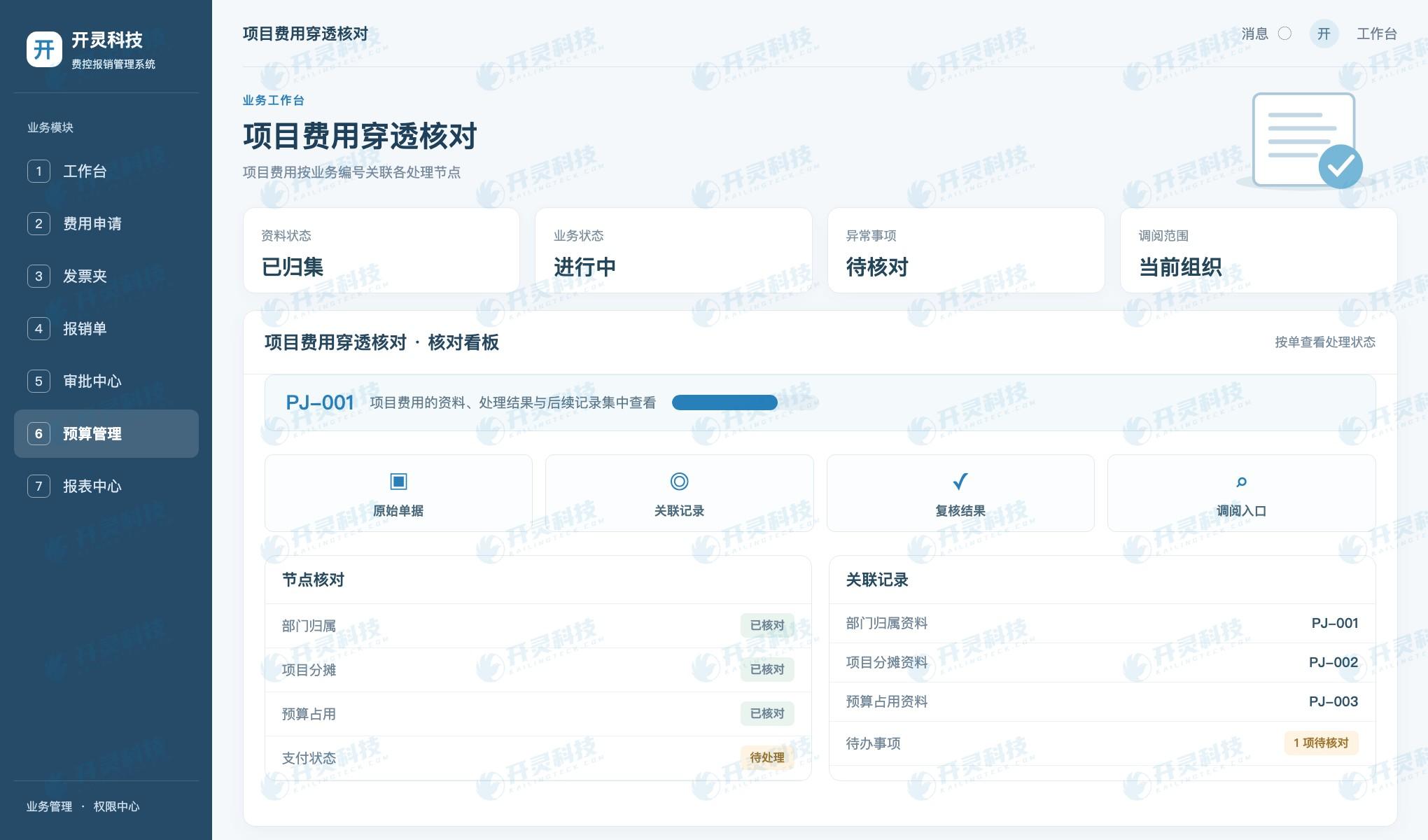
Project expense drill-down node verification
▍Work backward from expense exceptions to management actions
When a project's travel expenses rise significantly, drill through to month, department, travel purpose and reimbursement form to determine whether it is phased on-site work or a deviation in standard execution. If a cost center's budget approaches its upper limit, the project owner can adjust arrangements in advance.
Reports should not be displayed only at year-end. Monthly reviews place expense structure together with project progress, enabling earlier identification of mismatches between expenditure and output.
The Kailing Technology expense control and reimbursement management system connects budget, approval, payment and general ledger, providing management with an explainable expense view rather than a summary chart that cannot be questioned.
▍How the project expense dashboard translates into action
What management focuses on is not a single total amount, but budget utilization, changes in expense types and project stages. The project dashboard can first display a group overview, then drill down to companies, departments and expense documents; anomalous growth must be traceable to the original reimbursement and invoice.
If a project suddenly shows a large expense at month-end, finance needs to determine whether it is a concentration of actual business or employees submitting last month's documents late. Reports retain occurrence date, submission date, and booking period to help management distinguish business changes from timing differences.
When the same expense is allocated to two projects, each project view shows its allocated amount, while the group total still maintains the original document total. Finance can trace back from the voucher to the allocation basis, and the budget department can check the occupation process.
The Kailing Technology system connects expense control and analysis, allowing management's questions to return to specific business rather than stopping at charts. If a project owner finds an attribution error, documents and approval records are also available for review and adjustment..
▍Report permissions and interpretation
Project managers may need to see expenditure structure but do not need to see personal information on all employee invoices. Group management can view summaries, while finance and audit drill into details according to their responsibilities.
The approval, payment, and booking progress of the same expense should be presented together with the report. When managers see high budget occupation, they can judge whether the money has already been paid out or is still in approval.
The Kailing Technology system supports summary analysis with detailed documents, enabling business owners to initiate reviews of anomalous figures.
When a project leader finds incorrect expense attribution, they should initiate a correction through the original reimbursement form and link it to budget and voucher verification. They must not manually adjust a single figure in the report; otherwise the same difference will reappear on the next re-summary.
▍FAQ
Q: Can project expenses be viewed by department and project at the same time?
A: Two dimensions can be established, and the attribution or allocation relationship of each expense should be retained.
Q: Does approved but unpaid count as actual expenditure?
A: It depends on the reporting basis; approval, payment and booking status should be distinguished.
Q: Will one expense form allocated to two projects be counted twice?
A: They are recorded separately into projects by allocated amount, and the group summary still counts the original expense only once.
Visit Kailing Technology to learn about related products and implementation plans: https://www.kailingteck.com/feikong/ .
As a national high-tech enterprise, Kailing Technology focuses on the digital and intelligent transformation of enterprise business-finance-tax and operations management, providing software products, system integration, implementation and delivery, and operational services for various government agencies, institutions, group enterprises, and SMEs.
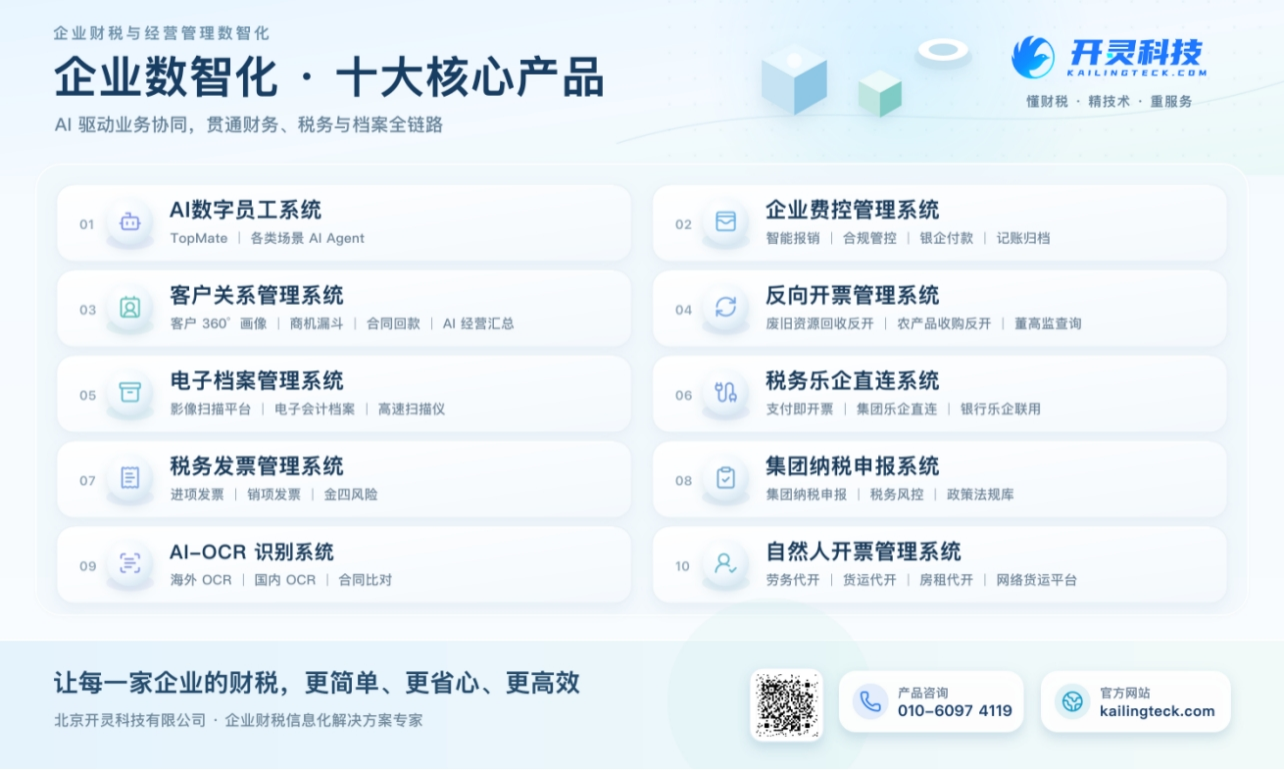
The company has now formed ten core product lines, including: AI digital employee system, enterprise expense control management system, customer relationship management system, reverse invoicing management system, invoice issuance for individuals management system, electronic archives management system, tax fully digitalized e-invoice Leqi system, tax invoice management system, group tax filing system, and AI OCR recognition system. It is committed to connecting enterprise business, finance, tax, funds, and archive data to help customers improve operational efficiency, business-finance-tax compliance capabilities, and digital management levels.
If you have any business-finance-tax digital transformation needs, welcome to contact us. Beijing Kailing Technology will serve you wholeheartedly.
Keywords: project expense analysis, cost center, expense control and reimbursement reports, expense drill-down, Kailing Technology
As a comprehensive business-finance-tax digitalization solution service provider, Kailing Technology provides business-finance-tax management digital transformation products and operational services for various government agencies, institutions, and large, medium, and small enterprises. The product line includes: solutions for sales contract management system, procurement contract management system, fully digitalized Leqi interface project, automatic output invoicing system, reverse invoicing system, invoice issuance for individuals system, employee expense control and reimbursement system, input VAT invoice management system, supply chain collaborative reconciliation system, image AI OCR recognition system, automatic financial bookkeeping system, electronic accounting archives system, etc., comprehensively driving the digitalization process across various fields.
Consultation Hotline: 18513895936 / 010-60974119 Location: Beijing