
If renewable resources are not reverse invoiced, how is the tax rate determined? First distinguish the entity and the tax calculation method

If renewable resources are not reverse invoiced, how is the tax rate determined? First distinguish the entity and the tax calculation method
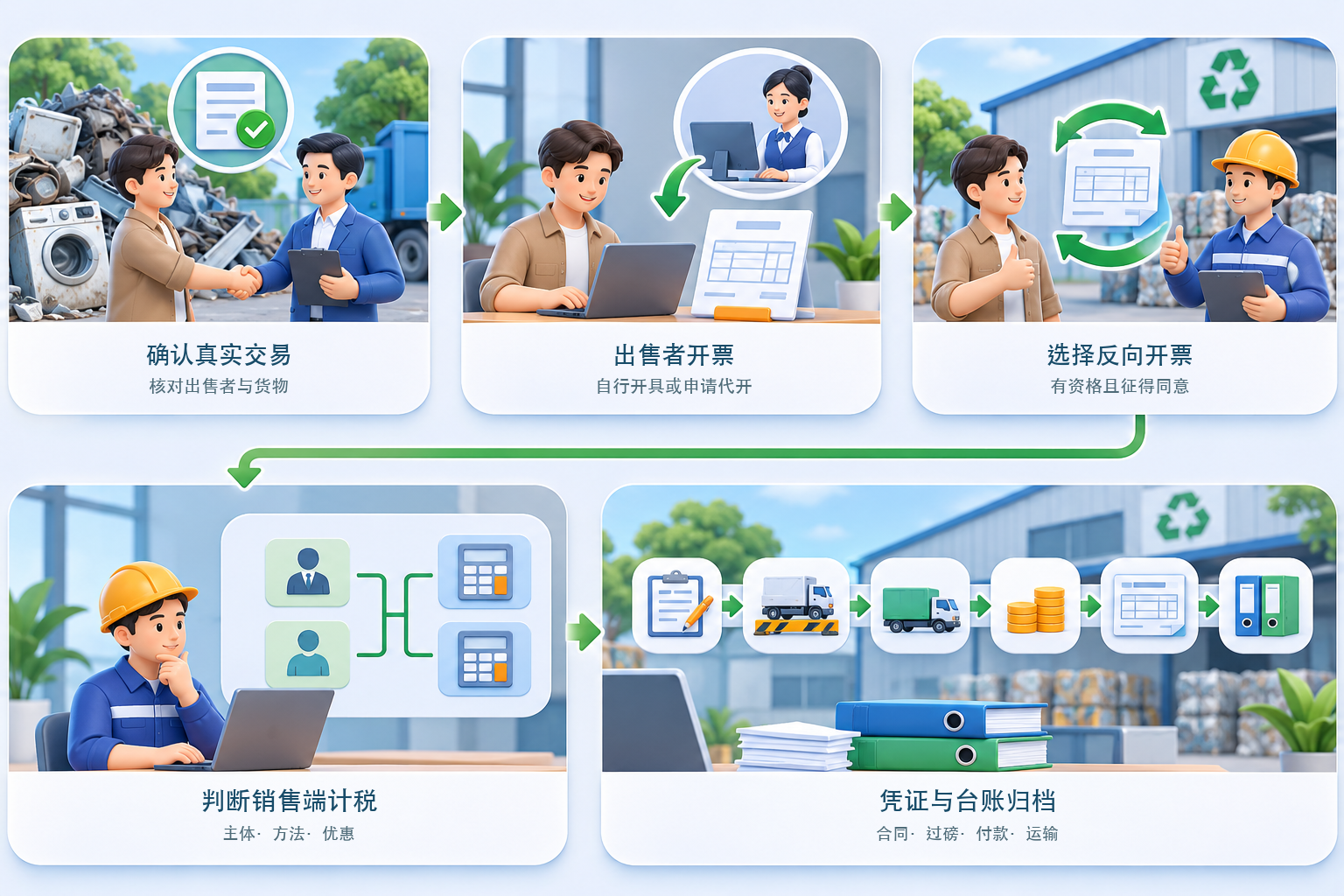
Conclusion first: whether to adopt "reverse invoicing" is a legal path for resource recycling enterprises to obtain invoices on the acquisition side, and it does not directly determine the tax rate or levy rate applicable when the recycling enterprise sells renewable resources. To judge the tax burden in 2026, first distinguish who is selling and what type of taxpayer the counterparty is, then determine whether the recycling enterprise adopts general taxation or eligible simplified taxation, and finally check whether legal vouchers consistent with the real transaction have been obtained.
The original draft equated "not reverse invoicing" with "no compliant input vouchers" and mixed the small-scale taxpayer preferences available to natural person sellers into the recycling enterprise sales side, which easily causes misunderstanding. Announcement No. 5 of 2024 by the State Taxation Administration uses "may" for reverse invoicing: sellers may issue invoices themselves, and eligible natural persons may also apply for tax authority-issued invoices; eligible recycling enterprises may choose reverse invoicing only after obtaining the seller's consent.
▍1. First look at the sales entity: the natural person seller side and the recycling enterprise sales side are not the same tax
When an individual sells scrapped products to a resource recycling enterprise, this is the acquisition stage; when the resource recycling enterprise then sells the purchased renewable resources downstream, this is the sales stage. The statements in Announcement No. 5 of 2024 such as "monthly sales of less than 100,000 yuan are exempt" and "the 3% levy rate is reduced to 1%" target qualifying individual sellers and do not mean that the sales revenue of recycling enterprises is always calculated at 1%. Mixing up the transactions of the two entities is the most common error when determining tax rates.
▍2. Recycling enterprise sales side: general taxation and 3% simplified taxation must be judged according to conditions
The VAT Law of the People's Republic of China takes effect on January 1, 2026. The standard rate for the sale of goods is 13%, unless otherwise provided by law. Announcement No. 40 of 2021 by the Ministry of Finance and the State Taxation Administration also provides that general VAT taxpayers engaged in renewable resource recycling, when selling the renewable resources they have acquired and meeting conditions such as qualifications or filing, may choose simplified taxation at a 3% levy rate or apply general taxation. After choosing simplified taxation, except for transitional situations specified in the announcement, it may not be changed within 36 months; therefore, one cannot simply compare the surface figures of 13% and 3%, but must also calculate based on deductible input VAT, customer invoicing needs, gross margin structure, and ongoing operating arrangements.
▍3. Small-scale taxpayer preferences also require checking the applicable period and exceptions
According to the 2026 preferential policy transition, from January 1, 2026 to December 31, 2027, small-scale taxpayers engaging in taxable transactions subject to a 3% levy rate may, except for exceptions such as the sale or leasing of real estate or the transfer of land use rights, be levied at a reduced rate of 1%. Enterprises still need to first confirm their taxpayer status, the nature of the transaction, the threshold, and other tax exemption conditions, and cannot treat "reduced to 1%" as a fixed tax rate for all renewable resource transactions.
▍4. When not reverse invoicing, which legal path should acquisition vouchers follow?
Not adopting reverse invoicing does not mean only weighbridge tickets and payment records can be kept. General VAT taxpayers and small-scale taxpayers selling scrapped products may issue invoices themselves as required; natural persons selling scrapped products may apply to the tax authority for tax authority-issued invoices. For eligible resource recycling enterprises that have obtained qualifications, reverse invoicing to a seller for the first time also requires the seller's consent for reverse invoicing and tax payment on their behalf. Recycling enterprises should choose a legal path based on the seller's identity and transaction conditions, and must not fabricate invoicing using the identity of employees or unrelated persons.
▍5. Input VAT deduction and corporate income tax deduction cannot be judged only by "whether there is an invoice"
Recycling enterprises under general taxation may deduct the tax amount indicated on reverse-issued VAT special invoices as required; recycling enterprises that choose simplified taxation may only reverse-issue ordinary invoices, and the corresponding input VAT may not be used for deduction in that simplified taxation project. For corporate income tax, compliant reverse invoices may serve as pre-tax deduction vouchers; other transactions should still be checked against the administrative measures for pre-tax deduction vouchers for the applicable conditions of invoices, tax authority-issued invoices, payment receipts, and internal vouchers, and contracts, transport vouchers, weighbridge tickets, transfer records, and acquisition ledgers should be retained to prove authenticity.
▍What should be managed with priority during system implementation?
Kailing Technology's reverse invoicing-related solutions can configure the linkage of transaction entities, acquisition orders, weighing, settlement, payment, invoicing, and ledgers by project, and assist with invoicing and status write-back within the scope of legal authorization and actual interface support. Whether special invoices can be reverse-issued, which tax calculation method applies, and whether deduction is possible should still be judged by the enterprise based on qualifications, real business, and the competent tax authority's interpretation; before go-live, end-to-end verification should be conducted separately for seller self-invoicing, tax authority-issued invoice application, reverse invoicing, general taxation, and simplified taxation scenarios.
Official basis:State Taxation Administration Announcement No. 5 of 2024Clarify the applicable entities, qualifications, consent requirements, invoice types, and ledger materials for reverse invoicing;Ministry of Finance and State Taxation Administration Announcement No. 40 of 2021Clarify that general taxpayers selling purchased renewable resources may, subject to conditions, choose either the 3% simplified taxation method or general taxation;"Value-Added Tax Law of the People's Republic of China"Stipulate the principle tax rate for the sale of goods from 2026;Tax authority 2026 Q&A on small-scale taxpayer preferencesExplain the applicable period and scope of the 3% reduced to 1% rate.
Keywords: renewable resource recycling tax rate, reverse invoicing, general taxation, simplified taxation, 3% levy rate, input VAT deduction, pre-tax deduction vouchers, Kailing Technology
As a comprehensive business-finance-tax digitalization solution service provider, Kailing Technology provides business-finance-tax management digital transformation products and operational services for various government agencies, institutions, and large, medium, and small enterprises. The product line includes: solutions for sales contract management system, procurement contract management system, fully digitalized Leqi interface project, automatic output invoicing system, reverse invoicing system, invoice issuance for individuals system, employee expense control and reimbursement system, input VAT invoice management system, supply chain collaborative reconciliation system, image AI OCR recognition system, automatic financial bookkeeping system, electronic accounting archives system, etc., comprehensively driving the digitalization process across various fields.
Consultation Hotline: 18513895936 / 010-60974119 Location: Beijing