
Different expenses require approval from different responsible persons. How can the reimbursement process be automatically routed? The Kailing Technology expense control and reimbursement management system configures approval rules by expense type.

Travel expenses, business entertainment expenses, and project procurement payments are all called "reimbursement," yet the responsible persons may differ. If an employee chooses the wrong process, the approval form is returned back and forth; if finance forwards it manually, it is difficult to leave a clear chain of responsibility. The Kailing Technology expense control and reimbursement management system configures approval paths based on conditions such as expense type, organization, and amount, so that documents enter the corresponding position after submission.

▍First clarify expense types and responsible persons
The enterprise must first sort out the applicable scenarios for expenses such as travel, dining and entertainment, meetings, and project procurement, and clarify who is responsible for business authenticity, who reviews the budget, and who is responsible for financial compliance. The approval authority for the same expense may differ across companies or projects, so rules cannot rely solely on a single name list shared across the entire group.
The Kailing Technology system supports multiple organizations and custom approval processes. During configuration, use positions and roles rather than hard-coding the name of each approver; only then are rules easier to maintain after personnel leave or organizational adjustments occur.
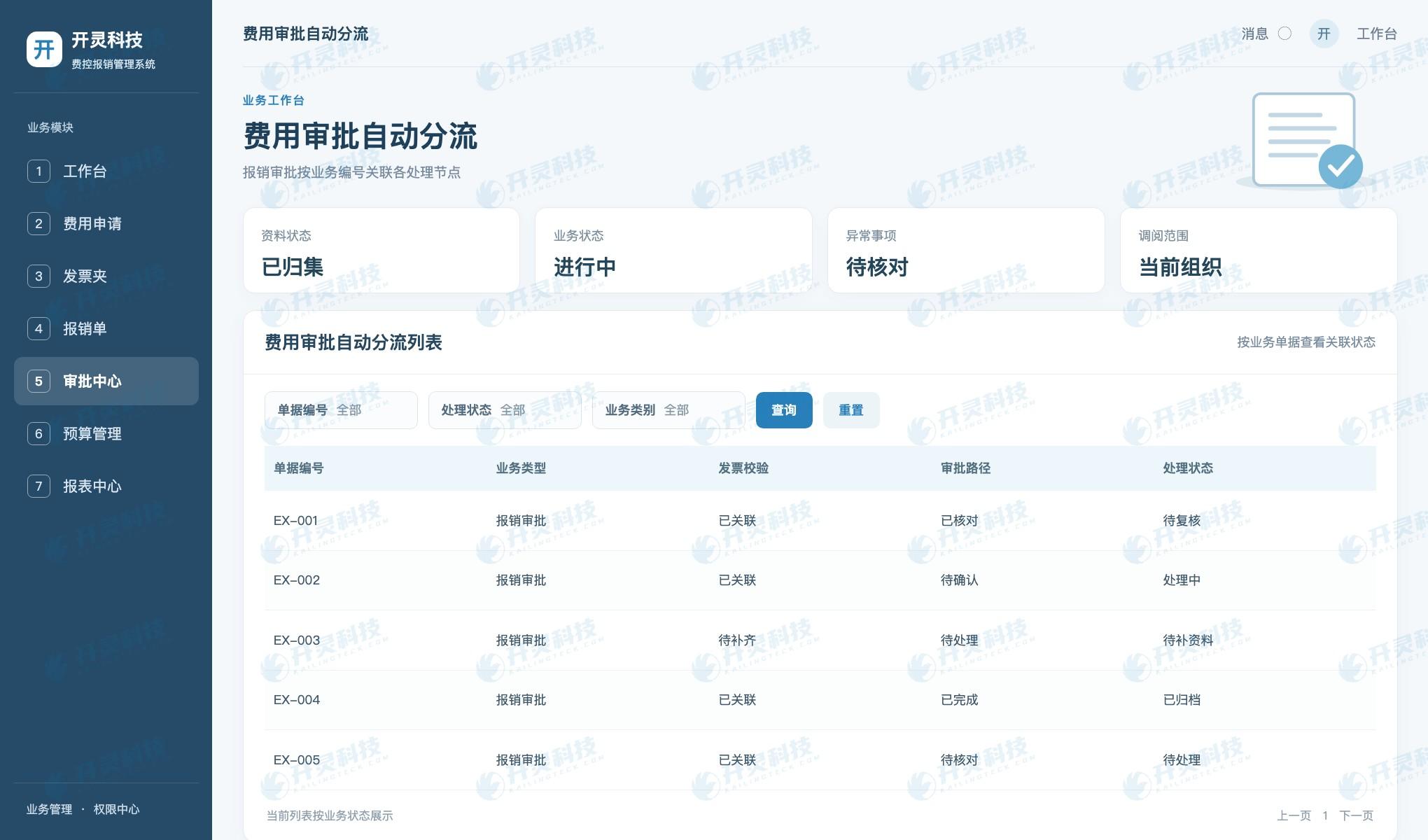
Expense approval routing business list
▍Validate basic conditions before submission
After an employee selects an expense type, the reimbursement form presents the corresponding fields and attachment requirements. Invoice verification, duplicate reimbursement, budget balance, and expense standards can be prompted or blocked before submission according to enterprise rules. Forms missing basic information are first completed by the submitter, reducing repeated returns after entering the approval chain.
The basis for routing should come from determined business fields, such as organization, department, project, expense type, and amount. After fields are modified, the system needs to re-evaluate the approval path to avoid a situation where an employee first submits under a low-authority type and later changes it to a high-authority expense while it still flows along the old path.
▍Approval nodes are automatically selected by conditions
For example, travel expenses are first submitted to the direct supervisor to review the trip matter, then the budget responsible person verifies the limit; project expenses add the project manager; special entertainment expenses are submitted to a higher level per policy. The system selects nodes by conditions while retaining the matched rules and flow records, so finance can explain why a form went through these people.
Methods such as joint approval, or-approval, return to the previous level, and added approval should be consistent with policy, not merely aimed at the shortest path. For expenses involving cross-department allocation, it must also be clear which responsible person confirms the expense attribution.
▍Exception routing needs a fallback
When an approver leaves, a position is vacant, or conditions conflict, documents should enter a pending queue and be transferred or reassigned according to authorization rules; nodes must not be silently skipped. If the expense type, amount, or project is changed during approval, the system must record the content before and after the modification and whether the corresponding approval is re-triggered.
The Kailing Technology expense control and reimbursement management system receives approval messages on the Web and mobile ends, and employees can view the current node. What finance sees is not a string of "approved" but the materials on which each position based its decision.
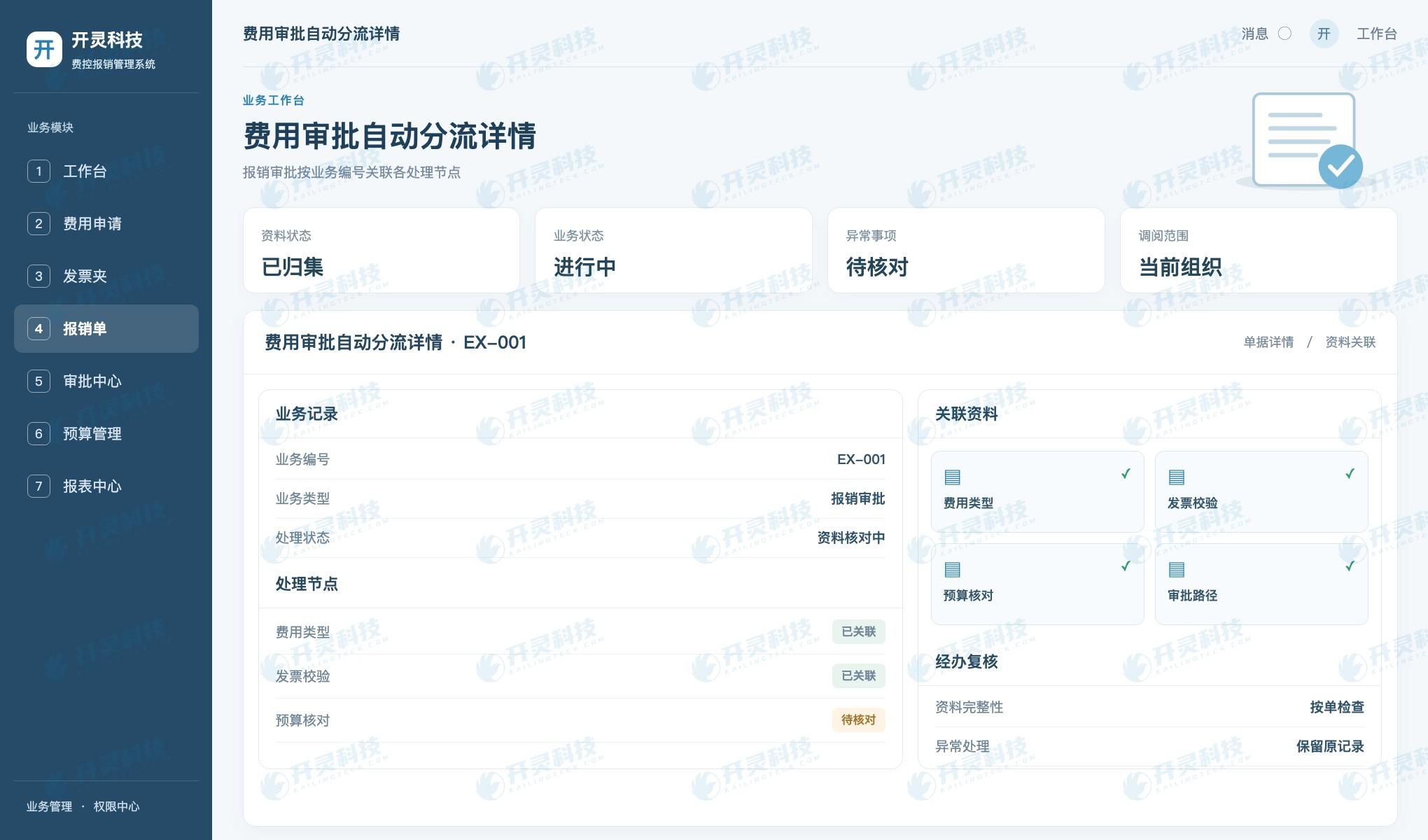
Expense approval routing documents and data linkage
▍At launch, first use real returned orders to find rule gaps
You can pick three types of forms that are often returned: travel exceeding standards, unclear project attribution, and the same invoice used for two reimbursements. Test pre-submission prompts, approval routing, and resubmission after return respectively. If the approval path is correct but employees still keep supplementing materials, the problem may lie in form fields and attachment requirements, which should be adjusted together.
Process reports show at which node each expense type is stuck and whether return reasons are concentrated. Rule optimization must be synchronized with financial policies to avoid long-term divergence between system configuration and offline practices.
▍How approval rules are implemented from policy
First organize the expense types, amount ranges, organizations, projects, and exception conditions in the policy into a rule table, then have business owners confirm the approval roles. The Kailing Technology system supports custom workflows; during configuration, distinguish "who reviews authenticity," "who controls the budget," and "who verifies invoices."
When a single reimbursement form contains multiple expense types, the enterprise must decide whether to route by the main expense type or approve line by line, and employees must not guess the path themselves. Rule match results should be visible so finance can explain disputes.
For urgent, cross-department, and executive expenses, set clear exceptions and authorization; do not leave all complex situations to administrators to manually change approvers on an ad hoc basis.
▍Reducing returned orders starts with the form-filling experience
If an employee selects dining and entertainment, the system prompts for the reason, customer or project, number of people, and receipts; if travel is selected, it prompts for itinerary, standards, and transport and accommodation receipts. Fields matching the expense type can identify missing items before submission.
Invoice verification and duplicate reimbursement prompts should be completed before the employee submits whenever possible. Only when approvers receive complete materials can they spend time judging business reasonableness rather than acting as form proofreaders.
Employees can see the current approval node, the specific reason for return, and the materials that need to be supplemented. Modifications after return re-trigger necessary validations, keeping the workflow records consistent.
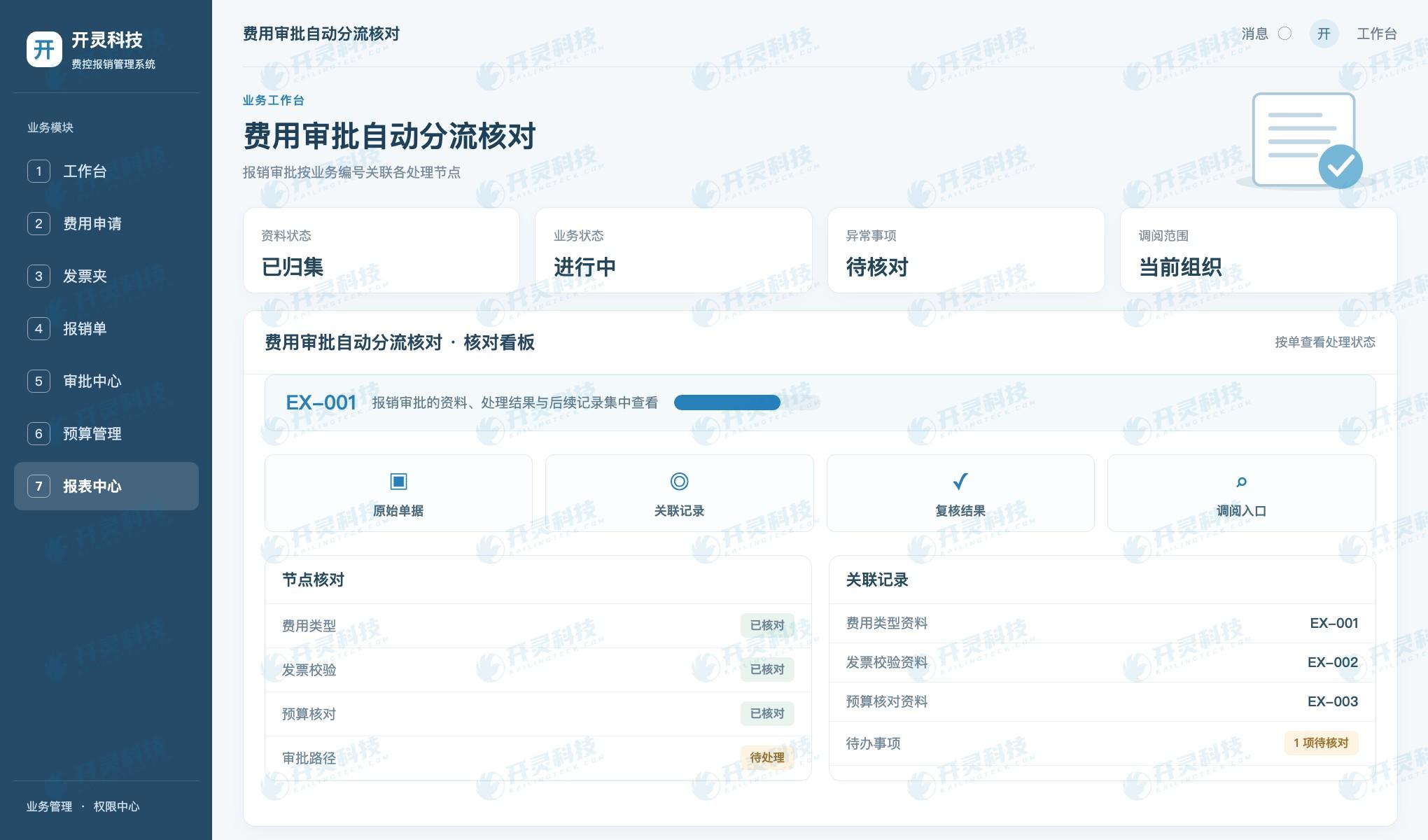
Expense approval routing node verification
▍Process analysis is used to adjust rules
After the system has been live for a period, calculate the average dwell node and return reasons for different expense types. If a certain expense type is always returned at the finance preliminary review, the field design may be unclear; if it remains stuck at the same position for a long time, check authorization or workload.
Fast approval is not the only goal. High-risk expenses require sufficient control, while routine small expenses can be simplified per policy. System configuration should be updated together with policy changes, and version effective times should be retained.
The Kailing Technology expense control and reimbursement management system places routing, budget, and invoice verification in one business document, allowing enterprises to continuously improve processes based on real data instead of relying on verbal notices to approvers each time.
▍Bring process changes into management
When expense policies are updated, system rules should record the effective date, applicable organizations, and approval roles. Whether submitted documents continue under the old or new rules should be agreed by the enterprise in advance, to avoid an approval node suddenly disappearing.
For long-term proxy approvals, temporary leave, and position vacancies, an authorization period must be set and records kept. Employees do not need to understand backend rules; they only need to see the correct responsible person and a clear to-do status after submission.
Sharing one form across different expense types may result in too many fields. Enterprises can streamline fields by expense scenario while still validating important invoices, budgets, and project attribution before submission, balancing employee experience with financial control.
The automatic routing of the Kailing Technology expense control and reimbursement management system is not fixed forever after one configuration. Through review of return reasons and approval time consumption, enterprises can continuously adjust rules so that processes remain consistent with the real organization..
▍Align expense types with budget subjects
The expense classification used for approval routing should preferably be mapped to budgets and accounting subjects. Otherwise, if an employee selects "project travel," the approval may go to the right person but deduct the wrong budget or generate the wrong voucher.
Before rule changes, finance can test new paths with typical documents: ordinary business travel, above-standard business travel, cross-department projects, and different amount levels.
Publish and take effect only after testing reveals conflicts, reducing large batches of rejected orders on launch day.
If the enterprise has dual approval by the project manager and department head, it should specify what each reviews. The system can select nodes by expense type and attribution conditions, and employees see the expected path after submission; when the path changes, the rule version is retained so approval records can be reviewed afterward.
▍FAQ
Q: Can the expense type be changed after it is filled in incorrectly?
A: It can be handled according to enterprise processes; after modification, approval conditions should be re-evaluated and records retained.
Q: What if the approver leaves the company?
A: Handle through authorization and transfer rules for positions or roles; approval cannot be skipped by default.
Q: Do all reimbursements require finance review first?
A: The order is determined by enterprise policy; the system configures corresponding paths by expense and organization.
Visit Kailing Technology to learn about related products and implementation plans: https://www.kailingteck.com/feikong/ .
As a national high-tech enterprise, Kailing Technology focuses on the digital and intelligent transformation of enterprise business-finance-tax and operations management, providing software products, system integration, implementation and delivery, and operational services for various government agencies, institutions, group enterprises, and SMEs.
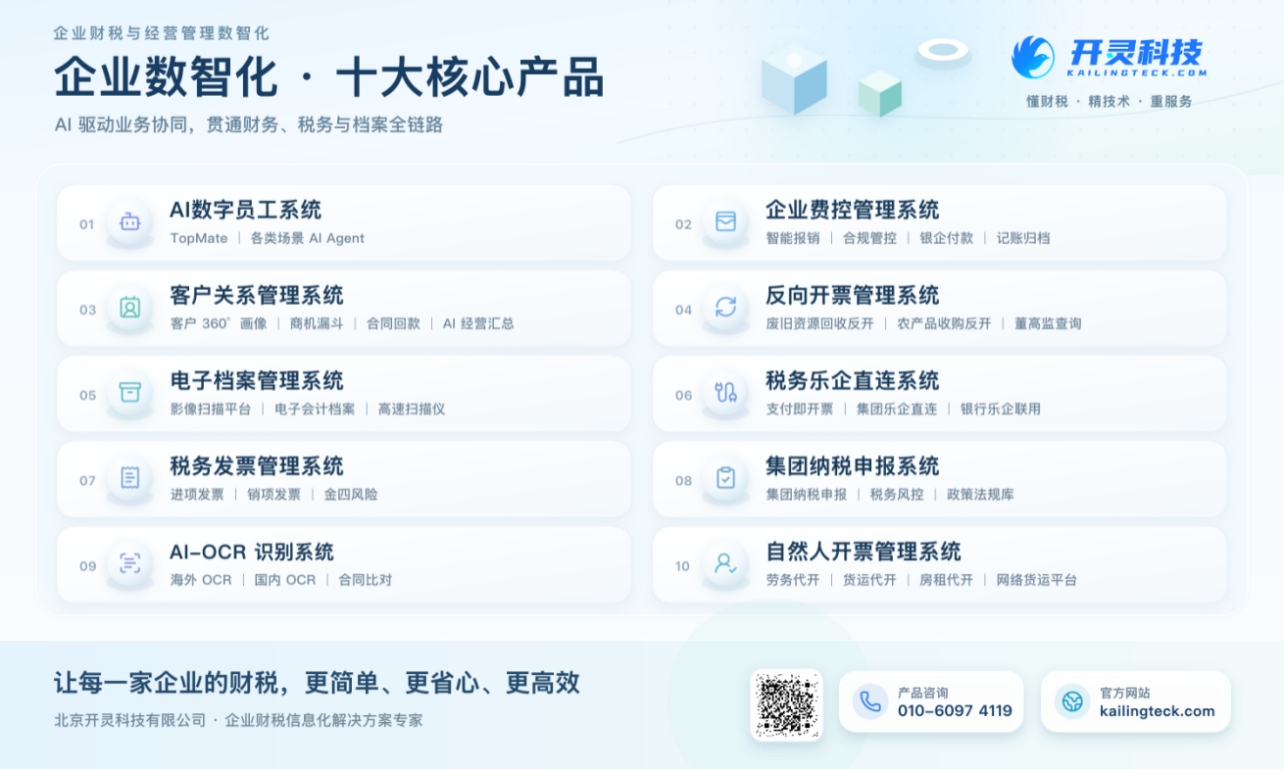
The company has now formed ten core product lines, including: AI digital employee system, enterprise expense control management system, customer relationship management system, reverse invoicing management system, invoice issuance for individuals management system, electronic archives management system, tax fully digitalized e-invoice Leqi system, tax invoice management system, group tax filing system, and AI OCR recognition system. It is committed to connecting enterprise business, finance, tax, funds, and archive data to help customers improve operational efficiency, business-finance-tax compliance capabilities, and digital management levels.
If you have any business-finance-tax digital transformation needs, welcome to contact us. Beijing Kailing Technology will serve you wholeheartedly.
Keywords: Expense approval process, automatic reimbursement routing, expense type rules, expense control reimbursement system, Kailing Technology
As a comprehensive business-finance-tax digitalization solution service provider, Kailing Technology provides business-finance-tax management digital transformation products and operational services for various government agencies, institutions, and large, medium, and small enterprises. The product line includes: solutions for sales contract management system, procurement contract management system, fully digitalized Leqi interface project, automatic output invoicing system, reverse invoicing system, invoice issuance for individuals system, employee expense control and reimbursement system, input VAT invoice management system, supply chain collaborative reconciliation system, image AI OCR recognition system, automatic financial bookkeeping system, electronic accounting archives system, etc., comprehensively driving the digitalization process across various fields.
Consultation Hotline: 18513895936 / 010-60974119 Location: Beijing