
How to choose expense control management software? First validate five configuration worksheets

How to choose expense control management software? First validate five configuration worksheets
Whether expense control management software is easy to use cannot be judged by demo pages alone. What truly determines the go-live result is the five configuration workpapers: expense catalog, approval matrix, budget basis, accounting mapping, and exception list. They translate enterprise policies into system rules and turn 'no rework when converting reimbursement forms into vouchers' from a slogan into a goal that can be tested item by item.
Many projects still repeatedly return forms after go-live, not because the system lacks approval functions, but because the same expense uses different names in application, reimbursement, budget, and accounting stages, or exception scenarios have no responsible person. Requiring the vendor to jointly complete these five worksheets at the selection stage can expose policy conflicts, interface gaps, and maintenance costs earlier.
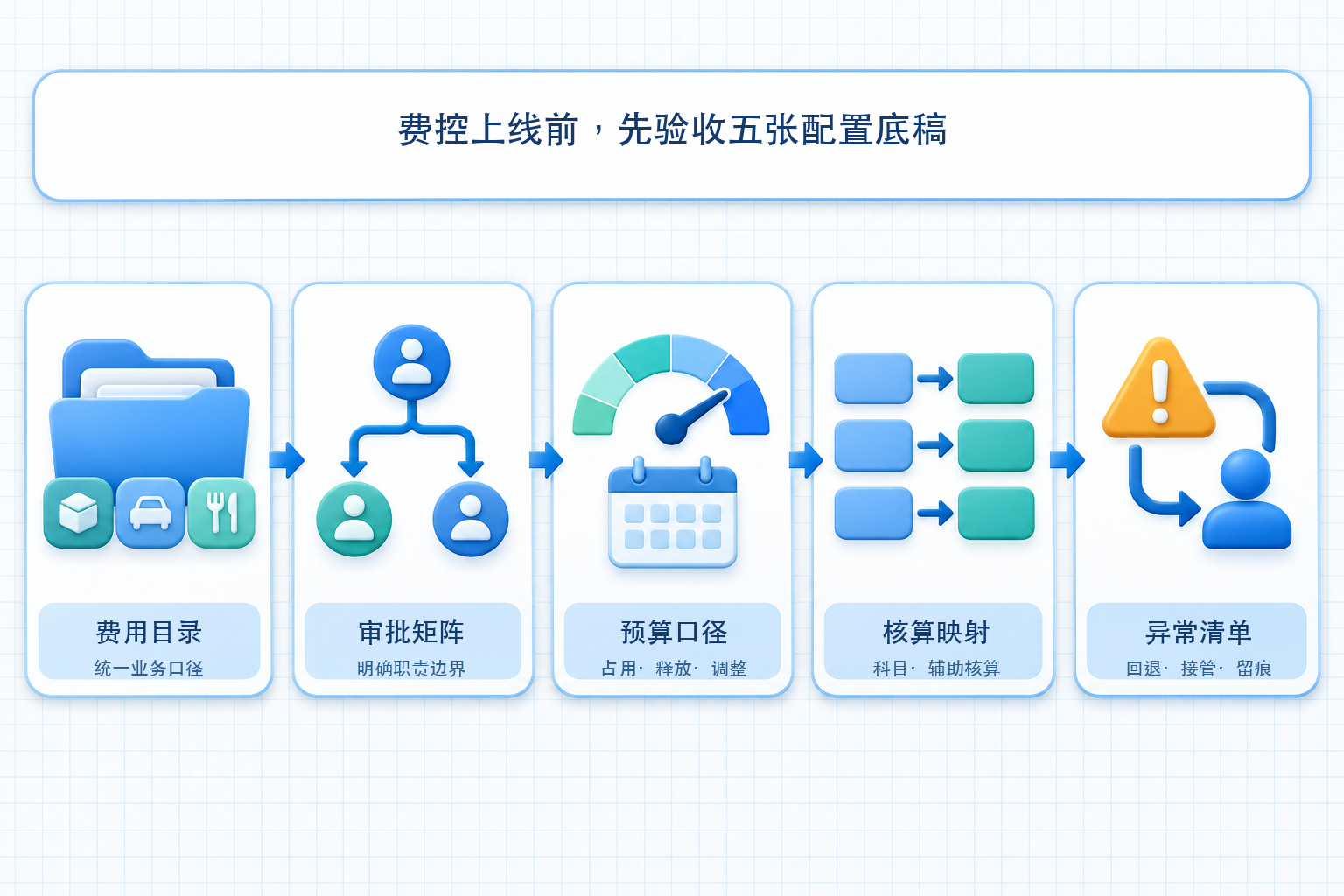
▍Worksheet 1: Expense catalog, unifying business and finance language
The expense catalog is not just a few names such as travel, entertainment, and procurement. Each expense category should clearly state its scope of application, prerequisites for application, required fields, attachment requirements, whether allocation is allowed, and the corresponding accounting basis. If the catalog is too coarse, finance can only re-judge at the end; if too detailed, employees find it hard to choose. During selection demos, check whether the catalog can be maintained according to the enterprise's actual situation, whether historical documents retain the original basis, and whether adjustments affect unfinished processes.
▍Worksheet 2: Approval matrix, clarifying who is responsible for what
The approval matrix should map amounts, departments, projects, expense types, and special matters to approval roles, and explain add-signer, transfer, delegation, and return rules. Responsibilities such as handling, business approval, financial review, payment, and system configuration should be appropriately separated. Also validate how pending tasks migrate when personnel leave, organizations adjust, or temporary authorization occurs, and whether necessary approvals are re-triggered after key fields are modified.
▍Worksheet 3: Budget definitions, clearly stating occupation, release, and adjustment timing
Even for the same budget control, some enterprises occupy budget at application, while others control at reimbursement or payment. The worksheet should clearly state budget dimensions, periods, currencies, occupation timing, release conditions, over-budget handling, and adjustment permissions. A normal form passing does not mean the budget logic is correct; you must also test withdrawal, return, partial reimbursement, cross-period, and concurrent submission to avoid duplicate budget occupation or delayed release.
▍Worksheet 4: Accounting mapping, making voucher linkage traceable
Accounting mapping should define item by item how expense types correspond to accounting accounts, cost centers, tax amounts, auxiliary accounting, summaries, and reversal rules. OCR recognition can be used to extract invoice fields, but recognition results may still be affected by invoice quality and rule configuration, requiring manual confirmation and exception review. The system can generate voucher drafts or transmit accounting data based on confirmed data and mapping rules, but before formal posting, a review step by authorized accounting personnel should still be retained.
▍Worksheet 5: Exception list, providing exits for failed processes
The exception list should at least cover blurred or duplicate invoices, insufficient budget, unbalanced allocation, changed payee information, payment failure, interface timeout, returned invoice reversal, and missing archive items. For each exception, state the detection method, handling role, fields allowed to be modified, whether re-approval is required, and final trace retention. The higher the degree of automation, the more indispensable exception rollback, idempotency control, and manual takeover become.
▍Two more items during validation: interface boundaries and data exit
If the project needs to connect to ERP, banks, external invoice services, or electronic archives, confirm legal authorization, interface scope, call frequency, status write-back, and fault responsibility. When the contract expires or the system is replaced, also confirm whether documents, attachments, approval logs, voucher links, and master data can be fully exported in the agreed format. No matter how many software features there are, if data cannot be taken away or exceptions cannot be traced, new management burdens will arise.
▍How does Kailing Technology participate in this validation?
Kailing Technology's expense control management related solutions can combine mobile reimbursement, invoice verification, approval, payment, and voucher linkage, and work in coordination with input VAT invoice management, AI OCR, and electronic accounting archives products. Whether vouchers can be automatically generated, banks connected, or external data obtained depends on the customer's existing systems, interface authorization, accounting policies, and implementation configuration. It is recommended to use the five worksheets as a common language and complete normal and exception scenario POCs with the enterprise's real documents.
Compliance basis: The Ministry of Finance's "Accounting Informatization Work Specifications" (Cai Kuai [2024] No. 11) and "Basic Functions and Service Specifications of Accounting Software" (Cai Kuai [2024] No. 12) took effect on January 1, 2025; the Ministry of Finance and National Archives Administration document Cai Kuai [2020] No. 6 clarifies that full-process processing of electronic vouchers requires verification of legality and authenticity, secure storage, necessary review and signing, prevention of duplicate booking, and compliance with archival requirements.
Keywords: expense control management software, expense control reimbursement management system, expense catalog, approval matrix, budget control, voucher mapping, exception handling, Kailing Technology
As a comprehensive business-finance-tax digitalization solution service provider, Kailing Technology provides business-finance-tax management digital transformation products and operational services for various government agencies, institutions, and large, medium, and small enterprises. The product line includes: solutions for sales contract management system, procurement contract management system, fully digitalized Leqi interface project, automatic output invoicing system, reverse invoicing system, invoice issuance for individuals system, employee expense control and reimbursement system, input VAT invoice management system, supply chain collaborative reconciliation system, image AI OCR recognition system, automatic financial bookkeeping system, electronic accounting archives system, etc., comprehensively driving the digitalization process across various fields.
Consultation Hotline: 18513895936 / 010-60974119 Location: Beijing